
You’re ignoring this member’s posts.
Importance of REM
70 replies325 viewsLast reply

 Texas Hill Country
Did you mean
Thanks, I get things mixed up sometimes. I edited the post to correct.
You’re ignoring this member’s posts.
 Poland
Analogy: you can feel degree of inflation of the car wheels by hand, but it's definitely better to measure pressure by pressure gauge.
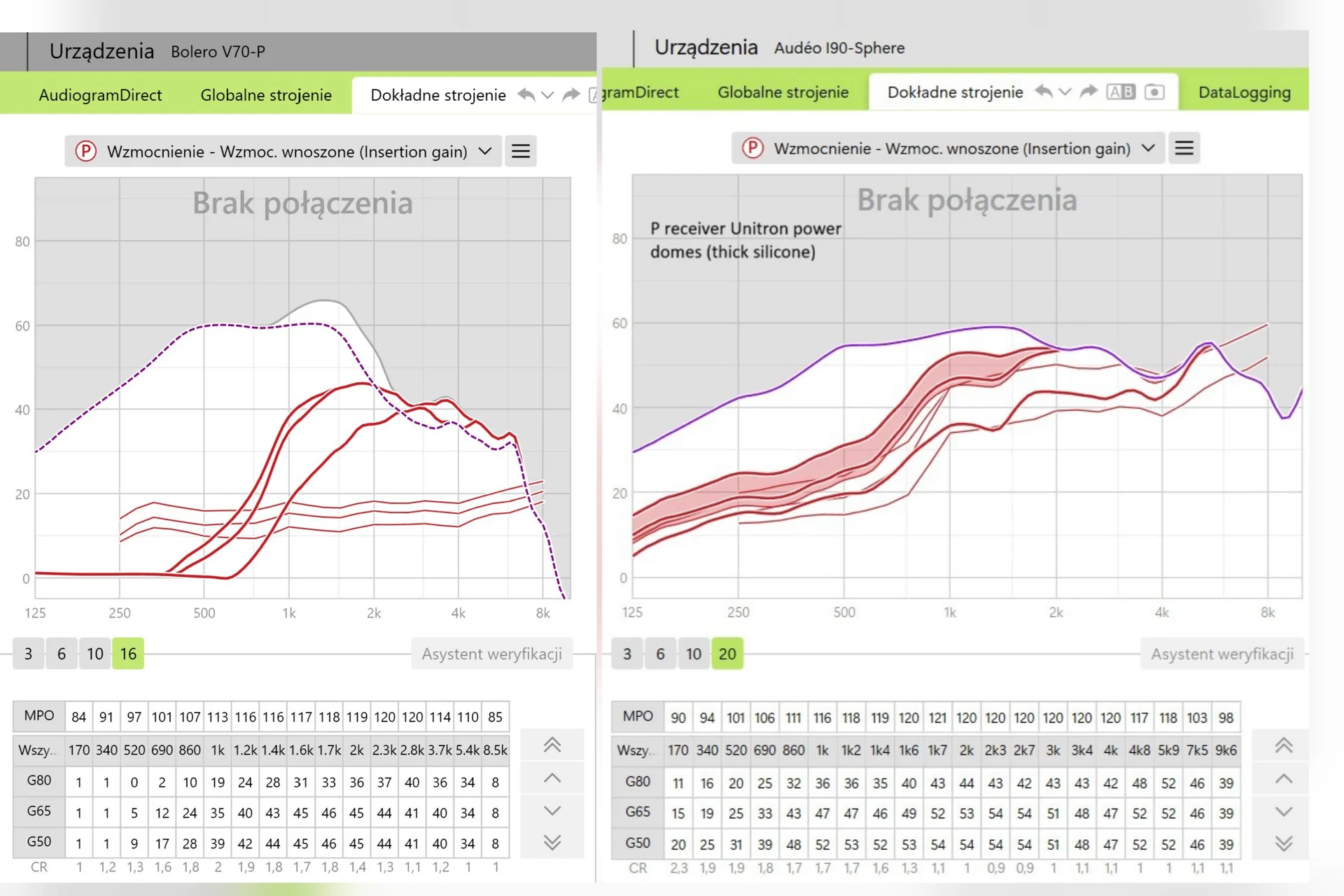
@bradw , I'm a little bitter that no one has done on me in the past. If it had been done, I would have known that maybe Audeo or Naida would have been better for me instead of Bolero.
My life could be definitely better if it were done. I know that also from situation where is noisy, but I understand speech also with Calm Situation program.
This is Bolero after REM, but after that, didn't say to me "probably your current is too weak, consider more powerful HA next time":
You’re ignoring this member’s posts.
@bradw , I'm a little bitter that no one has done REM on me in the past. If it had been done, I would have known that maybe Audeo or Naida would have been better for me instead of Bolero.
My life could be definitely better if it were done.
Yeah maybe so.
All I can say is that in my limited experience, I'm doubtful.
For years I wondered about ... could my fitting and aid experience be better if my Audiologist used it? I mean, my aids seem to be doing what I need them to do, and I'm happy, but could they be better? I keep reading about how necessary it is. I keep seeing people call it a "best practice"...
These were the sorts of questions I was asking for over 7 years with those aids and that Audiologist... from the initial trials and fittings to all the many follow-ups. Several hearing test updates and re-fittings through the years.
SO now, after having been fitted twice for two different models of aids, both using REM, I'm fairly confident in saying that we just got there a little faster. The end result with REM is not some euphoria or perfect synergistic result. It's basically the same as my other Audiologist gave me.
Without REM, only using the fitting software + experience, the audiologist started at a pretty good level. Then after some back-and-forth feedback from me about what I'm actually experiencing over a few follow-up visits, she dialed them in to be about where I've landed after maybe 1 follow-up visit when using REM for the initial fitting.
I still wonder if they used REM after every single setting change or adjustment; could it be even better? I reckon Yeah, probably a little. But I'm pretty confident it won't be earth shattering!
You’re ignoring this member’s posts.

Hearing_PotentialProvider
SO now, after having been fitted twice for two different models of aids, both using REM, I'm fairly confident in saying that we just got there a little faster. The end result with REM is not some euphoria or perfect synergistic result.
Basically worked as it should have in your case. It significant improves the chances of a good outcome, faster and reduces the chances of failure. If it were done correctly using measured to customize the targets to your individual ear canal acoustics it would be even better, but most audiologists don't do this on adults, rather they use an average RECD and very few people have "average" ears. You might find the results to be more natural and "synergistic" if they did.
I wouldn't expect "euphoria" from a hearing intervention, we're not dealing with psychotropic substances. People might experience a little momentary joy at best.
You’re ignoring this member’s posts.
 Wales, UK
If it were done correctly using measured RECDs to customize the targets to your individual ear canal acoustics it would be even better, but most audiologists don't do this on adults, rather they use an average RECD and very few people have "average" ears.
measures aren’t actually required to obtain an accurate . If you think this, you don’t understand the theory. RECD are only required if you want to separate REAG/ as distinct targets.
REAR is a sum total figure: so as long as you can get the at the drum, separating out the constituent parts of the calculation is unnecessary. Also if the impedance of the canal/drum varies with input by any amount your RECD figure is less accurate either side of the level it was measured. Unless you’re doing paediatrics (OR Px with motor issues), it’s more effective to measure the final REAR: often because the dynamic performance of the aid (especially the feedback manager) is accounted for.
EDIT: Or setting up aids remotely perhaps.
You’re ignoring this member’s posts.
Hearing_PotentialProvider
I think you misunderstand the purpose of measuring , which is to incorporate aspects of the individual's ear canal acoustics for the to conversion for target generation.
For insertion gain you measure the which takes into account individual ear canal acoustics when calculating prescription targets.
For the average RECD is incorporated when converting the client's HL thresholds into dBSPL and calculating targets. Especially for measured using insertphones incorporating a measured RECD results in a more accurate conversion of the hearing thresholds into dBSPL, more accurate targets and a better outcome. The real-ear aided response, or test box simulated real-ear aided responses are measured in all cases.
In one already successful clinic I worked at, we reduced returns to zero just by incorporating measured RECDs into all fittings. Removing this source of error made a significant difference.
You’re ignoring this member’s posts.
I think you misunderstand the purpose of measuring RECDs, which is to incorporate aspects of the individual's ear canal acoustics for the HL to SPL conversion for target generation.
Which is part of the (AGGREGATE) function - you can generate targets from the proportional representation of the residual dynamic range using the average long term of speech and translate them into - measuring REAR, as in Live Speech Mapping. Like I said, the weakness of breaking down the process into separate parts is that your snapshot, might not be actually happening (Impedance variation under different sound intensity). Or more directly how much ‘give’ there is in the tympanic membrane.
The way you’re doing it isn’t fundamentally ’wrong’ it’s just more open to flaws than measuring the gross SPL figure at the drum. Especially for higher intensity sounds where you’re going to see the most discrepancies and issues with the aided gain hitting the /Recruitment levels.
To embellish the tyre analogy above: You’ve created a model where you can establish the correct Tyre Pressure at 50mph/15 degrees Celsius on the Highway, but I bet your model doesn’t hold up if I take my SL on the Autobahn at 155mph on a 35Celcius Summer day. Worse than that, your fixed model doesn’t actually show which way you are wrong either.
REAR/LIVE SPEECH - live inputs and speech to an actual hearing aid not in a test mode, plus competing noise being measured live in the canal on a human. Otherwise you’re just doing ‘better estimation’ than the other guys…….
You’re ignoring this member’s posts.
Would measuring and then provide more benefit than REAR with average RECD? That may be what @Hearing_Potential is saying.
You’re ignoring this member’s posts.
For you it is anecdotal "little difference", but translating this to many patients over the course of a year, gets more steamlined serviced (less visits necessary for particular patient, because ofnless guesswork) and patients in general (as average) will get less wasting time on visits and will be sure that the hearing aid has at least a level of amplification that allows for audibility.
Another example: just because someone's tinnitus didn't improve after getting doesn't mean that using HA makes no sense regarding tinnitus treatment. He/she is simply unlucky. If someone has better luck, he/she will be in that ~50%, in which tinnitus will improve.
You’re ignoring this member’s posts.
As a teacher, the part of this that always surprises people is how the decibel scale works. Because it is logarithmic, a 10 increase means roughly ten times the sound intensity, not just a little louder. That is why a fitting that is only a few dB off target can feel like a big difference in everyday listening, and why measuring what is actually happening in the ear, as several people here have described, matters more than guessing from the settings alone. A measured starting point still leaves room for personal preference afterwards, but at least the adjustments are made from something verified rather than from scratch.
You’re ignoring this member’s posts.
Hearing_PotentialProvider
The way you’re doing it isn’t fundamentally ’wrong’ it’s just less more open to flaws than measuring the gross SPL figure at the drum.
This statement is currently self-contradictory. Could you please clarify which direction: less or more?
You’re ignoring this member’s posts.
Hearing_PotentialProvider
REAR/LIVE SPEECH - live inputs and speech to an actual hearing aid not in a test mode, plus competing noise being measured live in the canal on a human. Otherwise you’re just doing ‘better estimation’ than the other guys…….
As discussed I'm measuring the . What I'm doing is correcting the using the individual's individual ear canal acoustics using a measured . This is about the accuracy of the generated prescriptive targets to which you match the REAR at different input levels. If you use an average RECD in the conversion of the individual's thresholds to and you've measured using insertphones the resulting targets will inherently contain more error and result in a poorer outcome. This method estimates less and measures more.
You’re ignoring this member’s posts.
In reply to @Hearing_Potential
If it were done correctly using measured RECDs to customize the targets to your individual ear canal acoustics it would be even better, but most audiologists don't do this on adults, rather they use an average RECD and very few people have "average" ears. You might find the results to be more natural and "synergistic" if they did.
I don't know what any of that means. But how do you know that they didn't do that in my case?
You’re ignoring this member’s posts.
You’re ignoring this member’s posts.
Would measuring RECD and then REAR provide more benefit than REAR with average RECD
No, produces a snapshot transfer function to emulate the degree of difference between the persons ear and a coupler - nominally a 2CC coupler.
You use this difference to calibrate an aid without the user present/paediatric fitting to give you an estimate of the adaption made to gain needed rather than doing the in-situ modification.
RECD is moot in , because you’re already taking the canal acoustics into account - that’s baked-in by placing the probe tube near the drum.
You’re ignoring this member’s posts.
Because it is logarithmic, a 10 dB increase means roughly ten times the sound intensity, not just a little
In terms of that, not in terms of perception though, about double.
I log it up in 3dB steps, 2x intensity - 2x, 4x, 8x, plus a fraction, but s humans we don’t perceive it on the same basis.
You’re ignoring this member’s posts.
In reply to @Hearing_Potential
If you use an average RECD in the conversion of the individual's HL thresholds to SPL and you've measured using insertphones the resulting targets will inherently contain more error and result in a poorer outcome.
Citation for that?
That would potentially invalidate my 20+ years of legal testing if you’re claiming that Inserts don’t give accurate results.
Also FWIW when I went to MedRx in Seminole County to do my initial training on the ‘Otowizard’ in the 1990s, the preference for Inserts was based on the fact that they produce more accurate results than ‘Cans’ by some margin: with . Mainly due to the removal of variation in residual canal volume and leakage. The graphs are pretty well established, but if you want to dig out the papers, Mead Killion and others had pretty extensively proved by the late 80’s that the cans available to the industry weren’t up to snuff - which is why he developed the original Ear-Tones.
The transfer function of these is built into the MedRx software as a basis of the : not sure why they would need additional biasing.
You’re ignoring this member’s posts.
Hearing_PotentialProvider
That would potentially invalidate my 20+ years of NIHL legal testing if you’re claiming that Inserts don’t give accurate results.
I'm not claiming that insertphones don't give accurate results.
However foam insert depth does alter thresholds as insertphones are calibrated for a specific cavity size. In measuring the you correct for this effect resulting in a more accurate HL to conversion and more accurate target generation for measurement.
I know this from working with infants who already have a much smaller ear canal volume than the cavity used to calibrate insertphones. The principles don't stop applying because adults have larger ear canal volumes or because we're shifting from an sREM to an actual . The same HL to SPL conversion is still being used during target generation for both.
When working with infants we compare SPL across time rather than HL because changes in ear canal acoustics with head growth can result in apparent worsening of the HL audiogram that are solely due to increases in ear canal volume/configuration.
The same isn't required for adults as their ear canal volume generally remains stable so monitoring for sensorineural changes and comparing in HL isn't as big of an issue provided you're using the same insertphone insertion depth each time. However, if you were to compare pre-vs post surgical hearing with an ear canal procedure and there wasn't a reliable air-bone gap generated you would be better off measuring a pre and post-surgical RECD and converting the audiogram to SPL for the sake of the comparison.
If you're looking for references, you might consider looking at the Ontario Newborn Hearing Screening and Early Intervention Protocols. Susan Scollie from the development group was heavily involved in their development and I trust their judgement and explanations. That it happens to apply to adult audiology though to a lesser degree than infants is helpful. It may only be a few here and there, but if its smoothing out a peak or correcting for a resonance shift and resulting in a more natural sound quality and better audibility for soft speech then it's a good thing.
You’re ignoring this member’s posts.
The end result with REM is not some euphoria or perfect synergistic result. It's basically the same as my other Audiologist gave me.
I had a hearing test with my Kaiser audiologist today. I asked about . She said Kaiser always uses REM for first fittings. I mentioned that I had fragile/barely existent eardrums. "yes, you do" she said. She also assured me that Kaiser doesn't touch the eardrum with their probe. She then said basically what bradw said, above: rem is starting point but the end result remains the same without rem. she also said that she thought REM for patients with altered/weird ear canals is more important than for folks with normal-ish canals (non surgically altered canals).
So I was about to change my mind about having a costco tech, etc, sticking a probe into my ears.
Back home, writing this, I'm back to thinking, well, most techs will do fine with REM probes into my canals and trusting he or she won't bump against my fragile eardrums. And instantly, I go back to thinking: there's always a mishap about to happen.
I've always gone back for several adjustments for new aids. I've done this over decades. I know how to explain what I'm hearing. I've done a hundred or more hearing tests in my lifetime. so I'm back with the notion of simply working with my audi/tech verbally to fine tune any new aids. My adjustment visits are free and my tech is ten minutes away. I understand this isn't true for most people. Plus my tech advised me against REM, even thought he performs it for others.
You’re ignoring this member’s posts.
Log in to reply to this topic.
Related discussions
Hearing Aid Self-Fitting (DIY)2 replies
Fitting Software Requests1.1k replies
Fitting Software Requests513 replies
Hearing Aids104 replies
Uncategorized451 replies