 Hot Springs Village, Arkansas
You’re ignoring this member’s posts.
Oticon More: Rechargeable vs. disposable batteries
This topic is closed.
105 replies6.1k viewsLast reply

 Oticonian/Disposablyte
Someone in my house (don’t know who …) just put a More1 into the wrong riccepacule, and it started charging just fine. Took it out after this jerk put it in wrong, and it booted up immediately, no problemo.
You’re ignoring this member’s posts.

Maybe they did a redesign with the More aids due to a lot complaints
You’re ignoring this member’s posts.

Someone in my house (don’t know who …) just put a More1 into the wrong riccepacule, and it started charging just fine. Took it out after this jerk put it in wrong, and it booted up immediately, no problemo.
My OPNS1 aids flashed the red led over and over
Someone in my house (don’t know who …) just put a OPN S1 into the wrong riccepacule, and it started charging just fine. Took it out after this Genius put it in wrong, and it booted up immediately, no problemo.
Just to verify & confirm.
riccepacule?? is that a thing?
You’re ignoring this member’s posts.
riccepacule??
It’s the accepted spelling in the IFGS Manual (the word is of Italian origin, and was popularized by the electrical engineers who emigrated to America after WW2.)
You’re ignoring this member’s posts.
IFGS Manual
Momma mia! I don’t know where you find these pearls of wisdom, but keep 'em coming!!
You’re ignoring this member’s posts.
IFGS -> Internet Forum Grammar and Syntax Manual.
Authoritative source of erudition for any serious webster. Known for it’s culturally relevant spelling’s, defanition’s, pronumcilation’s, and correct usige’s.
You’re ignoring this member’s posts.
Now I have to charge one hearing aid at a time in the left side.
@robinlbauman: I’m just going on my common sense here, but I’d say the most likely reason for your problem is simply a bad charger.
Can’t you ask your audi to loan you a new/different charger so you can check out the theory?
You’re ignoring this member’s posts.

If from what I read is correct, @robinlbauman did say that she bought a new charger and it behaves the same way as the original charger on battery (only 1 side working).
But she did say that the charger works OK at home when plugged into a 120V outlet.
What I’m curious is whether both the original and the replacement charger continues to work OK at home with the 120V outlet anymore after the failure during the camping trip?
You’re ignoring this member’s posts.
I just bought brand new Mores and haven’t had any problem charging them at home with plug into electric. However, while camping I recharge via USB and then the right hearing aid quits charging after a couple of days. First time thought it was a fluke and got a new charger base.
[Does the “new charger base” mean a new battery module that clips onto the regular charger, à la Phonak? I wasn’t aware Oticon More chargers had such an option.]
@robinlbauman: could you please confirm the brand of charger you’re using? Is it the Oticon charger you got with the Mores? What exactly do you mean by “charger base”? Have you got more than one USB plug in your vehicle? Have you tried all of them?
I wear Mores, too, and my charger connects via USB exclusively. There’s no way to plug it directly into the wall at home.
I’m sorry for all the questions. I’m just trying to help, but some aspects of the story aren’t clear to me.
@Volusiano : Sorry I missed the new base part. Nice catch.
You’re ignoring this member’s posts.

If you look at it this way, if you have the same size battery as your competitor, and assuming that both your devices and theirs drain at the same rate, and you put in BMS so that your battery can last longer lifetime wise, but at the expense of the daily use cycle being shorter than the competitor’s, because the competitor leaves out the BMS for longevity so that they can tout a marketing claim of longer daily use cycle than yours, then who’s going to win out?
If this were so, why would Apple offer some of the best battery care advice for all their devices? Batteries - Maximizing Performance - Apple Why would Lenovo and HP put battery charging limiters for optional use into their laptops? They’d be putting themselves out of business according to your theory. Why would Apple even bother supporting smartphones for 6 years? (my iPhone 6S will run the forthcoming iOS 15, although not with all the features of the latest iPhones).
Also, Apple has implemented “optimized charging.” When you plug your iPhone in at night, the iPhone uses “” to “smartcharge” the device. The iPhone remembers when you typically arise in the morning. It takes the iPhone to only ~80% charge for most of the night (because being at 100% charge, and especially microcycling at 100% charge with some heating, is not great for long-term battery lifespan). In the hour or two before you get up, the iPhone charges to 100%, so with use, you immediately start escaping the less desirable 100% charge level, rather than spending all night there. According to your theory, Apple is just putting itself out of business with this feature - batteries will last longer and Apple won’t sell as many pricey smartphones as its competitors.
A proof of which way the wind is blowing as far as planned obsolescence for smartphones is that Google recently announced (under the gun from Apple) that it will now support (just newer?) Pixel devices for 5 years.
A number of things are influencing which way the wind is blowing. One is that device processors are getting more efficient all the time. People want devices where the battery lasts longer than all day. With the M1 chips and the A14 phone chip, according to Apple, you have devices that can get through the day with power to spare. It could be, unfortunately, that most of us are becoming relatively poorer, too, so people are keeping their devices longer. The flood of must-have new features and apps is slowing down; it’s no longer the early days of phones and computers. Maybe AI and AR will help keep things going and keep the demand going for newer devices. But right now demand for new devices is going the other way and any manufacturer that makes a device that won’t last, either physically or via OS support, will have to face the music Apple is playing.
Apple has just come out with a MagSafe attachable battery back for its latest iPhones. The battery pack holds 70% to 80% of the charge needed by an iPhone 12 and ~50% needed by the Pro Max, more than 100% of the charge for an iPhone Mini. iPhone 12 MagSafe Battery Pack Tidbits: Capacity, speed, more - 9to5Mac2
So with processor efficiency, ever better batteries, and convenient and easy-to-use battery packs (at least for iPhones), the limitation from the early days of smartphones on battery capacity is going away. Both for Android and iPhone users, there are quite a few battery monitor apps in the respective app stores that allow you to manage your battery (no one should want these according to your use-it-and-chuck-it theory). I get notifications from my iPhone on my Apple Watch when my iPhone charge has fallen low during use or reached the desired level when charging. Does not require any effort to keep track of.
I plan on getting an iPhone 13 or 14 Pro Max with 1 Tb of storage. Such a device should set me back at least $1500 to $1700, not counting all the add-ons like the MagSafe battery pack, etc. Having an efficient phone with more than enough battery capacity (esp. with the battery pack) to get me through the day will allow me to manage my expensive iPhone so it will last as long as I want it to, hopefully up to 6 years, same as iPhone 6S now. (Apple has offered relatively cheap battery replacements, too, for iPhones but there is always the risk there of the phone being rendered inoperable as for my brother-in-law). Apple would not be happily selling $1500 iPhones if users had to replace them every 2 to 3 years because the battery can’t be made to last.
A quick search on the web shows that Apple made something like 70% of the global profit in smartphones in 2019. So maybe planned obsolescence and a short device life is only a strategy amongst race-to-the-bottom Android phone manufacturers (whoever they might be…).
Hopefully, the same trends will take hold with manufacturers of rechargeable HA’s especially when the premium HA devices cost more than an iPhone Pro Max!
You’re ignoring this member’s posts.
You gotta read the original question posed to me by @flashb1024 closely first. The question asked was whether the BMS is automatically built-in so that when the device shows 100% charge, it’s not really 100% but it’s lower.
Your contention that Apple offers the best battery advice, or Lenovo and HP but battery charging time limiters for optional use in their laptops, is not the same as what was posed by the question:
“is it true that it’s automatically built in so that 100% is not really 100% but somewhere lower?”
I also mentioned in a previous post of mine that my Lenovo laptop has optional BMS but the user has to actively manage it. So I’m not arguing that mfgs want to hide the BMS stuff on purpose. What I’m arguing is that don’t assume that the BMS stuff is already automatically built-in and done for you in consumer electronics. If you’re lucky to be given a BMS option, you’d most likely have to manage it and enable it yourself.
Probably the only place where BMS is built-in automatically reliably for you so that you don’t have to worry about it is with the EV industry.
You’re ignoring this member’s posts.
@volusiano. I think that you’re right that culture plays a strong role, regardless of long-term economic considerations. So I think the way the world seems to be going with the EU announcing a plan to cut carbon emissions and some in the U.S. hoping to emulate that may influence what comes “built-in” as part of a changing (charging?) world.
My post above was rambling enough as it is but I think, as you say, with BMS coming built-in with EVs and many of the manuals for battery-powered tools and other stuff that I own having sections on preserving battery lifespan and storing devices long-term only partially charged, there may be an overall change in battery culture as we outgrow the Model-T days of a battery universe.
120 degree days in some inland areas of Southern California may help motivate at least some folks …
You’re ignoring this member’s posts.
An happy place to exchange about batteries and other energy storage systems; lithium, hydrogen, electric car, sodium, graphene, smart grid, renewable energies...
You’re ignoring this member’s posts.
I think the option for replaceable would be nice.Not my last phone, but the one before that had a replaceable battery. I can still use that phone (for example) if the battery is removed and left to sit on its own (for months). When I put that battery back in, it registers 100% or nearly so. The other old phone I have with an internal fixed battery is almost impossible to use because the battery doesn’t charge much and quickly discharges. Both are Samsungs.
Anyway size isn’t the only thing that matters. Larger in-ear “earphones” are and have been popular too.
You’re ignoring this member’s posts.
After a number of years as a satisfied Oticon MiniRight user I upgraded last year to the More. The advertised better sound technology and better Android connectivity were the reasons. I am only marginally satisfied, though I will keep them. I am very disappointed in Oticon.
I initially used the rechargeable ones (the only ones available at that time) for 4 months. I did not like the recharge at all and switched to the battery model when available. That said, they are NOT optimized for battery life and eat batteries in 3 days. Oticon clearly treated this models as an after thought and put little effort into it.
Next is the form factor. To accommodate the rechargeable batteries, the hearing aid size is noticeably larger. This is an ergonomic nightmare causing them to catch on masks, glasses and the like, and be much more visible. They were clearly designed by people who do not wear them. Form over function at its worst. Other brands have optimized the form factor successfully.
Next the APP. The Android App is poorly implemented (I am in the IT business technical side). It looses connectivity easily and does not reconnect well. Further, unlike previous hearing aid models, the More requires the App to change programs. This is a HUGE design flaw. No App = no program control. The hearing aid buttons should also control this essential function, as they did before. Again, a design and implementation failure.
In summary, the More has somewhat better sound characteristics but very poor ergonomics and user controls. Will I keep them, yes, but I consider them functionally inferior and an Oticon failure.
You’re ignoring this member’s posts.

tenkanProvider
That said, they are NOT optimized for battery life and eat batteries in 3 days
How many hours of streaming do you do? as this will influence the length of time before running flat, 3 or 4 days with a lot of streaming is normal for most brands, it’s not just a “Oticon” thing.
Oticon clearly treated this models as an after thought and put little effort into it.
I don’t think this is correct, I’m sure a lot went into getting these models released for the consumer.
Next is the form factor. To accommodate the rechargeable batteries, the hearing aid size is noticeably larger.
But it’s only mm in difference, again this can said of all the other brands as well, the rechargeable models are bigger/heavier.
This is an ergonomic nightmare causing them to catch on masks, glasses and the like,
If you look through the forum on this issue you’ll see that it’s disposable batteries as well that have this problem.
They were clearly designed by people who do not wear them.
I believe this as well, sometimes it’s like “what were they thinking”
Form over function at its worst. Other brands have optimized the form factor successfully.
Not quite true, all the other brands have this difference in size between rechargeable and disposal batteries.
Next the APP. The Android App is poorly implemented
Well this is going to be subjective! Yes it seems some apps are not ready for prime time, mostly the Android,but also iPhone, if you use the search button from right here on hearingtracker you’ll find plenty of posts on this topic.
the More requires the App to change programs. This is a HUGE design flaw.
Really, no push buttons on the more? But they do have a remote control available, still another device that you shouldn’t have to buy.
The hearing aid buttons should also control this essential function, as they did before.
This can be set up in the software by your audiologist, obviously this hasn’t been done if the buttons are available?
Will I keep them, yes, but I consider them functionally inferior and an Oticon failure.
Well this is gonna get some flank, here come the Oticonians!
You’re ignoring this member’s posts.
@tenkan: A sincere “Thank you” for your robust and objective defence of Oticon. You’ve done such an excellent job addressing this member’s concerns, anything I could say would be just to hear the sound of my own keyboard, so I’ll just stay quiet…
Happy New Year, BTW.
You’re ignoring this member’s posts.
Well for one have found that my Oticon More1 rechargeable aids to be the best of the best for my hearing loss. Personally I could care less about what aids you wear as long as they work for you even close to how well my More1 aids work for me. Hearing loss isn’t and shouldn’t be about what works for anyone but the person that wears the hearing aids. As someone that helps a number of Veterans with their aids and sometimes advises them on dealing with hearing loss, my advice is this to first find an audiologist that you trust and will truly listen to your needs. Never makes the comment that you will adjust to the aids, which is only partly correct. Hearing aids can be massively adjusted to help the person hear better, but it takes the person with the hearing loss to communicate the need, what the person is experiencing and it takes an audiologist that is willing to listen and take the needed time to make it happen.
Your hearing loss is your personal issue and your personal responsibility to see that you get the best possible hearing aids and adjustments that you need.
You don’t need the app at all If your aids are correctly set up you can change programs, adjust the volume, power off, and place your aids in airport mode. But you can’t mute the rechargeable aids from the aids themselves
You’re ignoring this member’s posts.
Further, unlike previous hearing aid models, the More requires the App to change programs. This is a HUGE design flaw. No App = no program control. The hearing aid buttons should also control this essential function, as they did before. Again, a design and implementation failure.
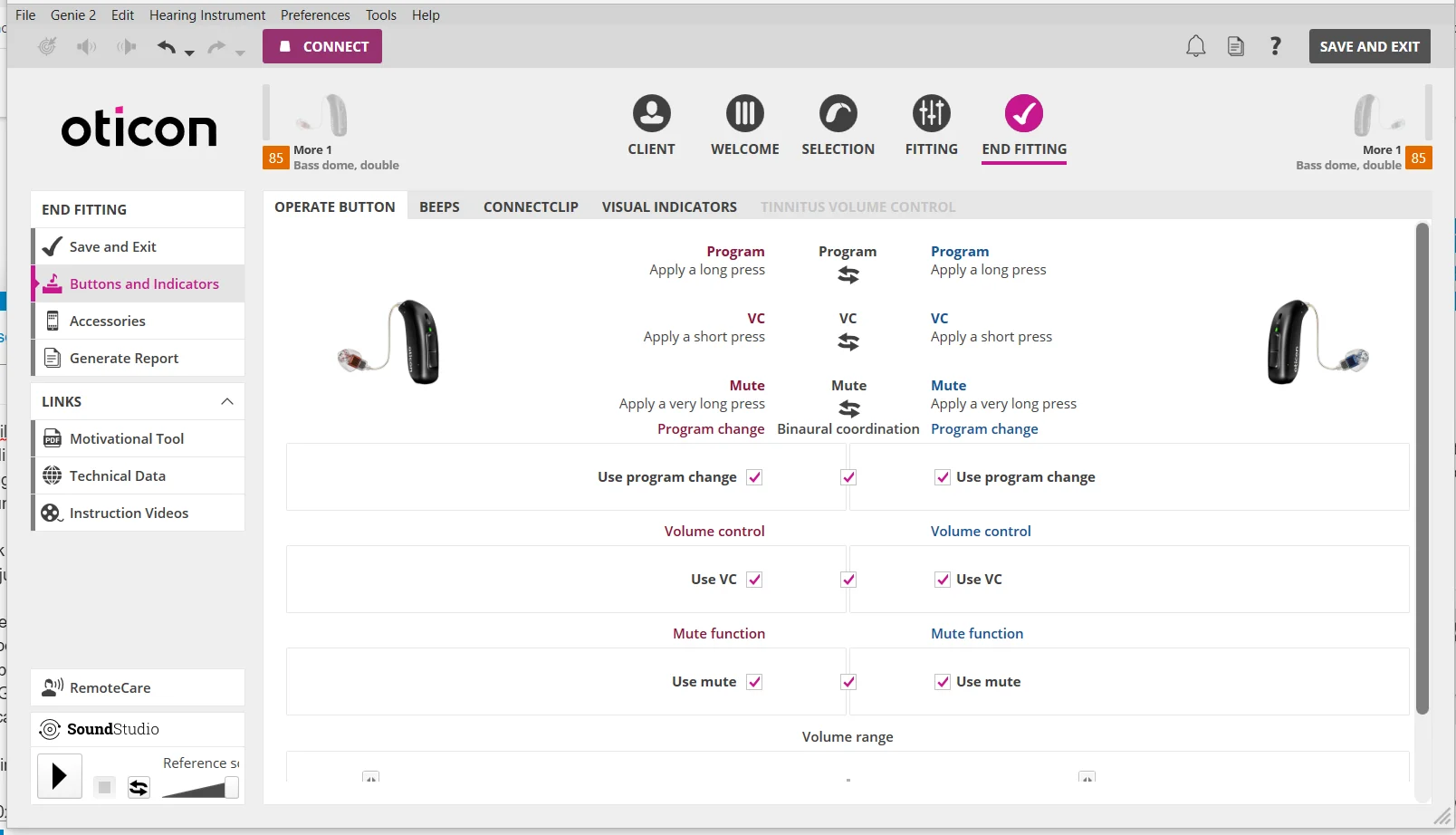
Did you ask your audi about enabling the program change and volume control onto the More buttons? Or did you just assume that it can’t be done?
Below is the screenshot of the More 1 miniRite T (the non-rechargeable version) Operate Buttons page. As can be seen, you CAN enable the buttons to be used for program changes and volume changes. You can do the same for the rechargeable version of the More as well as far as I can tell.
I’m guessing that your audi didn’t bother enabling them for you in the Genie 2 programming, and you simply assumed that it’s not available. Go back and ask your audi to turn them on for you. And chastise him or her if he/she told you before that it couldn’t be done because it CAN be done.
It’s one of those things that “if it’s too bad to be true then it ain’t that bad” (the reverse of “it’s too good to be true”). You gotta ask why would Oticon be stupid enough to not make program and volume changes available on their More buttons anymore if they had it available on the OPN and OPN S and even older models. So if it seems “too bad to be true” to you, the next logical thing would be to ask your about this, instead of assuming the worst. But if your HCP gave you misinformation on this in the first place, then shame on them.
The only thing you can’t do as far as I can tell with the More (and also the OPN S, too, I think) is that you can’t use the hard buttons to mute them (although you can cycle down the volume to zero to effectively mute, although this requires more button pushing). I think that one has to be done either via the ON app, or if you have an iPhone, it can probably be done via the iPhone MFI interface as well. I don’t know if the newer Android stuff has an equivalent with the iPhone MFI interface or not.
You’re ignoring this member’s posts.
Related discussions
Hearing Aids109 replies
Hearing Aids43 replies
Hearing Aids60 replies
Fitting Software Requests892 replies
Hearing Aids144 replies