Sorry, I don’t know much about custom domes, I thought that depended on your hearing loss, hopefully someone who knows more will chime in.
However, do you know if there are other domes (from other manufacturers) that are compatible with the Jabras? Just a thought because I am currently using Starkey domes with my Oticons. I started with Oticon domes but I seemed to be in between sizes so my audi had me try Starkey because they had a size in between and they felt much better, so I stuck with them.
I got molds. I thought they’d be especially good for listening to music. I was also afraid they’d make me feel as if my ears were plugged up. I was wrong on both counts. I MUCH prefer the power domes.
Here’s the thing, though: Costco will make the domes for $40 and refund your money if you don’t like them. All you risk is some time and possible temporary discomfort.
I saw my at Costco Friday. I have tried loaners from both Jabra pro 10 and Philips 9030 for 2 weeks each. I have had trouble with the Jabra power dome on my right ear. Medium gives feedback and large tends to give closed or unnatural sound. He suggested custom dome to alleviate problem. That may do it but I am ready to make a decision, so I decided to order the 9040. The 9030s fit perfectly and if I have a problem I can always do custom domes. It also provides clear, natural sound which I prefer.
Each has things I liked, and I felt either was a vast improvement over my 8 year old KS6s. I was tired of trying each and ready to make a decision.
The HCP was great to work with and has a lot of knowledge of the products they sell.
One concern I had was that the Jabra was noticeably louder. The HCP says that the Jabra is noted for being “hotter” (louder), but that I should hear clearly with either.
I will pickup new 9040s in 2 weeks and I am looking forward to that.
Thanks to everyone who responded to my questions. You were helpful to me in making a decision.
One concern I had was that the Jabra was noticeably louder. The HCP says that the Jabra is noted for being “hotter” (louder), but that I should hear clearly with either.
Thanks for sharing your final decision.
It should be a trivial adjustment to either lower the overall volume across the board for the Jabra if you find it too loud, or increase the overall volume across the board for the 9040 to be as loud as the Jabra, if that’s what you prefer. That way, you don’t need to tinker the volume of either aids upon each startup. So whether one is “hotter” than another in terms of volume should not be in the consideration as a criteria to choose.
I posted my initial impressions of the 9040 above, comparing to KS10 on the basis of what’s the most important to me: usable speech-in-noise w/o an aux device (because I kept forgetting to bring my Roger Select w/me) and more of an open soundscape than the KS10. I had one moderate speech-in-noise experience in a moderate background noise environment, which I commented on in the post above, and things went well. But it wasn’t a worst-case noisy background situation.
Recently I had another speech-in-noise experience, probably as close to worst case for me as what I’ll put up with. This time it was an outdoor setting at a brew pub, and the background noise was LOUD. performed surprisingly (shockingly) well.
We had a table of four. I had the aids in the General program. There was no attenuation of the background noise - at all. These hearing aids unquestionably promote a more open sound landscape than the KS10 and it isn’t close. The surprising thing was, that in spite of all the noise that was coming in, I could hear every word of everybody at the table. The hearing aids would lock-in on every person as soon as they talked. I could understand them through all of the background noise.
The background noise was so loud and so different from my KS10, which would close down background noise in this sort of environment, that I actually turned down the volume once click - and I could still understand the people at our table, no problem.
So as far as I am concerned the jury is now in. These HAs are far better than my KS10 in a noisy background environment, no comparison. You know, when I would go to certain at Costco and ask if the new hearing aids are better in noise I had one or two who would give the tired line “nothing is going to be perfect in a loud environment”, which is a put-down of the new hearing aids and, in my most recent experience, uncalled for. They are better and, at least for me, it isn’t close. The KS10 with Roger Select is still marginally better. But the 9040 sound is far more natural than listening w/Roger Select and I don’t have to remember to bring it with me.
The one thing that’s strange is that when I drive the car at high speed with the HA in the General program, wind and road noise are automatically cut down. You would think that in this restaurant experience the same thing would happen, yet there was no attenuation and I heard all the sounds going on around me. I can’t understand why in one noise environment one thing happens and in another noise environment a different thing happens. And both are happening exactly like I prefer, so I’m not complaining.
This is really good info! I got my KS10 adjusted where they finally work really well, it has taken me a long time (I do self adjust). CC was not able to get anywhere close.
I haven’t had any real challenging noisy situations for my 9040s, except in the car where they work very well.
Are the feature settings for your General and Noise in Speech programs the defaults or where they adjusted?
What kind of domes are you using?
The one thing that’s strange is that when I drive the car at high speed with the HA in the General program, wind and road noise are automatically cut down. You would think that in this restaurant experience the same thing would happen, yet there was no attenuation and I heard all the sounds going on around me. I can’t understand why in one noise environment one thing happens and in another noise environment a different thing happens. And both are happening exactly like I prefer, so I’m not complaining.
If you had the car windows open (or cracked open) when you’re driving, I can see how the wind noise (like the brushing by your ears part) would be cut down effectively by the 9040, because Wind and Handling Stabilizer is one of the 2 new features of the 9040 (beside Sudden Sound Stabilizer, the same 2 new features added to the Oticon Real from the More). They may use a different name for these features on the 9040, however, but nevertheless, it’s very obvious that these 2 new features added to the Real also got added to the 9040.
Beside the wind noise being cut down from that new wind stabilizer feature, why would the road noise be cut down as well? I think this is not anything new and most existing hearing aids have been programmed to recognized machinery type droning noise to cut it down already. Although the Philips 9040 derives a lot of its technologies from William Demant, it doesn’t expressively subscribe to the “open” paradigm that the Oticon aids are subscribed to. So unlike the Oticon which doesn’t want to eliminate road noise completely while driving (although they do attenuate it, but not as aggressively), the Philips 9040 would probably be designed to suppress the road noise more aggressively like most other modern hearing aids of various brands and models because it doesn’t have an “open” paradigm to be mindful with.
As to why the 9040 seems to outperform the KS10 for speech in noise like you observe, what you’re seeing is the stuff in the 9040 that manages speech in noise in action, vs the non-AI traditional beam forming in the KS10 that manages speech in noise in action. Apparently the traditional beam forming is more like a “brute force” approach, aggressively but simply blocking out sounds to the back and sides to let you focus on the front sound, but the sound in the front is still “muddled” with noise and it’s your job to separate that speech in front out from the noise in front. Meanwhile the AI approach is like a more “refine and filtering out” approach, not really blocking side/rear sound out as much as “filtering and highlighting” speech that’s going on to make speech cleaned up and stand out.
A crude analogy is let’s say if you’re looking at a huge bowl of alphabet soup where the alphabets in the middle of this HUGE bowl are arranged into a readable sentence. One approach is to block out the surrounding areas so you can focus on reading the alphabets in the middle where the sentence is formed. Sure, it’d still have a murky look and you still need to focus in to read it, but at least you know can focus on the middle part which form the sentence. But what if the murkiness due to the soup can be strained out so that you can see the alphabets (that form the sentence) clearly without the soup muddying it up? Then you can make out the sentence much more easily, even if the surrounding jumbled alphabets around this sentenced are still not blocked out to give you focus in the middle. And if soup is also strained out of the surrounding alphabets, then maybe you’ll be able to find formed sentences from the surrounding alphabets as well if you look.
There has been a debate that Phonak has employed AI all along just like any other major brands. I don’t dispute whether Phonak uses AI or not, but I’m guessing that Phonak uses the AI more or less to detect the right listening environment to apply its appropriate corresponding settings to → namely on its AutoSense feature. But Philips uses AI not to detect and select the right listening environment like Phonak, but applies the AI specifically with the job of cleaning up the muddied speech for better clarity in mind.
This is a pretty impressive endorsement. These are exactly the kinds of things that Whisper hearing aids do for me. Perhaps the Philips is a good alternative for anyone who is/will be moving on from Whisper.
I am using the 7mm Starkey occluded domes (that aren’t occluded, actually). I have the 9 mm that I plan to try. The 9 mm are also “occulded”, and aren’t. I really like these domes.
I didn’t ask for any special adjustments on the General or Speech in Noise or Music programs, which are the programs I have. If the did anything special he didn’t tell me. So far as I know I have the default adjustments on everything except streaming. For streaming I asked him to let more ambient sound in, and I think he took it down to blocking about 25% of the incoming noise. I’ll have it set to zero when I go in.
So basically I think that they just used the settings and sent me on my way.
I haven’t used the Music or Speech in Noise programs at all. I haven’t listened to much music lately and when I do I’ll use the Music program.
I haven’t used Speech in Noise either, as General seems to do a good job. I could have used it in the noisy restaurant and it would have turned down the background noise. Instead I just turned down the volume in General one notch and I liked that - I still had all the sounds from the room, but they were a little quieter and I could still understand speech at the table, although it was also a bit quieter too.
No cracked window. I didn’t realize that hearing aids are designed to filter out mechanical noises - I think your comment just cleared up the mystery. I like what they’ve done. With the KS10 I did not get as much help - I did get some quieting, but not enough. I had to change the program to Speech in Noise in order to get road/wind/engine noise to where I wanted it.
I think that is going to be the most overhyped thing we’ve seen in a long time. I fully expect the Wheaties box to have a sticker on it “Designed with AI” lol.
In the case of hearing aids, I think that AI is real. I have absolutely no idea of how hearing aid designers recognize speech, traditionally. Maybe for the a conventional hearing aid such as my KS10 they take a sample of different human voices, do some sort of harmonic analysis on them, and base their algorithm on that?… no idea. Philips says that their training set is 250K different voices - huge.
And there is something else that I wonder about, and that is the subject-object experience of the world. Science objectively tells us that the incoming EM radiation has a wavelengh of 700 nm, or whatever. Subjects subjectively tell us that they are seeing the color red, not 700 nm radiation. I have no idea how the AI algorithm for this hearing aid works, but I keep wondering if it is presenting to my ears something that gets a little more in tune with my subjective experience of sound. I don’t even know that what I just wrote is coherent, but somehow this hearing aid is grabbing human voices and presenting them to me in a way that seems rather different from the KS10.
I don’t even know that what I just wrote is coherent, but somehow this hearing aid is grabbing human voices and presenting them to me in a way that seems rather different from the KS10.
If you didn’t have a window cracked down, then the wind stabilizer part probably didn’t get activated, and it’s only the road noise that get attenuated. The Oticon philosophy starting with the OPN on up to the Real is that you really need the General Program 1 for most of your needs, so you probably didn’t need to switch over to Speech in Noise to get the road noise attenuated like you had to do with the KS10. In fact, when they initially released the OPN, they didn’t have built-in programs like Speech in Noise or Lecture or Comfort or what-have-you for the OPN, although they had 4 programs available for customization. That’s because they designed the general program to work well for the most part in all environment. It was ONLY after they got (unjustly) criticized by customers who were used to having multiple built-in programs in their other brands’ aids that the OPN was inferior because it didn’t have built-in programs that they started releasing built-in programs like Speech in Noise and such a year after the OPN release. Perhaps the Philips 9030 took this same approach as the Oticon aids and designed the main general program to be able to handle most listening environments already, hence your observation is consistent with it.
As to why the Philips 9040 seems to grab human voices differently than the KS10, that’s because most traditional that use frontal beam forming approach to block out the sounds in the rear and the sides to give you more signal-to-noise ratio on the front sounds where the speech emanates usually do only just that, and so the speech coming from the front is still diffused/muddied up with all the surrounding noise. And it’s your brain’s job (with now enhanced signal-to-noise ratio on the front speech, but still diffused with noise) to separate out the diffused noise from that front speech.
Starting with the Oticon OPN, because of their open paradigm, they must find a different way to clean up the diffused speech in the front because they’re not supposed to aggressively block sounds from the rear and sides (although they still do, but not as aggressively, and not when there’s speech from the rear or sides). So they made up a noise model of sounds from the rear and sides, then subtract this noise model from the diffused speech from the front to clean it up. This is kind of like how the noise cancellation on headphones is done, but more difficult to implement because the diffused speech is from ONE source unseparated for the hearing ids, while the streaming sound and the cancelled noise (as picked up by the mics) come from 2 separate sources for the headphones. Anyway, the now undiffused speech is clarified enough so it becomes easier for the listener to understand. There are still other sounds all around (although better balanced now) for the listener to contend with to learn to tune out, but the tuning out job that the brain hearing now has to do can be learned more easily now.
Anyway, that was the OPN and OPN S. When the More (and now Real) came around, the takes over the job of cleaning up that diffused speech, and can do a much better job than the OPN could do it thanks to the AI training. The Philips continues with this AI learning tradition, but its strategy is a little different than the Oticon More/Real. The AI on the More/Real is trained on creating a balanced sound scene (which ultimately also helps with speech as a balanced but highly prioritized type of sound), but the AI on the Philips 9040 is not focused on balancing the whole sound scene, but is focused solely on cleaning up the diffused speech. The AI also can clean up the diffused speech coming from any direction, so there’s no longer the limitation of only hearing speech in the front better (but still diffused) like with the traditional beam forming approach.
With the 9040s I’ve been able to cruise with the top down on the car and listen to the radio. Better yet I can understand most of the words on the radio! Something that’s not been possible in a long time for me.
I’ve been playing with some of the features on the 9040 and adjusted them using the built in sound scene generator (SoundStudio). I haven’t tried the new settings in a real environment, but can tell it’s different from the General program.
I’m using open domes (7mm Starkey). I would like to use the more occluded domes, but I can’t get used to the occlusion.
Thanks for the info you provided. It is very helpful and encouraging for the 9040. I am supposed to pick mine up on 6/17 from Costco. I hope my experience is as good as yours.
Before perusing some of the comments about the Philips 9030 battery
consumption, I thought what I have been noticing was just a fluke. Now, it seems it’s confirmed. My observation has been that the right ear consistently exhibited about an hour or so less of “time remaining value” as compared with the left ear. I’m going to ask the hearing aid specialist or audiologist about this matter during my next consultation. In my case it’s practical to say that the HA App was tweaked to enable the right HA to work harder since the result of my hearing test showed that my right was a few decibels worse than the left ear from lower to higher frequency bands.
Mine have different speakers on each ear. I’m sure the one with the higher power will deplete batteries a bit faster. Another think I noticed; I have some batteries that the expiration date is about 1 year out, those give me a lot less time than newer batteries. When I put the older batteries in, it shows 80-90% at the start, whereas the newer ones show 100% starting out.
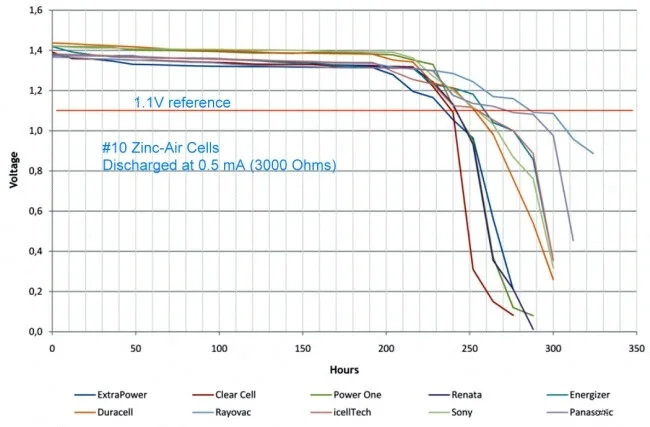
The discharge curve of zinc-air is pretty rapid, when the % starts dropping you need to find new batteries fairly soon.

 Northern Virginia