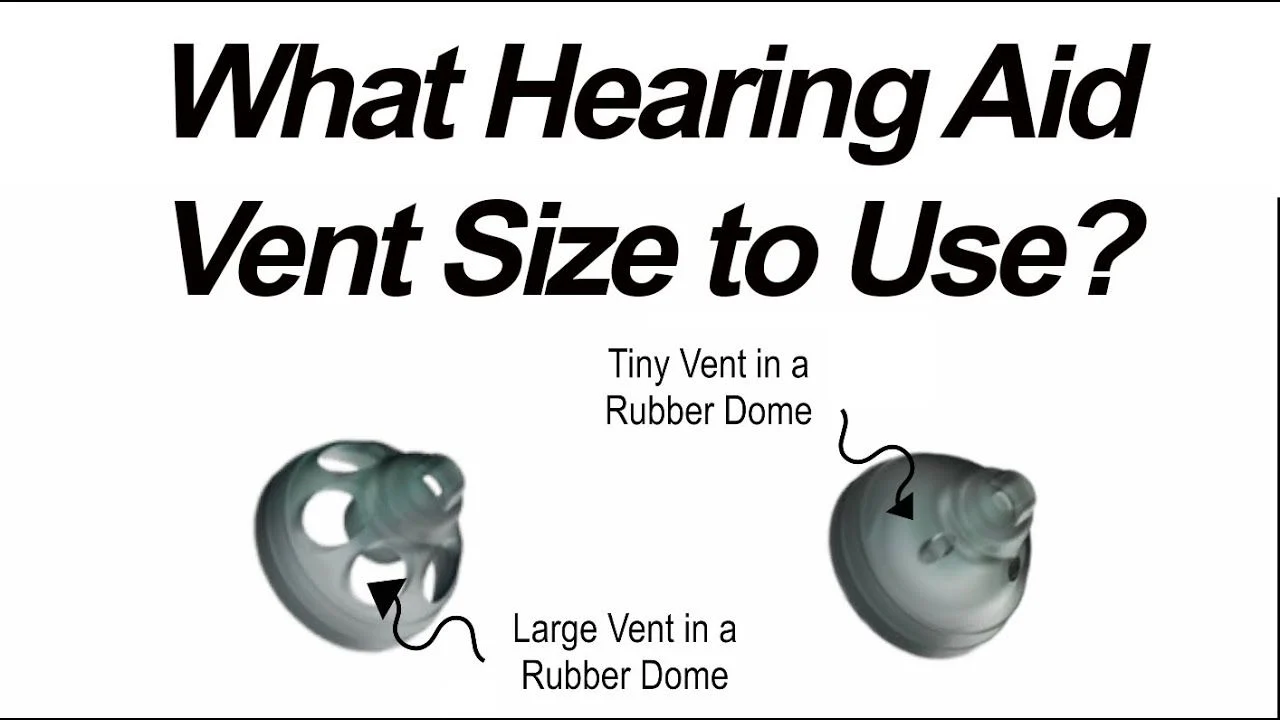
So finally I got vents, 1mm BUT the fitting software “recommends” 1.6mm or 2mm
So all that changes is the lower frequencies, you can see this when you change the acoustics, so yeah why not give 1.6mm a go, of course the best way is to actually have 1.6 or 2mm Vents, but ya know this thing is known problem, the “occlusion effect” google it this will help you understand how and why we change/chose the vent size.
but my question stands, should we “listen” to what the fitting software says or is there a better way?
As a project, you should “listen” to what your ears/ brain tell you, as in, only you will know for sure how you like to hear, but I’d go with what the software recommends to start with.
Those are, of course, domes, and in my opinion not comparable when comparing vent sizes as they aren’t a custom fit in the first place. Power domes give a closer fit, but I found the occlusion unbearable with them. My custom sliptips have 2mm vents and I have no occlusion whatsoever. However, On my backup pair, I “drilled*” my custom moulds to 3mm, and occlusion is bad in those.
Last month I migrated from power domes on my Phonak Lumity 90s to custom acrylic ear molds made by Phonak
After wearing power domes for 5 years, the comfort level is much improved. I did not receive documentation on vent size on my ear molds but the did ship what appears to look like monofilament fishing line to clean the vent. The line measures 1mm and that sounds appropriate for my level of loss.
Given that everyone is different, the ear molds do make sounds a bit sharper. I stream a lot of music while I am at the gym everyday and music sounds a bit more natural.
Also my are programmed using Phonak’s Adaptive Digital Contrast fitting formula instead of the more common . This formula, per Phonak, offers slower compression which is supposed to help with speech clarity.
My audi explained that with domes there is some leakage of low frequencies and this doesn’t occur with ear molds.
This formula, per Phonak, offers slower compression which is supposed to help with speech clarity.
Just to clarify for others, helps with speech clarity for individuals whose hearing loss is severe enough that they are no longer able to detect spectral cues well and have to rely on temporal cues. Individuals who may fall into this category would be those with more severe/profound losses, those with poor clarity even at audible levels (e.g. poor max ), and possibly those with greater degrees of cognitive decline. For less severe hearing losses, fast adaptive compression is generally still the better choice.
For me, Adaptive Phonak Digital is a better choice than . The only drawback for was that all voices sounded very “tinny”. That was one reason why I have stayed with APDC.
Since I have Phonak Target it’s easy fornme to go back at any time.
Yeah, prescribes a bit more gain above 4 kHz. I wonder, if you could match the gain from one to the other, whether you’d be able to still notice the compression differences.
I wonder, if you could match the gain from one to the other, whether you’d be able to still notice the compression differences.
I have done just that. I have KS10s which were programmed at Costco to use NAl-NL2. But I have forever had poor word recognition and difficulty understanding speech. My previous aids were Phonak VQ90s and provided much greater clarity to me. FWIW my at Costsco when fitted was 30% both
ears. Whatever tweaks I did in Target, I could not get the work clarity that I had with the VQ90s.
So I changed the KS10s to 2.0 but did not do any recalculation of the fitting (despite Target keeping asking me to do). I can say that for me the speech clarity level with APD2 is certainly better than and is very close to what I had with my old VQ90s.
So the compression ratios stay the same but I am assuming that the speed of compression is hard-coded into the fitting algo and there is no setting in Target to adjust that speed?
So I changed the KS10s to APD 2.0 but did not do any recalculation of the fitting (despite Target keeping asking me to do). [and got better speech clarity]
Without recalculation aren’t you changing only the targets but not what the KS10s are actually doing on/in your ear? What am I missing…?
There is nowhere in Target to change the compression speed. It appears that the compression speed is a function of the fitting algorithm, so to get a slower compression speed for Phonak , one needs to change the fitting algorithm to Contrast 2.0.
The compression ratios will change if I recalculate, but not the compression speed.
I wear the Resound Omnia and the speech clarity is terrible. After reading these posts, I tried an experiment, I plugged the air vents. Speech clarity improved significantly. I have the custom earmolds and they have large air vents.
OK, got it. So if I’ve tracked this thread correctly, you prefer the compression ratios of but with the slower compression speeds of Contrast 2.0? (You omitted “Contrast” in your penultimate reply, but I’m assuming it because the Contrast variant offers slower compression.)
You omitted “Contrast” in your penultimate reply, but I’m assuming it because the Contrast variant offers slower compression.
yes, correct.
I have since done a recalculation with APDC2 and seeing how that affects things. It certainly has reduced compression ratios across the board. Speech is less muffled than it was before, it is more crisp. Definitely an improvement on , at least for me, but still needs work.
I couldn’t stand ’s heavy compression, it was almost like someone had placed a seashell over my ear.
DSLv5A is the only less-compressive alternative that I have available to me, and although some things still need tweaking I’m enjoying the more natural sound. Pretty sure speech is easier to understand now too.
Thanks Peter.
Your post helps a lot.
I had a good hearing test about 6 weeks ago from my hearing aid practitioner… I’ve been back twice.
My issue is speech recognition.
"If sound gets out of your ear canal, and is likely to create feedback, your will automatically stop this feedback by reducing gain from those frequencies. These frequencies are generally the ones you need for speech recognition.
The more “closed” your ear canals can be should allow better speech recognition, as all the frequencies should be there. However, the downside is occlusion (that closed in feeling, and hearing your own voice really loud)."
I’m using power domes. I check them regularly to see if they’re in. Often they’ve squiggled out a bit.
Not only. I received a message from Phonak Audiology Assistant:
“(…) AOV is a ventilation in which the acoustic mass of the hole is calculated, therefore not only the diameter of the ventilation is taken into account, but also its length or shape (for example, it can be narrower in one part to expand in another). Thanks to the digital design of such ventilation based on the patient’s audiogram, we can create a solution that is as comfortable as possible for the user in terms of wearing (occlusi…