Now I’m going to the audiology department of my primary care medical service, and couldn’t be happier.
I doubt that that is an option here. seem to share the medical buildings with ha vendors but there doesn’t seem to be any connection. Afaik in Ontario we get $500 reimbursed by the gov per ear every 5 years. And we can claim the balance as a medical expense on our taxes. Aside from that, my ha will be out of pocket . . . so not an insignificant expense for a retiree without a private pension or insurance. I want to get it right the 1st time. However there are hundreds of ha vendors in Toronto and I am not in a rush.
Oh, I intend to. I want to trial both a Widex Moment and a Oticon Intent. Just as an aside, when I returned the Sphere the audi was out and a tech (an ) served me. She pitched it but when I raised a complaint about the upper mid nasties she admitted that when she tested it, she though it sounded “industrial” in that region. She did forget one in a glass of water for an hour so it passed the water resistance test . . .
I wondered about the adaptation period if testing different aids. That might affect your findings. I am currently trialling spheres against my NHS supplied nathos novas for music. So I’m not sure if I will get a fair comparison by switching between the two but not sure how else to compare.
When doing sonic comparisons for quality, choose 2 or 3 pieces of music that you know really well. Always compare at exactly the same volume because people tend to choose the louder one as the better one. And this is also true with a very slight mid/hi frequency bump, with many choosing the more forward sounding one as superior. While something with a mid lift will initially sound impressive, it can be fatiguing with extended use so choose carefully.
When doing sonic comparisons for quality, choose 2 or 3 pieces of music that you know really well. Always compare at exactly the same volume because people tend to choose the louder one as the better one. And this is also true with a very slight mid/hi frequency bump, with many choosing the more forward sounding one as superior.
I agree with this. In addition, you should select pieces that are recorded really well. I highly recommend something like “The Ultimate Demonstration Disk” (The Chesky Guide to Critical Listening). The pieces are of a variety of genres (jazz, classical, blues (mostly acoustic instruments)), and each piece is accompanied by an explanation of what to listen for. Each piece focuses on a different sound characteristic (depth, atmosphere, transparency, bass response, focus, dynamics, etc.).
To Teewens concern about adaptation period on the aid – I don’t think this is necessary (or really relevant) for evaluating the quality of sound. It is important for things like comfort and effect of occlusion.
Good advice. I did choose tracks that I know well but a few more than 2 or 3. Regarding volume I used the same source volume and had both aids set to the same volume in the Phonak app. I used the music program on both aids. Volume was louder with the spheres and with better tone and separation (bass \ vocals \ instrumental). By comparison the novas sounded flatter and more squashed although still pleasant to listen to. So is that worth £3k? Maybe.
What a superb exploration, throughout these replies! And how lucky many of you are to have direct tuneup access. Without that, the skill and the interest of an audiologist become crucial.
He or she may not be trained to fit for music, and in conversation might come to feel that they know less than you do about audio fidelity in general. So one has to proceed with tact!
For me (I am trained in recording and love classical music), years of squish, squash, flutter, and ‘holes’ were finally remedied by a wonderful new NHS audiologist. She was challenged by having just one, ghastly, species of aid that rang like a bell (poor transducers?), painfully overshot (compression mis-design?).
But she listened to me, and from some distant drawer retrieved a near obsolete pair of Phonak M70. ‘We issue these to children’ she said.
Two half-hour clinical sessions, across two years, included my ‘singing’, loud and soft, hand-clapping to check comping, mouthorgan to check high end clogging, five minutes sent out into the street to assess full-range capability and omni-directionality. (Being rendered deaf to the rear in traffic had nearly obliterated me).
The first session was successful, and the second even more so when this great clinician took away the phasey multi-band comping and gave me simple peak-limiting.
Yes, there’s still slight digital ‘mud’ on choir or full orchestra, but these are older, basic devices. And, remarkably, they work down to 40Hz. I celebrate what I hear, words and music.
A visual display helps by showing the audiologist the exact channels they should consider adjusting.
most audiologists don’t really have a good understanding of how to shape the sound of hearing aids in general, let alone for music, and so seeing the frequency domain information can give them better insights in terms of what is actually an effective adjustment, because at the end of the day no audiologist will truly know what its like to hear like their patient.
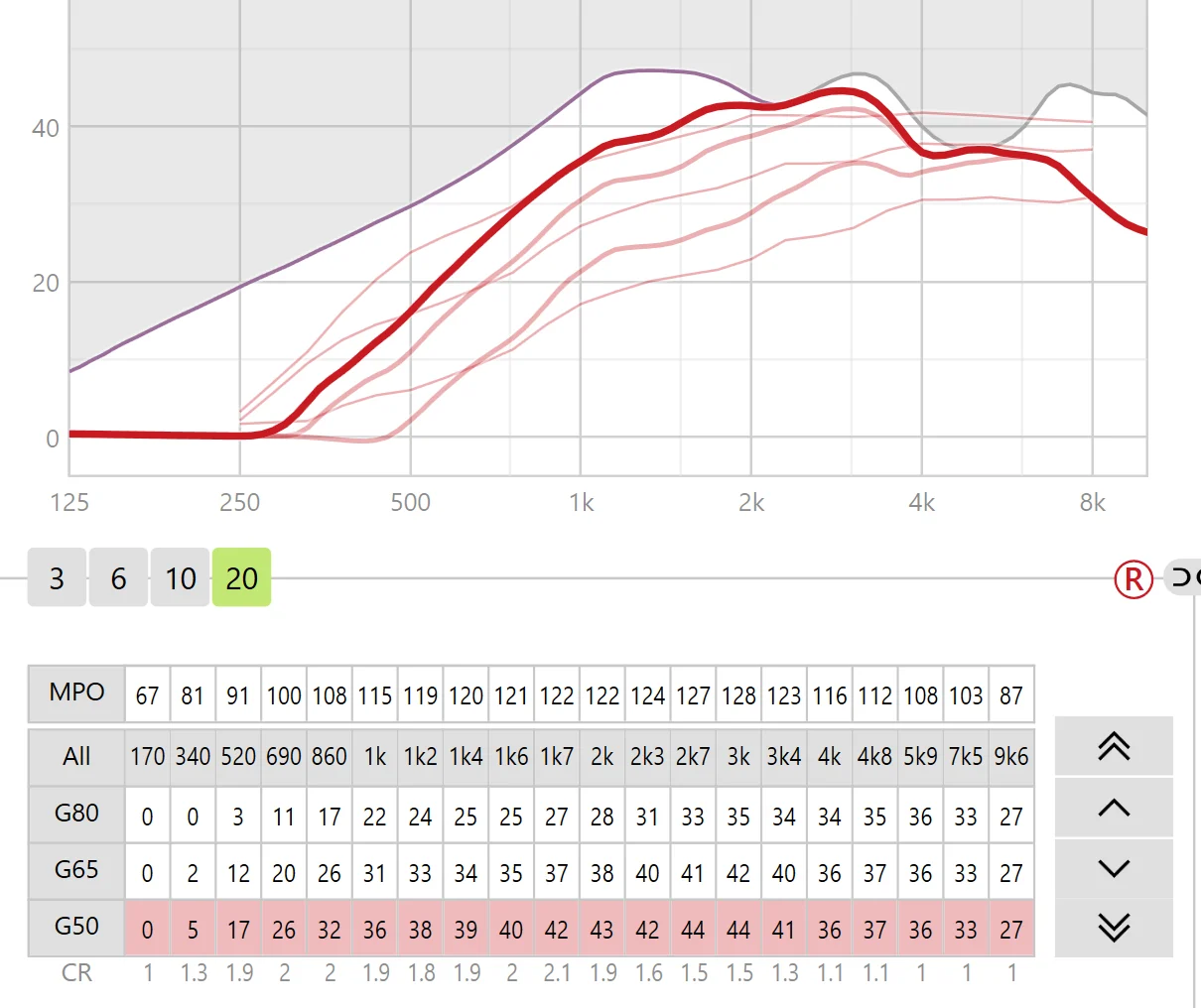
I purchased a Noahlink Wireless and obtained the Target 10.0 software to attempt to optimize the Spheres, especially for music. I have made significant improvements to the sound. The key improvement was reducing compression on the music program. I’m not sure of the “correct” way to do this, but I manually moved the gains for the 50 and 80 levels to match the gains for the 65 dB sound level. This made a huge improvement on the “snap” of the snare drum – I would guess the compression is time smearing the sound like a comb filter. Second, the feedback tuning forced the gain curves to not exceed the feedback gain limit, which not only limited the upper frequencies but also caused an artificial dip in the gains from 1 - 2.5 kHz. So I flattened these out, again manually. The results are still not as good as the Intents were (I haven’t tried the Widex), but they are much improved. I’m sure I’ll continue to improve them. Having this capability allows me to augment what the audiologist can do during the scheduled sessions.
I am starting the journey of adjustment of my Sphere program for music. for my quick experiments yesterday, using and turning off whistleblock was a big step forward. Also loved the A/B testing tool. But this all raised a different quandary for me. What does a piano sound like? I started piano lessons three+ years ago, and my hearing was already in a downwards trajectory, perhaps 10db better than what I am sporting now. So as I play with tuning my ears (), I realize that I am not tuning to what the piano should sound like - because I really do not know what that is! As I correct for my high frequency loss - the piano starts sounding…plinky? metallic? harpsichordy? perhaps I just need to get used to hearing high frequency components and let my brain take time to integrate them?
I am starting the journey of DIY adjustment of my Sphere program for music. for my quick experiments yesterday, using closed domes and turning off whistleblock was a big step forward. Also loved the A/B testing tool.
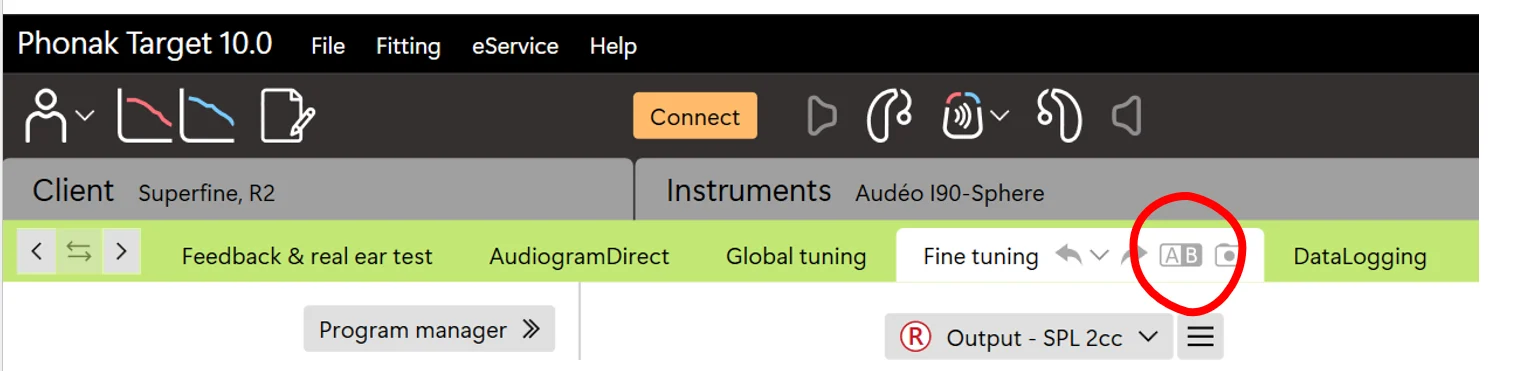
I haven’t stumbled across the A/B testing tool. Please tell me where it is and what it does. Also, I haven’t seen any sort of Undo capability – if you change some things and don’t like the result, then you have to approximate the way things were before, or else abandon the session. Am I missing something here?
Went to a concert last night of great country music. I was able to hear each of the instruments in the band and determine what they were by their sound. I could also understand the lyrics. And this all with my INTENT1 aids in the general program. I did have to lower the hearing aids volume to -1.
It is on the Fine Tuning tab. Next to it is the undo/redo buttons. Love it. The A/B lets you set up two different settings and then switch between them “live” so that the are updating in real time. I am having fun listening to a music piece and seeing the effects of various settings. Just getting started…
But this all raised a different quandary for me. What does a piano sound like? I started piano lessons three+ years ago, and my hearing was already in a downwards trajectory, perhaps 10db better than what I am sporting now. So as I play with tuning my ears (HAs), I realize that I am not tuning to what the piano should sound like - because I really do not know what that is!
You’re asked how we can objectify a purely subjective sensation. I consider myself to be a good music listener but not an audiofile; nevertheless, the audiofile community has done much to answer this. Years ago, Harmon Kardon scientists developed what is known as the Harmon Target Curve. “The Harman target curve is the idealized frequency response that headphones should have in order to give a tonally balanced sound. Headphones with the most flat frequency response subjectively sound too unimpressive, so the creators of the Harman Curve did research to figure out how to change the flat headphone frequency response target to get the best subjective experience.”
It is interesting that the ideal frequency response for headphones is different than the ideal frequency response for speakers, because of the sound changes induced by the shape of the ear and ear canal. Of course this isn’t the frequency response you want for your (because of your hearing deficit), but it does show how the community has settled on a defacto standard as the “ideal response”.
I recommend that you get a copy of the Chesky Records - The Ultimate Demonstration Disc. The narrator (John Henry) discusses what to listen for in a variety of pieces (classical, jazz, etc.) before the track is played. The pieces are superbly recorded, and you can make adjustments in Target that help you hear the fine points he describes.
phere program for music. for my quick experiments yesterday, using closed domes and turning off whistleblock was a big step forward.
I played with whistleblock on the music program, and I couldn’t hear any difference as I made adjustments. What made a big difference for me was to reduce compression on the music program. Unfortunately, the direct capability to change compression is a global setting (prescribed, semi-linear, linear). Instead, go to your music program, unlink the left and right, and highlight the G50 row and move it upward, closer to the G65 graph. Then lower the G80 row similarly. For me, this was a great help with transients – e.g., snare drums sound crisp and snappy, not muddled and muddy. I also changed my global setting from “prescribed” to “semi-linear”. Theoretically, by reducing compression, there should be soft sounds that I can’t hear and loud sounds that are too loud, but I haven’t been able to discern these artifacts.
Went to a concert last night of great country music. I was able to hear each of the instruments in the band and determine what they were by their sound. I could also understand the lyrics. And this all with my INTENT1 aids in the general program.
Hello bigaltavista,
I very much enjoy your comments and know I’ll sound ignorant with my observations I’ve had with the Oticon Intents which I’ve received gratefully through the here in Honolulu. First and foremost, music when I walk after work is medicinal for me. I was fitted with basic receivers that honestly sounded uninspiring. On hearing that my VA audi ordered me custom earmolds that have a sort of wing on the receivers that both hold them in place. When I tried them on, I got tears in my eyes it sounded so good. The music was robust and I could hear cymbals and actually felt the bass! One day I noticed when I pressed one of the receivers deeper into my ear canal the sound quality doubled! There was a presence now that I didn’t know was missing. Then I let off the pressure and the presence sadly went away. Now knowing what I am missing I use wax earplugs now on top of my receivers and get most of it back, but not like holding it in with my finger. I do have an opportunity to go with the Phonak Audeo Sphere with ActiveVents with Titanium molds and was wondering your thoughts are? Is there a way to not use the wax and hold the receivers tighter in my ears so I can get back that presence with my Oticon Intents? Appreciate the counsel you provide on these threads.
Is there a way to not use the wax and hold the receivers tighter in my ears so I can get back that presence with my Oticon Intents?
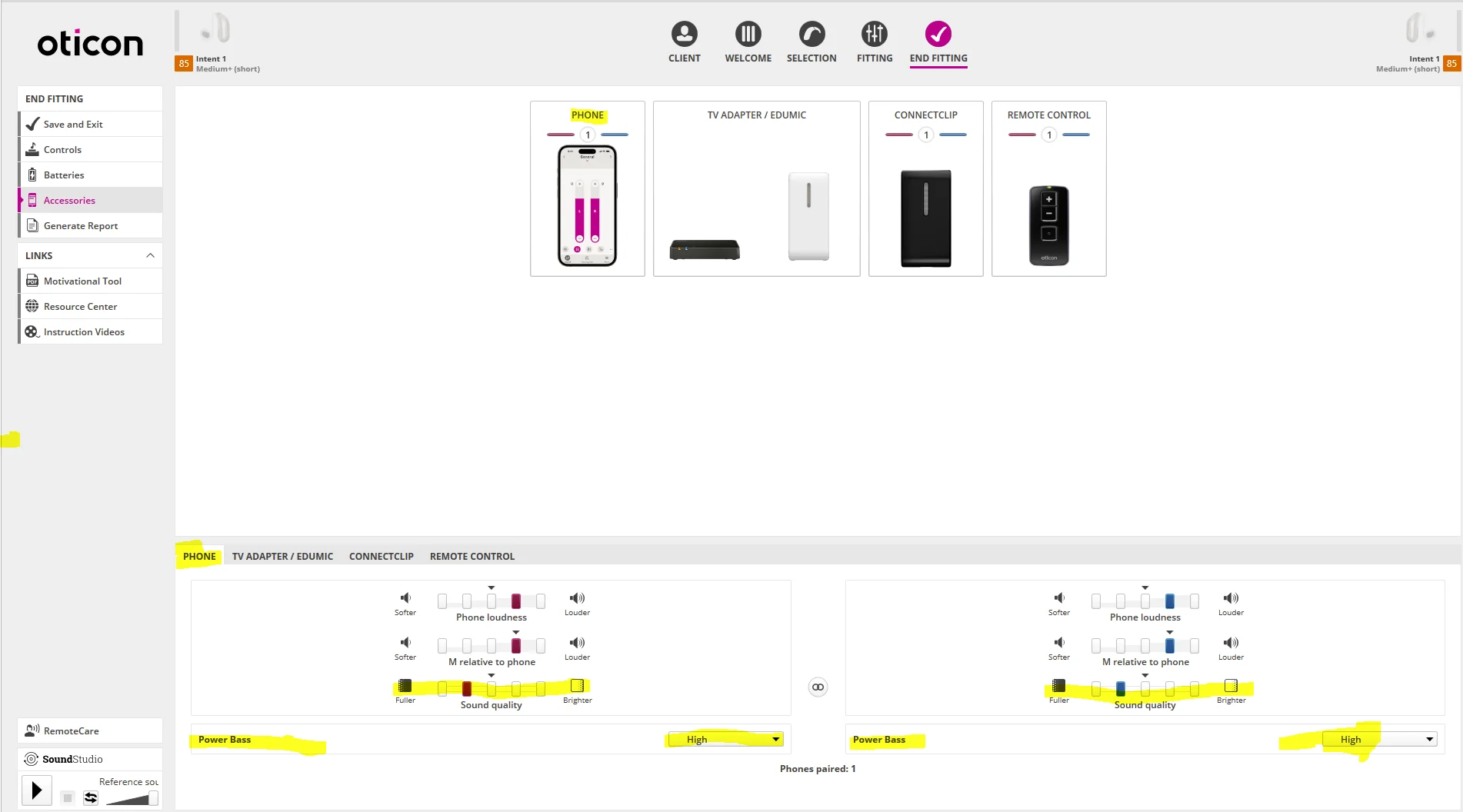
Your audi at the needs to make some adjustments in the Genie2 fitting software.
Specifically here:
Also, have them add the MyMusic program for you, it may help with streaming music.
I basically gave up on streaming music, and bought an Amp/DAC to connect my wired Etymotic IEMs, which go deep in the ear canal, and give me glorious fidelity, and cut down traffic noise while walking!
At home I can wear over ear headphones with my Intents, and enjoy music from any source I have.
It would be helpful if you post your in your profile, so it can be seen by us.




 Crediton town, Devon UK

 Hot Springs Village, Arkansas