cliffographyAuthor
I’m interested that you were able to turn off feedback managers for the Widex . How do you do this? Is it in the phone app?
You’re ignoring this member’s posts.
This topic is closed.
42 replies1.1k viewsLast reply
I’m interested that you were able to turn off feedback managers for the Widex . How do you do this? Is it in the phone app?
You’re ignoring this member’s posts.

No it’s in the compass software, the hardware interface is also required if you wanted to do things like this.
You’re ignoring this member’s posts.
I wonder, now that the allures are using cloud software whether they will set it up for remote control like Phonaks. I used that once with my audi and it was actually very easy and useful once I disabled my wireless connection, I’d not opened the firewall ports on my router so he couldn’t initially connect 
You’re ignoring this member’s posts.
Yes remote support could be done, not everything but most adjustments can be, so once this is set up the first time by the audiologist with Noahlink wireless,remote support would be available from then, but I’d still prefer to , one would need access to the software at the time of remote support being done.
You’re ignoring this member’s posts.
A couple of points to check here:
If after making the dedicated program for music you are running into feedback problems, then that means you will either need to restore a light amount of feedback management, pursue a more closed fit, or some combination of the two. Good luck!
You’re ignoring this member’s posts.
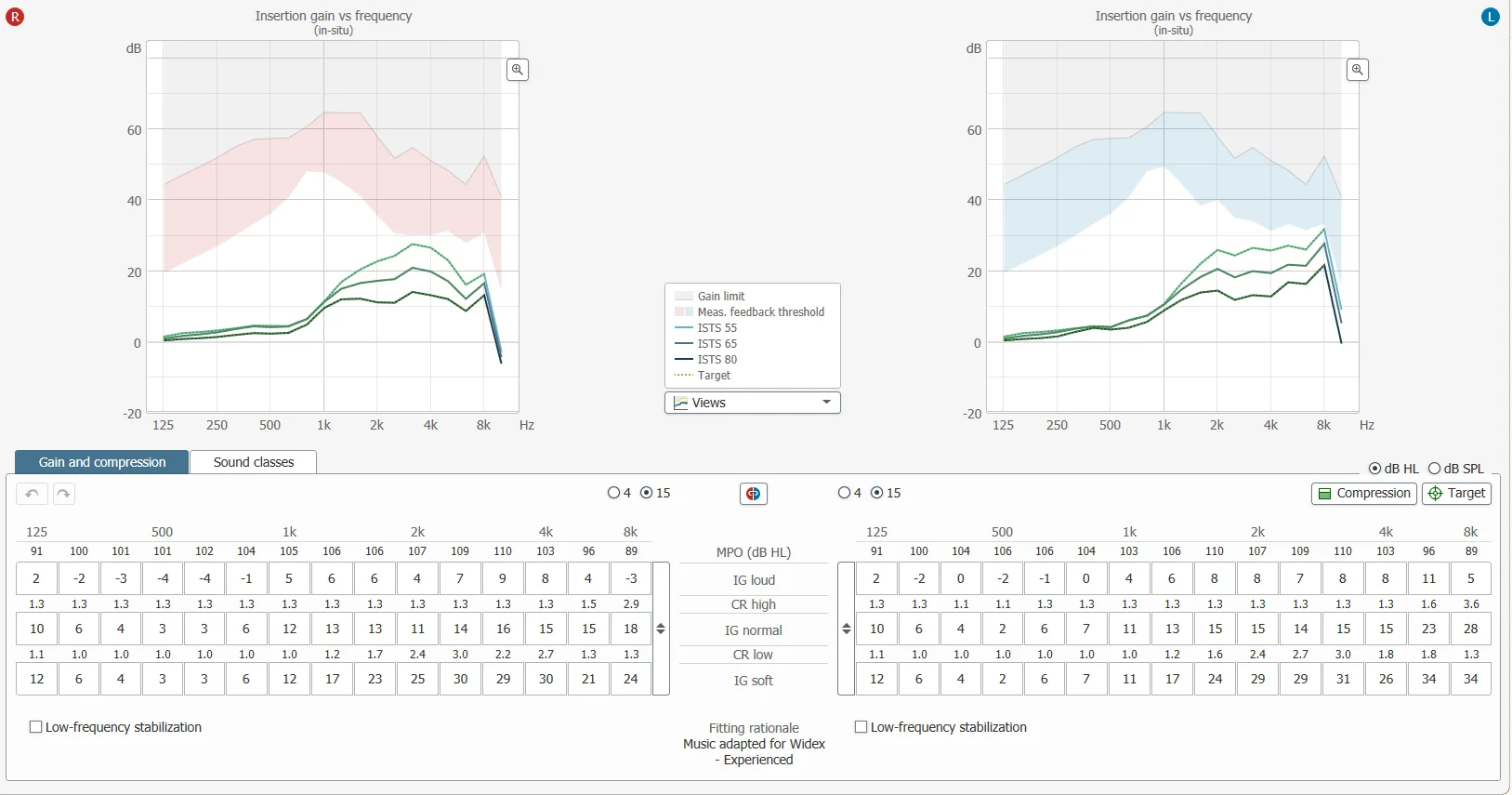
I just looked at the MPO values and can’t increase them but they are 103-107 dB and I know I’m not even coming close to those. Probably 80-85 dB max Just cranked the amp up and did some percussive stuff and only hit about 84 dB MAX on a dB meter so not close to the MPO values.
That’s output in your ear not free-field. If your loss at 2-4KHz is 65-70dB, you’ll certainly hit 85dB at threshold even for quietish speech with 20+ of gain. For 80dB inputs you’ll be straight into the limiter.
The maths of gain isn’t complex, but some of the discussion on it from ‘sound/music engineers’ is just twaddle.
You’re ignoring this member’s posts.
Hmm, very good point so I’ll rethink this and look at trying to change . My max gain for loud sounds (above 80 ) is only 9 db in music mode and 89 is below the MP0 there of 110 dB. And looking at other values of gain + 80 db VS MPO…I’m still looking “safe” and below MPO by 10-15 db at least.
I recently decided to go from inexperienced to expert (inexp. was set by audi when I complained about too much gain and that helped) and just noticed it made changes to my custom music program with 1.3 compression so I have to go back and do some tweaking. I’ve tried to keep the soft sound gains the same while adjusting gains for medium and loud sounds. I don’t know if that is the correct way to do this. Do you think 1.3 compression is a good compromise and my approach to adjusting valid. My left also has a very large 30-34 db gain at the highest frequencies while the right only has about 21-24 db, strange since left and right are not that much different from one another.
You’re ignoring this member’s posts.
So I’ve been meaning to try this: I took my hearing aids out, cranked up the high freq pot to 10 on my deluxe reverb (tonemaster so solid state) and played Melissa and Come Together leads…lots of 9-22 frets notes and bends. Wow, no distortion. And other things like chords etc. always sounded somewhat distorted were crystal clear, with and without the guitar pedal compressor and among single and humbucker guitars. Sounds like it’s more the left ear. Here is my current unmodified music program attached
You’re ignoring this member’s posts.
If I remember correctly, NAL-NL2 will be the most compressed, then DSL pediatric, then Widex proprietary, then DSL adult. Less compressed fittings will sound better with music.
I wonder where did you read that comparison. For examplec: 5.0 Adult vs. Pediatric - it’s because G50 in Pediatric is more amplified in relation to G80 than in the Adult?
. If using DSL adult, then make a “quiet” or “calm situation” type program a
I’m not sure if a calm/quiet program, instead of a music program, would still be better. I theorize that a music program may also have parameters that we cannot adjust, such as attack/release time, etc. Maybe someone more knowledgeable could tell more about it.
You’re ignoring this member’s posts.
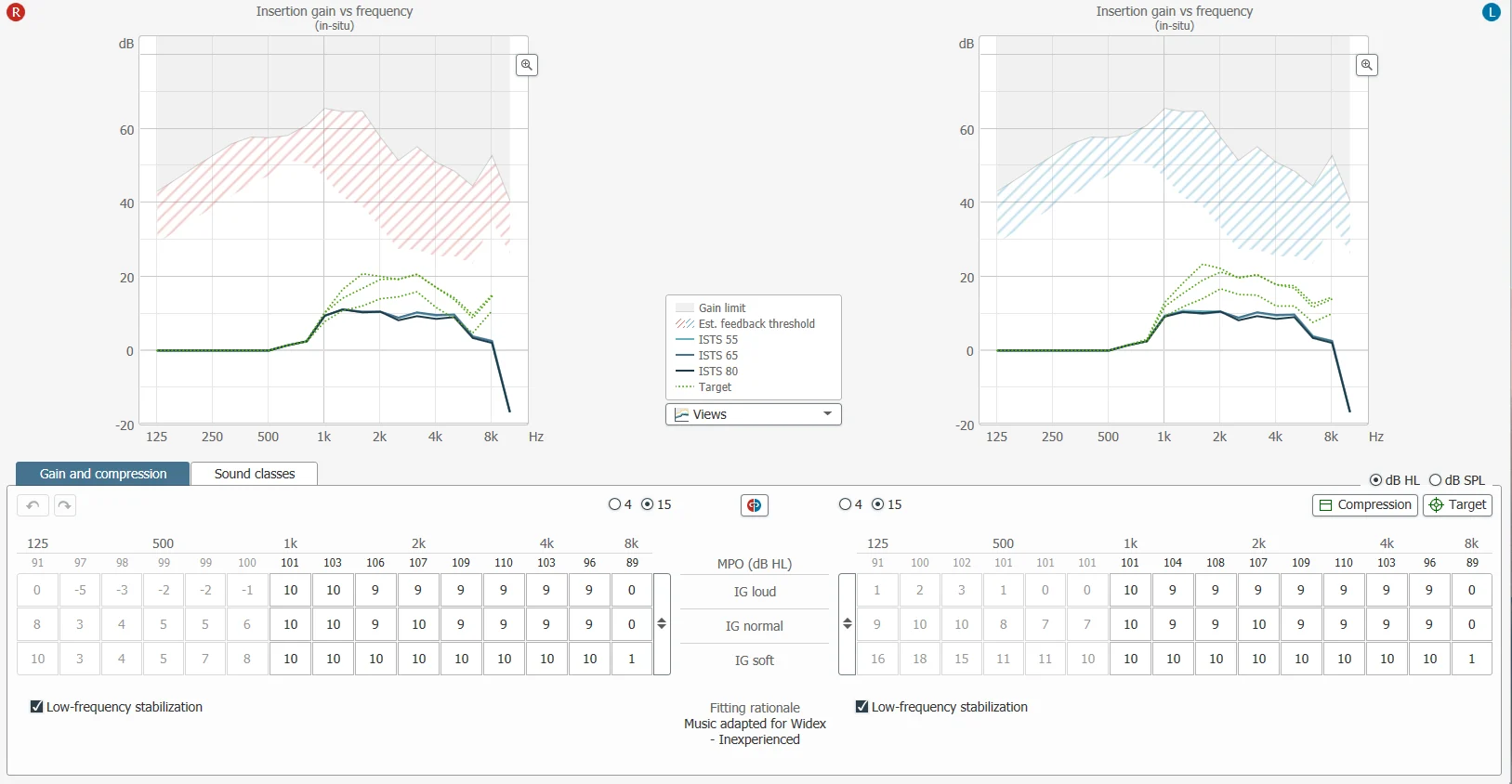
I went back to my inexperienced setting and created 3 music programs. Seems the music program had some high frequency boosting going on I could not modify without unchecking that option. I also did some research and one source said that sometimes just a 5-8 linear db boost can control distortion for live music better. I decided on trying around 10 . I could not see how to adjust the for 8 khz and since it’s 89 dB applying 10 dB to a loud sound of 80+ dB might cause it to clamp down I elected to severely reduce the gain there. Of the 3 different music programs I created this one is the very best and most natural sounding to me, electric or acoustic guitar. Not sure if only a 10 dB gain will cause me to set my electric guitar volume higher than others might like so I have to watch that. I’m sort of learning here as I go but I think this could be a lot better for me especially when playing with other musicians since that always sounds somehow out of tune or distorted in a not so good way now.
You’re ignoring this member’s posts.
3:1 compression is about the limit before you start noticing artefacts.
As for the gain variation LR, there’s likely something else been added in, like a set of bone conduction results to the one side to get an offset result.
Normally the targets should elicit similar gain values for similar threshold results. Given that none of your chart is over 70dB the maximum expected gain should be around 23dB.
You’re ignoring this member’s posts.
There is a myth about Widex and music that Widex has very successfully cashed in on. But, it is a myth.
You’re ignoring this member’s posts.
Yeah it’s just one those things that’s been around a long time, plenty of people who have tried them and gone on to others, but that pure sound low latency is encouraging.
You’re ignoring this member’s posts.
Maybe the “truth” is exaggerated a bit but it’s hard to deny how many musicians do swear by Widex after trying others. And maybe some of the others have caught up in some respects. It will be interesting to see how the allure is received by musicians and others. My only experience is with Philips and the Widex just did a lot better for me for guitar than Philips and I tried adjusting the Philips to the settings on the Widex and the quality was just not there in the Philips but I admit that’s an n =1 or 2, lol.
You’re ignoring this member’s posts.
Yes bone conduction is slightly different left to right and is my low freq so the low freq stabilization was turned off for the left side to allow some gain below 1khz. I did have an ent do some testing to make sure there was nothing physical they could measure to explain my higher low freq losses on the left side.
I think now I’m going to experiment was a couple of additional music programs with higher gains of maybe 12-15 db and also ones that don’t cut the gains at 8k. I imagine if I went to music specialist they might get me closer faster but the only one I know is 125 miles away in LA.
I was going to try the new Philips 9050’s when they came out before I got the $3K hearing aid benefit I could use for the Widex. A fellow musician that I play with got his first , the 9050’s, and says he has no complaints so far but we’re all biologically different. I would have liked to have tried the 9050’s. I’m still very hyperacoustic and just can’t tolerate the kind of gain I need to hear a lot better. And I think that’s why I seem to really like the Puresound option in Widex.
You’re ignoring this member’s posts.
For the fitting rationale comparisons, I think it is just from memory from seeing my prescriptions for my hearing loss side-by-side. Regarding the use of the music or calm situation program, it is because I think Widex’s music program uses the Widex rationale no matter which rationale is in place. If adult is less compressed, then it is probably better for music. The point you make about “under the hood” parameters is good - my recollection was that the attack and release was that it was long enough for me to notice it as an artifact when I play piano.
You’re ignoring this member’s posts.
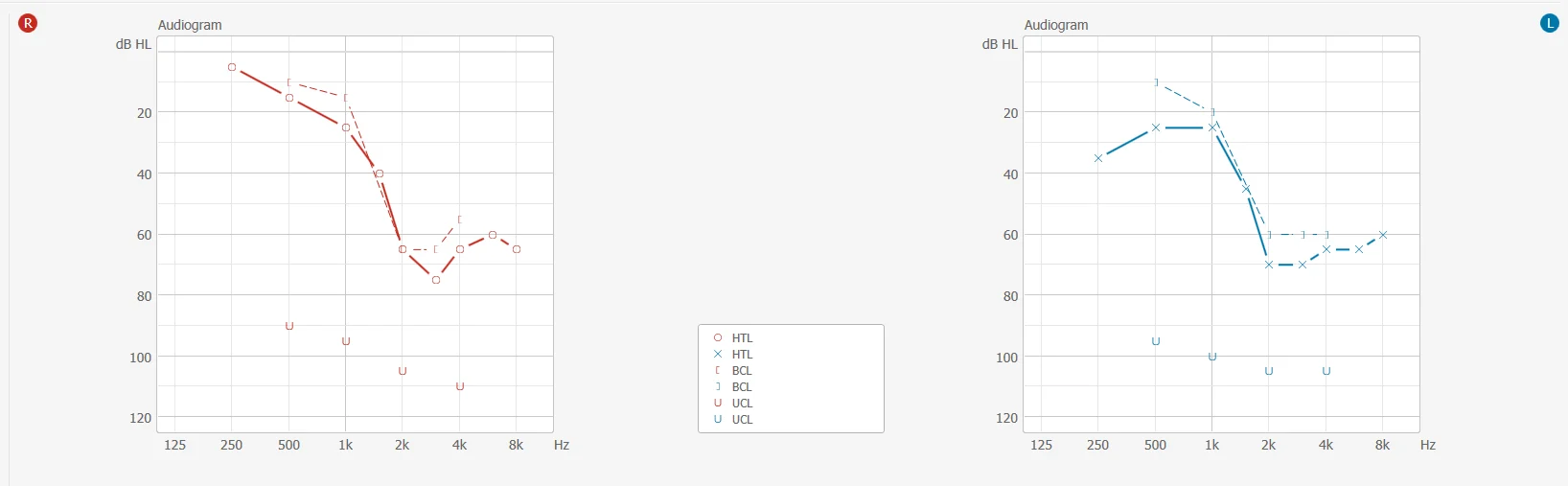
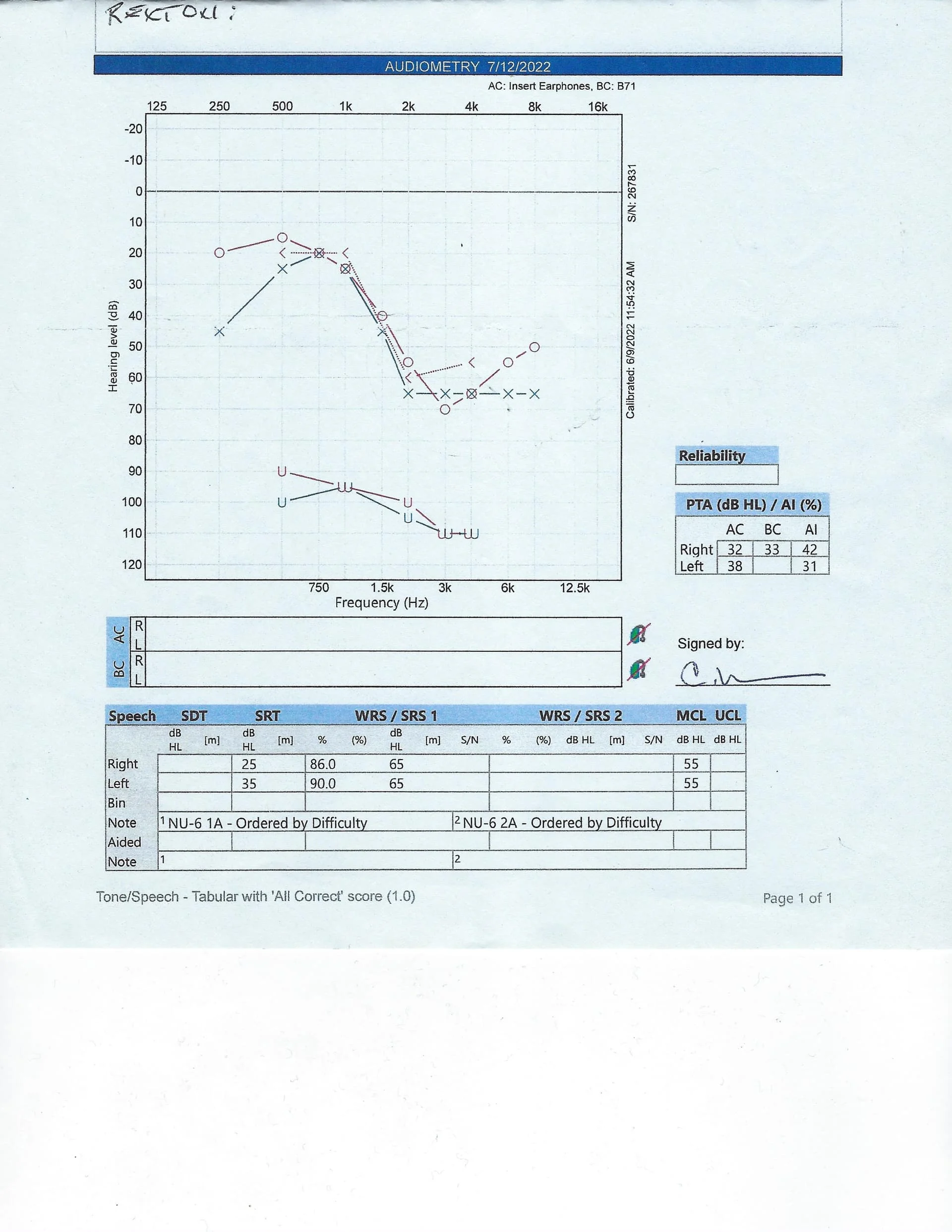
I can practically guarantee you that the measures at 3&4KHz are wrong: the audible output of the BC device cannot adequately be screened from you ear canal unless you used separate earplugs during testing.
If you’re reprogramming and you’ve got access to the , repeat the 3-4KHZ with in situ audiometry (it won’t be the best unless you get someone else to do it), to give you accurate and drop the BC values. Or tell the SW just ignore the BC.
You’re ignoring this member’s posts.
my recollection was that the attack and release was that it was long enough for me to notice it as an artifact when I play piano.
This is absolutely correct. Though it’s still better than several other manufacturers.
You’re ignoring this member’s posts.
My for my Philips from 2023. HearUSA did an insitu for my Widex since their machine was not working and still isn’t a year later, lol.
You’re ignoring this member’s posts.
How do you access the software to fine tune your at home. Can you buy it, download it, stream it? If so, from where? I would love to be able to fine tune and tweak the HA settings that have been discussed on this forum.
You’re ignoring this member’s posts.
Hearing Aids4 replies
Hearing Aids2 replies
Hearing Aids6 replies
Hearing Aids70 replies
Fitting Software Requests258 replies
 Wales, UK
 Poland