You’re ignoring this member’s posts.
Your Audiologist is Wrong: Real Ear Measurements are ESSENTIAL for Your Hearing Aids to Work Well
154 replies6.3k viewsLast reply

Yes, it’s still the case where I am that most adults are only covered for one, but for the last…at least ten years kids get two.
You’re ignoring this member’s posts.
You’re ignoring this member’s posts.

 Hot Springs Village, Arkansas
It was a program let by a speech therapist but was tuned to listening to understand what was being said instead of how to pronounce words. It is a means to concentrate on what someone is saying. And it was tuned to being able to do so without having to strain to understand. It worked a long with slowly having my aids having to volume increase. My aids are actually set gor more sound power than what my indicates I need. Because of that I hope I never have to have a different audiologist to deal with. In the frequency range of 1500 to 4000 my aids are set to 110% of prescription and my lows are set to 105% and my highs are set to 90%. Of prescription. I wear 105db receivers where the fitting software says I need 85db receivers.
You’re ignoring this member’s posts.
 Crediton town, Devon UK
Tone bleeps alone really are not adequate assessment. Real ear measurement better - but how about this: audiologist to use their basic threshold and recruitment info to modify conversational microphone audio into a pair of hi fi headphones which they wear so they can hear, approximately, what we hear unaided. Might help to increase empathy when necessary, might yield useful insights when clinician tries different settings on themself. Aliasing and compression overshoots can be difficult for the patient to describe, but once heard never forgotten!
You’re ignoring this member’s posts.
Aliasing is documented as something that can occur in hearing aids. How does it occur if it typically happens when the sampling rate is too low. What is Aliasing in Audio?3 Are hearing aids not sampling at a fixed rate or is the aliasing perceived due to the wearer not hearing some frequencies through the aids or something else?
You’re ignoring this member’s posts.
Aliasing, as you know, arises when audio frequencies come into conflict with those of the digital sampling - and usually, hopefully, only when audio is a bit too high level. Further, lower, frequencies get added. You make a good point about individual hearing: yes where normal high sounds might mask some lowdown aliasing, those of us who don’t hear much highs may well be more aware of junk in the lows.
My ’s created crud out of highs that I could not hear - and it was remedied by rolling off highs above my cutoff of 4 kHz. Playing a little keyboard in clinic gave the clinician the info she needed.
Something comparable was happening when I fed my keyboard into a digital delay box (not wearing aids): Top octave, to 4 kHz, played upwards, brought on a descending pitch - not at all harmonious! Simple remedy again: Roll down the top end.
You’re ignoring this member’s posts.
You’re ignoring this member’s posts.

Allow me to toss a little kerosene on this discussion.
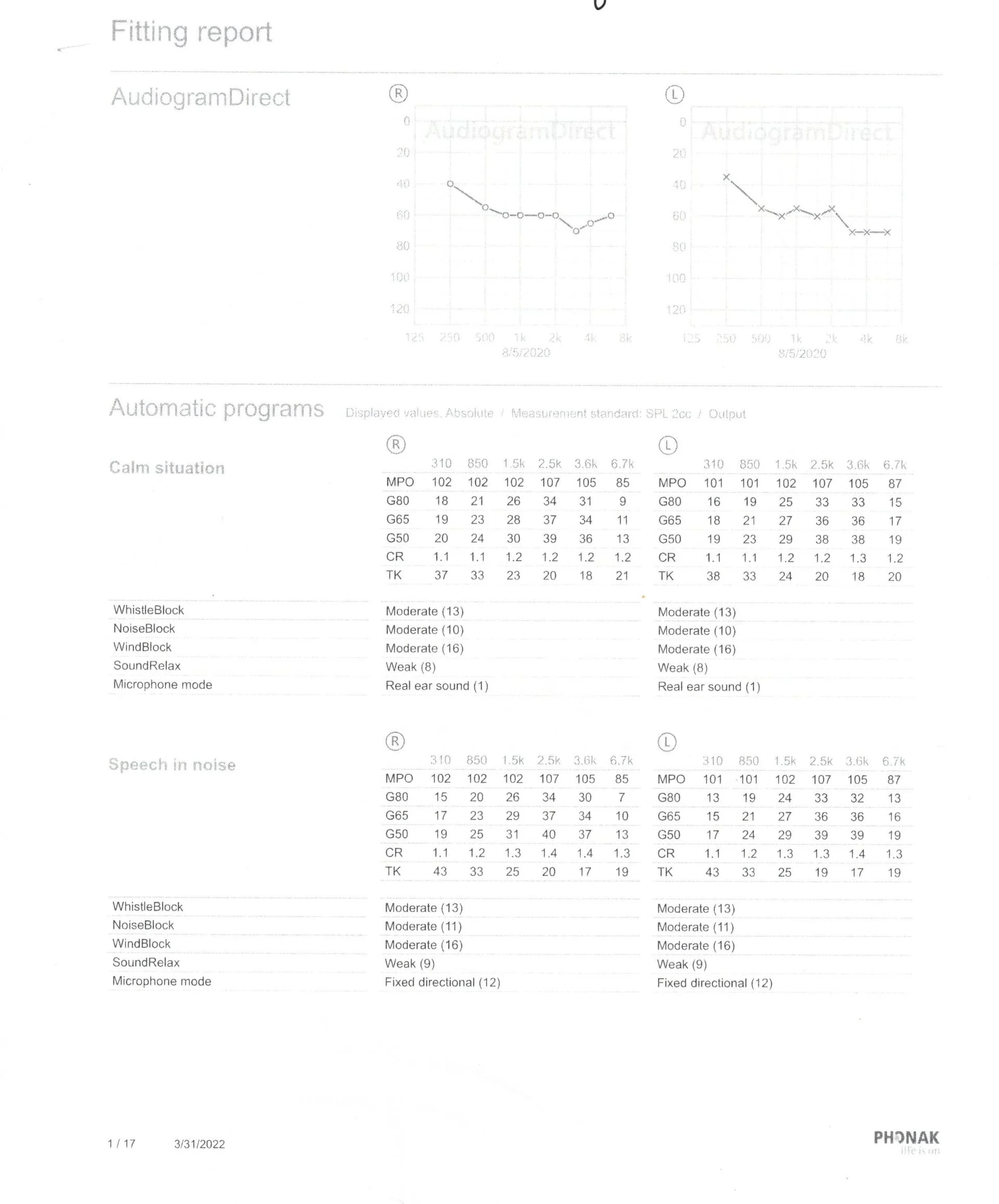
In 2021 I was wear Phonak Marvel 70-R with power domes. These were purchased in November 2019 and REM was NOT performed because the audiologist did not believe it was beneficial.
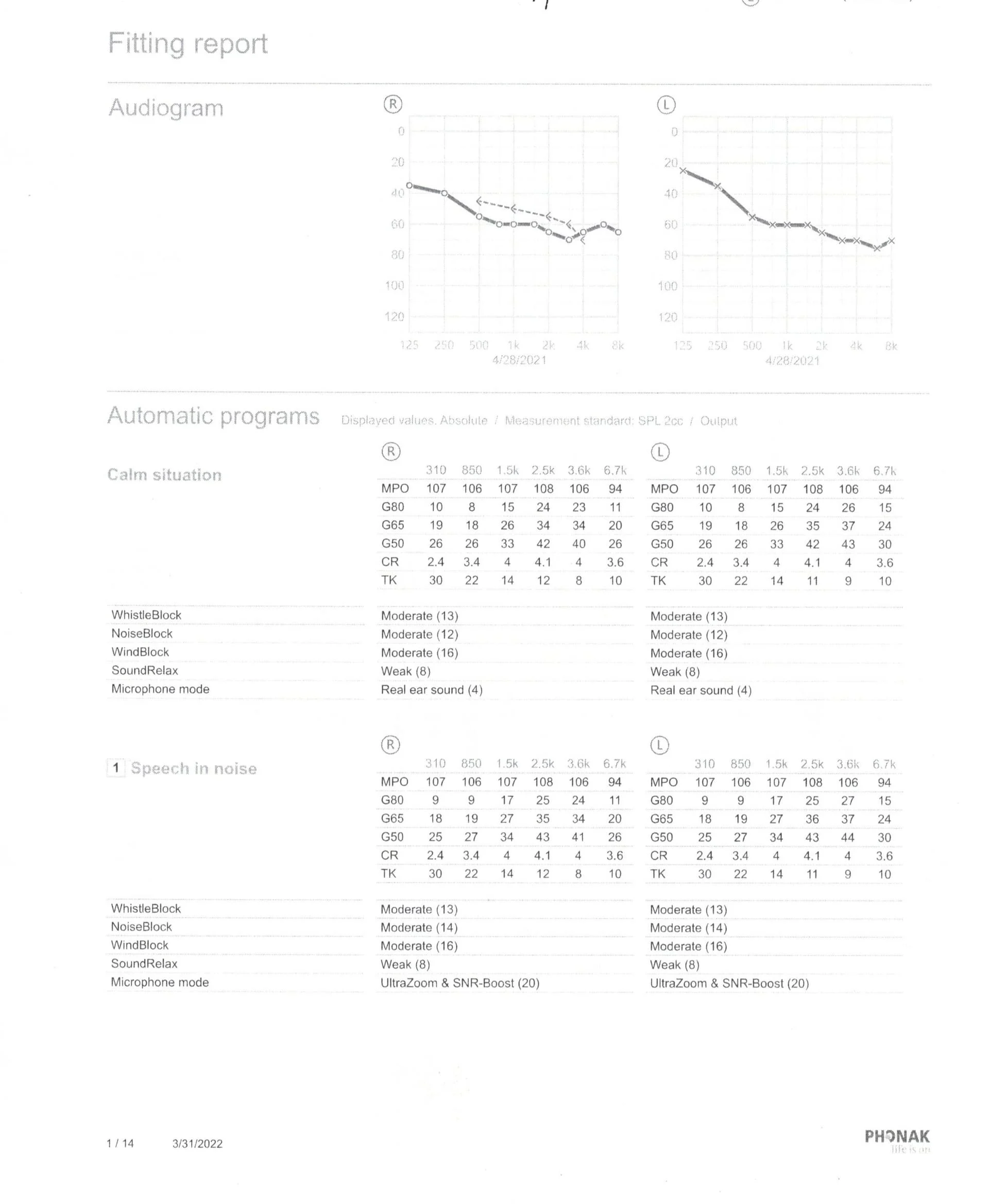
I was preparing for an extended International trip and I decided to roll the dice to present myself for REM fitting. I was already having trouble hearing conversation at retail point of sales and restaurants. Read that again. It’s not that conversation wasn’t clear, I couldn’t pick up anything.
I have posted fitting reports from March 2022. The top fitting report was non-REM using NAL-NL 2 and the bottom is REM fitting, also using NAL-NL 2. If you look at the gain values for Speech in Noise program for both fittings, the REM fitting did provide more gain than non-REM.
REM fitting DID NOT allow me to hear any better in challenging environments, i.e. retail point of sale; airport check-in; hotel check-in; open air markets and restaurants. Conclusion? The Marvel 70s had insufficient noise filtering, which is the same problem I am having with Infinio 90-Sphere when background reaches 75db.
If you look at my on these photos and compare to what is on my profile, I had better hearing in 2021/2022 than I do now. Yet I struggled greatly with background noise. The Infinio 90-Sphere probably would have been a miracle in 2021, now they are just ok.
I will let everyone draw their own conclusions about REM. Have I considered REM fitting with the Infinio 90-Sphere? Yes and I had a discussion with one audiologist. I was told REM would NOT allow me to hear conversation any easier. I was quoted $500.00 to perform REM fitting. Will I get $500.00 worth of better hearing? I have serious doubts.
I have a severe loss and for others that have a serious loss, what has helped speech intelligibility (TV & radio sound, Bluetooth music streaming, speech in Calm Situation ==> Switching to Adaptive Phonak Digital Contrast algorithm and choosing Semi-Linear Compression.
Thanks for reading.
You’re ignoring this member’s posts.
So, I listen along over headphones when I , which I agree is a good thing to do so that you can hear what is going into the patient ear (both direct sound through whatever venting and gain from the hearing aid, although at a lower volume as necessary). What it doesn’t do, however, is cut off the stuff that the client cannot hear. This seems like something that could be implemented, but I’m not sure it would actually be that useful? You’re still listening with a normal ear as opposed to the patient listening with an impaired ear. It absolutely helps me catch weird artifacts, but it doesn’t help me to experience the clarity issues that the patient has by virtue of the damage done to their auditory system. Interesting idea though, thanks.
REM fitting DID NOT allow me to hear any better in challenging environments
Those two fits are not terribly different. So congratulations on having either a very average ear, or a clinician who is a very light touch on REM. Glad you found something that helped though.
You’re ignoring this member’s posts.
I am by no means an expert on this issue. But in my opinion, the fault is not with , but that you have misunderstood the purpose of REM.
REM does not equal improved hearing by default. In most case it does improve hearing, but REM is the first step in the process, not the end of the road.
The point of REM is to verify the fit. If your says you need 2khz boosted by 15 decibels, then REM verifies that 2khz is boosted by 15 decibels. In many cases (mine included), REM does help you to hear a lot better, because a lot of people have smaller or larger than average ears so they are (in most cases) underfit by quite a bit in certain frequencies. REM = Verification
However, having the correct sound profile for your hearing, be it VAC+, , DSL5 is also very important (at least in my case, NAL-NL2 fixed issues I was having in the car).
Finally, even after choosing a sound profile that works for you, having REM done, you may still need to tweak the sound a bit more for certain scenarios - but (and this is key) generally you would have to tweak far less than you would with a non REM (non verified) fit. Hearing is not a scientific process given that some people love Oticon and others hate them, whilst I can’t stand Widex, Resound and yet many other people love them.
For me, personally, I found that Oticon are the only hearing aids that work well for speech in noisy environments. All other manufacturers I have the problem that I can hear everything except what I am trying to hear.
Sorry that REM did not help you, but that probably is more because your ears are very close to standard ears and as I stated REM is not the end of the process, but the first step.
You’re ignoring this member’s posts.

My usual is an hour away. I am trying a new one two hours away to see if there is improvement. I have a and 2 hours is the closest in state office that services my brand. I figure it’s worth the try to see if I hear better. It’s not that I have to go very often. Hope you get some better results soon!
You’re ignoring this member’s posts.
 Poland
My questions which arised after REM:
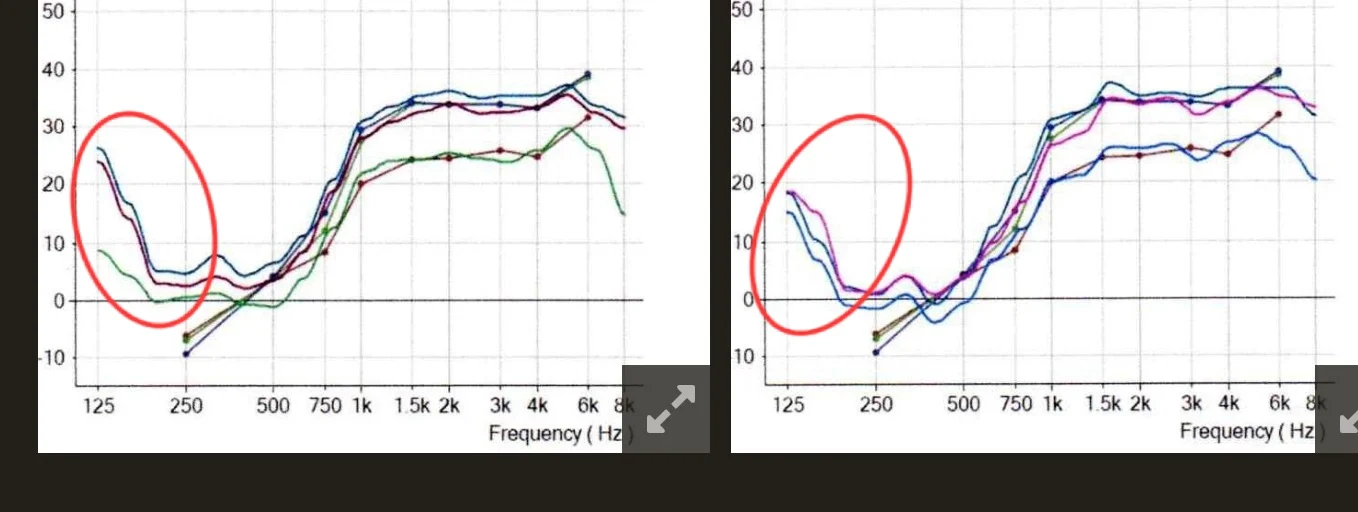
- Why, after using the REM with both the Paradise and the Sphere (both with DSL), am I off target with the low frequencies up to ~400 Hz, especially to 180 Hz?
- Is it because the 0.9 mm vent in Paradise allows LF to enter?
- On the other hand, the NAL-NL2 fitting is almost perfect. Perhaps this is due to the imperfect REOG in the NAL attempt?
- Are the REM results suggesting which vent I should use? Or should I not use a vent at all? This is probably the most important question, because I’ll soon be sending my titanium earmould to be remade with changing from P to UP receiver (main cause of complaint is AOV vent in Sphere cShell instead of ordered 0.6mm).
I’ll consider getting UP receiver with silicone earmold in another place than Phonak manufacturer “for science”.
- Why, despite getting the targets even in the loudest DSLv5 pediatric, the final volume was so quiet for me? The sounds have definitely too little power after fitting, especially in the low freq.
It’s because of that subtle new audiogram difference than previous ones? Or it’s simple my hearing habit?
I am a bit shy to ask for it, but I’ll get the job soon and it would be good to finalize my issues with my eamold.
Does in the cited post gives any useful info before remaking earmold? Currently I use Sphere with Unitron power domes with P receiver. @Neville, @Um_bongo, @Hearing_Potential?
I plan to buy cShell with UP rec., I’ve not know with which ventilation yet.
You’re ignoring this member’s posts.
I don’t think 0.9 vent versus no vent will make a difference for you. Looks like your feedback control is perfect, closing it won’t make a really audible difference. I don’t know if opening it is ont he table–sounds like you’re not bothered by the closed fit.
As for the other questions, it’s just really hard for me to know without you in front of me hooked up to the system. It’s also weird looking at insertion gain rather than at the eardrum.
You’re ignoring this member’s posts.
I have a severe loss and for others that have a serious loss, what has helped speech intelligibility (TV & radio sound, Bluetooth music streaming, speech in Calm Situation ==> Switching to Adaptive Phonak Digital Contrast algorithm and choosing Semi-Linear Compression.
Your loss is very similar to mine. I’ve never been given a Real Ear test, and I very seriously doubt it would be a “cure all” for me.
I shall try semi linear.
For the music program though, I take a screenshot of DSLv5a Adult, and adjust it to those Levels.
For speech, I find APD better than or DSLv5 (Adult).
Before joining this wonderful forum, and starting self programming, I never had a single Audiologist who discussed the choices of fitting programmes. That tells its own story.
Thank you sir.
Peter
You’re ignoring this member’s posts.
I don’t know if opening it is ont he table–sounds like you’re not bothered by the closed fit.
I like the earplug effect of my power domes and rely on compression, which is safer when there is a very loud noise source. I am also interested in maximally efficient anti-noise algorithms and directionality, which is why I opt for a closed fit..
As for the other questions, it’s just really hard for me to know without you in front of me hooked up to the system.
Yes, the system wasn’t perfect. There was a small, portable loudspeaker that couldn’t produce an input of even 85 for the assessment (maax 80 dB) . The loudspeaker wasn’t at eye level; it was 35–40 cm below. However, the calibration was performed, so perhaps it shouldn’t make a difference?
My question about closed vs. 0.9mm was because of that strange Insertion Gain in the lows, I wondered if it because of that vent or slit leaks. However, in accidental fitting of the lows is normal…
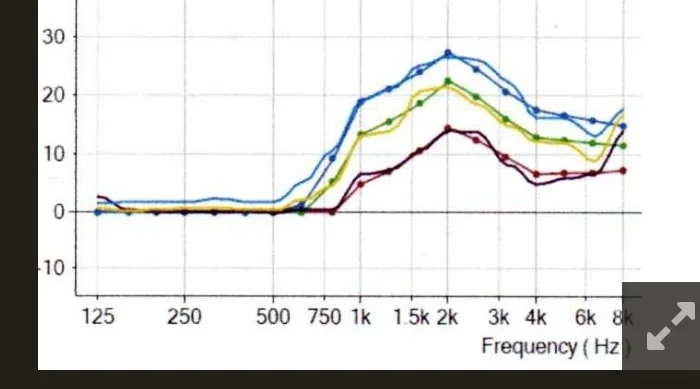
Okay, the reason for the remake of the titanium cShell is the AOV vent instead of the 0.6 mm vent, as written in the order form. Thanks for answer.
You’re ignoring this member’s posts.
However, in accidental NAL-NL2 fitting REIG of the lows is normal…
Yeah, I saw that too. But I don’t know off-hand what it is. I’d need to have the software and the Avant in front of me and start poking around. Can you hear it?
You’re ignoring this member’s posts.
Not really feel a difference, maybe because of my probably overamplified , before procedure:
There is my graphs before REM-based fitting:
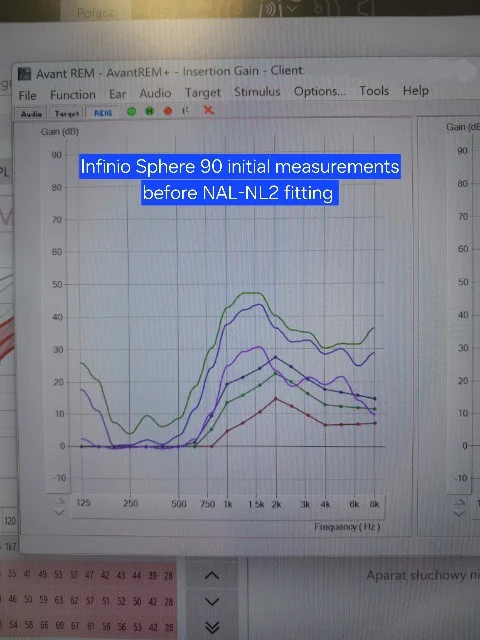
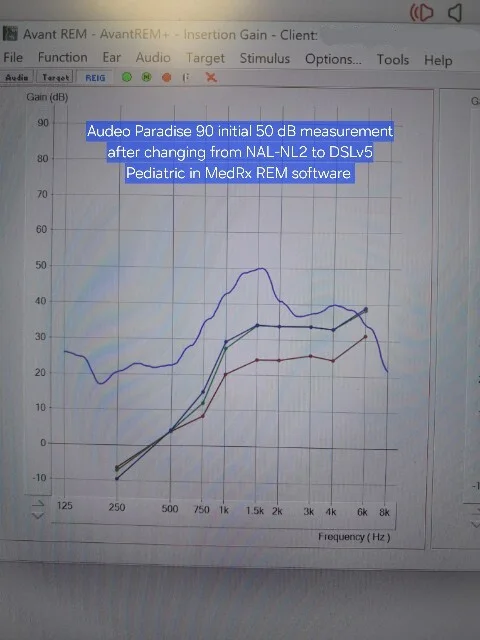
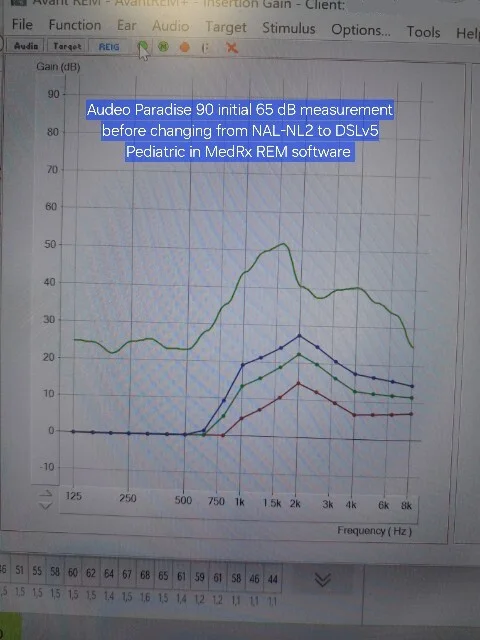
Now I have +9 step up gain in all frequencies, and +2 steps in 1-2kHz so for now didn’t hear it. It’s the only algorithm, in which gain could be increased without destroying the proportion of particular channels gain.
You’re ignoring this member’s posts.
rely on compression, which is safer when there is a very loud noise source
Doesn’t the UL limit loud sources irrespective of compression?
You’re ignoring this member’s posts.
Doesn’t the UL limit loud sources irrespective of compression?
Yes and no. Anything really loud will come in around the hearing aid and you should be wearing hearing protection instead (with some caveates for well fit full silicone molds) so we’re talking about regular loud noises. manages loudness comfort. Damage is caused by your volume dose over time. I’ve said elsewhere, we know that DLS child targets are safe. We don’t know whether or not anything above them are safe. If one is fitting above child targets, you’d need to start looking at threshold shifts.
@Bimodal_user It’s rare that I have to turn hearing aids down so much to meet targets. It’s a bit odd. Do you have really tiny ears? Or custom tips that are so deep that they basically reach your brain?
You’re ignoring this member’s posts.
Log in to reply to this topic.
Related discussions
Hearing Aids6 replies
Hearing Aids7 replies
Hearing Aids5 replies
Hearing Aids104 replies
Fitting Software Requests155 replies