I’m testing with Oticon More 3 and Bernafon Encanta 200. I am not sure what receiver should be best considering my loss. My main reason for use is tinnitus. I know I just hit 60 dB at 1 freq. But would that justify 85 db? I really like the 60 db more because of the smaller base. Thx!
you would likely have an , I think 60 should be ok, if the bad ear sounds distorted you could try 85 but then there might be feedback and you might need molds?
try it out I guess. unclarity and distortion would indicate 60dB might not be enough in 4khz .
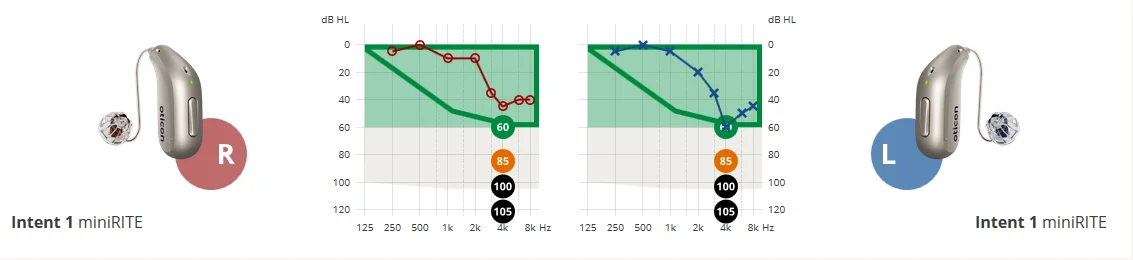
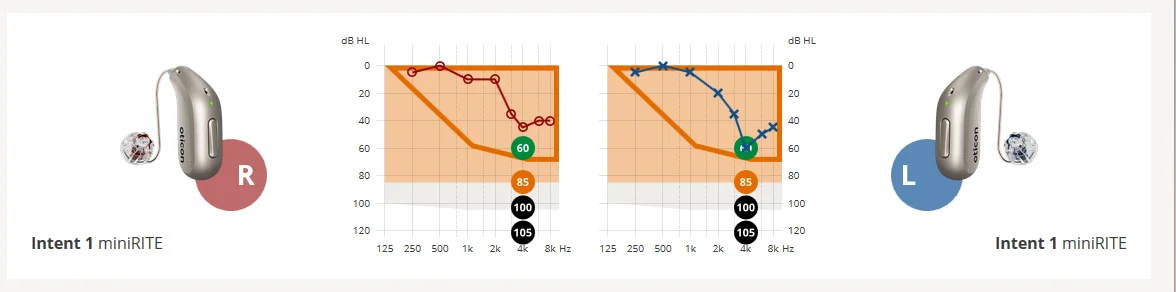
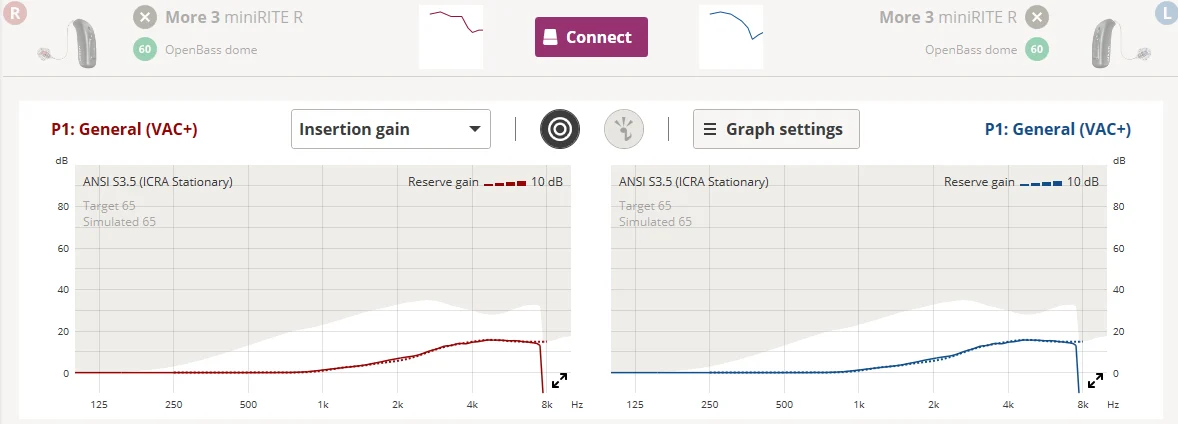
I ran the simulation in Genie 2 (the programming software).
The software recommends the 85dB receivers with OpenBass domes.
Below are the simulations for your for the 60dB and the 85dB.
EDIT: I just noticed you said the More and I ran the simulation with the Intent .I redid it with the More and the recommendation was the same.
My loss is stable last year. Measured 3 times last year. But my hearing issues started after a loud sound exposure 1 year ago. So I dont know how bad it was before.
I have also some mild hyperacusis. I have set the quite mild.
Is the 60dB receiver really pushed to its limit considering my loss? Wearing the bigger 85 to be future proof is not my preference due to wearing comfort. But if the 85 dB has other advantages over te 60dB (e.g. less floor noise or better sound quality?) , then I guess I must consider? I am now using the 85dB with the Bernafon Encanta 200. But the Oticon More 3 with the 60dB fits my hearing canal and ear much better. Also the metal housing of the More 3 is smaller.
I did notich some white / floor noise with the More 3. That is the reason why i am testing now the Bernafon Encanta 200, which does not produce white noise in quit rooms. But I think the More 3 should be adjusted differently. I like the More 3 much more considering wearing comfort. Too bad i dont have the Noahlink myself (yet).
Which of the 2 HA’s would you advise and use it with 85 or 60dB?
Which of the 2 HA’s would you advise and use it with 85 or 60dB?
You have excellent hearing out to about 2000 hz. Floor noise might be a problem for you with most aids. I believe the bigger receivers have more issues with floor noise but not sure. @Um_bongo might clear the air on this subject. He is one of our very helpful pros.
As far as which hearing aids to buy I can’t say one is better than the other. What I can say is the audiologist has more to do with which aid performs the best rather than the name brand of the aids.
Here are the simulation results for the 60dB receiver. The recommended gains, based on the fitting formula, are compatible with the 60dB specification.
I’ve heard that the default fitting formula in Oticon software tends to run low. I’m not very familiar with Oticon, but the values recommended at 4K do seem low. I’ll leave it to the experts to weigh in on this.
My take is that either would be fine. You might find one is better for you but your won’t determine which is better. If you have exceptionally small ear canals the 60 might be better or if floor noise is an issue (as mentioned by Raudrive. 85 gives you “headroom” for supposed “future proofing” but for devices that often don’t last for extended periods of time I don’t think it’s worth worrying about. When I started on the forum I asked if I should wear M or P receivers. (They’d given me Ms, but the higher frequencies of my audiogram didn’t fit in the fitting range) Many here authoritatively told me I needed the Ps. Some more experienced people said they were unlikely to benefit me. I’ve been in Ms for 9 years now.
Can you explain how to read the curve? I assume that the red curve is the dB output of the receiver, right? Why is the red curve not going higher then 18dB? My loss is much more in the high freq. range (50~60dB). I expected a compensation curve of the receiver close matching to the audigram? What do I not understand in the insertion gain graph?
So for a 65dB conversation, you’d get an output of 80-82 around 3 KHz. Which is bang in your residual dynamic range but not too loud that it would become fatiguing.
Noise floor can be an issue for some of these aids, you can try the 60 dB receiver.
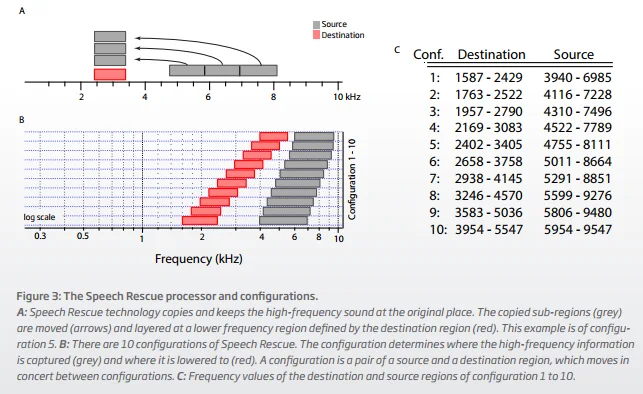
I’d also consider a small amount of frequency shifting to restore more of the 3-6KHz detail.
Only on the basis of whether it gives you more improvement. There is an argument that you can keep a more open fitting, but mitigate feedback risk by limiting a bit of the peak gain around 4KHz and reproduce the sounds an octave or so lower to keep the detail in the speech.
Question: Increasing the gain at a specific high frequency versus using a frequency shift—when is one method better than the other? Is it because too much gain can increase the risk of feedback, and using a more can cause uncomfortable occlusion? My audiologist set me up initially with frequency shift and the sound was terrible (specially music). TIA
That might seem a bit glib to say, but it’s not a one way street. Increasing the amount of sound transposition/compression works for some people (but not everyone) with sloping losses. There’s several factors to consider, especially the balance between venting and occlusion vs feedback. If the client finds the process adds more distortion than detail, you can back it off or remove it completely.
I wasn’t a fan of the early implementation of Sound Recover as it was a bit blunt in delivery; but more recently, I’m finding that given the right sloping loss, the right mental plasticity, motivation etc, the ability to drop the 3-6 KHz fricatives and plosives an octave down the response is helpful for some people. The ‘mix’ of sound could be questioned, but if it’s done properly, it should be like blending in (portions of) a slightly lower pitched voice with no delay, which the client can hear better
Part of my previous mental block in doing this was due to me not taking sufficient account of the degree to which the sound sensitivity/intensity changes over a 10dB per octave slope (SN). In absolute terms, the client probably notices a halving of intensity, but objectively, the scale tells us that they’re down to a quarter of both level and resolution. As a my new general rule of thumb, if a portion of the loss exceeds 10dB/octave (above 1KHz), I’ll certainly let the client try it.
If it doesn’t work, we just walk it back. I wouldn’t necessarily modify the venting, but using the frequency shift has some potential if the client finds the aid ‘fizzing’ certain words: where the feedback manager clips in and out on higher consonants in speech that need preserving.
I only have one question. Why start with old technology in the beginning. There is a reason there is newer technology.Intent is the latest and even the Real is newer than the More for Oticon.



 Texas Hill Country


 Wales, UK