
You’re ignoring this member’s posts.
What about China?
145 replies6.5k viewsLast reply

Am I the only guy here who learned on Cessna 150s? Hmph!
Actually, I spent more time with my father in his '55 Bonanza, and later his TravelAir when he upgraded, and I probably learned more from him than from my “real” instructors.
You’re ignoring this member’s posts.
The new Tesla Wall 2 at 13.5kw (I believe) costs around £5.5K here in the UK, I can buy 3 x Fogstar 48v 314ah 16.1kw smart batteries, that equates to 48.3kw, for the price of a single Tesla Wall 2,
I think you mean kWh (energy) when quoting the storage capacity of Tesla Powerwall 2 and Fogstar.
The Tesla Powerwall 2 is an older (and now recently recalled) battery with as you say 13.5 kWh storage but limited power output of 5.8kW. I am surprised they are still offering it in the UK. The newer Powerwall 3 has similar storage, much higher power output of 11.5kW and an integrated inverter.
The Fogstar 48V 16.1kWh specs, prices and warranty look great. What is the power output?
What is the process in the UK to get battery systems like these installed and grid connected?
Here in the US you have file a permit with detailed engineering specs for the complete system which have to be approved by the utility company and local city/county building departments and requires a full inspection once the system is installed and before the system can be operated.
The leading home storage battery companies in the US are Enphase, Tesla and Franklin. All 3 have the required UL electrical, construction, environmental, seismic and fire safety certifications that allow people to get permit/building code sign-off to get them installed.
What Certifications do the Fogstar units have, and what do you need to get them installed in the UK?
I am interested to see how it works in different countries. The process is complex and certainly adds cost here, but it should ensure that installed systems are safe for the users and the grid.
Back to the original topic. Yes Chinese engineering is excellent and improving. If they wanted to make hearing aids they certainly would have no problem designing and manufacturing very high end hearing aids.
As has been noted there is certainly a domestic market with the worlds largest and aging population and a growing middle class. So it is surprising that they haven’t.
With EVs they started with the domestic market, developed world class EVs which they are now exporting around world. They could do the same for hearing aids (albeit a much smaller market…)
You’re ignoring this member’s posts.

 BC
Am I the only guy here who learned on Cessna 150s
No. And anybody who doesn’t have a row of diamond dents in their forehead didn’t spend enough time at airports. 
You’re ignoring this member’s posts.
I think China lacks dedicated Customer Support and Service for specialized things like hearing aids. When you think about it, customers need to have hearing aids fine-tuned, adjusted, repaired, trouble-shooted, and China is not really set up for that kind of one-on-one interaction.
China is building superior infrastructure (high speed trains, a robust electrical grid with very high power transmission lines, solar farms in the high-altitude desert with stronger solar radiation, superfast fast charging networks, etc), best in class EVs, networking equipment, smart devices, consumer electronics etc
China has a large and growing middle class with money to spend - Chinese (and foreign) companies selling to these consumers need to and know how to support them exactly the same as the rest of the world.
You’re ignoring this member’s posts.

 Geneva, Switzerland
chinese engineering is generally superior
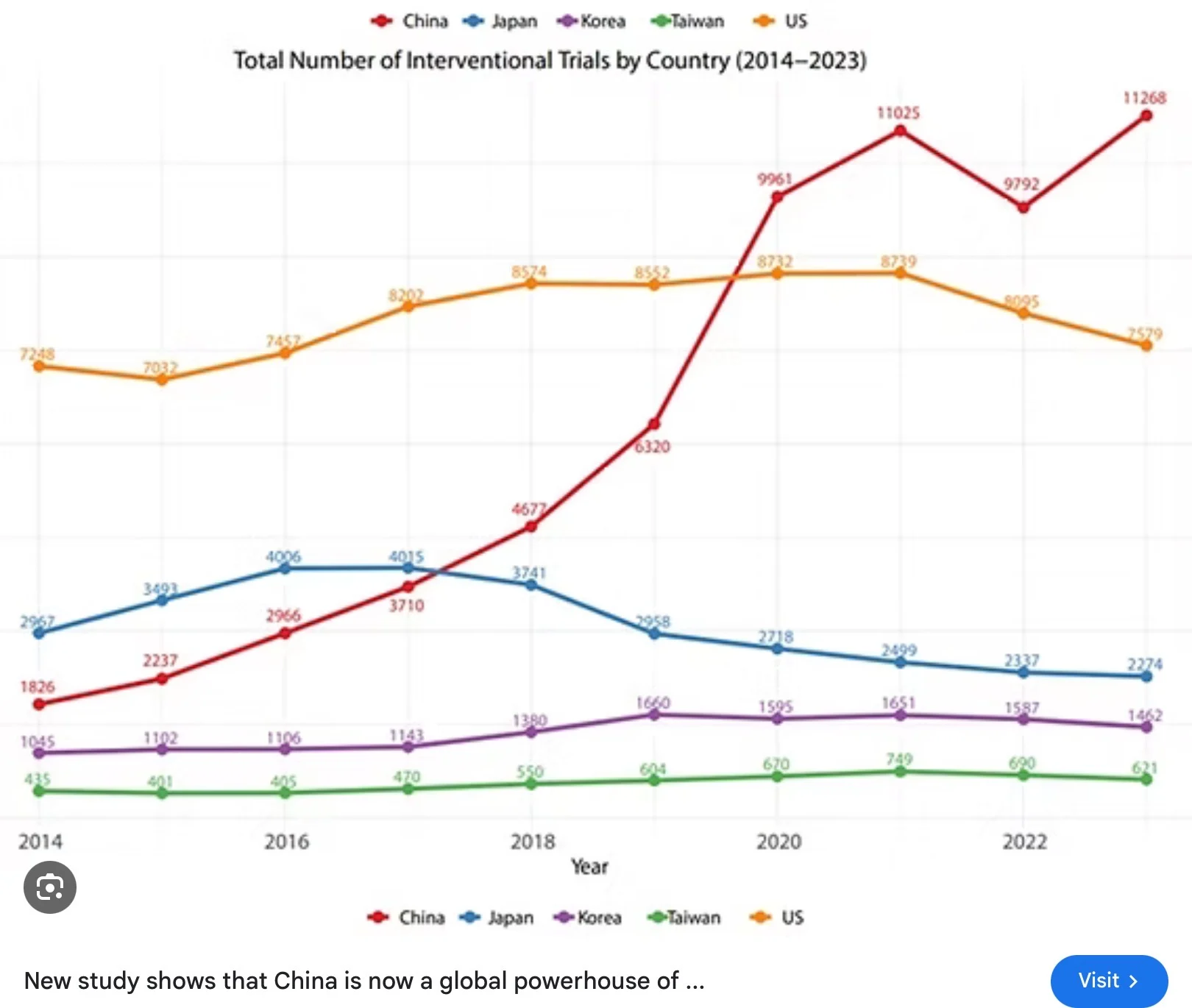
It is all still a bit odd- yes, China has absolutely brilliant engineers, but still falls (fell) short in biomedical research, medical devices and drug discovery. Concerns the latter it remained for ages in snake oil territory with their popular, medieval “traditional chinese medicine”, being slow to adopt robust Western evidence-based double-blind clinical trials. But this has dramatically changed in the past decade (see graph), and that is relevant, since conducting such trials is what makes this R&D so expensive- and these are no doubt far cheaper in China. High-end are to follow next- only a matter of time.
You’re ignoring this member’s posts.
Concerns the latter it remained for ages in snake oil territory with their popular, medieval “traditional chinese medicine”, being slow to adopt robust Western evidence-based double-blind clinical trials.
I am one of the first to ask for peer reviewed evidence supported data before accepting any clinical trial data and recommendations based on them.
Unfortunately the big pharmaceutical companies (Switzerland and the US we are looking at you) have tipped the (monetary) scales on some of the trials and unfortunately we seeing a little too much prescription of drugs in the west and less emphasis on telling patients that good diet, exercise and sensible life choices will help with a better quality of life.
Yes there are certainly conditions and diseases that need clinically proven drugs for a better outcome, and everyone should get their flu, Covid, RSV, shingles etc vaccines when recommended.
Traditional Chinese medicine predates the medieval period by a quite a bit and western medicine can still learn a thing or two from it.
You’re ignoring this member’s posts.
I think I saw a list of two dozen or so diseases that could be prevented or even cured by physical exercise. True, comprehensive healthcare ought to consider the complete picture rather than relying on (Big) Pharma, which plays by its own game rules. Then again- most people know that exercise is essential and smoking is bad- what can you do?
You are also right that there may be gems in chinese traditional medicine. The trouble is to separate the wheat from the chaff. One spectacular but little-known example is artemisinin, a new malaria drug that probably saved millions of African lives over the past decades. It was initially (re-) discovered based on a 3dC text on silk- but then went through trials run by Western NGOs. China can probably further dig into this resource.
You’re ignoring this member’s posts.

 Scottish Highlands
In reply to @coastal_california
Hello @coastal_california I believe, I was referring to the Tesla Wall 3, my apologies for that, I was indeed meaning kWh energy, these 48 volt Fogstar batteries are rated at 200 amps charge & discharge, in effect 190 amps according to my setup configurations… Fogstar also do a 32kwh battery, it is a heavy beast, 16 x 628ah cells, weighing around 200kg, each cell weighs 11.5kg each, they are also Grade A made by Eve… These Fogstar Batteries, are compatible with all the major inverters like Victron, they can be daisy chained in parallel… I have just set up my other solar system yesterday (I have 2 completely separate systems) I am just configuring it all, being dyslexic doesn’t help  but it is up and running!!! Cheers Kev

You’re ignoring this member’s posts.
these 48 volt Fogstar batteries are rated at 200 amps charge & discharge…
Sigh… I’ve been fantasizing about adding storage to our system (15 kW on our roof), but the numbers here just don’t support it. We pay basically the same price for electricity we buy at night (or when it’s cloudy) as we get from the electric company for what we upload to them when it’s sunny; the only difference is 18% VAT, which we pay them but they don’t pay us. So there’s almost zero economic case for us to add batteries to our system. Worse still, for safety reasons (which IMO are probably obsolete, but who asks me?) solar-panel owners here are not allowed to go into “island mode” - which means that even if the sun is shining brightly, if there’s a power outage our power goes out along with it. (So that’s another case for battery storage that doesn’t work for us.)
Hmph!
You’re ignoring this member’s posts.

 Wales, UK
To the original point. Given the amount of manufacturing in Suzhou, I’m sure there are fully functional Big 5 types of aids and very well made copies too. The domestic market is going to be huge and increasing in wealth/longevity. I don’t really think we’ve necessarily seen what they’ll be able to do in a few years.
Whether they’ll be able to dominate very well-established supply lines is another question.
You’re ignoring this member’s posts.
Hi @DonRadlauer
I have 2 separate systems, 4kwh of solar and a 5kwh grid tied inverter, it’s fairly old (13 years) but it still produces well, on a good day in spring it will produce around 28kwh per day, but probably averages around 20kwh, yearly yield is approximately 3500kwh, I believe? The second new system, is totally separate, 6kwh of 2 strings 250v 13 amps DC solar, 500wh PV’s 42v x 14amps, at exactly the same orientation (due south), no shadowing, 8kwh hybrid inverter, grid tied, but I will eventually run this with UPS mode activated, with all my essential loads on a backup consumer unit, and totally separate from the main consumer unit, this will be running off the UPS permanently, this effectively means that any power outages, will not effect me greatly, switchover to UPS during a power cut, will be approximately 4 mili-seconds, you can’t blink that quick! It also means my 6kw solar system is still running to charge the batteries when the UPS kicks in… Cheers Kev 
Edit; Plus 2 x 48v 16.1kwh batteries, giving me 32kwh of battery storage, I will probably add a 3rd battery next year, making it 48kwh… Cheers Kev
You’re ignoring this member’s posts.
A bit sad we are discussing China here in absence of people (it seems) who actually work and live in the place. Somewhat like a gathering of biologists who are admiringly discussing and investigating the inner workings of a busy anthill. Is this forum also blocked by the country’s Big Firewall (along with those rabid authors of the Wikipedia and all else that makes the Interweb sometimes bearable)?
You’re ignoring this member’s posts.

In reply to @coastal_california
China has a large and growing middle class with money to spend - Chinese (and foreign) companies selling to these consumers need to and know how to support them exactly the same as the rest of the world.
I have never been to China, and you are correct in saying this is a HUGE population - so surely there must be a percentage in need of hearing devices. If you submit a query for “customer support for hearing aids in China” there are a lot of links via search engines to Chinese manufacturing of aids, or OEM providers. But ask for “hearing aid dispensaries in China” and there is a paucity of actual clinics there where a customer could have a hearing test, referral from on what make/model to buy, but most important, a clinic that offers follow-on visits for setting up programs and fine-tuning of the aids to say nothing of what accessories (remote mic, etc.,) would be compatible.
It’s not that China is not capable of making aids - FAR more cost-effective than other locations - but it’s the customer/clinician interraction I don’t see much evidence of.
I also made perhaps an oblique assumption based on the reality for hearing aid service/support in India, and that is a place I have greater familiarity with, having been there dozens of times staying with my in-laws over 30+ years in New Delhi and Chandigarh. Despite India’s ENORMOUS population and millions being in need of aids, there were just a couple clinics where my folks could even get a fitting. These were invariably located up (or down) a long flight of concrete stairs in poorly-lit stairwells to get to a tiny office. Hours were spotty, technicians just getting up-to-speed themselves, and it was quite stunning to me how utterly sub-optimal the entire process was there clear up to 2017, my last trip there.
I’ve always believed that the follow-on relationship with one’s dispenser or AuD is what counts after the purchase of hearing aids, cuz they are instrumental in setting the device up - especially given the fact that many seniors like my in-laws were not tech-savvy or comfortable installing and using Target software, f’instance to get to an optimal set-up.
I don’t see any evidence of the one-on-one hearing help in China. Can’t be done over a phone, has to be done in person with convenient location, highly skilled fitter, and many repeat visits. Would love to be proved wrong here, cuz China - like India - poses humongous potential.
You’re ignoring this member’s posts.
A bit sad we are discussing China here in absence of people (it seems) who actually work and live in the place.
I think it’s okay to post even an uninformed opinion and then be corrected right here. I admit I have never been to China and rely on search engines to see what the state of hearing aid clinics and dispensaries is like there. Clearly not the same as walking the walk like folks who live there and have to find hearing solutions for their day-to-day life.
You’re ignoring this member’s posts.
At least 1 in 7 will have some form of hearing loss in China @1Bluejay probably 1 in 5 in the older age groups like us old foggies  So there will be around 200 million Chinese with a hearing loss, say half of those would benefit from hearing aids, that’s around 100 million, half of the 100 million will have a moderate to severe loss, around 5 to 10% will be in the profound thresholds, those eye watering numbers, will require significant resources, the prices I saw for hearing aids a few years back, we’re around a quarter of what we pay in the west, but still a significant outlay, for many Chinese, much depends on how good a job you have… Cheers Kev
You’re ignoring this member’s posts.
The over 65s only make up 15% the total population.
Even though it’s a massive base, I’m not sure how high priority hearing healthcare is: or how well they are served by the domestic market.
You’re ignoring this member’s posts.
I’m not sure how high priority hearing healthcare is: or how well they are served by the domestic market.
That is the thing! It seems that everyone with vision issues gets a pair of Rx glasses with no problem. But somehow, us folks who need to HEAR are either considered too dumb, not worth the effort or marginalized for some odd reason. Hearing is critical like eyesight, and I simply don’t know why there is such negative halo and bias against helping us.
Another case in point: insurance companies that offer assistance with drug, alchohol, weight or mental conditions, but again, SO LITTLE help for us with hearing disability. If you want to drive me to drink, drugs, weight gain and insanity, just tell me I’m on my OWN for addressing my HEARING issues cuz they simply don’t matter like the other conditions.

You’re ignoring this member’s posts.

arydantMinnetonka MN
Be careful. The CCP is best at propaganda and censorship. You will only see glowing reviews of anything out of China.
You’re ignoring this member’s posts.
WRT China, it may well be that the concept of getting electronic assistance via hearing aids for deafness is not well established as a norm among the population - this would account for low levels of domestic manufacture.
You’re ignoring this member’s posts.
Log in to reply to this topic.
Related discussions
Hearing Aids3 replies
Hearing Aids16 replies
Hearing Aids8 replies
Fitting Software Requests1.1k replies
Hearing Aid Self-Fitting (DIY)302 replies