You’re ignoring this member’s posts.
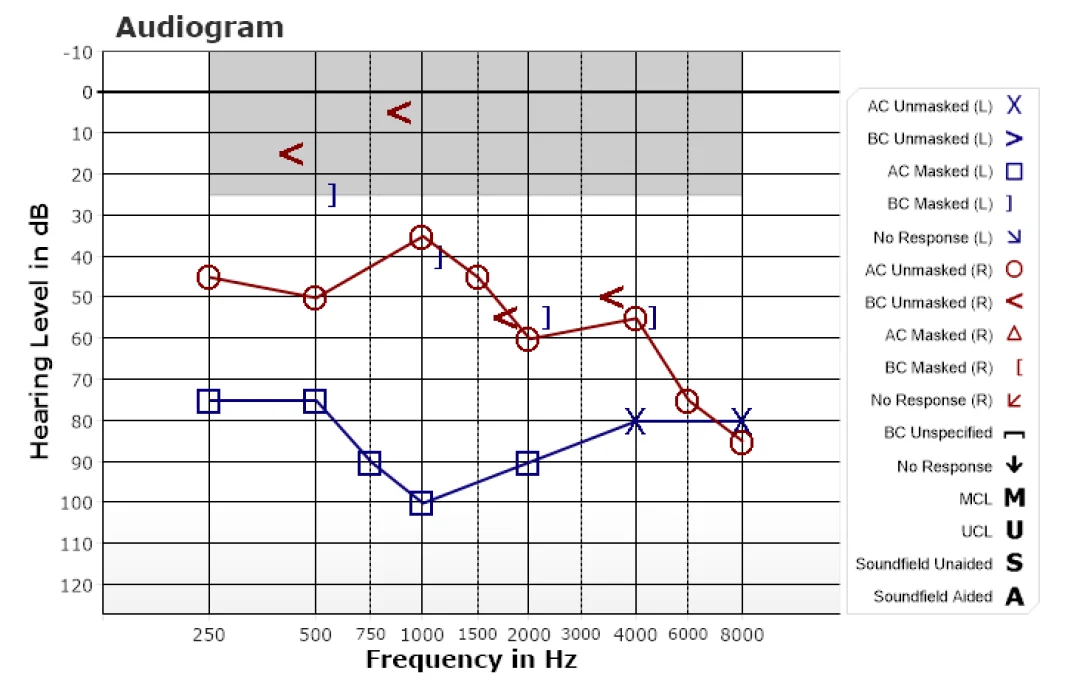
Audiogram 11-05-25 (mm-dd-yy)
7 replies253 viewsLast reply
Good!! I believe that everyone here needs to do this. Especially if asking for assistance or feedback.
You’re ignoring this member’s posts.
 Wales, UK
That’s incomplete. Where’s the masked left ?
Nobody can prescribe a left aid using that as you can’t tell the size the conductive portion.
You’re ignoring this member’s posts.
For some reason my audiologists usually measure on only one side. Should they being measuring both sides for everyone or is it something about this OP specifically that warrants checking both - the assymetry perhaps?
You’re ignoring this member’s posts.
I’m very new to this so - from what I’m seeing on this …
Air conduction for both ears are test (masked/unmasked). Bone conduction is measured for both ears BUT the left ear is closer to the right ears results. This person has a hole in their left ear drum (from a sickness when they were a teenager).
But what this means for a left hearing aid? Currently using a custom mold on the left ear (vent on that is 0.9-1.1mm - according to phonak target from the acoustic code). Right ear uses open dome.
You’re ignoring this member’s posts.
should be within 10dB of the . If it’s greater than 10dB difference, the non-test ear should have narrowband masking applied.
In this , it would make sense to mask both the left and right for 500Hz to ensure that the correct side is responding as potentially the gap between bone and air on the right is actually from the left side picking up the sound. Really, same could be said for 1000Hz to be thorough and it barely takes any more time.
Also would be nice to know what of masking was applied because it’s easy to make a mistake and not apply enough masking. And would be nice to know inserts vs headphones. Then things like, word recognition scores - individual and dichotic - and dB it was tested at, and whether it was properly masked (individual scores).
You’re ignoring this member’s posts.
The assumption would usually made that the shown ‘usually’ belongs to the better ear as the air-bone gap is slightly too large (max 40ish ) for it to belong to the left. What you can’t tell from that is the extent of the conductive loss in the worst ear.
If the loss on the right is mainly conductive at 80dB (air), it’s going to need 40dB of gain, if the loss is mainly SN, it’s going to need circa 26dB. That’s got big ramifications for the coupling and venting prescription too. Also, the manufacturer’s initial prescription will assume the LHS is an SN loss and massively under prescribe it.
Looking at the chart, I’ll hazard a guess that both ears have a significant mixed portion within them. That’s a guess, but one the software can’t make. Also, your target is likely to be way off on the left.
You’re ignoring this member’s posts.

You’re ignoring this member’s posts.
Log in to reply to this topic.
Active discussions
What the forum has been talking about this week.
Uncategorized452 replies
Fitting Software Requests514 replies
Hearing Aids106 replies
Fitting Software Requests1.1k replies
Hearing Aid Self-Fitting (DIY)302 replies