I have read and heard repeatedly that real ear measurement () is important, some may add, extremely important. My question, just how important? I understand the theory I think, but in terms of what really happens in the clinic, is their usually a perceived difference by the patient after adjustments are made following the REM?
My question is prompted by my recent purchase and use of Apple Air Pods Pro 3 which I find adequate for my needs excepting in noisy environments, but neither are my Oticon Real 3 , fitted with REM. (I do admit the Oticons do perform better overall.)
I realize that professional audiologists have a vested interest in emphasizing REM. But from reading contributions to this forum, it appears even many audiologists do not perform REM.
You’re ignoring this member’s posts.
NBUP22 people in this conversation39 min readJump to latest↓
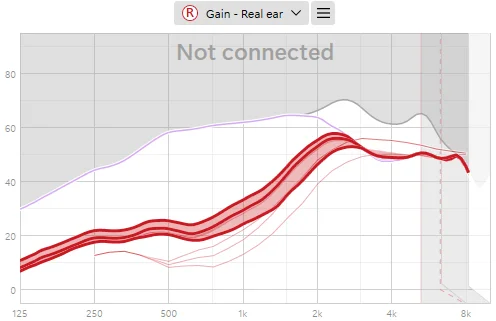
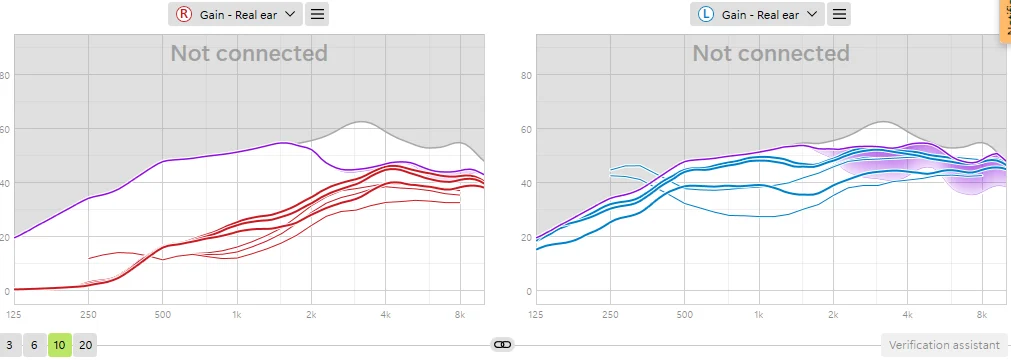
I can look at my last couple of patients and show you how far off of software gain suggestions I had to go to hit true targets on real-ear, if that helps. There’s a lot of individual variability though. I’m not actually sure professionals do have a “vested” interest in promoting considering how many do not do it.
Here, the solid lines are where the gain was set to hit targets, the softer lines are where the software put things.
is measuring if the aids are delivering sound at your prescription level!
To me that is pivotal in any setup & an aud that doesn’t appreciate that is not worth paying for!
The only measurement you “can take to the bank” is the initial threshold test.
An should be conducted THAT first visit using a generic mushroom. THEN an REM on delivery of your hearing aids would mean that store has delivered a correction for your loss.
It is wrong to believe the REM is aimed to deliver a flat frequency curve. Various factors change the tone in its passage to your ear drum and then after your ear drum, your meat-system has a lot to say about how it sounds and how well you can discern women’s (treble) voices. You can see that for yourself since the target result is a generic curve, not a flat line. If you are tested on Day One, the curve is for your ears and not generic.
But as any HiFi fan who has tested their loudspeakers can tell you, that is just the start of turning for your satisfaction.
Well, I’ve been following these post on very carefully, and I’ve been wanting to find the answer to the question that Portage asked also. I read that only about 30% of clinics do it.I
It seems that the majority of posts say YES.
But yet, the question remains: Can we function o.k. with it? That answer is also YES.
However, more and more companies advertise remote adjustments and are supposedly offered to give access to a professional audiology team and allow users to fine tune their hearing aids without needing to visit a clinic. For example Jabra Enhance Select 700, and Elehear support this capability.
At my age this is very advantageous and enticing. In light of traveling expenses, getting appointments, and age related health issues, having the knowledge my aids to work their best, or close to it, without leaving my couch is comforting.
… and the target curve is different depending on how loud the sound is. Specifically, bass sounds diminish as the sound gets softer. So proper correction would have bass boosted for softer sounds. If you turn down the volume on your radio late at night, the cello in a string quartet will start to disappear relative to the other instruments.
As I said, the paired tests just establish the hearing aids are boosting as intended. Then the personal tuning can begin.
At my age this is very advantageous and enticing. In light of traveling expenses, getting appointments, and age related health issues, having the knowledge my aids to work their best, or close to it, without leaving my couch is comforting.
Yep this is why we have , very popular now for just this reason.
This debate is becoming tiring like the posts. Can we stop these because there is no legitimate debate. Go ask the supposed 70% of providers who do not do (it may be 70% of providers but not 70% of customer volume given Costco//many others do REM) whether their professional organizations advise that it is best practices to skip REM. This 70% number is promoted to support lesser care. Why not pick better care with one’s dollars.
Why anyone would argue for skipping a step that could help them, is harmless, and costs little is puzzling. It’s not perfect and further adjustments may be needed. Dedicated DIYers and skilled fitters may happen upon a better fit with time and care, possibly due to idiosyncratic aspects of the wearer versus the fitting formula. On aggregate REM is superior to no REM and that is why it is recommended. Of course poorly done REM leads to a poor fit but that just means the provider is not good not that REM is an unnecessary step. Or it means the patient has a complexity that may limit the benefits of aids or just needs longer to adapt. As more informed consumers here many already understand these issues. Search probably adds as much as can be said until there are further studies showing us REM is not needed.
REM is not a once and done tool. It needs to be redone when changes occur to the hearing loss and fitting prescription or acoustic coupling (dome, mold, etc.). Some will argue about how significant the change must be to require REM. Again it would take maybe minutes to check so why not be sure.
Can one function without it is a low bar. If DIYing maybe. If paying why would one want lesser care and not to know the amplification is on meeting targets which may help one hear better.
There are some who live very far from a provider who offers REM. Those patients are stuck with inconvenience or lesser care. It does not change best practices. Rural care is often lesser in access and quality. Same for some countries versus others.
At the risk of becoming tiresome, I would like to add something to the discussion. First: Assertion of fact is not demonstration of fact. Second: Argument from authority, medical or not, absent proof is not convincing evidence. Third: That which can be easily measured does not demonstrate the importance of what is measured.
Audiology is a profession, as such it is expected to rely on scientific evidence. The question I have is whether real ear measurement () has been part of a well designed study with two groups: one group fitted with hearing aids using REM, the other group fitted without REM. I would think that an important criterion would be comparison of word recognition scores between the two groups. No doubt the study would be expensive and time consuming.
Maybe there has been such a study? I don’t know. The mantra of “REM is important” cannot stand solely on its repetition.
Over the counter hearing aids approved by the are less than five years old. They are a small segment of the market, but will likely not remain so. As remote fitting of hearing aids becomes more sophisticated it seems to me the relevance of REM will be put into further question.
he question I have is whether real ear measurement (REM) has been part of a well designed study with two groups
Yes , this has been done by several authors but a gold standard study has not been done AFAIK. It is not just only about comparing two groups but: are the size of those groups statistically significant and cover the necessary variables required to create an accepted clinical stardard? This is a very large and expensive project and so far , I’ve seen conflicting results in the pubs I’ve read.
If we had a gold standard , there wouldn’t be so many discussions about it. For decades the standard hearing test uses pure tones in a sound free box . Is this the best representation of a real world situation? Or why two formulas ( or NAL-NAx) can cover all the types of hearing loss in all situations ? All does is verify the prescribed gains reach the eardrum but how “exact” are the fitting formulas and the pure tone tests ? These may be reasons why fittings can require multiple adjustments .
A fitter may say : why spend $$$ on REM equipment when the patient is going to come back so many times for adjustments (or maybe the fitter wants the patient to come back more times ).
I’m not making any statements but trying to see this from a broader perspective .
The link below shows one critical trial. At the
end of the page there are some publications .
@OcramSagev Thank you for that reference. Quoting from the document: “… evidence which would clearly show that based hearing aid fitting (which is time-consuming) is clinically relevant and cost effective is lacking, and thus warrants further study.”
I’ve read other studies that say it is relevant hence my comment about the gold standard .
The important is that people understand what it is: it’s a tool the fitter can use to make the aids more effective. How much more effective? I have no clue
That’s a selected quote without full context. It’s from a study plan and carries no academic weight. The article may be out soon if the study is running on schedule.
Most patients in the US do not need to pay more for . One could pay less at Costco. Or pick another provider. Cost is not the best measure in this context anyway as the cost is a fraction of the cost of aids.
National health systems are cost conscious and some use REM (e.g., folks here say UK).
You do not get “lesser care” just because isn’t done, it’s just another tool in the box, the reason most don’t bother is because they know it doesn’t guarantee a good fit, REM hasn’t got a clue nor the Audiologist as to what or how the client likes to hear, there’s no way the is gonna do REM every single time they make additional adjustments to try and get things sounding “ok” for the client, this is why works so well for most people.
If you’re not going to bother with REM why would you bother with audiograms and those pesky fitting formulas in the first place?
It’s impossible to fit without the “Best practice” using the manufacturers software, so they decided that “best practices” was compulsory audogram and a fitting formula, they deliberately left out what they didn’t think was part of “Best Practice” REM, if it really was as important then they would off made that part of the fitting “compulsory” as in- no fitting without this step being entered.
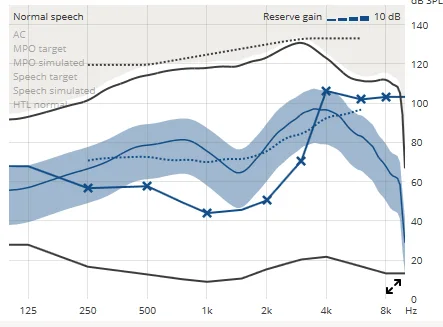
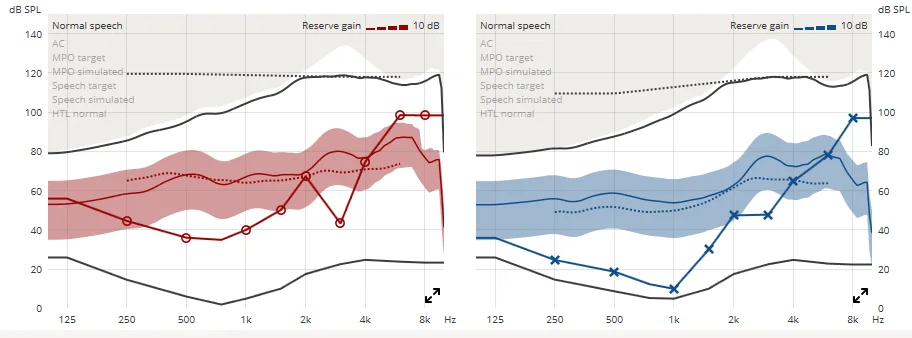
My audiologist uses to verify that my aids do what they are supposed to. Then the real adjustments start so I can understand speech. After my aids are adjusted so I have optimal speech understanding the curves never match the REM or my . Why? I have dead frequencies or worst or better frequencies in between the hearing exam frequencies that are normally checked. This made my speech understanding very bad for almost a decade of wearing aids. I am a retired IT professional/electronics engineer so I did my on hearing test in much smaller frequency increments. I actually took my signal generator to my VA clinic and showed my audiologist what I discovered. To compensate my aids use receivers more powerful than my audiogram would normally suggest. But I can understand speech much better.
REM is important but if my aids were just adjusted by REM I couldn’t understand speech much better than without my aids.
It’s a fair question. I don’t have time at the moment to construct something smooth and coherent, but I’d suggest a couple of things.
-The audiology research community is small and resources for research is limited and definitely doesn’t progress as quickly as one might like.
-There are a couple of adult studies showing benefits of real-ear (e.g. Comparison of Performance with Hearing Aid programmed to First-Fit and Optimized Fit - PubMed2 , Differences in Word and Phoneme Recognition in Quiet, Sentence Recognition in Noise, and Subjective Outcomes between Manufacturer First-Fit and Hearing Aids Programmed to NAL-NL2 Using Real-Ear Measures - PubMed4 ) but there is also consideration that as manufacturer first fits get better at meeting targets from the get go, which they certainly have done, benefits of will be reduced again. However, particularly for cases with less average ear canal acoustics I don’t think we’re at the point yet where the manufacturer software can really reliably judge and completely adjust for the fit–some manufacturers seem to be better at this than others. But even when they get good at this, manufaccturers will always have an interest in an acceptable first fit in so far as they are not there to cheerlead the patient into neural adaptation.
-In pediatrics, McCreery has done some nice work showing that children who are closer to prescriptive targets have significantly better language outcomes. Does this apply to adults who are post ligual? Certainly less, but as they progress into older age and experience cognitive changes, perhaps more again.
-What exactly do we mean by “worth the cost”? Research has shown that real-ear verification reduces follow-up appointments for patients, which saves time and money and aggravation on both sides. Our clinic does not “charge extra” for REM, it is just part of our standard of practice and we would like to think that in the long run it actually saves us money because it increases how quickly we get to an optimal fit and how easily we can troubleshoot problems. Clinics who don’t use it can maybe churn through fits faster and therefore lower their prices? Not actually if they require more follow-ups, but perhaps if they are the sort of clinic that isn’t very responsive to these sorts of follow-up appointments. But maybe more predatory clinics (who in my experience often do not do REM) will simply charge whatever the market can bear. It’s sort of fuzzy. I do know that there are clinics who don’t use REM as standard and charge a fee for it, but I find that quite bizarre. Part of the skills you aquire when using REM as a tool come from you doing it day-in-and-day-out.
-Some patients want to optimize and some don’t. If 80% of people can get 80% of the benefit is that good enough for you?
-Your brain cannot process what it literally cannot hear, and I am constantly amazed at the patients who come to me from outside clinics with hearing aids that give them 50% of the audibility that they could have and the patient simply doesn’t know (nor does the other clinician, really) and has been counselled on hearing aid limitations.
-I know a number of people who work doing audiological research for manufacturers, and when they are doing it they use REM to make sure that the on-ear gain is actually what they want it to be.
As for hearing aids and the importance of a precise fit, I’ve just reached a point where my 20/20 vision has slipped from perfect. Should I get prescribed glasses or readers or just go without for a while longer? I’m not sure it’s actually a related question because the visual system is not as plastic as the auditory system and I’m not sure what the visual correllary to loss of speech in noise skill would be, or whether there are detrimental changes in the brain if I deprive myself of clear vision within 9 inches from my nose. It’s just the decision I’m making right now. I also think that people are better at assessing whether their own vision loss is “mild” compared to people assessing their own hearing loss as “mild”
I appreciate all the comments provided. There is room for disagreement!
The one paper referenced by @Neville states that “70-80 % of audiologists do not routinely use when fitting hearing aids.”
Whatever else that can be said, I think this quote from Hamlet may be appropriate.
“…it is a custom more honored in the breach than the obervance”
Yes, it’s a interestingly huge case of clinical inertia. Similar to, say, doctors still overprescribing antibiotics and PPIs. But I think that the stats are also a bit out-dated and different regions will be different. Here in Ontario, among audiologists, I’d guess that it is at least over 50% if not higher. 100% of Ontario pediatric audiologists are using real-ear measures.


 Roanoke, Va.