The appropriate REM-like procedure is to compare the REM curve after delivery with the REM curve before you get your aids BUT using a generic mushroom or other replica of your choice of aid
I may not understand what you are trying to say but the way this comes off is completely incorrect. doesn’t set any curves. That is not how it works or what it’s for.
Whatever else is doing, it is implicitly producing a frequency curve. If you were exposed to a perfectly flat loudspeaker producing sound, the REM frequency curve would not be flat because there are many influences on the path from the sound reaching your head to the REM microphone (including your pinna and resonances in your ear canal).
Therefore, the only way to assess by REM is your new hearing aid is boosting according to the intentions of your audiologist, is to compare “before” and “after”. The “after” is obviously with your hearing aid in your ear. Therefore, the “before” must be done with an inoperative mushroom dummy or in-the-canal dummy.
Those remarks relate to the boost of frequencies (especially higher frequencies) as based on the initial threshold and related measurements. As cvkemp pointed out, good hearing and satisfaction in daily wearing are definitely not simply a matter of proper boosting. (So I would conclude that REM adds so little information and might even be deceptive, it is hardly worth the effort, assuming the factory setting wasn’t made on a Monday by a hung-over technician).
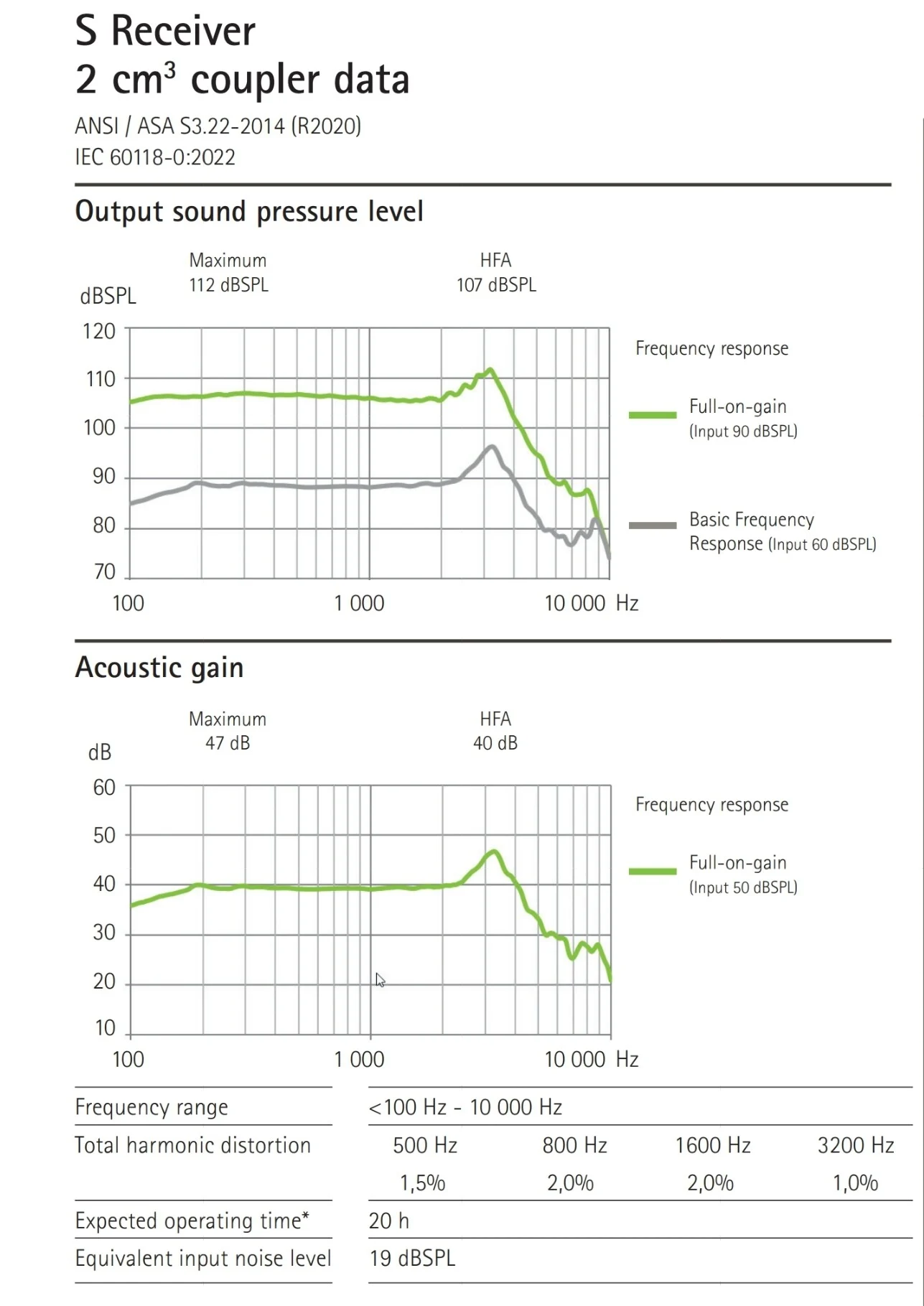
It is totally crummy that distortion is not assessed, I feel. Anybody ever seen harmonic-distortion specs for their hearing aid? (OK, maybe tricky since the manipulations inside a hearing aid make HD assessment problematic.)
I largely don’t understand what you are trying to say in regards to , but warble tones underestimate thresholds in sloping losses due to side frequency hearing. What makes you think they are more appropriate than pure tones?
A variety of factors influence the loudness of a test tone on its way to your ear drums from a loudspeaker and a bunch more when using your aids. But the influence varies note by note according to the acoustics of your room and your head and which way your ears are pointing, etc. If using aids, the idiosyncrasies of the aid microphone (for the moment, ignore the operations of the aids).
So just like owning a diversity of equities in the stock market, you want some diversity in each test tone, in other words, instead of testing using a pure tone of 500 Hz which has certain influences, you use something that rapidly warbles between 450-550.
You would be correct if you conducted the before and after as I described earlier. But be working incorrectly if you are comparing initial human tests with the measurement you described.
I suspect the is a cooked curve which takes into account the canal resonance, etc., not just taken at face value (the electric signal from the REM mic) as the criterion of performance.
BTW, it is naive to equate the physical impingement of the eardrum (or the signal of REM mic) with the experience of hearing.
Sorry, I find what you say largely unclear and I’m not sure whether it is because you are unclear about what you are talking about or just communicating unclearly. The measure is indeed converted to an at-the-eardrum measure using the individually measured , and then the results of are again collected at the eardrum. You seem to be suggesting that an initial measurement needs to be made with the ear plugged by an inopperative hearing aid, but I’m not sure why. Certainly you can measure insertion loss, but it is already compensated for by virtue of the hearing aid being present in your ear when adjusting to prescriptive targets.
I cannot interpret your last sentence. Either you meant something other than “impingment” or you might want to check the definition of that word. I wonder if there is a language divide here that is making things difficult.
Sorry, I still don’t understand how that answer relates to your point about the only way to assess is to compare before and after where before involves an inoperative mushroom dummy. I’m trying to engage man, but I’m getting the idea that you don’t really know what you are talking about.
I’m curious about your comment regarding though. Do you actually measure RECD?
Out of my limited sample size of 4 clinics that did , none actually measured RECD. Maybe the predicted values are typically good enough to justify taking a shortcut?
Also, I think I need to read up on RECD and how it fits into the larger context - I don’t fully understand its purpose.
It’s used to fit comparatively, mainly with paediatric fittings.
When you’ve got the measure, you can tune any hearing aid away from the client and fit when convenient based on canal volume. It doesn’t necessarily take account of dynamic impedance changes of the canal either.
Yes. With pediatrics we measure very frequently as they grow, as well as frequently with middle ear changes or tubes. Just constantly, really. It also helps us to know what is a real change in hearing rather than something that looks like a change but is actually ust ear canal growth. With adults we measure on new fits or with significant weight change that would require a new custom tip (i.e. as sometimes happens with illness), or with any new perforations. But adult ears don’t grow quickly, so we don’t measure it frequently. The average RECD is okay for average ear canals. Small women will be over fit and big men underfit (or vice versa, but that’s the pattern).
Ignoring your rudeness, is a measurement to confirm that the folks in the factory and audiology office actually did follow their instructions. Seems wasteful given the value of everybody’s time. But to do so, you need a proper “before” measurement to compare it to (and maybe using a sweep or warble tones).
REM does not establish that the settings of the aids are reasonably on target. That is because the REM curve is contrived: that’s because a flat frequency curve at the ear drum does not correspond to a flat perception (human perception) curve. And it certainly doesn’t have much to say about user satisfaction (for example, reducing the big boost on the highest frequencies if the big boost is giving you headaches without helping treble speech or if the mushroom integration fosters or hinders listening to classical music).
Returning to the core of this thread, when aids are delivered, the user should be given ADEQUATE testing on their performance in human ears…. probably a week later.
Do all audiologists know what they are doing? In my case, the audiologist asked me how I like the sound of her voice. She was newly arrived from a language ethnicity very different from mine in a reverberant room with zero acoustic refinement. On that basis, she expected me to comment.
Being able to hear the hiss of the toilet tank filling with water is my favourite criterion. But in a dispensing office, there should be some kind of set-up and collection of stimuli to capture the pragmatic aims of hearing performance.
Like in any field some are better and some are worse. But first language and ethnicity isn’t a marker of whether someone does or doesn’t know what they are doing.
@Bentoronto, are you aware that the probes that are dangling from the patients ears have two microphones each?
One is the reference microphone which is professionally calibrated and measures the sound outside the ear. The other one is the probe tube microphone. The latter gets calibrated against the reference microphone every time a new probe tube gets attached. It’s pretty straightforward and I don’t see any logical gap that would prevent meaningful measurements.
Aside from that, what makes you think that being a professional in another field makes you an expert in audiology as well?

 Texas Hill Country


 Wales, UK