My sons have been trying to get me to use an app on my iPad. I finally did yesterday asking three apps to tell me the best hearing aids in 2026. All three produced a list of recommendations. Only Gemini went into researching 74 sources and not only told me the best, but also discussed items like neural processing and dual chip architectures, which I had not understood. In an 11 page printable paper of different hearing aids, both professionally prescribed and over the counter hearing aids. It offered both the strengths and weaknesses of the different brands. All three AI apps picked the same brand and model as the best. I am not going to reveal its conclusion, but I am encouraging all members to get onto a computer PC or MAC or mobile device, use Google’s Gemini and ask, “Best hearing aids.”
@Bonaprof Thanks for that. Off topic inquiry: I am intrigued by your nom de plume. If I may ask, are (were) you a professor at a college in the Northeast? Somehow I’ m thinking snow and rolling hills!
What a waste of power and other resources. A simple search here, in a search engine, or of ratings area here would probably give the same answer. reads these sources but you could too. It is a probabilistic guess but it will not be right for everyone, accessible to everyone, affordable for everyone, etc.
The problem is that the answer depends on (among other things ):
1.- The quality and details of the question : best hearing aid for what? Profound loss ? Performance in noise ? Battery life? Is the sound natural ? Warranty terms? Bluetooth performance ?
2.- The sources used to get the answers: user comments ? Audiologists reviews?
Manufacturers marketing materials ? How does the AI tool determine what sources are reliable or not ?
3.- people have different preferences for sound profiles , live lifestyles, different and different needs. For example , a Phonak sphere for a senior who is mostly at home and does not frequent loud environments is an overkill , specially if the persons budget is tight.
So no , I think AI can be misleading and does not replace a clinical recommendation . Would you buy a car just based on an AI recommendation ?
In a way LLMs present a new source of seemingly custom ratings. People do buy things including cars based upon ratings. They buy things based upon audiologist and salesman and magazine and friend recommendations. These can all be wrong or at least suboptimal for the reasons you note. One would hope with cars people would at least test drive but many have decided before they shop and barely pay attention on the short drive (or even price).
Ask a Phonak selling audiologist if one should buy Sphere and they may reinforce one’s yes please even if a cheaper option could get the job done too. At least the audiologist should consider whether the patient needs a which the LLM decided was probabilistically less likely. The audiologist should ask many standard questions which may help them see the Sphere would not be best for a particular patient.
The audiologist should ask many standard questions which may help them see the Sphere would not be best for a particular patient.
This — like a good clinician , ask all the necessary questions before making a diagnostic . The answer is going to be as good as the questions and information available.
I’m not against the use of as long as the user understands the limitations of the answers provided.
Buying based on or even customer reviews is always gonna be flawed, only a genuine trial of the HAs is going to find the “best” one for any one individual, mate it’s why we have so many to choose from, cars, phones, TVs etc you need to do the hard yards to find the one you like, anything else is just “hearsay”
The biggest concern I have with is that people feel it offers “godlike” answers to “big”, sweeping questions, and do not see it as the interweb’s echo chamber (that it really is). Being eloquent offers no protection from the “garbage-in-garbage-out” law.
Call me old-fashioned, but I still use Google to help me find and read the original sources so I can assess them for quality and pertinence myself.
Some LLM use may be driven by search becoming worse and information dropping off the web or being locked in closed ecosystems such as Facebook. People want easy answers and are not going to bother to figure out what is accurate anyway. There’s a wrong notion that everything is online and can be located but search has been tailored to the use for a long time. LLMs further this unique experience and expand blindspots.
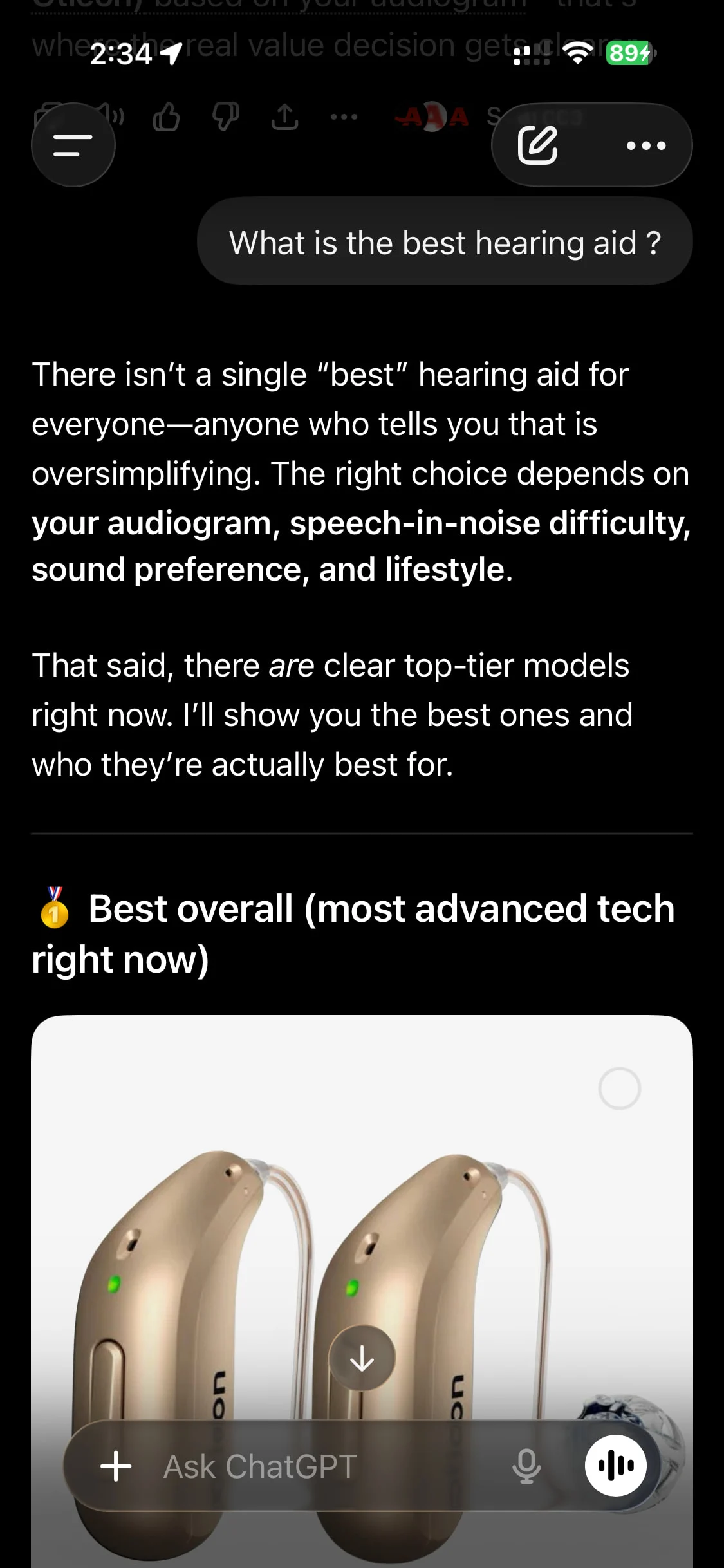
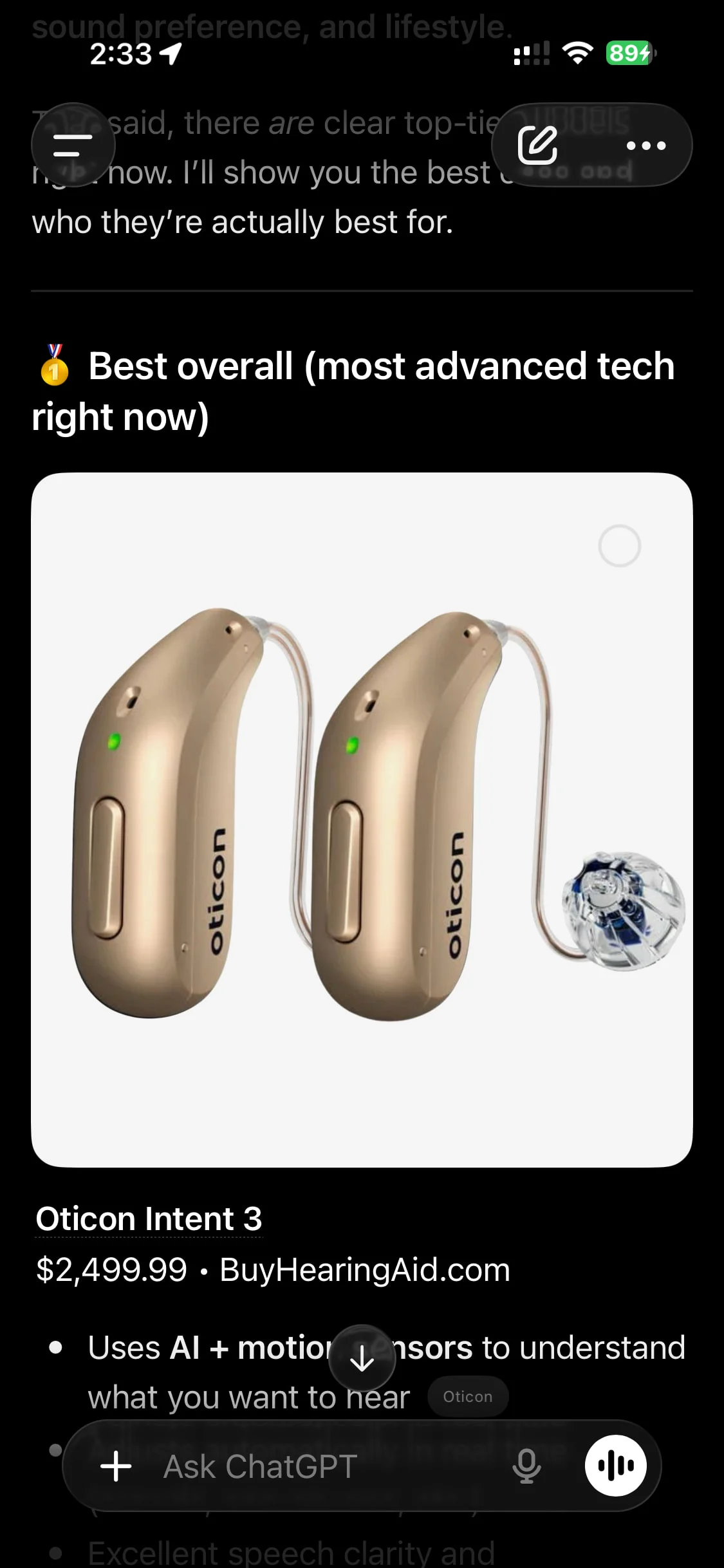
I was curious so I asked ChatGPT “what is the best hearing aid?” . People say “ a picture is worth a thousand words “ . So yeah , the oticon intent 3 is the best hearing aid ( laughing )
I tried and got Sphere (then Real 1 for natural sounds) citing this site. Then asked again and got non-Sphere followed by Real 1. It has not trained on the Fortell materials yet.
The LLMs summarize the results of what a search would find. They are not trained in evaluating the validity of what they ‘read’. They edit out facts that might be crucial to you. The answers they provide depend on the question they are asked.
Often they’re flat out wrong on facts. That’s great if the error is obvious, but you actually have to check every fact.
Every brand has its fans. If you shop for the ‘best’ , you need to ask yourself what keeps Signia, Phonak, Starkey, GN Hearing, Demant in business. It could be that each manufacturer makes an HA that’s ‘best’ for someone. There’s no universal ‘best’.
So far, LLMs don’t do a good job when it comes to value judgments.
My only suggestion to you, is to vet your experience by asking some questions about topics in which you are the expert. I test it regularly and its accuracy, at this point anyway, is spotty. It can gather features/benefits lists, it can poll others’ experiences, and it can also find erroneous information, and from that make recommendations that may or may not be accurate. I suggest you try it across a range of disciplines and see what you find.
Unfortunately some responses missed what I was trying to say. My comments were not seeking to get better educated about and draw up problems to solve or to create. There are many recommendations about hearing aids by fellow members, published articles, Consumer reports, and YouTube, who hasn’t seen a vlog by Dr. Cliff? Fifty years ago Apple unveiled that opened home computers and a few years later we had the worldwide web. I used them many times in the following decades. Recently the idea of AI arrived and will change human life. However, I’m 83 and enjoying my retirement. Like anyone when my physicians told me that I needed hearing aids, I looked for advice. I found suggestions from this forum, periodical, and, of course, Dr. Cliff on YouTube. Before getting my first hearing aids I had some idea of how I will have a hearing test, hear the audiologist what they would recommend, and order a pair. After a couple of months I got used to it and when mingling with others over coffee was used by some would be brought to their spouses and let them hear how aging and accidents had prompted me to get my first hearing aids when I reached my 75th year. I was amazed by the stero input I now could hear. However, those darns restaurant noise caused me to seek better solutions. My audiologist fitted me with a better one every couple of years. They still did not work in noisy places. Recently my son, who is a professional techie got me to use AI if there is something better. He told me to try Gemini, Chat, and an AI app that hasn’t been released. Compared to Chrome or Safari the Gemini AI app provided me with an eleven page survey and recommendations. I admit that I was so convinced its conclusion from 74 sources that I will try them. I may never use an AI app again and clearly do not want or able to become a techie, but I greatly appreciate what I learned from my AI search. I wrote my advice to others to give an AI app a chance. I purposely did not include its recommendations to me so that they will get an answer based on research so that they could find suggestions best for them.
I used Gemini and ChatGPT to get hearing aid recommendations for my . They both highly recommended Oticon and explained how their frequency transposition was more appropriate to me than frequency compression. Of course, I don’t know if they are right or not.
When I read an response, I visit the links it provides. Verification is necessary.
For example, recently I was looking up which foods to avoid to prevent kidney stones. I went to a link, and saw that the AI had included, in its list of the foods to avoid, all of the ones that were safe to consume as well! It just copied both lists and presented them as one.



 San Francisco


 Geneva, Switzerland

 Ontario