A few months on, I thought it might be useful to add something less comparative and more lived than what I wrote last.
At this point, the Virto i90-R are simply how I hear. There isn’t much active thought involved anymore. I put them on in the morning and the day begins. That part has not changed.
I’ve been listening, repeatedly, to Glenn Gould’s Goldberg Variations — a recording I know extremely well — and it holds. Piano is unforgiving in that sense: if something is off, it immediately feels synthetic, almost plasticky. That hasn’t been the case here. The instrument retains weight, attack, and decay in a way that feels intact. Not enhanced, not «hi-fi spectacular», but sensible.
Where I was less certain was large-scale orchestral work — the kind of material that can easily collapse into a wall of flat sound. So I tested it there as well. Shostakovich, Mahler, Bruch — dense passages, full orchestra, dynamic swings.
That also holds.
Not in the sense of extracting every last micro-detail, but in preserving structure, and importantly, individual instruments. I can follow sections, spatial placement, the rise and release of tension. It doesn’t smear. It doesn’t flatten into noise. The complexity remains legible, which, for me, is the difference between «hearing sound» and actually listening to music.
More broadly, that has been my experience with music: not perfect, but coherent enough that I stop evaluating it and just listen.
Two caveats, because they do matter.
First, busy social environments. A lot of people, loud music in the background — the typical home gathering with something like reggaeton playing — that remains difficult. I don’t catch everything, and I do find myself asking for the volume to come down. This is not specific to this model as far as I can tell, but it is part of the reality of using hearing aids.
Second, something more material.
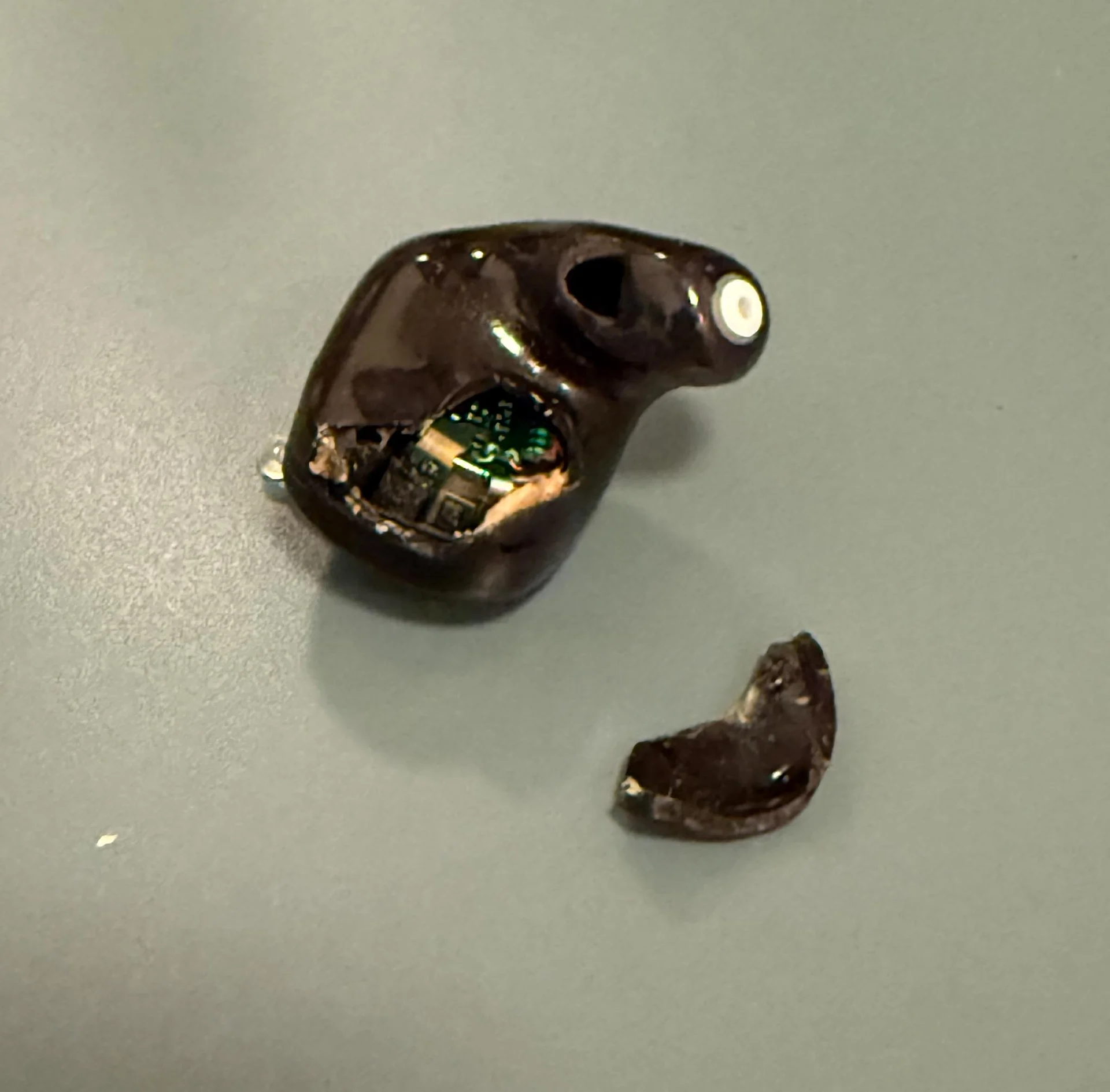
A couple of weeks ago I started noticing a slight irritation in one ear that didn’t quite resolve. One evening, while removing the right-hand side device, a small fragment of the outer shell came loose and remained in my ear canal. Nothing dramatic, but not ideal either.
From what I understand, this can happen: the shell is under constant mechanical stress — insertion, removal, jaw movement — and over time that can affect the outer layer.
I sent it back to Phonak via my audiologist. They handled it immediately, no discussion, no friction. It’s being replaced under warranty (three years in my case), and that was the end of it.
In the meantime, I’m back on the Stylettos 3AX.
Which, incidentally, has been a useful reminder: they are still rather excellent devices. But the difference is immediately noticeable — not in headline performance, but in effort. I am once again more aware of the devices, more involved in managing them.
So if there is an update here, it is this:
The strengths I described initially were not a first impression. They have held.
And the limitations — acoustic and material — are real, but manageable, and in at least one case, well supported by the manufacturer.
That, in practice, is the full picture for now.
You’re ignoring this member’s posts.

 Hot Springs Village, Arkansas