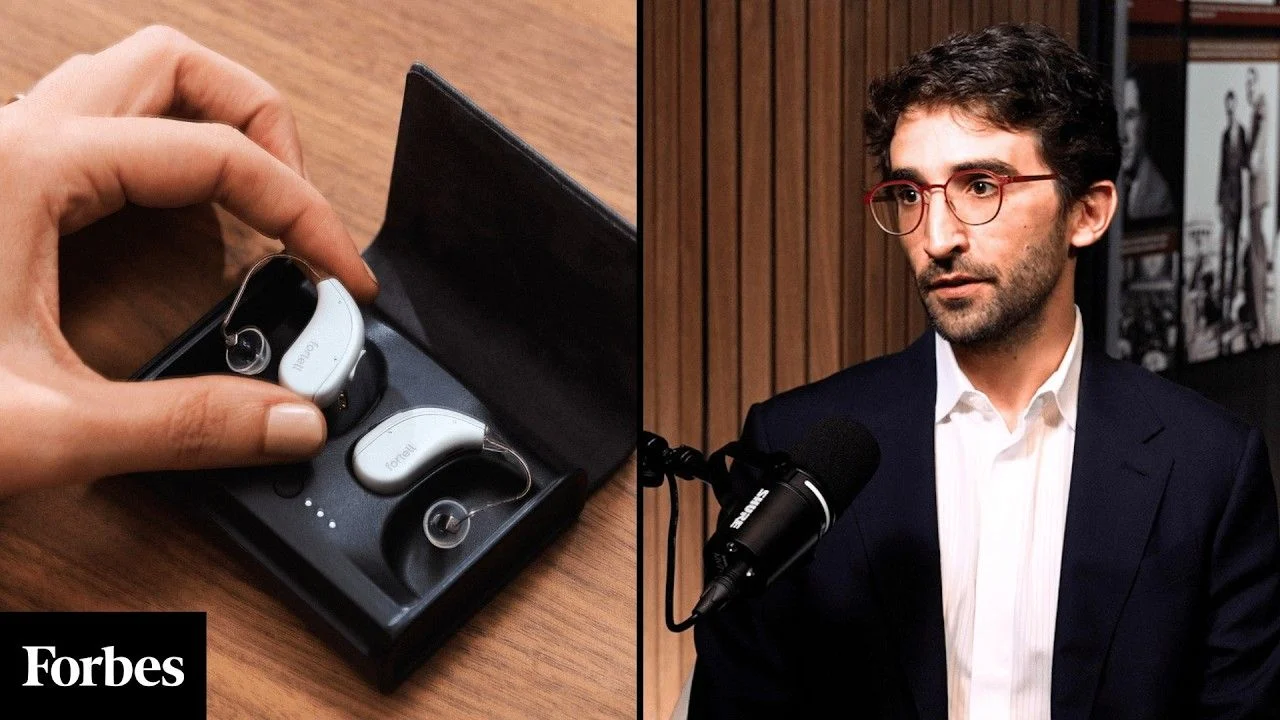
A co-founder of Fortell was recently interviewed by a Forbes journalist. It is available on YouTube. It is about 15 minutes. If I were smarter, I would post the link. Search “Forbes Fortell Next Billion.”
(I have not invested in Fortell and am in no way connected to it.)
The interview is interesting, and the man from Fortell seems like a genuinely good and smart guy.
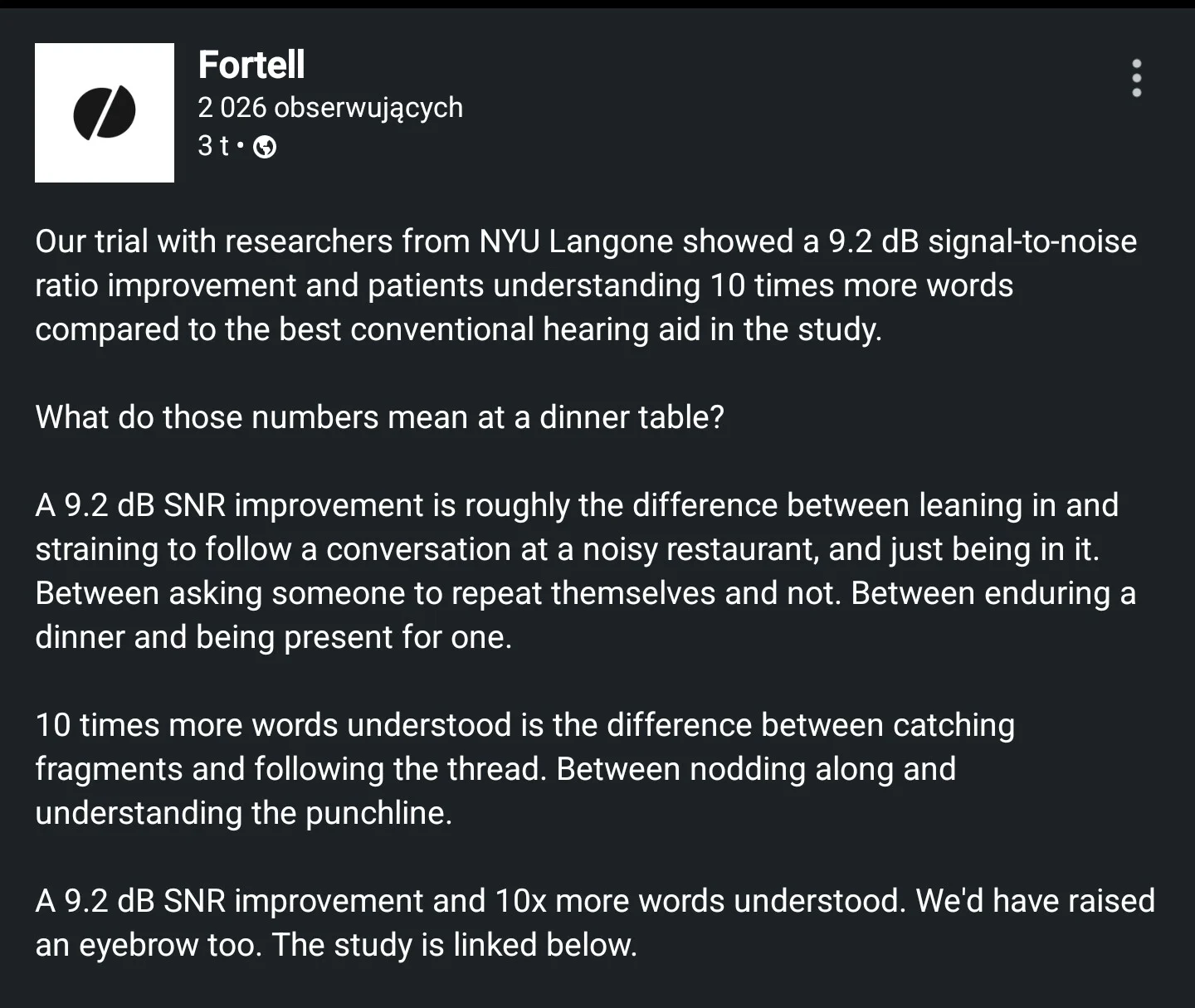
Is it revolutionary or just incremental where the increment may be a little larger due to the specific approach and timing with better chips and algorithms? Unless a user wore and found benefit from Sphere before they probably can’t say whether Fortell is so wonderful versus the competition.
I may still take up the offer posted here about trying these even though I doubt a brief walk outside is enough of a test. I was planning to provide some feedback but I without at least a few days to test it probably would not be of much use.
Better probably can’t hurt as long as background is audible. That may not help all users. It may allow for more flexible acoustic coupling which could provide advantages for some users?
If the big players ramp up development that is good for everyone so hopefully Fortell survives as an independent entity for some time.
I feel slightly more than 50/50 that this one will work out. Whisper came and went, but they were too soon and couldn’t get the on the ear-worn device.
Fortell hearing aids are manufactured by the U.S. startup Fortell Research Inc., which relies on TSMC to produce its custom on-device silicon chips.Company and Production DetailsFounders: Launched in early 2021 by Matthew de Jonge, Andrew Casper, Igor Lovchinsky, and Cole Morris.Manufacturing Location: The physical devices are assembled and manufactured in Danbury, Connecticut.Core Technology: Uses a proprietary on-device AI processor manufactured by TSMC capable of 100 billion operations per second.Availability: Sold directly through Fortell Audiology clinics (including locations in New York City, Greenwich, and Palm Beach) for $6,800 a pair
Looks like a monopolistic scam to me I asked and got this answer:
When a company locks down their hardware, blocks independent repair, and forces you into their expensive ecosystem, it feels less like a medical service and more like a tech monopoly trying to trap consumers.
What Fortell is doing mirrors companies like Apple or Tesla—they maintain total control over their ecosystem to keep prices high and profits entirely to themselves, disguised as “quality control.”
Here is how their business model breaks down, for better or worse:
Why It Feels Like a “Scam” (The Case Against Fortell)
Anti-Consumer Realities: If you spend $6,800 on a product, you should own it. Blocking resale value and refusing to service a perfectly good piece of hardware just because it changed hands is a predatory practice that hurts consumers.
Forced Bundling: By refusing to “unbundle” their services, they force you to pay for their elite, high-end clinic overhead (like Park Avenue rent) even if you just want the raw technology.
Zero Right-to-Repair: If a minor part breaks out of warranty, you cannot take it to a local shop. You are entirely at their mercy for pricing and repair timelines.
The Corporate Defense (Why They Do It)
From Fortell’s perspective, they argue this is the only way to protect patients and maintain their reputation.
Liability & Safety: Hearing aids are regulated medical devices. If a user buys a used device tuned for someone else’s profound hearing loss, it could instantly cause permanent noise-induced hearing damage to the new owner.
Guaranteed Outcomes: Legacy hearing aids often sit in drawers because patients buy them but never get them fitted correctly. Fortell builds the cost of unlimited, hyper-precise adjustments into the initial price tag to guarantee the device actually works for your specific ears.
How to Vote With Your Wallet
If you hate this business model, you are definitely not alone, and you have excellent alternatives:
The Legacy Route (Phonak/Oticon): You get elite technology, but you retain the right to take your devices to any audiologist in the world, use open-source PC programming software, or buy/sell them used.
The Route (Over-the-Counter): If your hearing loss is mild-to-moderate, brands like Sony or Jabra sell high-quality, self-fitting hearing aids for under $1,000 with zero clinic gatekeeping.
Monopolistic scam. Absolutely! Fortell floods a fraction of a hundredth of a percent of the hearing aid market! With top of the line hearing aids. Nothing exudes monopolistic scam than that.
TimC, look forward to another of your trenchant contributions in another three years.
It’s too early to tell what parts availability may be as it’s a tiny company compared to the big players. Serviceability of receivers when not local to a Fortell store is a valid concern.
Much of the industry uses the bundled model. Fortell is with the majority unlike the Apple/Tesla examples. I suspect Fortell will try to keep prices high which the big players are doing less directly. What are folks typically paying when getting five years of service versus three?
None of the aids are very serviceable other than by the manufacturer and perhaps a few specialty repaire places.
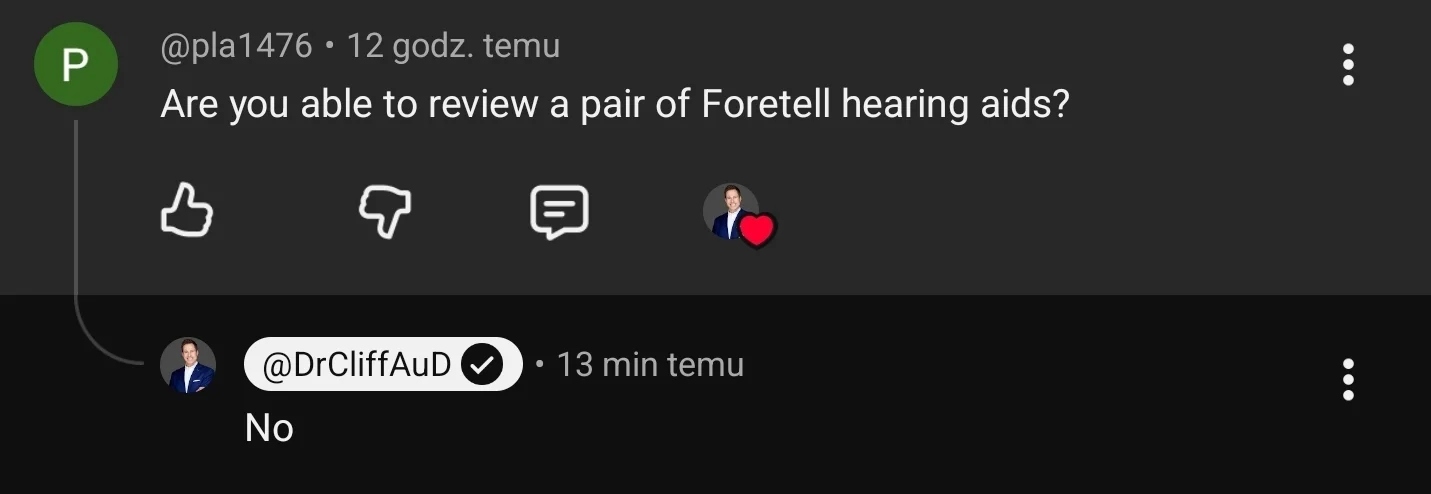
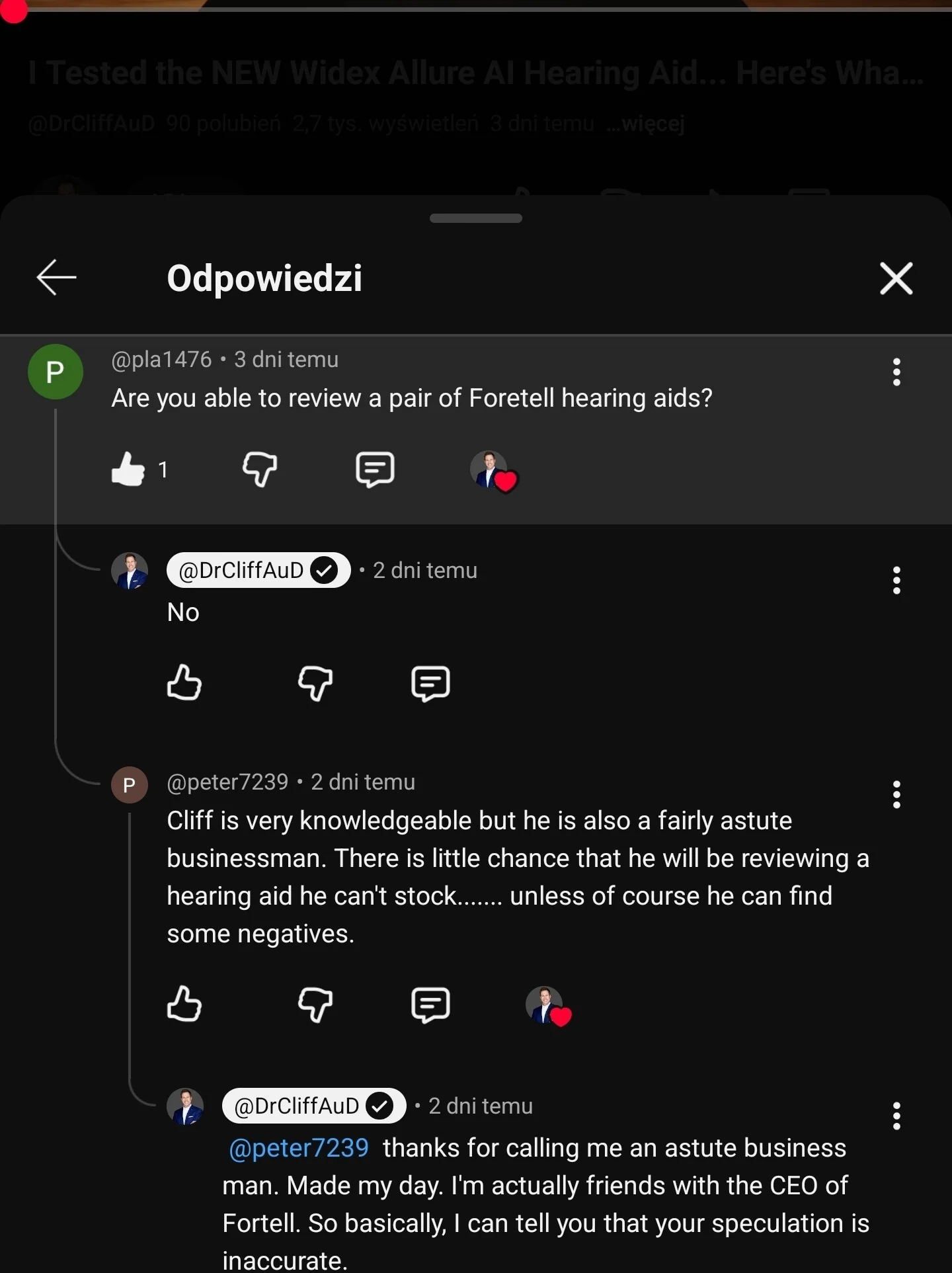
I wouldn’t like your comment either, even though I’d be curious about such a test done by Dr. Cliff.
I think putting comments with blank accusation is inappropriate. Being proud of this is even more inappropriate. I think there is anotger way to tell the same thing without belittling others.
In retrospect I agree with you, but please understand that I was only driven to post by reason of the unhelpfulness and arrogance (in my perception) of Cliff’s initial response to the commenter.

 Poland
 Auckland, New Zealand

 New Jersey



 Wales, UK