Thanks for all the great feedback. At the moment I’m trying to figure out which hearing aid. What would be your recco. I think it’s either the Sphere or the Intent 1.
You’re ignoring this member’s posts.
86 replies2.3k viewsLast reply
Thanks for all the great feedback. At the moment I’m trying to figure out which hearing aid. What would be your recco. I think it’s either the Sphere or the Intent 1.
You’re ignoring this member’s posts.

It’s your preference at the end of the day. All I would suggest is avoid Resound as their technology has been ineffective in my experience and you really need a good one.
You’re ignoring this member’s posts.

Your the only one who knows for sure which is best for you, no one else could possibly tell you which sounds better to you, and you don’t have a complex hearing loss, nothing any /Audiologist couldn’t help you with, yeah don’t let them “rush” you, nothing worse then that, it takes time to fit HAs.
You’re ignoring this member’s posts.
@tenkan, complex doesn’t mean impossible, it means that there is probably going to be a lot more work required to reach an optimal outcome than for example someone with standard . Any audiologist would call the OP’s loss complex because it’s asymmetric and profound in one ear with cochlear dead regions being almost certain and asymmetric speech recognition. This the kind of loss that would require the involvement of an audiologist over an audiometrist in my country.
I would refer to you the recent Oticon Intent thread with the OP from Bulgaria before saying “any Audiologist.”
You’re ignoring this member’s posts.

you don’t have a complex hearing loss, nothing any HAs/Audiologist couldn’t help you with, yeah don’t let them “rush” you, nothing worse then that, it takes time to fit HAs.
I agree with this as well. My hearing loss is worse than the OPs and I self programmed Phonaks with great results. At my first evaluation the audiologist couldn’t believe how well I could hear with those self programmed aids.
You’re ignoring this member’s posts.
You’re ignoring this member’s posts.
You’re ignoring this member’s posts.
restaurant
Restaurant isn’t Spheric Speech in Noise program…! Do you have manual program Spheric Speech in Noise? That should be set up by audiologist.
Restaurant is traditional way to dealing with noise - ordinary (non-) noise reduction and directionality. Something similar to Speech in Noise or Speech in Loud Noise, but I don’t know much about technical differences between them vs. Restaurant.
How much “amount of” noise do you hear when you turn off haering aids?
You’re ignoring this member’s posts.
Not much different. Or no noise reduction. I don’t think they are programed properly. Seeing the Audiologist tomorrow. Will let you know.
You’re ignoring this member’s posts.
How much “amount of” noise do you hear when you turn off haering aids?
Not much different
So, after turning off hearing aids you don’t feel much less intensity of noise?
Hard to say this, but if it was the case, it is definitely worth to give a chance to more occluded fitting and deeper placed earpieces, e. g. power domes from thicker silicone (from Unitron) with less size (e. g. M instead of L due to narrower ear canal in deep placement).
Another issue is does your measure your Loudness Discomfort Level () for making proper set of (Maximum Pressure Output) for each handle across the frequency response of hearing aids. If MPO Ls were set too low, there may be problem with understanding others, especially in noisy conditions.
However, MPOs shouldn’t be too high (over LDLs, see above) due to risk of acoustic injury. So balance matters.
You’re ignoring this member’s posts.
These are just a test to see which I prefer. My is not spending much time adjusting these. I have good low end so don’t like the feeling bigger domes.
You’re ignoring this member’s posts.
I have good low end so don’t like the feeling bigger domes.
Good low end is only one part of the whole picture. It is not engraved in stone: “I have good low end, I should have open earpieces”, that’s not.
All depends on your lifestyle and requirements. If you need real improvements in noisy conditions you need to compromise, because unprocessed noise overwhelms processed sound provided by near eardrums. Another issue is if your left ears has usable reception of the high frequency (as in my case). If yes - you need proper amplification of them to hear better, especially in noisy situations.
To provide high frequency amplification, there must be no acoustic feedback, so again - there must be more occluded fitting.
Every antinoise feature (directional mics, denoising algorithms) works better if processed sound doesn’t compete with unprocessed noise.
There is also sometimes problem with comb filtering effect, which can be prevented by less open earpiece.
There are interesting blog posts about openness/closeness of the acoustic couplings (translated by web browser):
34, 35, 37°C au mois de juin… tout va bien ! Les derniers glaciers fondent dans les Pyrénées, et se décrochent dans les Alpes. J’arrête là ce climato-alarmisme pour me consacrer à un su…
and
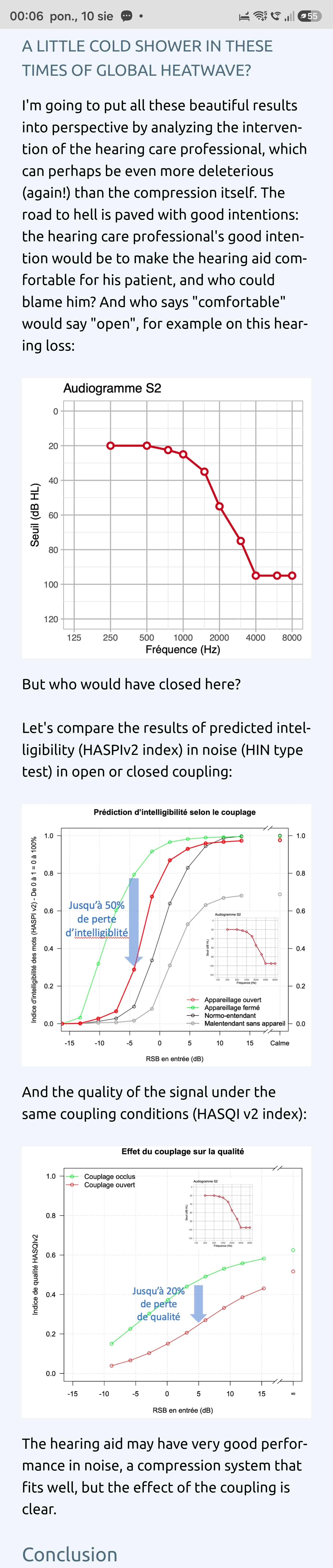
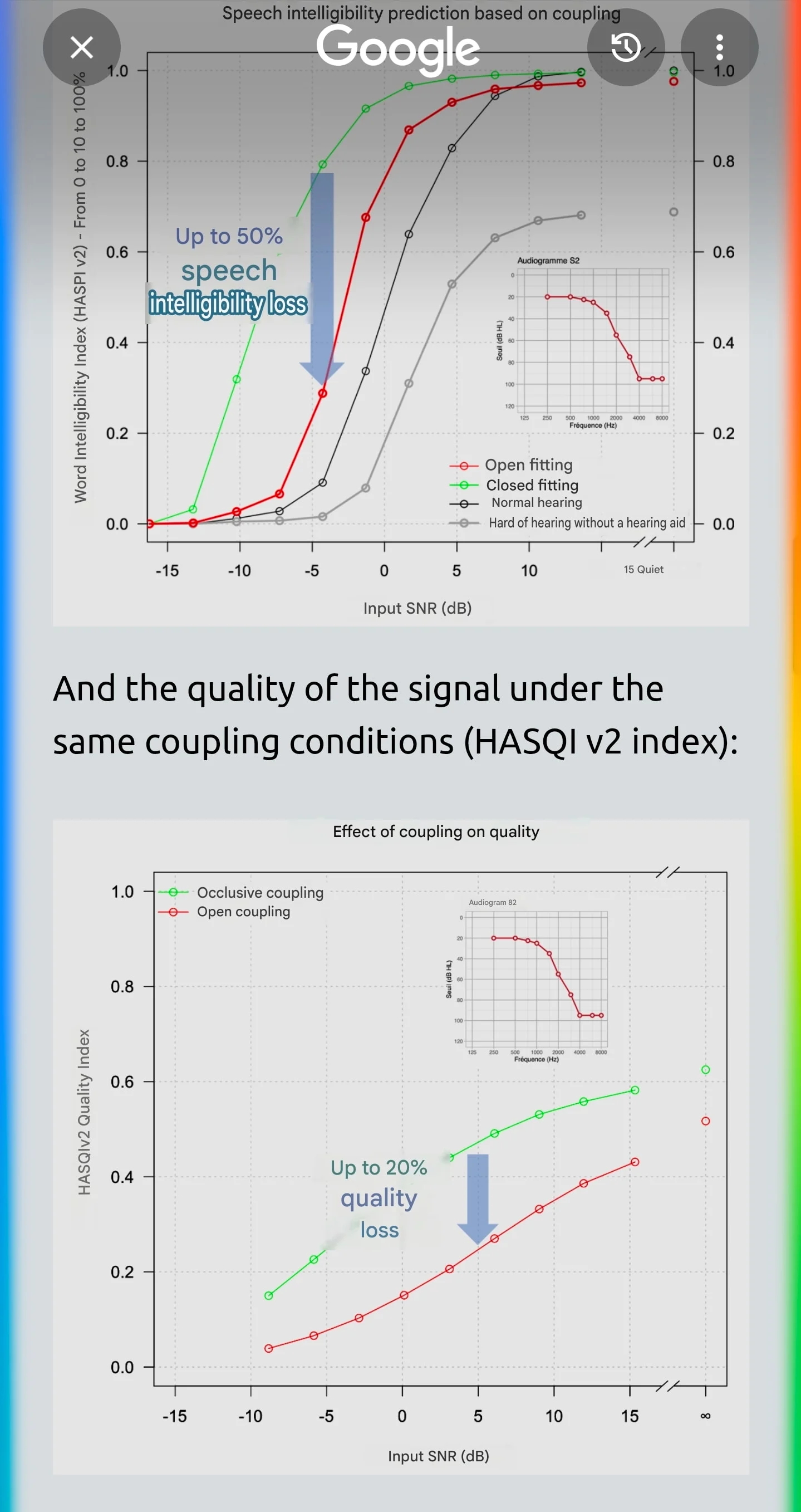
HOWEVER,
if you don’t take part in conversations in noisy places very often, and your priority is to hear in silence and better sound localization - then you can really stay with more open ones earpieces.
So, it’s all about lifestyle - something like person with peaceful, quiet life probably doesn’t need to have top-of-the-line HAs.
You may consider having a trial at another audiologist.
You’re ignoring this member’s posts.
You’re ignoring this member’s posts.
You’re ignoring this member’s posts.
You’re ignoring this member’s posts.
Look on the end if the receiver. The part that goes into your ear. There is the receiver size.
You’re ignoring this member’s posts.

This is what it might look like. Although you would more likely see size 3 and p power instead of zero S.
WH
You’re ignoring this member’s posts.
You’re ignoring this member’s posts.
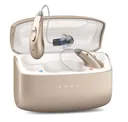
L=1P
R=3P
There you go, Power Recs, probable downward spread of masking, occlusion issue and dead-spots.
Finessing these kind of fits requires access to the correct tools, enough knowledge to know what to do, but more importantly enough knowledge to know what not to do. FWIW, you can’t ‘make’ the aids (without an activent) work properly at both 20 and 120dB*. Slopes of more 16dB per octave encounter adjacent channel reproduction issues (it’s one balanced armature/beam) doing all the bouncing around: this means that a single drive cannot handle that amount of differential in the drive power.
So, what do you ?
You either botch it with a bit of `frequency fiddling’ or cut your losses and do what I do: fit Medium receivers, abandon the region headed to the dead-spot, by turning off/down the aid above 2KHz on the RHS. You’ll save your self a whole lot of pain.
Now, here’s a bit of to explain the scale for you:
How Decibels Work
Decibels (dB) use a logarithmic scale, not a linear one.
For power measurements, an increase of 10 dB means the power is multiplied by 10 (\(10^{(10/10)} = 10\)).
An increase of 120 dB minus 20 dB = 100 dB total difference. [1, 2, 3, 4, 5]
The Calculation
A 100 dB difference breaks down into ten steps of 10 dB (10 × 10 = 100 dB).
In power ratio terms, this is calculated as \(10^{(100/10)} = 10^{10}\), which equals 10,000,000,000. [1]
Real-World Reference
20 dB: A quiet whisper or rustling leaves.
120 dB: A loud rock concert or a jet takeoff close by (the threshold of human pain). [1, 2, 3, 4]
If you’d like, I can explain the difference between sound pressure level () and electric power (dBm), or help you calculate a different decibel differential.
You’re ignoring this member’s posts.
You either botch it with a bit of `frequency fiddling’ or cut your losses and do what I do: fit Medium receivers, abandon the region headed to the dead-spot, by turning off/down the aid above 2KHz on the RHS. You’ll save your self a whole lot of pain.
Is there a particular test during hearing testing to check whether there are “dead spots” in the range of these frequencies or they are roughly OK, just needing very much amplification?
Or it is: “we just try with more amplification and we’ll see if there will be any distortion or worse speech understanding”?
I ask, because theoretically in my better ear (a bit similar to left ear of the @Kiwicom) I also “should” have dead spots, but I found much benefits from more amplification in that range.
Very creative solution with M receiver and cutting amplification over 2 kHz. Like that out-of-the-box solutions. A bit similar to the hybrid cochlear implant idea ( electrical stimulation for the high frequency, amplification for the low in the one ear).
You’re ignoring this member’s posts.
Log in to reply to this topic.
Audiologists and Hearing Aid Dispensers14 replies
Hearing Aids59 replies
Hearing Aids64 replies
Hearing Aids7 replies
Cochlear Implants30 replies
 Texas Hill Country
 Poland

 Wales, UK
