I measured using the printable version of the Widex tool and the size seems big so perhaps there was a scale change and the printable tool is not up to date? There can be trial and error even with careful measurement by an audiologist.
I got my reveal pack today. The new plum colour used in the advertising is a lot darker than it appears on screen, so it'll be more discreet amongst long hair.
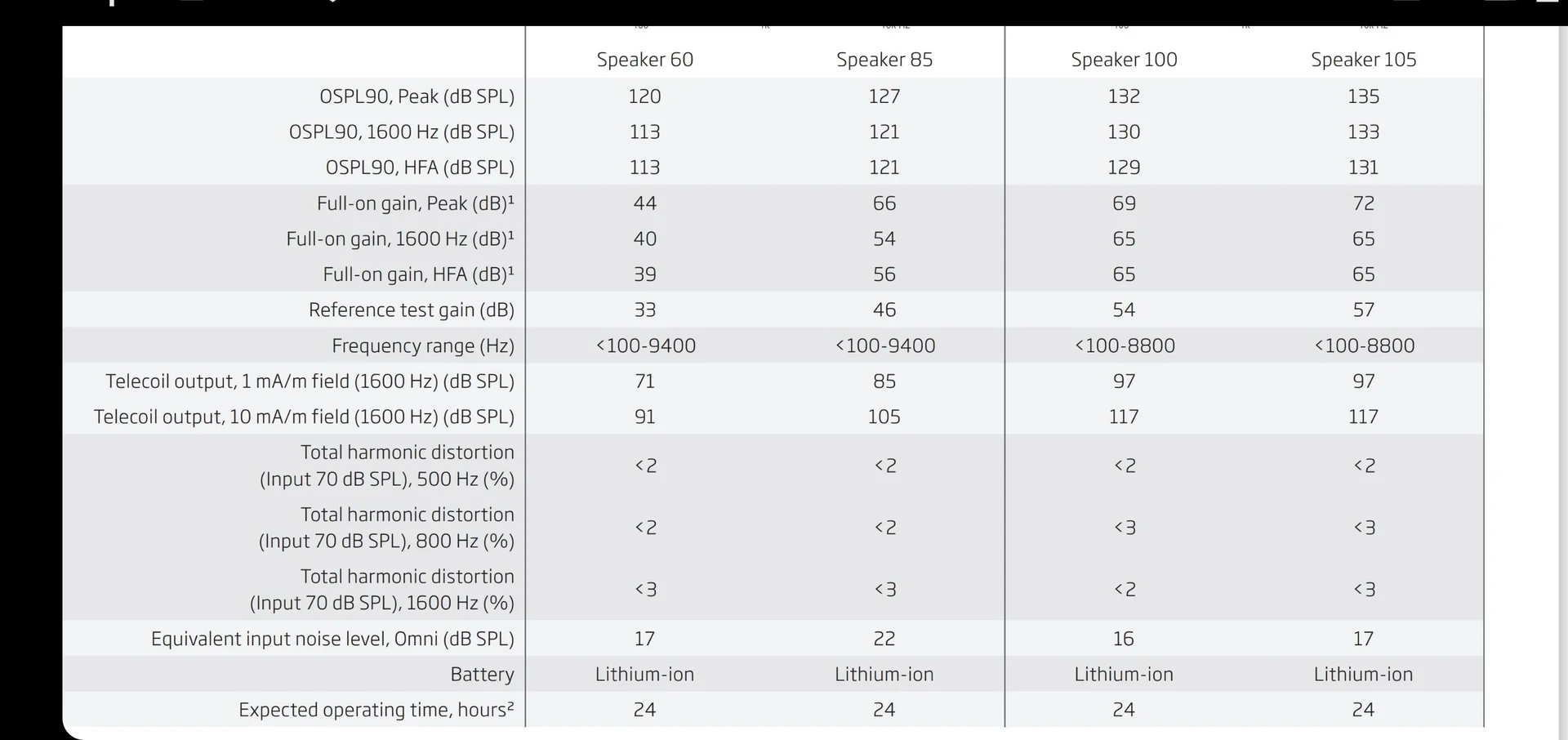
I looked at the Oticon Genie, the Power receivers are just as strong as the Phonak, the sound amplification goes up to 105db. This is important to me because I have severe hearing loss at high frequencies.
The question is: how to they perform in different frequencies at high power . @BiModal was talking about this in another thread (regarding the performance at high frequencies ). The 105dB response is not flat at all frequencies.
You need to look at the datasheets for each speaker type as these are the only acoustic measurements standardised across all manufacturers. Comparisons from in the software or fitting ranges won't be equivalent.
I'd recommend going to the datasheets themselves if you can. The graphs give more nuanced information than the summary tables can which is useful if you're near the limits of the fitting range or have questions about sound quality.
Going through the whitepapers released with Oticon Reveal there are some interesting technical measurements being performed particularly with regards to their new feedback manager. As they don't use standard clinical measures of speech intelligibility, it is more challenging to interpret exactly how much better their new feedback manager is compared to competitors with the hearing loss chosen as it is unlikely that the targets for the N4 hearing loss used would prescribe audible gain to the end user in the first place, but I look forward to trying it out in real life.
However what is more interesting are the cortical auditory evoked potentials (CAEPs) studies. CAEPs are objective measurements of what is going on in the brain in response to sound. They are often used as an objective measure of audibility in young children with hearing loss who are too young for reliable behavioural assessment, or as an objective measurement for individuals with neurodevelopmental disorders or who cannot be reliably assessed using behavioural testing.
Activating Reveal Clarifier increased cortical responses by up to seven times in the presence of competing contextual sounds. Oticon Reveal 1 also produced approximately 60% stronger responses than Oticon Intent 1 in speech-relevant mid frequencies indicating a cleaner and more balanced auditory input that supports more efficient cortical processing in everyday listening. As Demant owns Interacoustics which manufactures auditory evoked potential measurement equipment this kind of study can be done in house and we don't currently have comparisons with other manufacturers.
What hasn't yet been presented is information showing that this results in improved speech intelligibility.
we don't currently have comparisons with other manufacturers.
Your first question has been answered in advance. Your other questions will require a little research as the available information on the study performed doesn’t include coupling type used. I'll have to get back to you after training is available.
I disagree with his statement that "it doesn't mean that if you go down a technology level you will lose performance" with this particular product. It is quite clear that lose performance as you drop down each tech level with Oticon, particularly speech in noise performance with a reduced input dynamic range as you drop from tier 2 to tier 3. Other manufacturers offer the same wider input dynamic range across all levels of technology because it is a feature that everyone benefits from because it allows for less distortion of high input levels in noisy environments which improves the performance of every subsequent step in the signal processing chain.
I thought you meant a comparison in the same study. Comparable data could be from another study or from some manufacturer documentation. It seems we have neither. Hopefully you can learn something more from the training.
It was really good to see the improvements in stability of bluetooth connections for LE () audio. Apple really need to start supporting it, as many hearing aid users will start switching to Android devices if they don't.
I think overall that was a pretty fair review. I agree with him in that you shouldn't buy the Reveal if you want good streaming music quality. Demant brands really need to improve on this aspect of their products and it's going to require increasing the sampling rate of their hearing aids which is something that is long overdue but will probably require significant changes to all of their processing.
Who does better streaming than Demant? Genuine question. In the last few years, I've tried Phonak, Resound and Philips. Mfi, 'classic', , . When I saw that the new models would bring more stability to LE Audio streaming, I was surprised because I didn't believe any improvements in that area were needed. Once my aids take a LE Audio or stream they don't glitch at all. Music quality is the best of the ones I've tried, but so much of that is in the fitting.
Please note, we're discussing streaming music. Streamed speech is totally different as you don't need such high bitrates to achieve an accurate percept as you do with music.
Objectively speaking, Widex has the highest music streaming sound quality when using LE audio. Sonova brands using bluetooth classic will be next highest. Mifi aids will be the lowest with variations between brands that depend on the total sampling rate being used by the hearing aid .
If you don't hear a clear difference in the sound quality between Demant products and competing brands, it's probably because your auditory system is no longer able to encode the differences in sampling rate between the various manufacturer products.
The lower sampling rate of Demant brands might actually mean less distortion for an auditory system incapable of encoding more detail because less information is present in the signal provided by the hearing aid for the hearing system to generate its own distortion when encoding the signal.
Sound quality is very subjective, so it's good that there are different options. Objectively speaking Demant brands have much poorer streaming audio quality, but it'd be interesting to see how hearing aid users with different configurations and degrees of hearing loss rank music quality.
From what I watched in the video, the complaints about streaming audio quality were specifically regarding the lack of bass for open domes, and no automatic switching to a music program during streaming. I didn't catch him commenting about sample rate or lack thereof.
Of course, looking at the datasheet for the Reveal, it still looks like the max frequency for Reveal 1 is still only 10KHz. I don't know if that's the max the hearing aids can actually output for streaming, or if it is a limitation on the fitting options available.
I only have on my More's, and the audio quality is... usable. But that's not a problem with Demant, that's just because ASHA sucks. It is limited 16KHz max sample rate, and uses a telephony audio codec from the 1980's (G.722).
I don't know what sample rate Demant uses for . If I were to guess, it's probably the 24KHz sample rate option, which - let's be honest - is probably just fine for most hearing aid users. Plus has to be much better than G.722.

 Poland

 Croatia

 San Francisco


 New Zealand