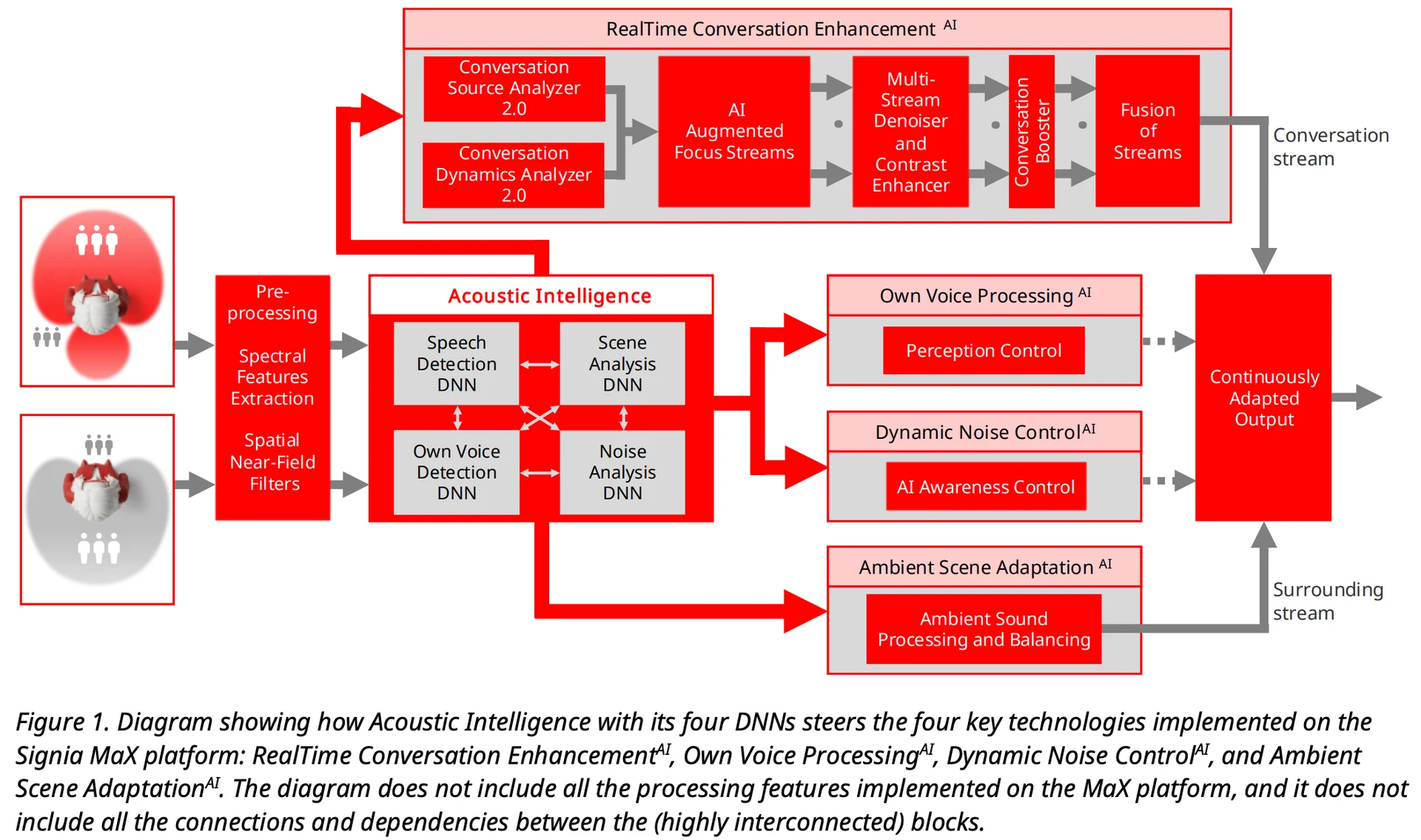
Signia’s new flagship -powered platform uses four task-specific to coordinate speech, noise, the wearer’s own voice, and the surrounding sound scene—while bringing broader connectivity and new evidence for performance in group conversations.
Task specific is definitely the way forward. I'm very interested in learning more about this.
Signia says the new MaX chip offers 54 times the processing power and twice the memory of the IX platform, while being 50% more energy efficient.
Task-specific AI is way more efficient and powerful.
Signia also introduced what it calls OneConnect Technology. The Pure Charge&Go MaX 7 device we tried out in Munich combines Bluetooth Classic, Bluetooth with capability, and a in one hearing aid.
They've upgraded their ear to ear wireless (now version 5.0) so that it is 35% more stable, allowing for higher quality bidirectional audio processing and bluetooth classic streaming audio quality.
This looks like a much more advanced version of what Oticon has been doing, indeed with Oticon Reveal they're leaning into what Signia has been doing but without OVP and RTCE.
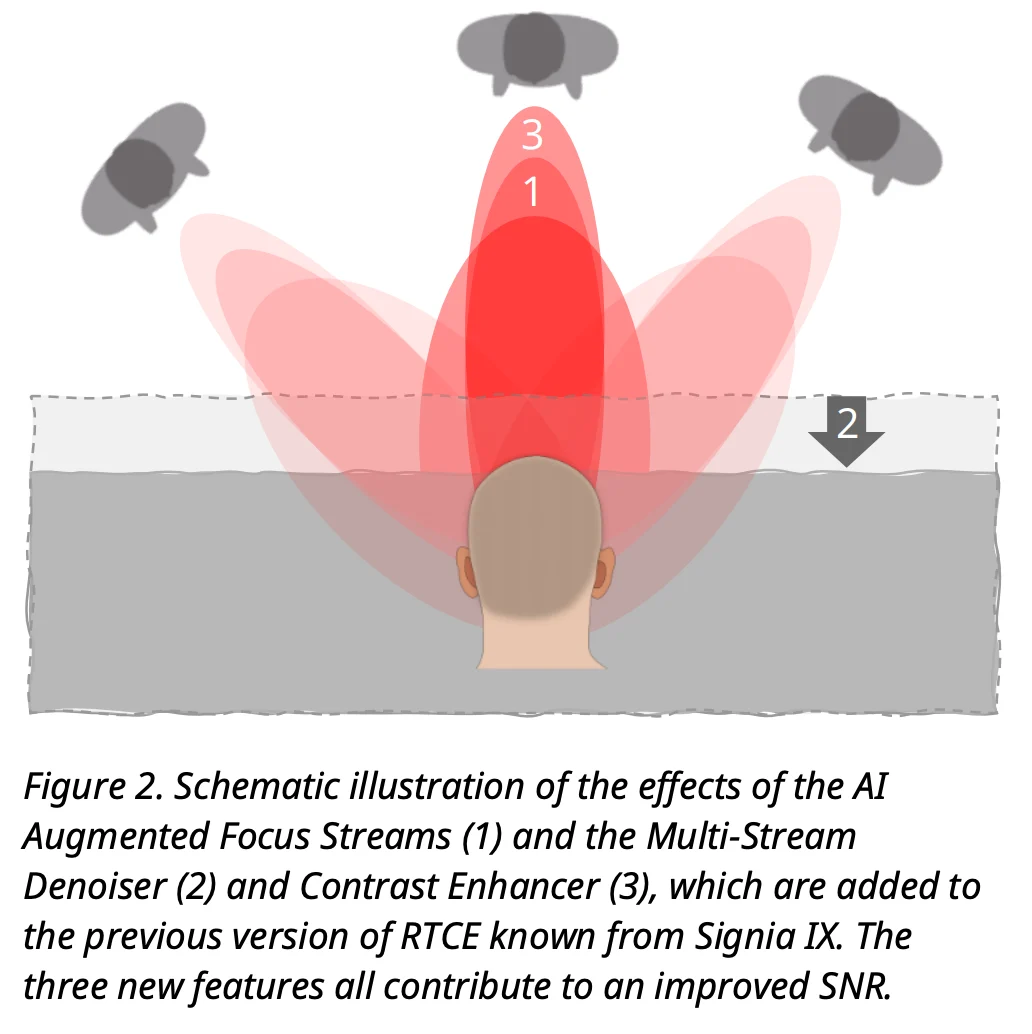
Real-time conversation enhancement now has 3 new streams of processing being applied to the multi-stream beamformer for an even better for the up to three talkers that the hearing aids can focus on in real time.
In Signia MaX, the own voice detection is now managed automatically by Acoustic Intelligence, and in particular by the Own Voice Detection , which has been trained on a large number of non-speech and speech samples, including both the wearer’s own voice and the speech of other talkers.
The DNN is trained on the output of a set of spatial near-field filters designed to distinguish between own voice and external speech from the front. This enables the DNN to differentiate between the wearer’s voice and the voices of other nearby talkers in front of the wearer. These filters are part of the preprocessing block shown in Figure 1, which provides the input to Acoustic Intelligence.
For talkers to the side of the wearer, spatial lateral detectors assist in making the decision that the detected speech is not produced by the wearer. Besides eliminating the need for individual training of the own voice detection system, the new DNN-based detection also provides a very high accuracy of the detection with a false-detection rate (the likelihood that own voice is detected when others in front of the wearer speak) of lower than 1% with the new DNN-based detection.
Yikes, this is definite upgrade of the kind that Phonak has with it's windblock 2.0. It's really surprising that soundsmoothing was working in such a crude way previously. The new version is vastly superior.
"Whereas the previous version only applied transient handling in two broad bands, SoundSmoothing 2.0 increases the resolution substantially by applying transient reduction in each of the 48 processing channels. This means that the gain is attenuated only in the narrow frequency bands where the transient is present, without affecting speech signals in adjacent channels.
Furthermore, the e2e 5.0 communication between the hearing aids includes a new fast (low latency) data channel that paves the way for synchronization of the transient handling in the two hearing aids, both when it comes to detection and attenuation.
This allows for more stable interaural level differences (ILDs), enabling the wearer to better localize transient sounds due to better preserved ILDs. Tests suggest that SoundSmoothing 2.0 can reduce the RMS localization error caused by ILD variation by around 30% compared to its predecessor, allowing more precise localization of transient sounds, especially in the high frequency.
The fast binaural communication between the hearing aids essentially allows a “look -ahead” function. When a transient is detected at the input stage of one hearing aid, the communication between hearing aids (which is faster than the filter bank processing time) passes the information over to the output stages of both hearing aids, preparing the output stages to effectively apply attenuation to the entire transient."
Wind noise reduction is also upgraded in Signia MaX working in 16 channels rather than using broadband detection and selecting the microphone with the least wind noise for processing first similar to what Oticon has been doing since it introduced its wind and handling noise stabiliser and to what Phonak are doing in the Eon product. It's an upgrade over the IX platform, but no spectrogram analyses are provided and between manufacturer performance is unknown.
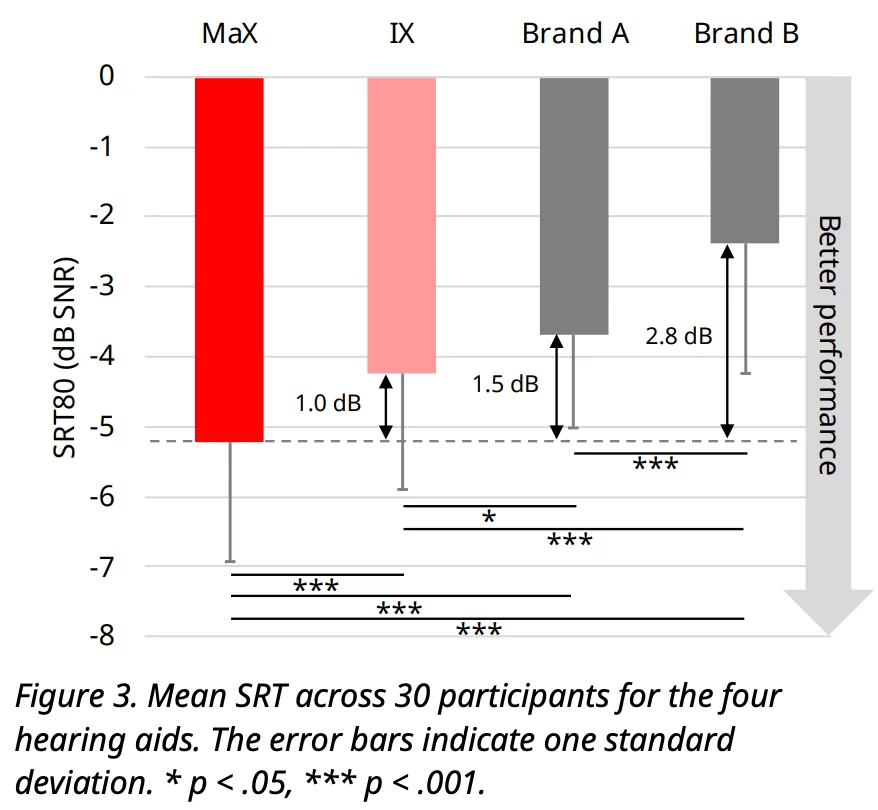
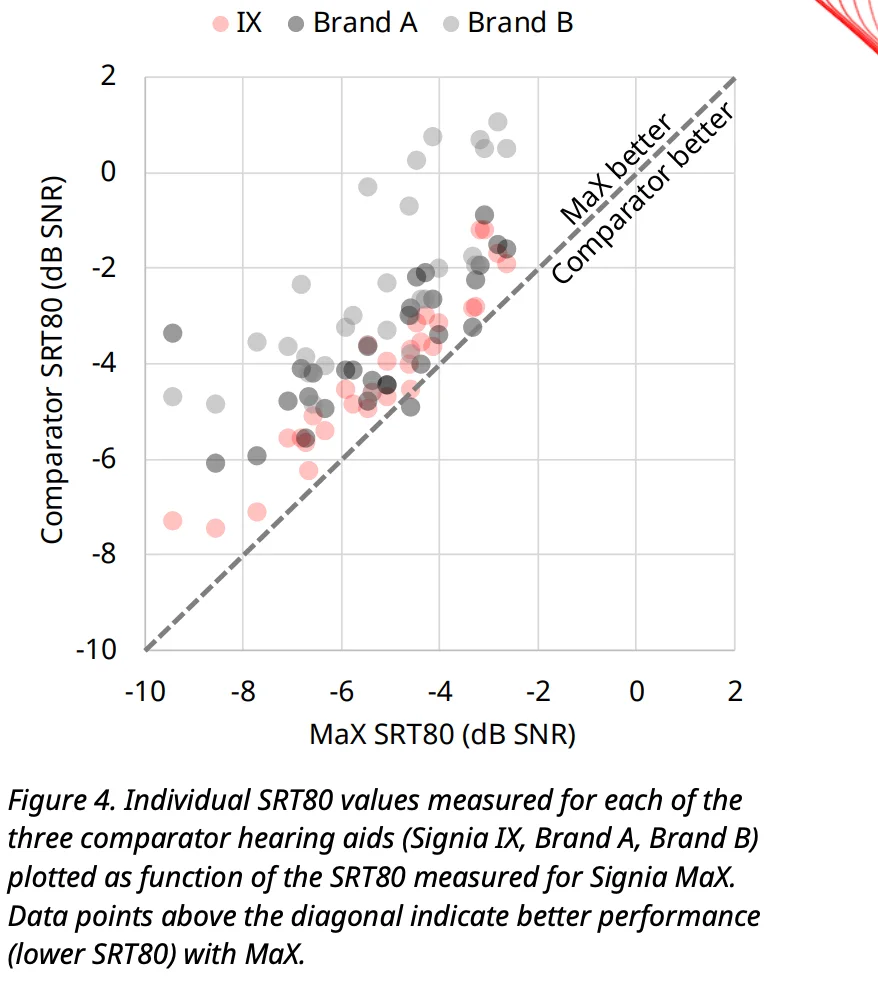
The most interesting part of the launch documentation is the study which looked at the SRT80 (where users are getting 80% of the speech correct) vs IX and 2 manufacturers with dedicated co-processors, which would likely be Phonak and Resound given the timing of the studies. Signia did the best in this study even without AI processing (IX platform).
I wonder if Signia will offer the latest version at Costco
The three announcements at the same time might shake things up. If it were just one, that manufacturer might think they can afford to hang back like Phonak has done. Three new technology release at one time? Hopefully that means a bit more pressure to get their new technology out there and compete.
For myself, a new Rexton with this new tech would have me giving it serious consideration.
Watching the thisweekinhearing interview8 it was interesting to see that Signia have dropped both and Mifi from its new devices, relying instead on and Bluetooth Classic.
You can now chat with Signia assistant to make changes to the hearing aid settings and troubleshoot problems.
H_P, Based on what has been provided by Signia so far, can it be determined whether they have aimed more for temporal processing vs. frequency processing?
Is there a list of which brand use temporal versus frequency processing? With all this chip advancement couldn't there have been a fifth to adjust the processing approach? For another aid in the future I suppose.
Unfortunately that aspect of the processor design is built into the hardware itself. It's an either/or option. Widex is the only brand known to be using temporal processing. I suspect what Bernafon does with their channelfree tech would be classified as something in between both types of processing but they definitely use spectral based analysis for noise management.

 Auckland, New Zealand