If I asked for a (P) power receiver with starkey omega ai 24 hearing aids. It would also be with custom ear molds. What would be the pros / cons with my high frequency loss. Will be getting new hearing test in October. Hopefully doesn't change much. Not planning on getting the new phonak or oticon. More than likely will be . But I'm interested in . Just based on ear real-estate. Already switched to wire frame glasses
would be a good choice, power receiver would work, you'll need to get the correct sized vent worked out tho for your moulds,this could be a bit of trial and error,but sounds like your hinting you have small ear canals?in that case you might not be able to get the size you want, you don't really need amplification under 30dB until looks like 1000-1500Hz anyways, but yeah a big ski drop off, what was you last set up with the you use now?
You have normal hearing at low frequencies. In this case , the critical part is choosing the right mold that will have enough venting so that you do not get occlusion but that is sealed enough that will not create feedback (this is more difficult to achieve with ). You can use the power receiver but choosing the right venting is , imho, the key to success here.
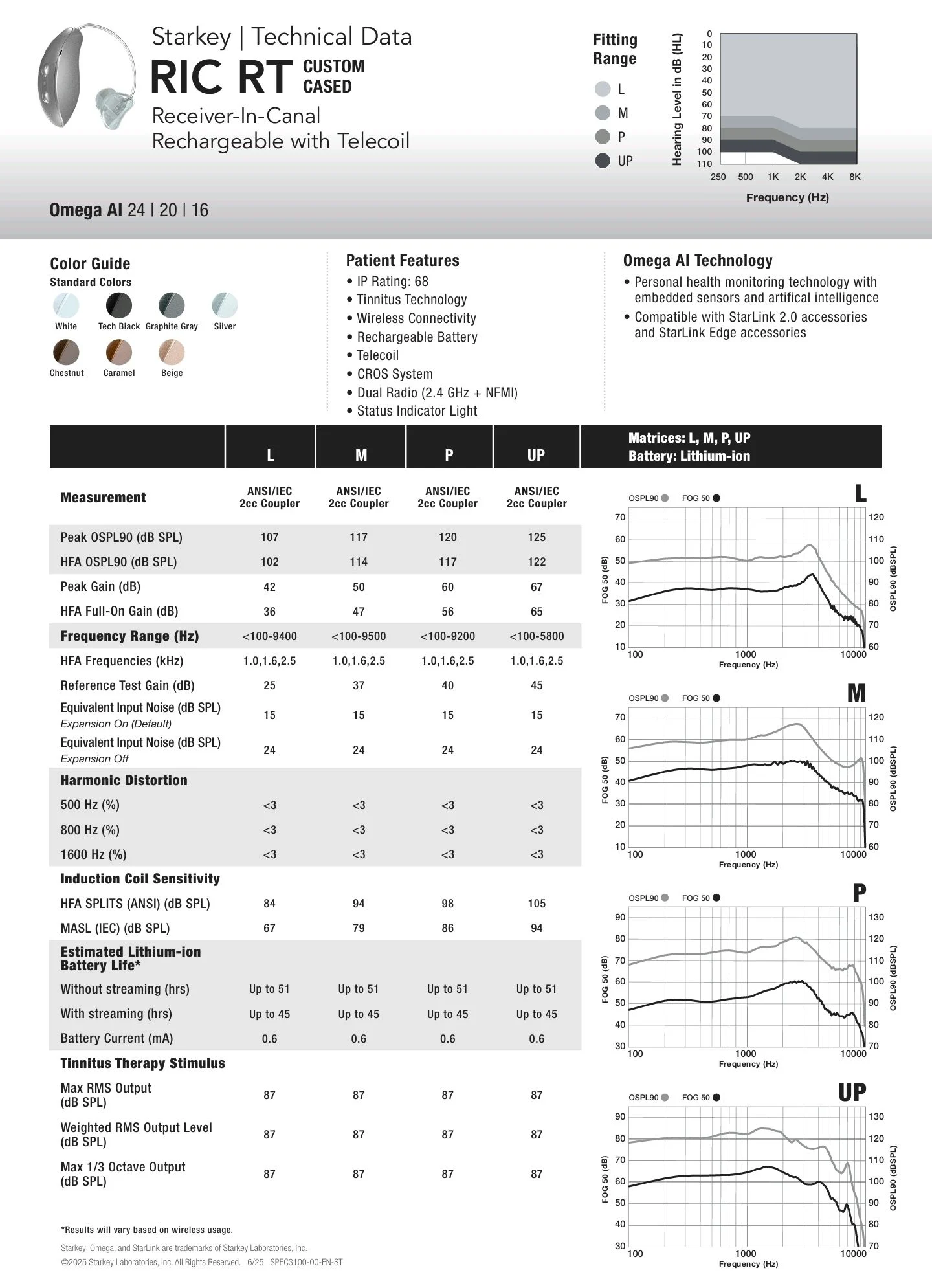
Below is the spec sheet for the Omega ITE. The sheet shows the fitting ranges for different receivers and you see how they are a fit for your .
Yes I have narrow ear canals. Currently have acrylic
earmolds on my phonak lumity. They have D- shape vent hole. Maybe 2-3 mm in size. Not sure how to correctly measure them. Other than eyeball with a scale. No occlusion almost never. Wearing them 16-18 hours a day.
I'll respond more later, but have you considered trial P receiver with thick silicone power domes (I use that from Unitron - very nice thick silicone) BUT placed very deep, positioned at least in some extent in the bony part of ear canal? That bony part is ~⅓ length nearest to the eardrum.
That position will greatly reduce risk of occlusion effect.
Additional benefit: more "free gain" for higher frequencies due to Boyle's law thanks to less volume in cm³ of ear canal between receiver outlet and eardrum.
You can ask audiologist if Phonak Easyguard power will fit to the Starkey P receiver.
However, that may require changing size of power domes to smaller, in my case from L to M size, because the closer tonthe eardrum, the narrower ear canal can be.
Of course, ultimately, it is worth having an earmold (I wait for one with UP and no vent), but trialing decribed above is a good starting point.
That's not all I wanted to write, but I am in some rush.
I've tried a lot of domes open, closed, power, and different sizes. With the exception of easy guard. I get better results with earmolds. Currently have phonak lumity M receiver in acrylic. I ask about silicone molds. Before getting acrylic. Audiolgist said I couldn't get them. Didn't give an explanation. I assumed they couldn't vent properly. But again I'm not sure.
Hi, I have moderate to Severe hearing and I do not have particularly large canals, I have had the Starkey Edge UP receiver for over 2 years now and for me personally these are the best 's I have ever had.
In loud crowded rooms I can hear better than my normal hearing friends and this is in Personal (Standard Program), I have never felt the need to use the Edge AI program.
Back to your query because ITE is more in the bowl of the ear rather than in the canal I think that these would work for you.
And as I have mine in Black people just think I am wearing ear buds, including Security Personnel at Airports, so there has never been a truer term of hidden in plain sight.
For me personally I can't think how an HA can be any better.
Cool. Really glad you found some aids that work great for you. Does the come with vent holes like some earmolds? I thought seen a video last year with some of that information in there. But couldn't find it. Still not sure my audiolgist at the will think they will be helpful. Especiallysince I have ood low frequency. Took a couple years for me to get them to let me try earmolds. They kept saying it wouldn't help better than domes. For me the earmolds are far superior to anything they tried with domes.
I've tried a lot of domes open, closed, power, and different sizes. With the exception of easy guard.
In the proposal of power domes + p receiver, I had no intention of proposing this as a target set. I'm waiting for cShell +0UP receiver with no vent myself for Phonak Audeo Infinio Sphere 90 Ultra. That deep placed power domes is mainly for testing if you'll perceive occlusion effect.
It must be also assessed if providing gain in highest frequencis will give you benefits or, if you're unlucky with that loss, more distortion.
I ask about silicone molds. Before getting acrylic. Audiolgist said I couldn't get them. Didn't give an explanation.
Phonak manufacturer simply doesn't offer them. I know, because I wanted silicone one also, especially when I wanted UP receiver with no vent. They don't offer silicone earmolds in the order form.
You have a bit problematic hearing loss, because if you want as much high frequency gain as possible and maximise effectiveness in noisy conditions, you need pretty occluding earmold to avoid acoustic feedback.
This is why I, after testing 1mm diameter vent, I have gone for no vent.
However, no vent means some drawbacks in the form of, for example, limited directional hearing of low tones. It's completely not a problem for me.
If I asked for a (P) power receiver with starkey omega ai 24 hearing aids. It would also be with custom ear molds. What would be the pros / cons with my high frequency loss.
With P instead of M (power domes) I finally perceived benefits from Spheric AI program quite as in Phonak advertisements.
BUT the real improvement (even in quiet) I had with UP receiver, despite too large, 1mm diameter vent. In my case, I finally could understand TV without intermediary devices.
More occluding earpieces - less bass leaking = better streaming quality
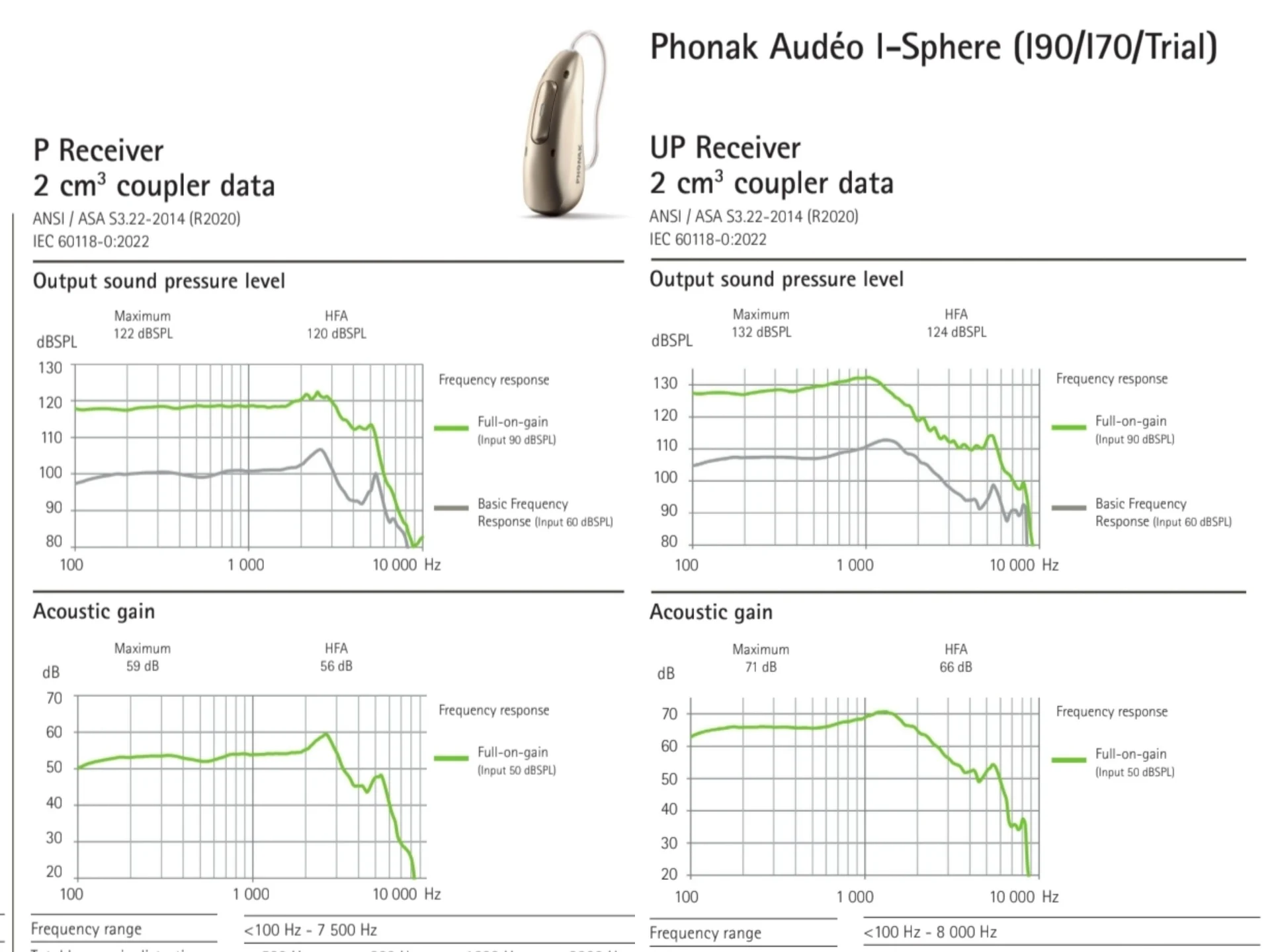
However, keep in mind that, according to the datasheets, Phonak UP receiver has better frequency range than Starkey (P receivers are roughly similar a bit better than Phonak Ps according to the datasheets). Phonak UP receiver has also very quiet noise floor, I don't perceive it.
Cons - mainly because of necessity of more occluding earpiece:
Occlusion effect - not a problem for me, but it's individual. This is somewhat manageable by making deeper fit, as I described in previous post. The silicone impression should reach at least 5mm past 2nd bend of ear canals
More occluded earpieces means less using unprocessed low frequencies which are entering via vent after being collected by your pinna, so theoretically losing pinna directionality. However, I heard that pinna effect is mainly for4-6 kHz, so maybe someone more knowledgeable woukd chime in.
Maybe 2-3 mm in size. Not sure how to correctly measure them.
Yeah as been mentioned far to large to get adequate gain in higher frequency,feedback would be a problem, check size with a drill bit or fishing line, 1.6mm approximately could work, very limited occlusion effect and a lot more available gain, soft silicone do make for nice molds,but acrylic will be fine as you know, I think more importantly for you is the correct receiver and P could work, going higher would mean no room for any venting, you'll then need to deal with another problem being the occlusion effect, not many people with good lower frequencys will tolerate this.
Was just giving general information of what I currently wear. Some people like more information before giving opinions. And my vent hole is approximately 2mm.
With your loss >3kHz and that diameter there's indeed probably some benefits left on the table due to insufficient high frequency gain because of low feedback threshold.
I've had the Starkey omega 24's with power receivers since December of '25. With acrylic molds and proper venting, I have mild occlusion in my left ear, but it seems to be transitory. The first set was returned to Starkey for a re-make and the results are now better than at the first try. Their earmolds seem to be more stable than the previous ones I had with Oticon, and for this reason I am pleased. There is a range of options for speech-in-noise, and the choices available do make a noticeable difference in restaurant and noisier settings. The Edge function is remarkably different. Unfortunately, there is no way that your questions will be adequately addressed without a trial period. BTW: I have no feedback in the higher frequency ranges, and I hope that you find a workable solution
Looking at your hearing configuration you're probably a good candidate for a Signia device using Own Voice Processing, which uses a separate processing path for your own voice to reduce occlusion and abnormal own-voice perception. This would allow you to go with a more occluding fitting to achieve optimal mid and high-frequency audibility without compromising as much on your own voice. Less venting would also allow you to benefit more from the hearing aid processing in very noisy environments.
I'm not sure what the state of their custom tips is at this point in time. Widex custom tips weren't bad though and they've combined their operations so hopefully they've improved alongside them. The current generation MaX product and the previous IX product at the top tier had very good performance with three independent beams tracking voices in very noisy environments. You might consider giving them a try.
If you're using frequency-lowering I've had better experiences with Signia's frequency compression than Starkey's frequency-lowering technology. Its similar to Phonak's original implementation but more adjustable. It has the benefit of reducing feedback risk alongside improved audibility of unvoiced consonants important for speech understanding in noise.
Are you saying it might be more beneficial with smaller vents? To get better high frequency results.
Depending on your current fitting - with most probability - yes. That's probability, not certainty.
I risked going with as small venting as possible (see my low frequency hence I write "risked") and outcomes is good.
Changing earpiece to more occluding requires new fitting, ideally new -based fitting, because there is more insertion loss (earplug effect), which should be overcome by new fitting.
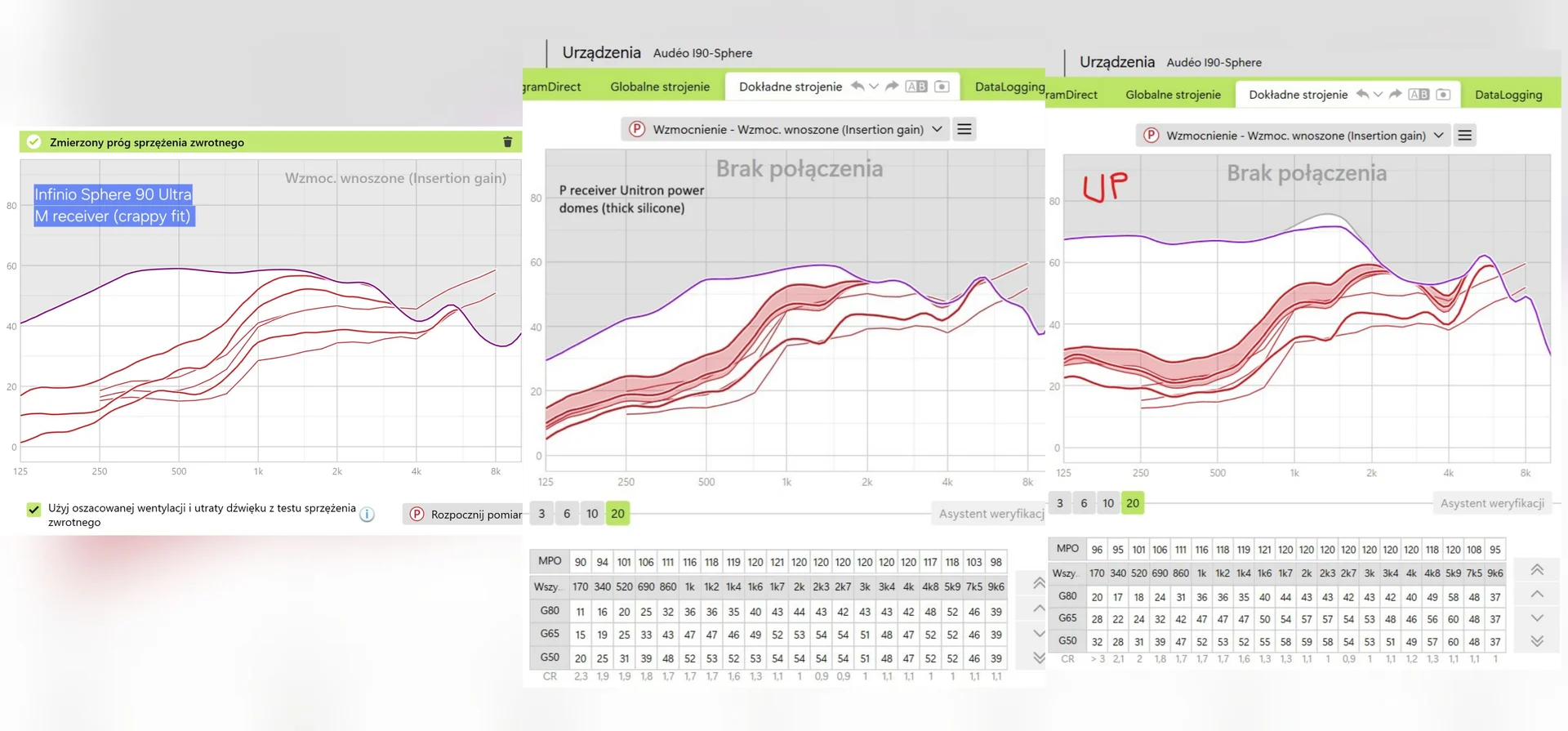
There is my fitting. From the left:
With M receiver which fitter gave me based on my audiogram - crappy - new was worse than my old Paradise.
With P receiver and Unitron power domes (because of thick silicone and better feedback threshold) very deep placed, so M size instead of L
With UP receiver in custom - cShell with 1mm vent
However I plan to try option 3., but with no vent - for better earplug effect necessary for my ear rehabilitation:
Looking at your hearing configuration you're probably a good candidate for a Signia device using Own Voice Processing, which uses a separate processing path for your own voice to reduce occlusion and abnormal own-voice perception. This would allow you to go with a more occluding fitting to achieve optimal mid and high-frequency audibility without compromising as much on your own voice.
Very interesting solution. I would add also some old-schooled - placing domes very deep, at least partially in bony part of ear canals, which ⅓ of their length, nearest to the eardrums.
The same applies for custom earmolds, which should be from silicone impression reaching at least 5mm past 2nd bend of ear canals.
Like to thank everyone for your input and suggestions. It much appreciated. I'll try to give updates later once I've received my new aids. Will likely be into November. Appointment is beginning of October. So about about a month or so to receive once ordered. has a werid time line sometime.



 San Francisco
 Poland