I understand whistling is caused by the low frequencies hitting the microphones on the Hearing Aids. And therefore people who need more gain in the low frequencies could experience more whistling than others (and properly fitting earmolds greatly reduce the feedback).
I guess my confusion is with the frequency of the whistling. Let’s assume that the ear molds fit properly (ASSUME ) Then, wouldn’t the feedback happen pretty consistently? And conversely, if the molds weren’t fitting properly (were seated properly in the ears) wouldn’t the feedback happen pretty consistently?
Here’s the reason for my question… My mother is a senior person, and she has low frequency, hearing loss, and custom molds. She almost consistently will hear the feedback when she puts her Hearing Aids on in the morning (which I understand). But there are times throughout the day when they whistle. I’m trying to find out the rhyme a reason for why they do that throughout the day.
Feedback occurs when any sound ,from the ear canal, emitted by the aids, leak and reach the hearing aid microphones. This can happen at any frequency, not just the low frequencies you mentioned.
Feedback depends on the amount of sound that leaks and, this can vary throughout the day. So no, it does not have to happen consistently during the day. It may depend on the sound volume, frequency , if the molds moved, if she raises the volume to hear better, etc.
The only way to fix chronic feedback problem correctly is to fix the leak. It could be that the molds are not sitting properly in the canal (or they move) or the venting on the molds is not optimal. Also check that your filters are clean.
Since this requires a physical inspection , it is best that she visits her provider for an evaluation.
Thank you both. This helps. I think it’s more than just the way the ear mold seals the sounds, but that’s the starting point.
She has meniere’s but hasn’t had a flare in years. We are learning the hard way, that her hearing is still fluctuating because of the meniere’s. I also wonder if when she becomes overwhelmed, and emotional, there’s a change in fluid levels affecting not only her hearing but also, possibly, causing more whistling.
Hello @Louaberg… As most posters on this thread might agree, as a rule of thumb, feedback/whistling is invariably caused by ill fitting moulds or molds to our American cousins… This is the predominant reason, the other causes have been stated…I recall my own father who was , probably in the severe threshold, at that particular time, I was rather ignorant about hearing loss, and hearing aids in general, I had just recently had bilateral myself, and it was a severe learning curve, with full blown Meniers Disease to follow in a few short years later! Anyway, my father’s aids whistled on a semi permanent basis, he also had severe dexterity problems, with severe arthritis in his hands, thinking back, with a large dollop of hindsight, I would say, he struggled to send the moulds fully home, and he was always readjusting his glasses, the combination of both, was probably moving the moulds further out the ear, thereby creating semi permanent feedback! As for Meniers Disease or MD, it can be a very traumatic experience, both physically and mentally… MD gradually destroys your vestibular (balance organ) I think you mentioned burnout, usually 5 to 8 years after the onset of MD, most folks will have classic burnout as MD subsides. I personally got cluster attacks, visual distortion, hearing distortion, horrendous tinnitus, vertigo, fullness of ear, nausea, and chronic fatigue after each attack, were the most common symptoms, there were others though, some attacks lasted an hour or 2, or sometimes all day, this could go on for days, occasionally weeks, burnout for me was around year 6 when these symptoms gradually subsided, over the next year or so… Not only does MD destroy your vestibular, it will also take some of your residual hearing, depression is very common amongst MD sufferers… Nowadays, I am mostly fine, my hearing is pretty knackered, my balance isn’t very good, especially in the dark, I live with depression and anxiety, but I survived! Cheers Kev ;-)
A wee edit here, having reread your posts, I rarely if ever get any feedback from my aids, maybe some slight feedback if my hand gets too close to my aids, or if I am wearing a hat! I can state most categorically, MD will not cause feedback! Cheers Kev.
I really appreciate the time you took to share yours and your father’s story. It has certainly given me more insight into the situation.
I guess I don’t think meniere’s causes the whistling per say. I suspect there are many contributing factors…and I am not sure I want to rule out MD being a factor (as opposed to the cause). I believe that every unique individual will have a unique journey. It’s really just one more thing to consider.
Is sound leaking always the cause of feedback? What about people with open domes? Isn’t it possible that her targets are just too close to or actually in the feedback zone?
Feedback occurs when the sound generated by the aids reaches the hearing aid mics . It’s a physical process. To stop feedback, you have to stop that sound reaching the mics .
Algorithms can shift the offending sounds to other frequencies or reduce the gain so that the effect is minimized but the root cause is always the same.
Yeah Dave, if a hat or hood is too close in proximity to your hearing aids, you will get occasional feedback… Analogue Hearing Aids (Pre-Digital) were terrible for this, nowadays with digital, the feedback management system usually curtails this, if it’s switched on, it normally is? Cheers Kev 😉
You are very welcome @Louaberg… Like all hearing loss, all hearing losses will be different, a personal is unique to that individual, bone conduction will usually vary, IMO it is equivalent in relative terms to a fingerprint, I have yet to see anyone with the same audiogram, they can be similar, but never identical once you throw in personal preferences, likes and dislikes, and other mitigating factor's… Some folks, with similar audiograms will love certain hearing aids, others with similar losses will absolutely hate them, tis the way of the world, and there is no one size that fits all, we are indeed totally unique individuals! In that vain, Meniers Disease is similar, my experience with MD is unique to me, how it effected me, the intensity of attacks, the symptoms will vary, for instance, some folks will vomit intensely due to vertigo/dizziness, I never did, I got the nausea, but no actual sickness… There is no cure for MD, once you have it, it is yours for life… It is well over 20 years since I have experienced MD burnout, prior to that, my life was on total hold, I couldn’t work, whom would employ me? I couldn’t plan anything, I was to all intensive purposes, a virtual recluse! Fortunately, most of the symptoms dramatically improved, and much to my surprise, I was able to return to work for approximately 15 years or so, (now thankfully retired) yeah, I was severely damaged goods, both mentally & physically, but we are very resourceful human beings, we learn to adapt… I reiterate, feedback is not caused by MD! Good Luck in finding a solution though… Cheers Kev 😉
Right, my post was poorly worded. Of course leaking sound causes the feedback. But sound always leaks with a non-occluded fitting. If gain is adjusted too high getting close to or into the feedback margin you will have feedback, right?
There must be a bug in this system @AbramBaileyAuD I replied to Jackhammer in the last post, only to see 2 versions of the same post, so I deleted one, and they both disappeared… Cheers Kev 😉
My mom’s hearing seems to change. Sometimes better and sometimes worse, and most notably in the low frequencies - both ears. She consulted a very well respected who said MD can do this. I suspect this is related. As you point out, it’s an individual journey. Many thanks.
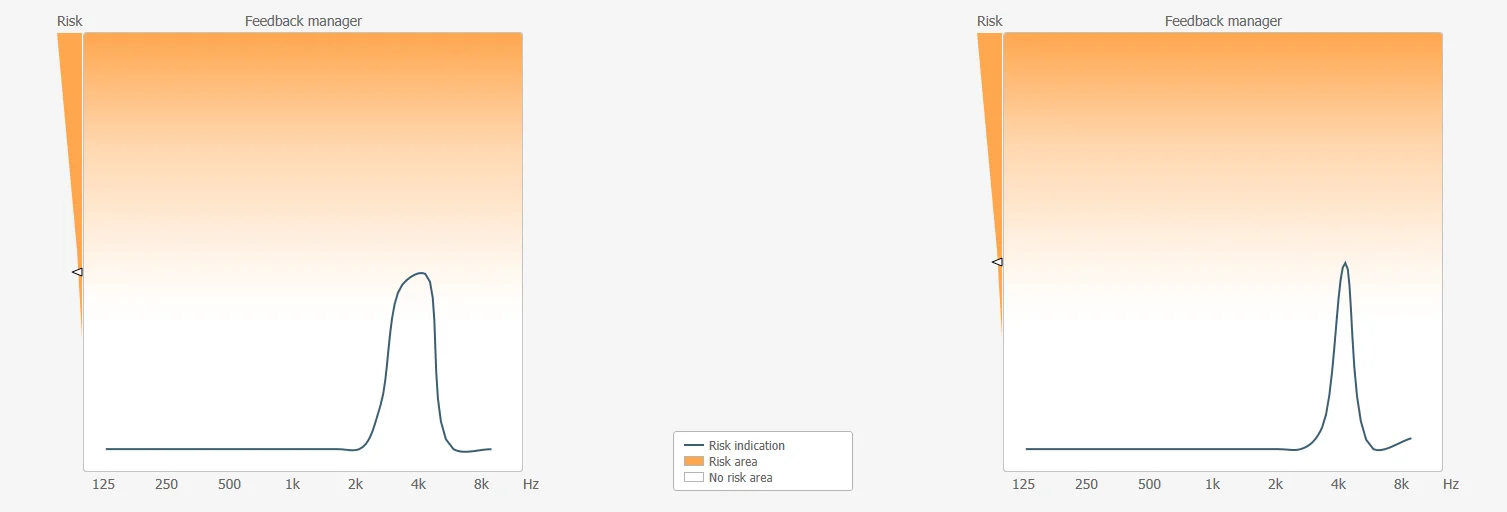
It depends on the brand's feedback manager, the position of the dome, ear canal characteristics, wax, etc. It also depends on how the brand defines the feedback limit (Widex is conservative for example).
Some fitting software, like Widex, have a chart that shows the risk of feedback at each frequency.
I replied to Jackhammer in the last post, only to see 2 versions of the same post
Is it possible you saw 1 version in the nested replies and another below? If so, that's normal, and they would both be deleted if you delete 1 since they are effectively the same post shown in 2 places.






 Wales, UK
 Canada (Toronto) YYZ

 Scottish Highlands


 Auckland, New Zealand