I was just thinking, trying to verify a hearing aid fitting for your hearing loss on-ear might be quite difficult as the probe microphone used to measure the output of the aid creates a leakage path for sound that increases the risk of feedback which can result in constant whistling for profound hearing losses because of the amount of gain required. Such fittings can often be verified in a test box after taking a measurement of your ear canal acoustics known as an (abbreviated).
For most profound hearing losses there isn't any venting but for your fitting venting will be required to some degree. The only verification equipment that can simulate venting in the test box is an Audioscan Verifit 2. If you can find a clinic that has one of these it'll make the process easier and a lot more accurate.
In terms of hearing aids, avoid Resound as their technique is near useless. If your audiologist can measure RECDs and get different devices in they can simulate their performance and how the frequency lowering works for your loss in the test box to help narrow down appropriate devices. The University of Purdue Frequency Lowering Fitting Assistants 2can be helpful with this process.
Very similar for me. High pitch, consonants, unheard or miss heard. Can have reasonably good conversations and banter with some people, impossible with others. Happily use subtitles for the telly. When I tell people I’m not reading them, but hearing the dialogue perfectly, they just don’t get it. Not sure how it works, but it must be something to do with constant context or one sense piggybacking on the other. Anyway, I just wanted to ask a question about frequency shifting technology . If I can pay £60 for a bat detector, why do I have to pay 30 times that for the same technology to listen to people .
I did indeed respond to all frequencies during the audiogram.
My hearing was much worse than yours prior to going bilateral . My upper frequencies turned out to be unable to define sound although I could hear painful pops and crackles. This is essentially dead zones that can not assist your brain to understand speech.
Your ability to understand speech better while streaming is helpful information. It proves you should be properly fit with aids and use them long enough to give your brain a chance to learn, might be 6 months or longer.
If you did consider CI most countries that I am aware of expect the patient to wear properly fit aids aids for a predetermined time prior to implants.
If I can pay £60 for a bat detector, why do I have to pay 30 times that for the same technology to listen to people .
A) Bat detectors can use a range of technologies such as heterodyne detection, frequency division, time expansion and real-time expansion - they aren't the same thing as the technologies in hearing aids.
B) Each manufacturer has a patented solution (or licenses a patented solution) that works different to all the other ones and they took a lot of effort to develop. These make up a very small part of the total cost of hearing aids, you're getting a lot more than this single feature.
Some good points raised and gives me hope that treatment is available even if it has not been addressed in a number of years.
I'll make sure to ask about when I follow up with an audiologist.
Regarding the cochlear implant assessment on the NHS, do you know the steps involved, @michael1 to getting access to this treatment? Should I start by asking for a referral to one of the main hospitals in either Liverpool or Manchester?
I was referred by a Specsavers audiologist who commented that Boots should have referred me.
So it seems that any audiologist could do it but minot want to.
Try your GP who will probably referr your to the NHS clinic, if the waiting list is long then ask Boots or Specsavers if they would cooperate. I was lucky to have one that cared and wouldn't sell me any aids that wouldn't help so there not all sell sell sell.
In fairness, although your loss is a definite referral for , the OP’s loss is entirely different and he would be potentially unlikely to meet the CI criteria if he’s got a working hearing-aid solution. (Unless things have changed locally).
The fact that it’s notionally a ‘free’ path in the U.K. shouldn’t really sway the surgical choice either.
If well-fitted hearing aids work for me, then that's great. I've just been trying to understand what the appropriate treatment or assessment is for my particular hearing loss, and how I go about getting it, before potentially spending £5,499 on hearing aids privately.
I did have a private assessment and a short trial on Friday. The audiologist was very honest about the limitations, particularly given the very steep drop between my low and high-frequency hearing. He wasn't sure how much useful improvement in speech understanding could be achieved, although he did discuss frequency shifting as a possible approach.
Not sure how much of this is helpful at this point (there's a lot of good replies), but:
For most of my life I've simply called it "high-frequency hearing loss", but I've recently realised that doesn't really describe what it is like to live with it.
I don't live in a world where sound is simply loud or quiet. I live in a world where sound is often there, but the information inside it isn't.
I can hear someone speaking, sometimes quite clearly, but the words themselves can disappear.
My wife can shout to me from downstairs and I can hear her voice, but I have absolutely no idea what she said. A child can be standing in front of me asking me something and I can hear them talking without being able to understand the words. Someone whispering and the words can disappear.
This actually is quite consistent with hearing loss at higher frequencies. Your (later provided) also confirms this - and in fact you have losses also in the mid frequencies as well, so it matches what you describe quite well actually - just that there are losses even further down the spectrum in addition to the "high".
The reason why the information often isn't there is precisely because of the missing frequencies - the information is (simplistically) the mixture of all the frequencies together, so if you are missing some, it can be critical frequencies that are missing. It would be like reading a document with missing letters - depending on the letters missing and which word, you might be able to compensate through context, or you would be left saying you know there are words there (or meant to be) but you don't know what it says.
The first thing would be to try and see how to assist in getting better response (lower and flatter thresholds) across the frequencies. There's already good responses that cover that. Then it would be how to work with that (e.g. if we can't get good responses, then frequency shift etc.). Then it would be a process of trying to train to make better use of them (e.g. auditory training.)
Analogously, that would be like saying:
The first things is to get better responses (see if we can get most of the letter read correctly, rather than just missing)
If we can't, then we can try to work within that limitation (reword the document to keep the meaning, but avoid words with those letters/words that become unintelligible without those letters, or use alternative spellings)
Training to get used to the new spellings / vocabulary or new patterns of letters that you can now see.
At this point it seems you'd probably be best exploring step 1 further, and other responses have covered that in detail already, along with the potential challenges in your case.
Can you understand sounds on all frequencies of your audiogram? The answer would lead you to power aids with occlusive molds or it would lead you to frequency lowering.
Thank you 'Raudrive' I did indeed respond to all frequencies during the audiogram.
I don't know which hearing aid do you have (or don't). If you have some patience and like to experiment (and spent some money ~$100 equivalent, maybe less, just for getting knowledge about your hearing) - based of my experience with my relatively good low frequency hearing - consider:
Manufacturer with low floor noise UP receivers, like Phonak and its SDS 6.0 UP rec.
Very deep silicone impression, at least 5 mm past 2nd bend of ear canals to make deep placed cShells (earmolds) to minimise occlusion effect risk.
Occlusion effect can be alleviated when at least part of the cShell (earmold) lay in the bony part of ear canal (1/3 length of ear canals, closest to the eardrums)
cShell with no vent to maximise feedback threshold so then maximising available gain for high frequencies.
That looks like simply, but the difficult part are:
who is willing to make deep silicone impression or deep digital scanning
Sometimes cShell should be remade because of not being fitted enough
You may have to get used to the occlusion effect, at least to some extent (not necessarily, depending on depth of earpiece)
If you have narrow ear canals, then titanium cShell would be needed or hearing aid instead of . Then Naida Lumity (or maybe Naida Infinio/Eon soon, I hope) would be better, especially with SoundRecover2.
That from MY experience, because I don't feel occlusion effect, or it's manageable. YMMV.
Oticon Reveal 1 with 105 receivers may provide more gain in high frequencies, but I am not sure about Oticon floor noise with their 105 receivers.
Another option is to use something like SoundRecover2, which compresses the frequency. It might take a bit of time to get used to the new sounds, though.
My loss is some what similar to yours. Also loss since childhood. I don't remember since i was so young. But was basically deaf for three days. (Probable Reason) Exposer to gun fire around age 5. (1980)No hearing protection other than fingers/ parent not making sure i pluggedthem up. Hearing came back. Since I could hear somethings really well it was chaulked up to I need to pay attention more. Crap doctors plus my whole family talked loud so it seemed i could here fine. A lot of your other experiences have occurred to me . Especially hearing speech but not understanding it. I currently have phonak lumity with acrylic eamolds. They work good enough. I still have trouble in cars and group settings. I'll be getting a new hearing test in two weeks. Hopefully no new loss. Will be ordoring ne hearing through the . Maybe starkey omega. I would suggest trying different brands if possible. What works for me may not work for you. Good luck. It's a journey.
You wouldn’t normally occlude to that extent with this kind of loss, the risk is that you’ll block/diminish/process the quality out if the ‘good’ portion of the .
You wouldn’t normally occlude to that extent with this kind of loss, the risk is that you’ll block/diminish/process the quality out if the ‘good’ portion of the Audiogram.
Yes, I considered that, remembering post from @Hearing_Potential about 24 kHz sample rate in Phonak . But in practice, I don't perceive that deterioration at all, even when I play semi-professionally with guitar.
And benefits with no vent: more efficient noise reduction and high frequency gain not bothered by feedback threshold are unpararelled.
So if I were you, indeed, I wouldn't propose my setup for patients with good low frequency hearing, espencially when they're inexperienced ones. But after some counselling and when patients like to experiment despite some costs...
I wouldn't propose my setup for patients with good low frequency hearing, espencially when they're inexperienced ones. But after some counselling and when patients like to experiment despite some costs...
Yeah?, no.
Tonal reproduction isn’t speech. Also the approach for a new user is entirely different than an experienced one. People with very good low frequencies usually dislike ‘any’ occlusion.
This might not fit with your experience but as I often say on here: ‘Data isn’t the plural of Anecdote’.
This might not fit with your experience but as I often say on here: ‘Data isn’t the plural of Anecdote’.
Yes. I agree. As a clinician, you must choose the approach that is most likely to be best for a given patient, in accordance with best audiological/medical practice. With my loss this is earpiece with some vent. And making "out of the box" ideas like mine is a bit risky, regarding sound quality, etc.
However, my anecdotal case is real, but that don't undermine what you said and I in the paragraph above.
I even renewed my ~1 month ago - it's still the same.
It can help, but once you occlude canal completely your reproduction has to be spot-on and the representation of the directional field too. Bear in mind that most directional systems also roll off low frequencies.
Bear in mind that most directional systems also roll off low frequencies.
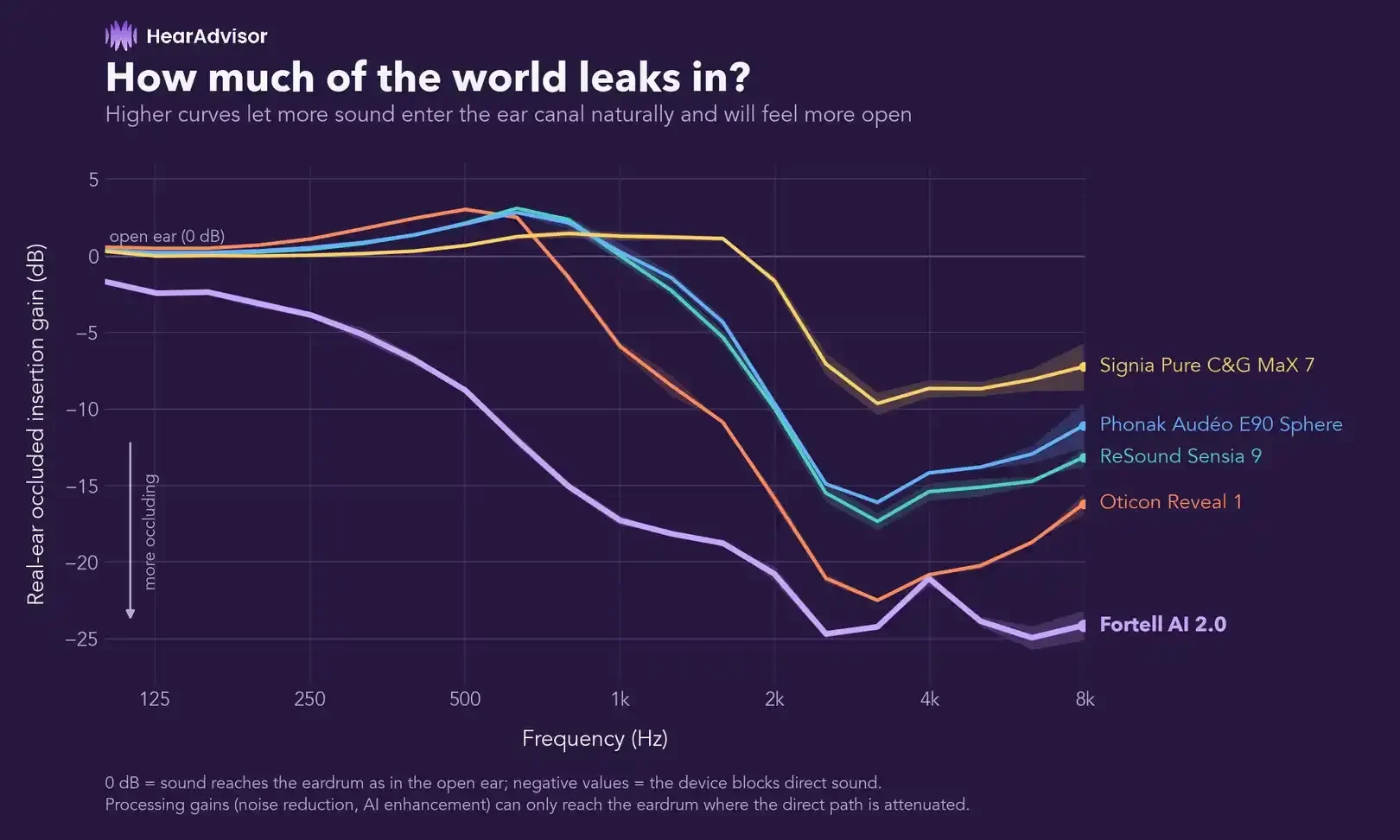
For what I see from my REOG (and Fortell's with power domes in HearAdvisor testing) - it's hard to roll off frequencies below 250-300 Hz unless I am not taking something important into account.
However, you have definitely more experience with REOGs testing.
 Doncaster UK


 Donegal, ireland

 Texas Hill Country
 Wales, UK
 Poland