Recently, my stated that the was a far more important number than the results. Mine is 80 in the worst ear. Comments?
You’re ignoring this member’s posts.
This topic is closed.
16 replies6.6k viewsLast reply
Recently, my stated that the was a far more important number than the results. Mine is 80 in the worst ear. Comments?
You’re ignoring this member’s posts.
Could be 70% at your next appointment and that would not be a significant difference. Sometimes and will say 80% but it will mean 8/10 live-voice which is almost meaningless.
That was a pretty general statement about something with dramatically high variability. I think, if pressed, the might set some parameters for his comment.
You’re ignoring this member’s posts.

Oh how I wish I had that high. Mine are down around the 30 mark… Just take care of your hearing from now on.
You’re ignoring this member’s posts.

My audiologist hasn’t explained my word recognition scores. Mine appear in a column in the marked “/SRS1.” Then there are 2 columns labeled “%” and the other labeled “” I’ve assumed that percent meant percentage of words I recognized and they are 84 for the right ear and 96 percent for the left. In the other column (dB HL) it says 65 for the right and 50 for the left.
I think this means that my left ear has almost no loss, and that the decibel column probably means I could hear quieter sounds (50 decibel) in my left ear at a 96% percent rate while the 84% recognition in my right ear was measured with louder sounding words (65 decibel) and I only heard 84 percent.
Have I interpreted these results properly? Do any of these numbers represent how I hear, unaided, in noise?
You’re ignoring this member’s posts.
People needs words to be both loud and clear. An indicates how much amplification from things like hearing aids or you need in various frequency ranges. The indicates how challenging background noise, reverb or distance will be and where noise cancellation, directional mics and using strategies and/or other technology like large area listening systems and can help.
You’re ignoring this member’s posts.
Word Recognition, or Discrimination score is more important in determining potential success or failure with hearing aids than the frequency scores are. It gives the Technician a snapshot of the overall health of your hearing system.
Most people with 80% discrimination scores will do well with hearing aids if they give it the effort and time necessary. When it drops below fifty percent, it is 50/50 at best as to whether or not a person will get the benefit they are looking for with hearing aids.
You’re ignoring this member’s posts.

It means you understand x% of words at x . So I can understand 40% of words when they are amplified to 90dB
You’re ignoring this member’s posts.

Does anyone know if you need a if one ear is 56% and the other 12%.word recognition?
You’re ignoring this member’s posts.
CJ, most likely a person with the discrim scores you quoted would be much more successful with a than a fit. 12% discrim means that the auditory nerve and Acoustic Imaging Center on that side of the brain is pretty much incapable of doing it’s job as originally intended.
You’re ignoring this member’s posts.
Thank you, I needed to hear that the is the way to go not a hearing aid. It does work fine. And thank you for explaining my auditory nerve, my audi never explained it.
You’re ignoring this member’s posts.
You’re ignoring this member’s posts.
I have a progressive loss and at this point t am at the profound loss stage with 20% speech comprehension. I’m waiting now to try the new marvel naida with my loss I have to be realistic regarding expectations. And I really don’t want to get a cochlear implant.
You’re ignoring this member’s posts.
I’ve had two hearing tests recently (oops, need to update my posted , looks similar from memory… but the posted one was from a test two years ago…) and I’m pretty sure there was no word recognition test. Both involved listening for beeps and briefly that cochlear thing they put on? No ‘words’ involved, hmmm. 
I have high hopes (hard not to?) that the new KS9’s I pick up Saturday will be awesome but I guess I’m mentioning it because, if its not too obvious, it’s words I have a problem with!  Seriously… as my hearing (and/or aids, wearing 10 year old failing Audeo Yes’) has declined when I ask people to repeat themselves (way too much now…
 ) even when they increase the volume and I really really concentrate, some words I just can’t get… so we need to give up… Its embarrassing after the 3rd(?) “sorry just say that ONE more time!?” Anyway we’ll see I guess. Just wondering.
Oh tests here in UK were with Specsavers and Costco
You’re ignoring this member’s posts.
Well I screwed up linking my reply so the forum is being grumpy with me.
interesting. I don’t think outside of the school run tests when I was a kid that I have ever had a test w/o word recognition. Really wish I had gotten my printout in December. Will have to do that on the 23rd when I go for retest and fitting because I feel (and so does my wife) that there’s been a change in that time. And jeez this week on travel I have been struggling more than ever. Fortunately one of my teammates has been acting as a repeater for me where she can.
You’re ignoring this member’s posts.
And I really don’t want to get a cochlear implant.
You might want to follow along with Piper’s experience.
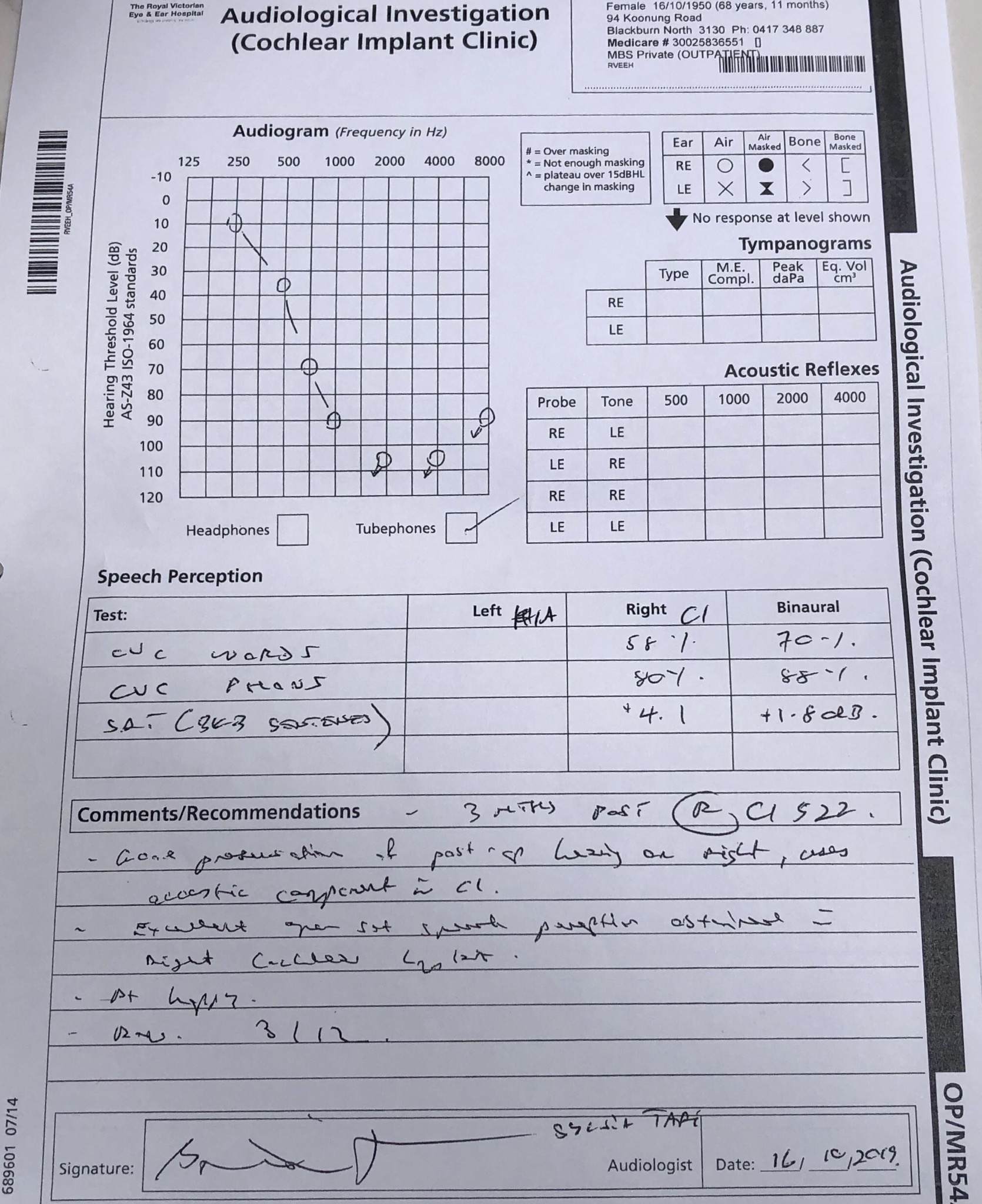
@Neville I know it’s a stupid reaction, But fear of the unknown is very real! Along with hindsight! I went for a HA adjustment today, my Aud was going through the results with me. She kindly printed out my missing page of my 3 month report from the CI clinic. My audiogram, umm jeepers, my residual is in normal range!It’s not been in this range for 40+ yrs. [image]
A CI is a big deal, certainly a huge decision, and there are some scary unknowns. But good outcomes with a CI can take you from 20% word recognition to 80%. When it works, it’s life changing.
You’re ignoring this member’s posts.

are not indicative of one’s hearing in noise. WRS are helpful for letting you know how you can expect to hear and understand speech in quiet. You need a Signal to Noise test to know how you can expect to hear in background noise.
You’re ignoring this member’s posts.
Oops, yes thanks for clarifying Alex. I should have mentioned the “Speech in Noise” test. I was trying to make the point that the is an indicator of how clear words will be, but not necessarily in noise.
You’re ignoring this member’s posts.
Hearing Loss80 replies
Hearing Loss1 reply
Hearing Loss8 replies
Fitting Software Requests1.1k replies
Uncategorized451 replies

 Melbourne
 Memphis Tn.