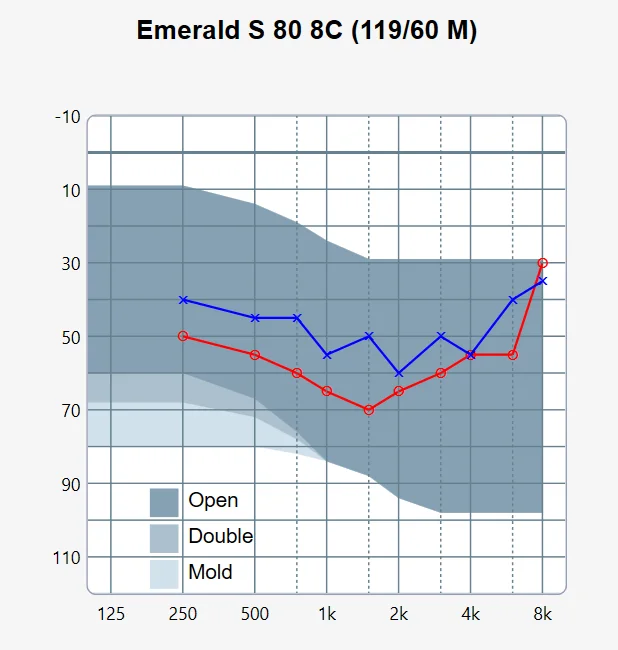
I have been cursing the forum for the last several weeks, as I’m looking for a new pair of hearing aids. I’m 42, and I have Alport Syndrome. My hearing is expected to continue to decline, possibly quicker that I’d like. I see that a lot of people keep referring to the “typical ski slope” , however my audiogram is more like a smile. I have been looking at the typical top 3, the OPN S, Quattro, and Marvel. I have tried the OPN 1, and the Quattro 9, haven’t tried the Marvel yet, but I want to. I haven’t yet come across anyone else that has my type of hearing loss. Is there anything I should be concerned about with the 3 I’m looking at? Will one work better for my type of loss? I currently have the Starkey Halo 2’s, I got several years ago, and they were ok, but I find myself constantly asking people to repeat themselves. I have had them adjusted and adjusted and they still are not really helping. My family is really tired of having to repeat themselves. Any insight or suggestion is greatly appreciated. I just updated my audiogram if it helps.
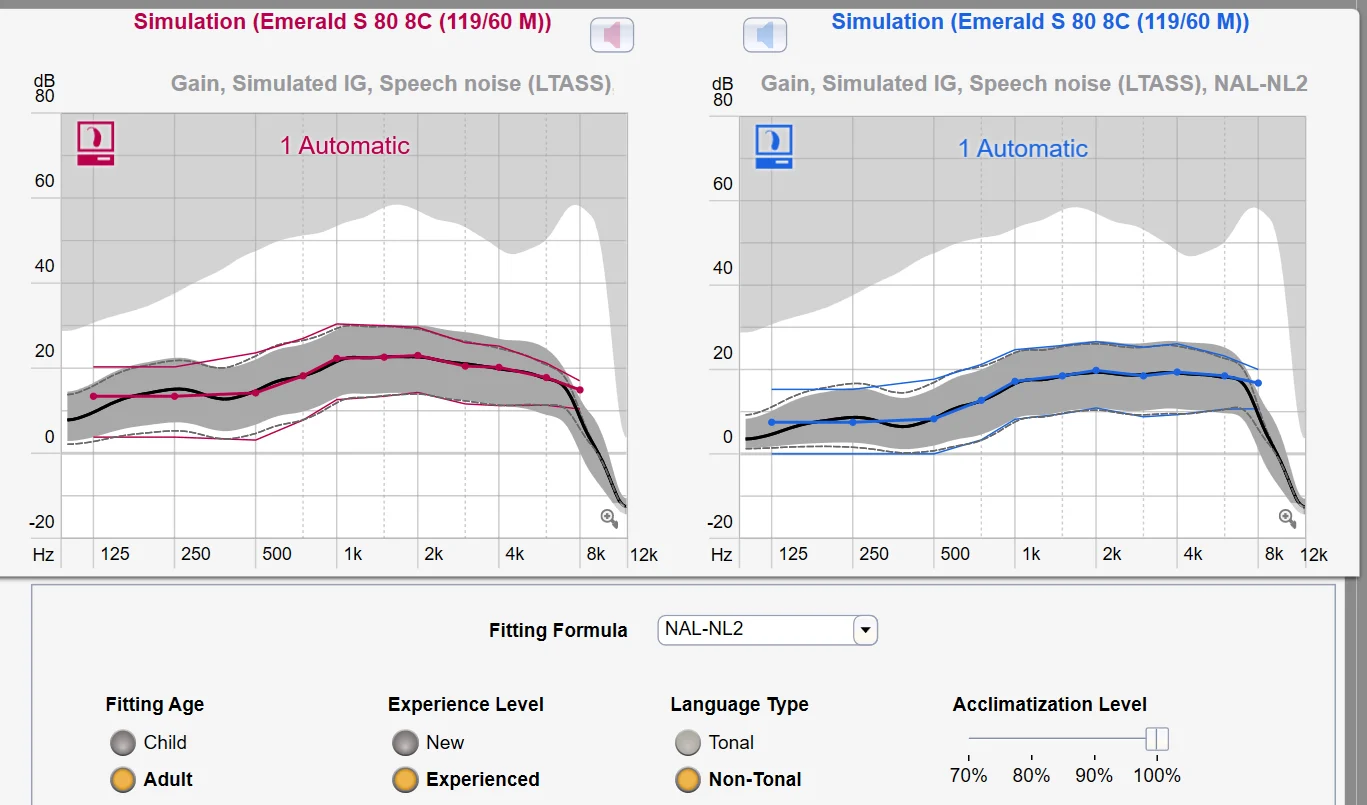
I’m new to this stuff, but I have downloaded some software that lets me display how hearing loss fits on the Rexton (Costco Kirkland and Signia) hearing aids. On a quick look your hearing loss would appear to fit a M receiver on the Costco Kirkland Signature (or Rexton Emerald 80, or Signia Pure 7Nx). However if you wanted to get something more powerful to provide for further deterioration, the P receiver should work too. The chart for the M receiver:
The gains with closed click sleeves seem to fit quite comfortably within the capability curves using the fitting formula.
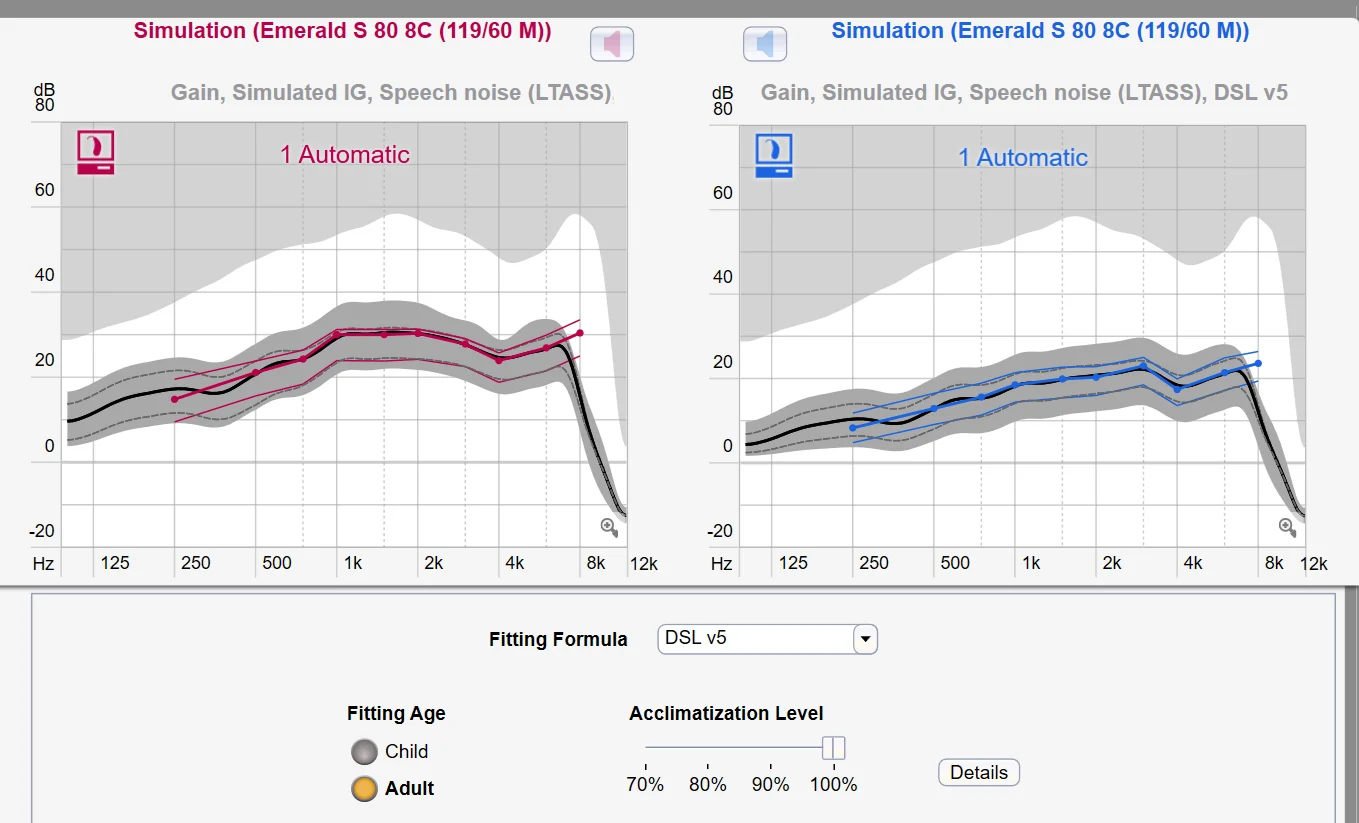
Here are the gains using the v5 fitting formula. It provides more emphasis on the higher frequencies. Since you have a smile shaped loss curve, you can likely hear these frequencies without high levels of amplification.
My thoughts would be that you may not need anything special for a hearing aid and the M receiver Costco KS8 or the equivalent Rexton or Signia may do just fine. However, what I would focus on is the fitting formula and request a fitting using both the NAL-NL2 and DSL v5. I am not 100% sure but I think they can use the program feature of the hearing aids to put one correction formula in one program and the other correction formula in another. Then you can go home and try each to see how they compare for speech recognition if that is your main concern. Or worst come to worst, you could try one formula for a couple of weeks and the other formula for a couple of weeks.
I would think any of the aids you mentioned would do well. I think most important is the hearing aid professional you work with. Some of it depends on your preferences (basically personality). Do you want hearing aids that “just work?” If so, I’d say the OPN S or Marvels. If you like tech and being able to make multiple adjustments via an app, the Quattros or the Widex Evokes could be good choices. Something to consider if you find yourself in situations where noise is an issue is that a Marvel and a Roger microphone could be very effective. A less expensive approach could be the Quattro and a MultiMic.
The common term for your type of loss is called “cookie bite”. The term “smile” is not what is commonly used for that type of loss, and why you are not finding much info.
Try this search for “cookie bite”. Goog luck, have fun.
Thanks for the clarification, that will definitely help me when searching in the forum. I struggle the most with understanding speech. I often find that everything is amplified but I still can’t “hear” or rather understand what people are saying. This may be common with my type of hearing loss as I hear highs and lows ok but suffer in the mid ranges. My wife thinks I’m just ignoring her most of the time. What I really want to be sure of, is that the device I choose will be able to roll with the progression of my hearing loss. I have been told that due to my condition my loss will likely continue to decline.
I would go with the Marvels. Their Ultra power receiver has been great for my profound loss, better than Quattro. You may not need the UP receiver right away, it could be something you grow into. Marvel’s UP receiver is better than Quattro (more frequencies available in Marvel UP). You may just need the power receiver for now, though.
Clarity seems to be your issue. I found Marvels better than Quattro for clarity. This is entirely subjective though and relies heavily on the skill of the audiologist, as well as fit.
If your word recognition scores continue to decline, I would encourage you to be open to cochlear implants. I personally look forward to the day I get mine—I’ve seen people do so well with them. What are your current word recognition scores? They’ll be found on your .
My word recognition scores are 68% in the left and 60% in the right. I find myself doing a lot of that awkward smile and nod when people say things that I don’t quite catch.
Speech crosses a wide range of frequencies and amplitudes. To have good speech recognition you need to be able to hear most frequencies and amplitudes. The shape of speech is sometimes referred to as a banana, as a banana shape encompases most of the sounds used in speech. Your problem is that the cookie bite hearing loss almost matches the banana shape and you could be missing almost all speech. The more typical older age ski slope type loss misses a little bit of the higher frequency softer sounds (f, s, th), but includes most of the others. You on the other hand may only be hearing the f, s, and th sounds and missing the rest. See this graph of a cookie bite loss imposed on the speech sound banana graph.
As I suggested I think that most premium well set up hearing aids should work for you. My focus would be on the fitting formula used to provide the best speech improvement.
The formula provides higher compression, so soft sounds are amplified a lot more than loud sounds. It also does not amplify as much in the higher frequencies. It is commonly used for older people with typical ski slope loss. Because of the higher compression it is more suitable for those with long standing hearing loss with reduced dynamic range.
The v5 formula uses less compression so more of the dynamic range of sounds will be preserved. It also tries to maintain the high frequency hearing, while the NAL-NL2 kind of gives up on it. It also may be better for those where the loss is not long standing. It is frequently used for those that are younger and children.
But one could argue the pros and cons forever, and the quick and dirty is to try both and see which works best for you.
I suggested Costco because the price of the KS8s are good, and the fitting is all at no cost. The return policy is excellent. The other good feature of Costco is that they use real ear measurements () to actually measure in your specific ear what levels the ’s produce, and adjust the output to match what the formula predicts. Many HA dispensers skip that step to save time and money.
This is great information, I have learned so much from this forum. I have considered the Costco hearing aids but I’m working with my insurance and I may actually be able to get the before mentioned hearing aids for less money out of pocket.
Speech is definitely where I have the most issues. I think the next best step will be to try out the marvels and see how I like them. I’m intrigued by Autosense 3.0. I’m very into tech and thought I would like the ability to adjust everything in the app, but I’m not sure I want to constantly do that work.
I think it is easy to get swayed by the bells and whistles features of ’s. Some are helpful, and many, not so much. I find the Universal program in mine covers almost all situations quite well. The marginal gain by using specialized programs for special situations is kind of underwhelming. I will say again that getting the right fitting formula for your specific hearing loss is likely the most critical issue for speech recognition. And getting a to ensure it is really set up correctly is also critical. Ensure your audiologist will do it.
That said, the features that I do find useful are:
Ability to stream directly to my iPhone - provides very good phone speech sound
The ability to adjust the “focus” of the microphones to a narrow beam (with my iPhone)
Noise/Party program
The recorded music program
Other features I use occasionally, but if truth be known, I can do without them…
EDIT: I thought about this a little more, and had to add the Noise/Party program to my list of useful features. It does work a little better than the Universal program.
Hello! I have Ménière’s with fluctuating and intermittent mild-moderate loss in my left ear and near-normal, consistent hearing in my right ear. I have the Quattro rei761 model and love the personalization I can do with the Smart 3D App. My audiologist programmed two of the four default programs to one for “good” hearing days and one for “bad” hearing days based on my best and worst . Even though I don’t need the For my right ear, I wear it as the communication between the left and right is important for my situation. I need to adjust the balance between my ears.
I have tweaked the settings based on my “good day” settings for the environments I am in most frequently and saved them as Favorites. I turned the GPS setting on for those so when I arrive at that environment, the HA’s automatically switch to that program. It is awesome!
If you can adjust the aids you are trying, work with the middle slider, up or down, to adjust for your type of hearing loss. Boosting or lowering bass or treble affects ambient sound (bass) and sharp, edgy sounds (treble.) The mid-range slider covers the speech banana range. Read something out loud and when your own voice sounds right to you, save those settings as a favorite.
My Home favorite kicks in when I drive up to my driveway and my Away setting changes when I get to an intersection I go through most of the time. I also have a favorite for school/church. When I’m anywhere else, I use my default Good and Bad programs, depending on my hearing level for the day, and tweak the sliders, if necessary, for the sound environment I’m in at the time. They will go back to the defaults the next time you restart the HA’s or if you touch “reset” manually in the app.
I also have the Music and Outdoor default programs enabled and I find those programs very useful, as well.
If you are tech savvy, you will figure it out with any HA that is advanced enough to give you flexibility. Let us know how it works out for you.
Cookie-bite is pretty rare and often needs quite unusual settings. Many audiologists don’t have experience with it, which doesn’t help. It depends a lot though whether it is long standing and maybe “developed” to become more noticable over the years, or whether it has appeared very suddenly.
People who have “always” had it, including people for whom it has slowly got worse (developed) over time, tend to have naturally learnt lots of skills to work around the cookie-bite. Often it is unnoticed until age 30+ or 40+ because they are so good at working around it. They often have apparently amazingly high word recognition scores compared with others with similar loss levels (mild, moderate etc.). That all sounds great, but it can cause clashes with how hearing aids are commonly set up best to help the vast majority, those who have either ski-slope loss or have noise related hearing loss.
If it has suddenly happened though then its possible those natural skills won’t be as prominent and a more normal setup and programming could be helpful.
Cookie-bite, other than for Severe or Profound loss, mostly seems to have better outcomes with very open fittings such as // with open domes. In-the-Ear types and ’s with molds are often a nightmare it seems. Lots of channels seems to help particularly get nice customised settings, and wide-bandwidth is a real help for many. That is all good news with the newest generation of premium hearing aids because they are far better at working when set up like that than 10 years ago. Also the RITE/RIC/RIE are often very tiny nowadays which is a nice bonus.
Differences I have seen with fellow cookie-biters (compared to the majority of hearing aid users) also include mostly wanting some of the fancy tools/software built into lots of hearing aids turned off, or at least turned down. Things like some of the “compression” techniques where they include frequency shifting can confuse or disorientate because they compete with how cookie-biters have often naturally learnt to use the sounds they can hear well. Music programmes tend to be great because they mostly turn off those tools and to give the nearest possible to exact sound - that often works great
Some of the anti-feedback tools can on occassion cause problems as well because again they can include frequency shifting.
As I said - for cookie-bite the most modern hearing aids are a huge leap forward compared with a decade ago
Thanks everyone for the replies. Most people with Alport Syndrome report hearing loss much earlier in life. I always considered myself lucky that my hearing loss came a little later. However after you mentioned that cookie-biters learn workarounds with their hearing, I think I may have been in that group for a while.
I also find it interesting that you mentioned open domes. I have been struggling with my current hearing aids for quite a while and I was switched to very a couple of years ago. I also find that many of the audiologist I visit immediately go to closed domes, or suggest ear molds. This suggestion along with your mention of feedback suppression makes me think that the OPN S I was considering my not be best for me. I experienced horrible feedback with the original OPN and closed domes. The OPN S claims to help this with their new feedback suppression, but that may actually make things worse.
I understand many audiologist suggest premium hearing aids because they don’t want to leave anything on the table, I feel the same way. I want to make sure that whatever I get will continue to do a great job in the years to come.
I have trialed a number of hearing aids over the last month or so and I have to say that generally I feel let down by how I hear with them, regardless of who programs them. They obviously amplify sound, but I don’t feel that I can understand speech any better. Is there something in particular that I can suggest or lookout for when they’re being programmed?
just in case it helps - lots of cookie-biters I know of have had good success with the OPN1’s you have. They have really wide bandwidth compared to older ’s and they have loads of channels for precise setup. For whatever reasons the OPN2/3/Siya have narrower bandwidths. BUT the people who love them all seem to have versions, have had them fitted with open fittings, mostly used a reciever size/power chosen to maximise bandwidth and avoid. Also they are programmed differently from normal, pretty much ignoring the automatic “target” based programming settings in Genie2 software. Mostly aiming towards “exact” sound.
65dB losses can certainly be coped with without feedback being a major nuisance even when in “music” style settings and with the anti-feedback minimised. Mine are less advanced than your HA’s and even they cope OK with my loss level. My hearing aids the specialist also softened the curve of the boost the hearing aids give compared to the “target”, and that worked for me, but we are all unique.
I found the years when I had closed fittings and then molds forced upon me by were an absolute nightmare. Here in England most audiologists have never treated a real life cookie-biter. Audiologists that have no experience with cookie-bite keep trying to use the standard rules, which can be appalingly bad for many cookie-biters. Finding a cookie-bite experienced audiologist can be hard though. I know of a few in the USA who have to fly to see there audiologist ! They get great outcomes though
I have trialed a number of hearing aids over the last month or so and I have to say that generally I feel let down by how I hear with them, regardless of who programs them. They obviously amplify sound, but I don’t feel that I can understand speech any better. Is there something in particular that I can suggest or lookout for when they’re being programmed?
Some questions:
Do you have trouble with speech in quiet one on one conversations, or only in noisy environments?
Have you had real ear measurements () done with your current or trial hearing aids. Did they adjust them to target?
Have you tried both and v5 fitting formulas?
If feedback has been a problem, I doubt that open fittings would work. Neither is feedback suppression likely to work. Seems to me it is best to avoid the feedback, not suppress it.
I generally have issues with speech in just about every environment. I find myself reading lips A LOT. If a person is turned away it’s almost impossible to understand what they’re saying. I hear they’re saying something, but I can’t make out the words. I have had done with the OPN’s I tried, and it seemed to help but the OPN’s strike me as a hearing aid that really requires an extended use to get used to the way they work. I’m not sure that hearing EVERYTHING is something that I can handle right now, when it requires so much focus to understand what’s being said.
As far as your last question: honestly, I’m not sure what that is, maybe you can explain a little more?
Here is an article8 that talks about the differences between the fitting formulas used. It is fairly complicated. Your fitter should be able to set your hearing aids up to or v5. The NAL-NL2 is the more common one used for older adults. It may not be the best for you though. That is why I suggested trying both fitting formulas to see what works best for you.
The graphs I posted earlier show you what each one would do for your hearing loss. In the simplest generalization the DSL v5 provides less compression, which means it does not reduce the amplitude of loud sounds as much, and it does not amplify the level of soft sounds as much. It leaves them with a wide dynamic range. The NAL-NL2 formula does compress the loud sounds more and amplify the soft sounds more. The overall level may be higher. The DSL will have more dynamic range. I think in your case each method of correction is worth a try.
This is great info, I’ll make sure to discuss it with my Audi. I like having something that makes them think outside of the box. What I have seen in the past is they just increased the volume, and say “try that over the next 3 months”
An open dome will not fix your problems. It will just make them worse.
Cookie-bite fittings can be fairly similar to reverse slope, so when you are shopping around you can check if the audiologist is familiar with reverse slope instead if they are new to cookie-bite.
Do you know the presentation level of the word recognition test? Is that your word recognition at 75 or at 90?
 Rio Rancho, NM