
 Your cat is soooooo cute!! Thank you for the words of encouragement!!!
You’re ignoring this member’s posts.
This topic is closed.
132 replies9.9k viewsLast reply
Your cat is soooooo cute!! Thank you for the words of encouragement!!!You’re ignoring this member’s posts.
You’re ignoring this member’s posts.
I wouldn’t recommend faking for a candidacy assessment. Those cut-offs are there to try to separate people who will experience significant improvement with a CI from those who may NOT experience significant benefit. One wouldn’t want to go under anaesthetic and wake up to no significant benefit if one could help it.
Dieslgrl’s scores are too good for CI candidacy where I am by a reasonable margin, so just doing not-quite-as-good on the testing wouldn’t change things. American candidacy is different though; their government doesn’t pay for it.
They are maxed out w/volume. My receivers are normal size (high power doesn’t fit inside my left ear canal bc of a funny shape.)
If your volume is insufficient and you cannot fit a power receiver in your ear canal, then you are in the wrong hearing aids, frankly.
You’re ignoring this member’s posts.
Awesome feedback! Thank you!! I definitely wouldn’t fake the test and if it’s common knowledge I hear too good for a then I better start investing in all the directional microphones I can get my hands on.
But even if they push straight to my hearing aids, it doesn’t always help me actually understand what people are saying. Does anyone know if Phonak offers trial for the Pen? I want to try but it’s a big investment and receivers need to be installed and all kinds of stuff so I’m thinking I’ll be stuck w/it even if it doesn’t work. My ear dr/surgeon feels the CI is in my future. Just not yet.
As far as being in the “right” hearing aids, I’ve worn Oticons Opn and now Phonak Marvel. The Oticons fit me better but aren’t suitable for my new work environment. I have tried in the ear and over the ear. My left ear is just shaped funny so nothing fits well on that side and that’s the side that’s the worst for hearing too. What kind of aids are better for narrow and bendy canals?
You’re ignoring this member’s posts.
Thank you so much! Honest this board and all the people on it are phenomenal!
You’re ignoring this member’s posts.
If you haven’t already tried, you may be able to get a power receiver onto your existing and into your ear if you use a custom cShell. If not, a traditional with an earmold can always push more power into a smaller canal than a RIC can. The Phonak Marvel power rechargeable BTE isn’t that much bigger than the rechargeable RIC.
You’re ignoring this member’s posts.

Phonak receivers are S, M, P and UP.
I do know the P is physically larger than the M. I have not seen a UP receiver so I can’t describe one.
Do you know which receivers you have? If you did get more gain would that help you understand speech better? Thinking cochlear implant needs.
You’re ignoring this member’s posts.
@Neville I know we have derailed this thread a bit here but I have a question, something I don’t quite understand and I am still going to throw down the new guy card. Why in the first place? What was the idea behind them? It seems from what I read on here that they’re more susceptible to moisture, they’re a bit more fiddly for cleaning with and what not, and for a lot of folks you still can get better sound with an earmold. So, why did get largely pushed to the wayside for RICs?
You’re ignoring this member’s posts.
I’m not the best person to ask. I haven’t been in the field all that long. @Um_bongo would likely know better–I’m not a history fan, but I don’t think the change happened that long ago and so he may have watched it come about. I presume the was developed while chasing an for the huge population of people with normal low frequency hearing and a sloping high frequency loss. Putting the receiver in the ear offers a better high frequency gain response than a slimtube, which loses highs as they travel down the tubing. Then on top of that, with a removable receiver suddenly you can have one device with multiple power levels (that is smaller behind the ear) rather than having numerous . It gives the clinician more flexibility to fix a hearing aid in-house if the breakdown is in the receiver, or adjust a hearing aid to continue to work for a user whose hearing has changed. There are a lot of benefits to a RIC.
There’s the stigma factor, too. People don’t want a full earmold. But when it comes to small ears–well, to illustrate, children stay in earmolds up to about 11-14. At that point their ear canal is usually big enough to take a RIC if they want it. Some switch over and some don’t. I’ve have some kids switch over and then switch back because they find the RIC fit annoying compared to the more stable fit of the mold.
You’re ignoring this member’s posts.
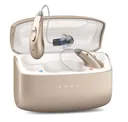
It’s a design enhancement.
aids encapsulated the ‘need’ for smaller aids, open fittings and moving away from custom shells.
If you’re designing a , the difficulty in separating the receiver waggle from the mic in a very small shell becomes impossible at higher gain levels. Putting the components at different ends of a wire makes sense.
Most hearing losses slope towards the HF end, the use of more separation and decent feedback management allows the provision of more HF gain while still keeping the maximum possible venting to minimise occlusion: which customers find comfortable.
The lack of custom shell and the in-office (Signia=Morons) interchangeability of receiver are just a clever way of shifting cost/effort down the line to the Audiologiest/Dispenser. It also adds convenience to the dispense from a client point of view.
The customer leverage and manufacturer leverage (profitability) has pulled the industry in this direction.
You’re ignoring this member’s posts.
You’re ignoring this member’s posts.
You’re ignoring this member’s posts.
The Styletto needs to be returned to Signia to exchange the receiver, which is clearly the stupidest hearing aid engineering decision since someone at Resound said ‘Let’s make the ‘Be’ ‘.
You’re ignoring this member’s posts.
So bad. I’ve been told they will be fixing it in a few months with a smaller styletto with a removeable receiver.
Maybe it’ll look like a regular hearing aid.
You’re ignoring this member’s posts.

So downside to , snow can blow into your ear. Okay, not a big deal but it was cold and that wasn’t something I have had to worry about for a while.
There was an electronic gurgle that I had been hearing in quite that seems to have disappeared at some point, except for a few minutes after I put it on in the morning.
You’re ignoring this member’s posts.

@pathurley You must live in an area that is in the midwest or not that far from it because we had some snow earlier this week. It was supposed to leave up to 6”, but we only had 1”. Isn’t spring around the corner?
Did the make the electronic gurgle because of the snow and cold? Wonder if rain would cause the same effect? Just wondering if this is something I’ll need to watch out for.
You’re ignoring this member’s posts.
I live in upstate NY, we have had lake effect snows for the last few days.
The gurgle is something that I have had in quite since it was turned on. I imagine it is just something that needs more fine tuning, but I missed the one week follow up due to a storm and the next appointment they had was for next week. So I deal with it and it seems my brain is adjusting to ignore it.
You’re ignoring this member’s posts.
When you say upstate New York, I think Buffalo. It seems upstate New York always gets hit hard with snow. I feel for you.
However, being a native Chicagoan, I know lake effect snow all too well.
Thanks for clearing the gurgling noise up. When I read it, I wasn’t sure if you were trying to say that it was because of the snow that got in your ear with the implant and it caused the gurgling sound. I’m thinking don’t go outside when it’s snowing or raining.
You’re ignoring this member’s posts.
I am southeast of Syracuse.
All of the are fine in most weather, pouring rain like that is like a shower might require a hat to protect them but otherwise it should be fine.
You’re ignoring this member’s posts.
I hope it’s ok to ask a question.
Has anyone gotten two ’s at the same time?
You’re ignoring this member’s posts.
What the forum has been talking about this week.
Fitting Software Requests514 replies
Fitting Software Requests1.1k replies
Hearing Aid Self-Fitting (DIY)302 replies
Fitting Software Requests419 replies
Hearing Aids104 replies
 Texas Hill Country

 Wales, UK