 Central Virginia
I’m not aware of any factor that makes rechargeable aids inherently preferable for a company to produce.
They are likely considered more”green” for the environment.
You’re ignoring this member’s posts.
This topic is closed.
193 replies10.1k viewsLast reply
I’m not aware of any factor that makes rechargeable aids inherently preferable for a company to produce.
They are likely considered more”green” for the environment.
You’re ignoring this member’s posts.
They are likely considered more”green” for the environment.
Maybe an after-the-fact feature to mention, but not a factor in decision making, IMO.
You’re ignoring this member’s posts.
More & more worldwide companies are considering ESG issues in their decision making. The World Economic Forum wants to force them to do that to be able to perform business transactions.
You’re ignoring this member’s posts.
Maybe an after-the-fact feature to mention, but not a factor in decision making, IMO.
Sorry: that’s nonsense. Why do you think all the outer packaging is cardboard now?
Why do you think that several of the companies have 100% carbon write-down vs. their production?
Using 2 cells of metal over 2-3 years vs 100-150 disposable IS a green decision - even if you don’t understand the mechanics of why or have been convinced that just because batteries are cheap you can throw them in landfill with no consequence.
You’re ignoring this member’s posts.

I have an idea how to avoid it.
To be constantly connected to the charger, and in a drawer somewhere elevated, like a shelf if you have one.
Charging should be done with a time-charger that should charge the hearing aid at least once a week for at least 20 minutes. And to use the weakest adapter that will do it with a weaker current.
You’re ignoring this member’s posts.
Using 2 cells of metal over 2-3 years vs 100-150 disposable IS a green decision
2 years of size 13 batteries at a pair a week is 6 ounces of waste, not counting packaging, which has room for improvement. Rechargeables have the charger to account for. Two chargers if one buys a spare or a travel charger. The way things seem to work now, those chargers won’t be usable with the next set of aids.
You’re ignoring this member’s posts.
Sorry, in civilisation we use SI units. Is 6 ounces a few KG? Yes, agreed: a terrible waste of refined metals.
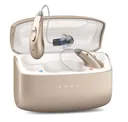
The Oticon Charger appears to work across several sequential models.
There’s no reason why inductive chargers couldn’t be common. Why don’t you propose your legislature mandates this rule?
You’re ignoring this member’s posts.
Is 6 ounces a few KG?
Sticking to SI units, two hundred size 13 batteries have a mass of 166 grams, or roughly 1/6 of a kilogram.
You’re ignoring this member’s posts.
smart chargers that are programmable over six months so your back ups are automatically charged without your having to think about it.e3tc. . Well, that might be nice. I personally have no need or desire for all that. I like simplicity for my devices. I’d rather not pay for all that and do it myself, Natty Bumpo style.
Smart SOC management in the charger, in conjunction with matching features in the aids, would help the vast majority of users get maximum value out of the aids they paid for, and minimize their trouble and aggravation. Wild guess: The cost to develop that capability will increase the price you pay by $10.
You’re ignoring this member’s posts.

Yes, agreed: a terrible waste of refined metals.
I agree with what you’ve said about environmental concerns. I’m going to save all my used disposable zinc-air batteries. For other household waste reasons, I have to visit one of the City of San Antonio’s hazardous waste facilities every couple of years (to dispose of CFL and LED light bulbs, old electronic devices, waste gas-oil mixtures from 2-cycle engines, etc.). So, I will hopefully recycle my used batteries and alkaline, NiMH, and Li-ion batteries. Especially because of the economic incentives for EVs, there’s hope that the world will come up with better rechargeable batteries. I’ll own a Ford F-150 Lightning EV in a month or two. IIRC, the cost of replacing the 131 kWh battery in the truck is $36K! Hopefully, that kind of economic pressure to come up with something better and cheaper is going to have a trickle-down effect on the useability and durability of HA rechargeable batteries, sooner rather than later…
You’re ignoring this member’s posts.
Yes.
I was being sarcastic. The numbers are tiny, but the basic premise is correct. Something you use more than once is inherently ‘better’ than something you burn through in one use.
The paradigm ‘has’ shifted to recharging. We do still offer other battery aids, but they are seriously a minority demand.
You’re ignoring this member’s posts.
Maybe someday, there will be something like a carbon tax and trade for other commodities with environmental effects. Perhaps it wouldn’t have to be formal. Just like the nutrition labels on foods help you make informed decisions, perhaps there could be environmental cost labels that come with products and services (look at the way Apple, Google, and Microsoft are striving to be carbon-neutral).
At the very least, one might then keep a personal scorecard. If our household saves big on home heating and cooling costs, I could at least use some of my “credit” there to excuse my “sin” in using disposable batteries. One of my sisters and her husband are environmentally conscious in so many ways at home, e.g., using a biodegradable, relatively environmentally non-toxic dish detergent. Yet their favorite vacation is a jet plane trip to France to relax in a farmhouse in the countryside of southern France. That global jet travel probably totally wipes out all of their more modest efforts on the home front!
You’re ignoring this member’s posts.
“a minority demand”. Now that I own a pair of rechargeable aids, I would have guessed that. I had a lot of trepidation about rehcargeable aids, but now I wouldn’t go back. But my experience has been easy and seamless. Others have had issues. Still, my guess is that the vast majority of folks using rechargeable aids wouldn’t go back if they could. I love how easy and convenient they are.
You’re ignoring this member’s posts.
The paradigm ‘has’ shifted to recharging. We do still offer other battery aids, but they are seriously a minority demand.
I agree with that. I got a deal on my M90s because they were battery and my audiologist was only selling rechargeables because of the demand for rechargeables.
At the time I wanted battery aids, now I have a set of L90s on order.
You’re ignoring this member’s posts.
The numbers are tiny, but the basic premise is correct. Something you use more than once is inherently ‘better’ than something you burn through in one use.
I’m not any more convinced that rechargeables are a net environmental improvement. But now I have a sinking feeling that manufacturers will be judged by and act on metrics that ignore the interests of users.
You’re ignoring this member’s posts.

Apologies if this article has been referenced on other occasions or if EVERYONE knows of it but me, but I was still unsatisfied with WHY battery-powered aids are going the way of the dodo, and here’s some enlightenment from our very own Abe Bailey7! 
Just SCROLL down to the section “Rechargeable vs Disposable”
Noteable quote: << At the end of 2021, a whopping 4 out of 5 (79.4%) Receiver-in-Canal () and Behind-the-Ear () hearing aids sold in the U.S. were rechargeable, and these two hearing aid styles accounted for 87% of all hearing aid sales, according to Hearing Industries Association1 (HIA) statistics. As noted earlier, the MarkeTrak consumer survey indicates that about half (52%) of current hearing aid owners use rechargeable aids.>>
I’m impressed that he surveyed users to not only track the rising use of rechargeables, but also took the time to say “EVEN SO!” and list many conditions whereby a user would be happier with battery-powered aids.
In fact, the crux of the matter is not just how many folks are BUYING and USING rechargeable aids, but again, how many manufacturers are still offering BATTERY-powered ones. Cuz if you remove the battery-powered aids from your product lineup, there won’t be any other choice but rechargeable. Over time, the percentage of users wearing these rechargeable devices can only go UP UP UP.
So, I’m hoping Abraham will do another survey (hey, start with all of us!) and ask: “If an identical aid that you currently wear now was available in rechargeable or battery-powered form, which one would you prefer - and WHY?”
That we we could gather statistical data and subjective input on the two choices out there. Would I love to see the final result! And if I worked for Phonak, Oticon, Starkey, et al, product development, I’d want to know: Are we making THE MOST-PREFERRED option for our customers? Or are we shoving a single option their way and holding them hostage with just ONE choice?
You’re ignoring this member’s posts.
if you remove the battery-powered aids from your product lineup, there won’t be any other choice but rechargeable.
You just described Phonak. Either no other choice or move to a different brand.
You’re ignoring this member’s posts.
I’m also wondering if the lack of choice could be a function of the Li-ion battery demand? Are these better for streaming and hearing aid functions like , etc., than the old zinc air batteries I’d put in my Marvels?
You’re ignoring this member’s posts.
Their runtime for streaming us shorter, especially when using classic Bluetooth. Manufacturers also warn against using them in potentially explosive environments like in hospitals using oxygen. They have not been tested for those situations.
You’re ignoring this member’s posts.

I may be wrong but my understanding is that the lithium rechargeable batteries operate at a higher power level than disposables and this allows for additional features and functionality to be added to the hearing aids.
Jordan
You’re ignoring this member’s posts.
Hearing Aids16 replies
Hearing Aids92 replies
Hearing Aids20 replies
Hearing Aids12 replies
Hearing Aids169 replies
 Wales, UK
 Croatia
 Toronto, Canada