 Oticonian/Disposablyte
You’re ignoring this member’s posts.
Oticon Real
This topic is closed.
402 replies15.4k viewsLast reply
 Central Virginia
Please quote the false copy
Machine learning means they are learning new data. If their knowledge source has been fixed, by definition it is no longer learning.
You’re ignoring this member’s posts.

@prodigyplace: You’re not addressing my challenge, Bruce. Please demonstrate the “false advertising” of which you’re accusing Godic - 🫢 Oops ! I mean Oticon.
You’re ignoring this member’s posts.

Machine learning means they are learning new data. If their knowledge source has been fixed, by definition it is no longer learning.
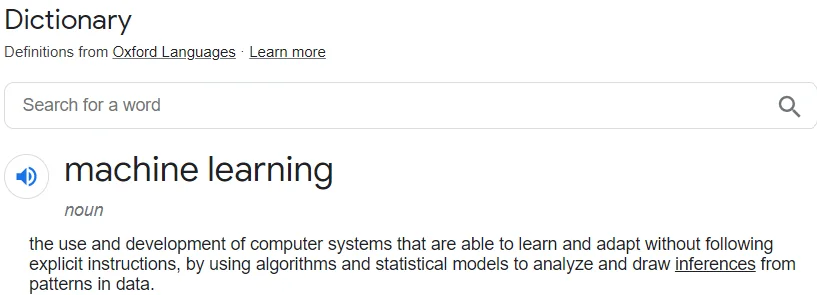
There’s nothing in the definition below that says that machine learning must always learn from NEW data. Even if it is no longer learning, it still did learn a lot.
As long as it DID learn enough to be able to analyze and draw inferences from that fixed source of knowledge in order to predict more accurately the results from unknown sources that it hasn’t learned from yet, then it has still graduated from the class when it passed the tests.
If Oticon has said that their NEVER stops learning, then it would be false advertising. I never saw anywhere that Oticon said such a thing.
You’re ignoring this member’s posts.
If Oticon has said that their DNN NEVER stops learning, then it would be false advertising. I never saw anywhere that Oticon said such a thing.
@Volusiano:  Exactly. MrV

 … Exactly!
You’re ignoring this member’s posts.
false advertising
Saying it is machine learning when it learns no new knowledge is false. If it learns nothing new it is not really learning. It is just programmed with existing voice data prints. Advertising as learning when no learning is happening is false advertising of feature capabilities.
It did learn in the past and that was incorporated into the aids as fixed knowledge. It is no longer learning though.
You’re ignoring this member’s posts.
Saying it is machine learning when it learns no new knowledge is false. If it learns nothing new it is not really learning. It is just programmed with existing voice data prints.
@prodigyplace: Please, either substantiate your assumptions, cite sources for your definitions (which are unorthodox), or stop spreading false information by which others may be misled.
You’re ignoring this member’s posts.
substantiate your assumptions,
The plain definition of machine learning. If it is not learning from new data)knowledge) it is programming, not machine learning.
1. the process of computers improving their own ability to carry out tasks by…
Substantiate something other than the plain English definition.
You’re ignoring this member’s posts.
Oticon uses Deep Neural Network technology, which - although it is a subset of “machine learning” goes far beyond it.
Deep learning is a subset of machine learning that focuses on utilizing neural networks to perform tasks such as classification, regression, and representation learning. The field takes inspiration from biological neuroscience and is centered around stacking artificial neurons into layers and "training" them to process data. The adjective "deep" refers to the use of multiple layers (ranging from three to several hundred or thousands) in the network. Methods used can be either supervised, semi-sup...
I’m hoping @Volusiano will check in here with one of his great synopses.
You’re ignoring this member’s posts.

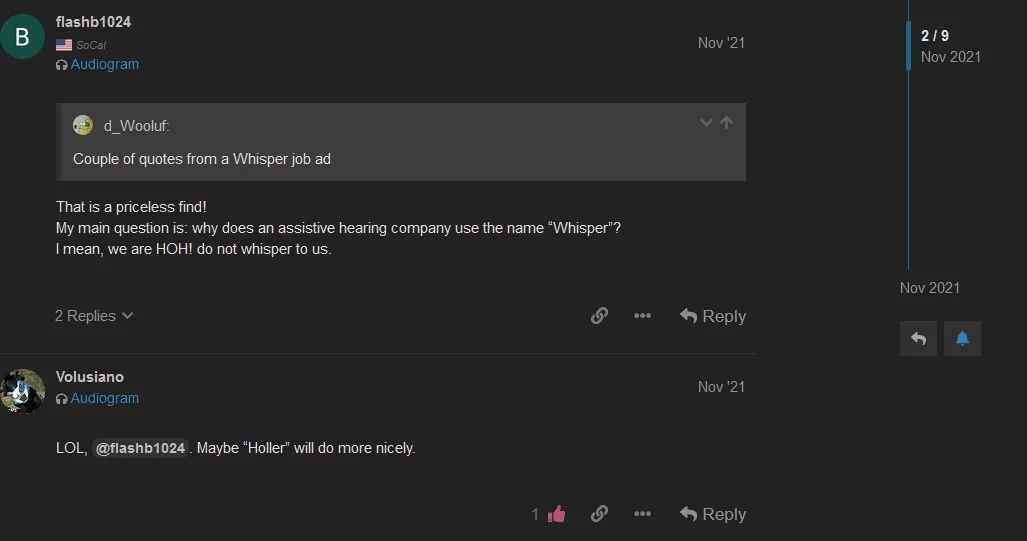
By the way, I wonder if the current Whisper aids can help with whispering or not already? If not, then the Whisper folks oughta work on giving that priority so that the brand can live up to its name.
Hey V , you previousely replied to one of my queries with a great name for that OTHER co.
You’re ignoring this member’s posts.
 Flash
You’re ignoring this member’s posts.
You’re ignoring this member’s posts.
The plain definition of machine learning. If it is not learning from new data)knowledge) it is programming, not machine learning.
It doesn’t really matter which definition of machine learning is accurate because it’s irrelevant in the context of what Oticon said they did. They very clearly stated in their whitepaper and YouTube video and marketing materials that they used a deep neural network and trained it with 12 million sound scenes to be able to have it arrive at accurate enough results for both trained data and unknown data.
And I’ve said this earlier but I’ll repeat this again here, I’ve never seen anywhere where Oticon claims that the More design is a continuous learning setup with new data collected on the fly from users environments and fed it back into their to self improve. In fact, Oticon made it explicitly clear in their whitepaper that they DIDN’T want to train their DNN with too much data because their DNN design has limitations which will not yield accurate results on unknown data if too much training data is forced into the DNN.
So if Oticon was that explicitly clear and never gave any impression otherwise that the More is designed to learn on new data from users, then it seems kind of silly to fault them on some symantic interpretation of what machine learning is supposed to be.
You’re ignoring this member’s posts.
Hey V , you previousely replied to one of my queries with a great name for that OTHER co.
LOL. Wouldn’t it be funny if both Oticon and Whisper read this forum and this thread specifically. Then Whisper sets out to add a whispering feature like I asked, and Oticon decides to buy out Whisper for that whispering feature for their next generation .
You’re ignoring this member’s posts.
You’re ignoring this member’s posts.

 Ipswich
Are we still talking about Oticon Real, seems the heading needs to be changed to “way of topic, Oticon Real”
You’re ignoring this member’s posts.
@wayne59au: Yes, in a warped sort of way we are. We’ve descended into trivialities, following in the trajectory established by Oticon in the design and launch of this unnecessary “new” hearing device.
You’re ignoring this member’s posts.
Neural networks, even with static data like the Oticon More, are not “programming” in the traditional sense of the word. They are not following an algorithm that can be specified explicitly, but are instead comparing data against pre-recorded patterns. That’s pretty much the definition of .
You’re ignoring this member’s posts.
Are we still talking about Oticon Real, seems the heading needs to be changed to “way of topic, Oticon Real”
I don’t think it’s necessarily way off topic because the recent discussion is a confirmation that the Oticon Real, just like the More, is not a continuous learning design like some folks may presume it is simply because it has machine learning.
You’re ignoring this member’s posts.
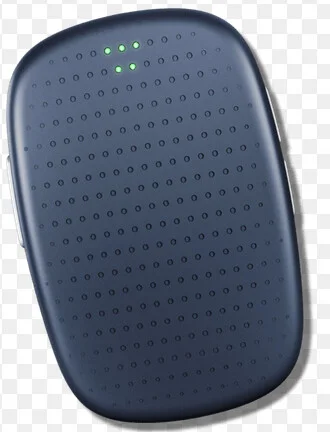
@Volusiano : Then, would the company name be Port-a-Oti?
Haha, that sounds almost like it can transform into PottyEar (as opposed to PottyMouth). How about Whisp-Oti-R-on?
@wayne59au → OK, this stuff here is way off topic, LOL.
You’re ignoring this member’s posts.
Related discussions
Hearing Aids175 replies
Fitting Software Requests1.1k replies
Hearing Aids9 replies
Hearing Aids28 replies
Classifieds2 replies