What about announcing a 50% improvement in speech in noise comprehension?
I’m sure they would if they thought they could get away with it. It’s Oticon after all. 50% improvement is speech in noise comprehension and makes you 37.5% more attractive to the opposite sex!
One thing I can think of is that when I was still working, while in meetings, some co-worker may lean over to me and whispers something to me while the meeting was going on.
Anyway, don’t mean to be off topic here. But I really hope that after the Oticon Real will be the Oticon HearAll. Or maybe the Oticon EavesDropper, or the Oticon BionicEars.
All banned due to usefulness for nefarious purposes. ;(
The engineers have been collecting and refining a couple more years worth of situational sounds, not via the aids.
As far as I know, there’s nothing been mentioned about the aids actually machine learning during the fitting or wearing process.
I know everyone is scoffing about the regularity of model updates, but unless Moore’s Law has peaked due to layer thickness constraints; every 18months, we should see a doubling of processing power or halving of size. If you work in hearing aid hardware/software engineering; every two years you get to go back to your drawing board - put another alongside and implement your ideas (or the ones you couldn’t put in the last model) in the free space. That’s a level of opportunity you’d not get in practice in many other industries.
So: 50% incremental improvements in ? Well, if you consider that’s roughly only 5dB of signal over the noise, a pair of aids that has an steerable beam forming array system ‘should’ be able to get there at some point - provided you have the spare processing capacity.
How about linking it to your specs with pupil tracking and a rangefinder like autofocus cameras use too? That’s probably on the Real Soon……
One thing I can think of is that when I was still working, while in meetings, some co-worker may lean over to me and whispers something to me while the meeting was going on.
Quite true. I remember these text pagers before the smart phones came out which we used to exchange private comments in meetings. But it didn’t completely replace whispering though because there are still situations where whispering is still preferred because not everybody look at their texts all the times in meetings, but whispering commands the unavoidable attention of the listener.
@prodigyplace , I didn’t mean that the were collecting data, although I realize it sounded like it. I meant that maybe Oticon was adding to the dataset that they are feeding into the . As I understand it, the larger the dataset, the more effective the AI is, or at least can be.
If I remember, Oticon really emphasized the machine learning aspect in the marketing for the More. I’m surprised that the videos don’t mention it for the Real.
I was also thinking that maybe someone at Oticon jumped the gun by posting these videos to YouTube before Oticon’s official introduction. I hope so. I hope the Real is a real improvement over the More. These Oticon model names sure do lend themselves to puns, don’t they?
there are still situations where whispering is still preferred because not everybody look at their texts all the times in meetings, but whispering commands the unavoidable attention of the listener.
Since 2020 the vast majority of my meetings have been virtual. Most with Microsoft Teams that contains an individual chat function. I work in the IT department at a University. I think I can count on my hands the number of in person meetings I have had since that time.
Oticon has released a press release but it appears USA visitors are automatically redirected to their USA website. Here is the link, I was able to access it using a VPN simulating a European country: oticon.global/about/press/center/press-releases/2023/new-oticon-real
I thought that is what artificial intelligence and deep neural network implied
does imply machine learning, but it doesn’t dictate where the learning takes place. Oticon has said that they did the training for the More up front in the labs using 12 million sound scenes that they collected. They never said that they designed the More (and now the Real) to continue to collect more data from users’ aids out in the field.
As for the Real, Oticon has shown in their marketing material that the Sudden Sound Stabilizer resides in the RealSound Amplifier section. which is not where the DNN is. But the Wind & Handling Stabilizer resides in the RealSound Intelligence section, which is where the DNN is. So quite possibly, they probably collected more sound scene data in their wind tunnel testing to train the DNN further is how to detect and handle wind noise. And the Handling stabilizer is easily trained into the DNN as well by simply rubbing and manhandle the aids in an exhaustive number of different ways using hands and acts of putting on, taking off eyeglasses, brushing the hair, wearing hats, etc.
AI DNN does imply machine learning, but it doesn’t dictate where the learning takes place. Oticon has said that they did the training for the More up front in the labs using 12 million sound scenes that they collected.
I viewed that as a starting point. If it is static after that it becomes programmed response, not learning.
They would enter the eyeglasses industry too? Many people here wear contact lenses either exclusively or part of the time.
Not necessarily; however in terms of steering, range, adaptation and learning parameters; pupil tracking would present a huge advantage. Imagine your audiologist just telling you to look in the direction you wanted to hear to listen to enhanced speech in that direction. You could even use it to train a hearing system and then drop the need to use them.
AI DNN does imply machine learning, but it doesn’t dictate where the learning takes place. Oticon has said that they did the training for the More up front in the labs using 12 million sound scenes that they collected.
I viewed that as a starting point. If it is static after that it becomes programmed response, not learning.
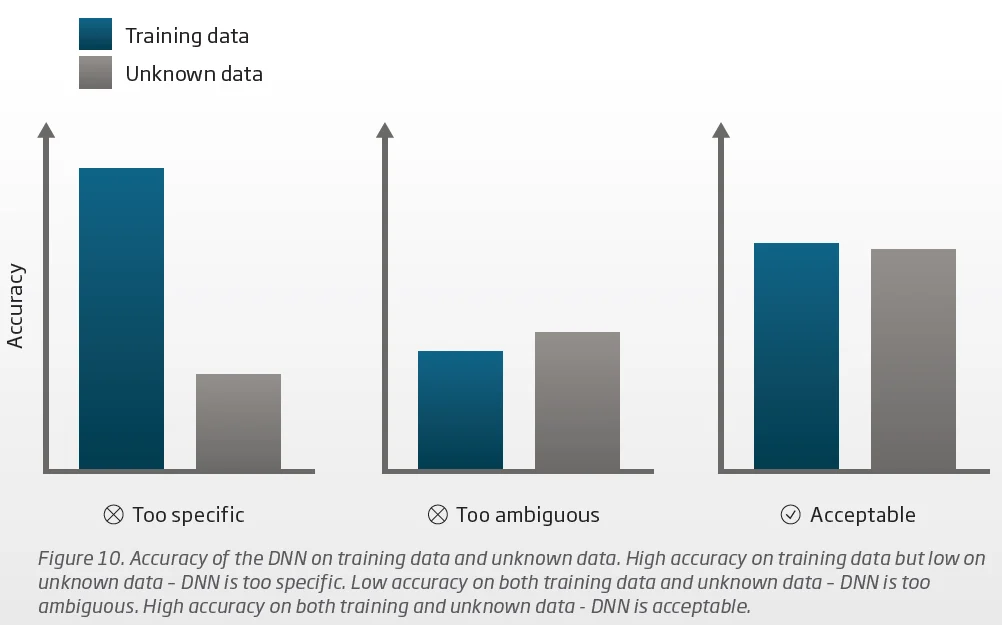
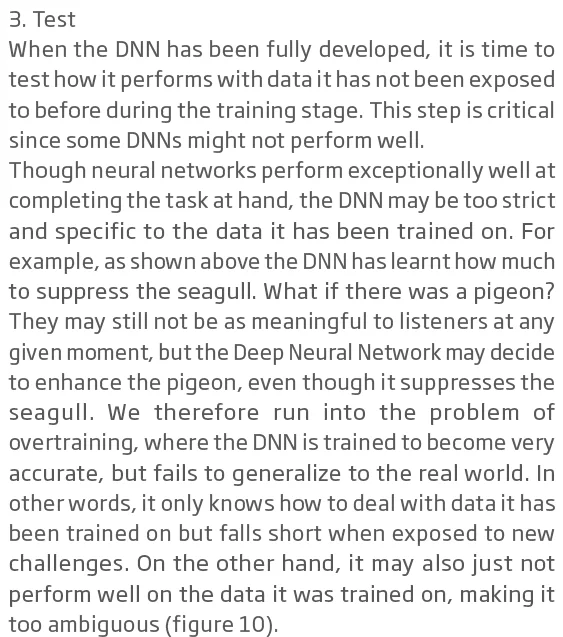
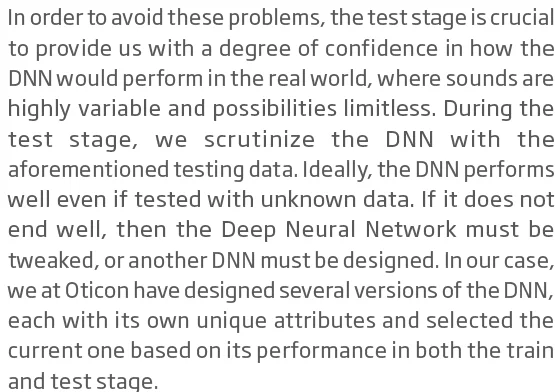
In theory, that may be true. But in the real world, I guess things are not as black and white. It also depends on how the is designed. Oticon did specifically say in their MoreSound Intelligence whitepaper that too much learning may be accurate for the data the DNN has learned, but the flip side is that for the data it has not learned, it can become less accurate. So they don’t want it to learn too much, they only want it to learn enough so that both the learned data and the un-learned data in a DNN gives a balanced but acceptably accurate result in both cases.
I think the takeaway here is that if it were a real brain, maybe unlimited learning would make it better and better. But because it’s a fake “brain”, unlimited learning is not necessarily always the best thing because the fake brain has limitations that need to be balanced with the amount of data given to it to give the best overall result that applies not just to the learned data, but also to the unlearned data.
the fake brain has limitations that need to be balanced with the amount of data given to it to give the best overall result that applies not just to the learned data, but also to the unlearned data.
@Volusiano: Ummmm … …
Okay, MrV … … If you say so, Sir!!!

 Central Virginia
 Wales, UK



 Oticonian/Disposablyte
 …
 … If you say so, Sir!!!
