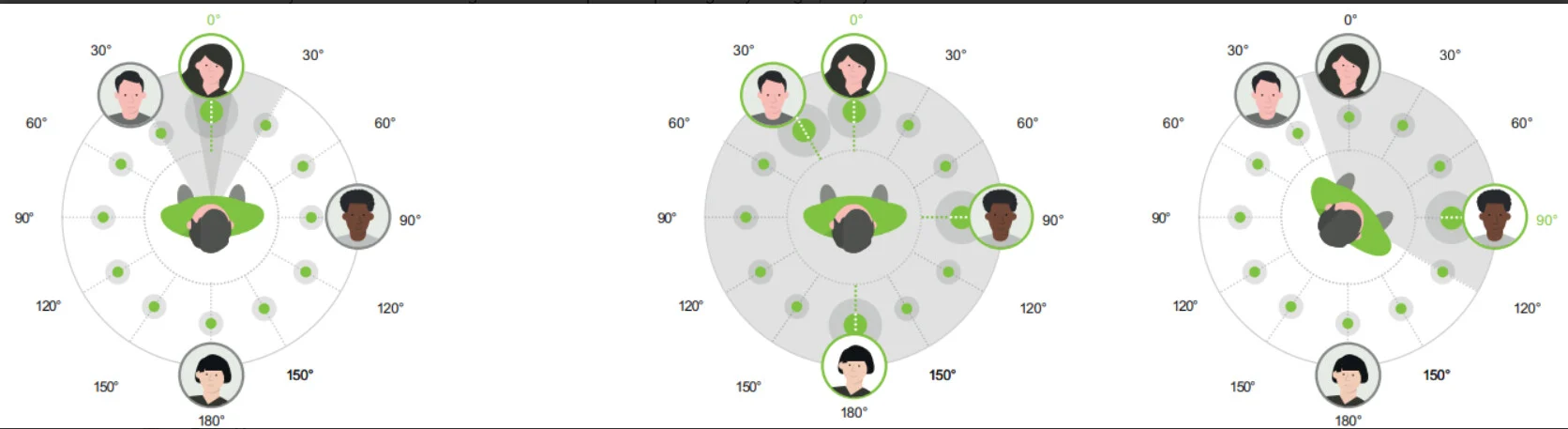
FIrst off, full disclosure here that I don’t wear Phonak aids. I wear Oticon aids. But I looked into the Speech Sensor before out of curiosity. I guess the screenshot below gives an easy to understand view of what Speech Sensor does. On the left, if your speaker is in front of you in a noisy place and the Phonak aids goes into a program that does beam forming to block out noise, it looks like you get a 30 degrees field on each side to the speaker directly in front of you. If there are multiple speakers around you detected by the Speech Sensor, like in the middle diagram, then the beam forming is removed to let you hear everything around you. If the speaker is to one of your side, then the beam forming is widen to about 130 degrees in front of you.
Of course I don’t have any personal experience to tell you whether it’s worth the $1000 upgrade or not. But if you look at the functionality and how it works as shown below, then you can deduce a few things:
- If you’re in a close space with many speakers around you, for example you have your back right against another table behind you full of people who talk in their own party, then you enter scenario 2 below and it’s going to be a problem for you all night, because you don’t want to hear from people with another party right behind you or on your side. If there’s any easy way to disable Speech Sensor in that situation, then it’d be fine. But if not, Speech Sensor will hurt more than help in this situation.
But if you want to have awareness of speakers around you so that you can turn around to focus on them (and narrow the beam to block out the noise), then Speech Sensor is desirable.
- If you have a side speaker (which you said you do most of the times), then it’s the scenario on the right, and if you don’t want to have to turn around to face that person completely (like in the left scenario), then I guess Speech Sensor would be helpful here. But it comes with a compromise, a wider beam form means more noise allowed in, therefore lower signal to noise ratio for your right side speaker. You can always turn to face that person directly if you can to inarrow the beam down to 60 degrees and improve the signal to noise ratio, however.
If you’re seldom in noisy environment, then maybe it’s not that important or useful for you most of the times anyway.
I would say that the real value of Speech Sensor is to raise awareness of unexpected speakers not in front of you. But if you almost always have expected who your speakers are, and are willing to turn to face them for better clarity, then Speech Sensor wouldn’t be of too much value to you.
 Ontario, Canada