I tried Dvorak and got up to the same speed as with Querty. I found it grossly over rated and changed back. Both times took months rather than weeks to get fully up to speed. I tried it so you don’t need to.
It’s been about two years since my last post, and I wanted to share an update: I ended up getting the Signia Pure C&G. I have no idea where things are now in terms of new hearing aid releases since I bought mine. I’ve traveled twice since then, and I’m always nervous about losing my charger or ending up somewhere without access to power. I carry my older hearing aid with batteries as a backup, just in case. I still prefer battery-powered hearing aids, and if any new models come with replaceable batteries, that’s what I’ll buy when I upgrade.
I also far prefer the disposable battery aid. I need a SP aid for my loss. 3-4 months ago I had to get a new Resound SP aid. My had trouble finding a disposable battery type Resound aid so it would pair with my . I won’t be at all surprised if in 4 years when my aid needs replacing I won’t be able to find a disposable battery aid. Sadly my preference for this type of aid is slowly vanishing from the market.
“re:not being able to find the charger because it’s black inside of a black suitcase…”
what happens when you misplace your batteries? it goes both ways. By the way my travel charger is white. I’ve never lost it inside of a suitcase.
Another option is to put a piece of red tap on top of your charger. Or,hey, feel around inside of your suitcase with your hands until you find the charger. this is trivial, hardly a reason to hate on rechargeable .
When I go on a trip whether by car, plane or ship I always bring my rechargeables in my back back pack.
I load the following.
My Anker five port charger. My hearing aid charger. My sleeping hearing aids and their charger. My wife’s Apple charger for her watch and ear pods. I actually keep a ten foot extension cord with multiple ports in it for when I do not have enough receptacles. I also bring my pixel 10 charging brick. My Kindle my wife’s Fire tablet.
My charging cord for my watch.
All necessary chords for the different devices.
The back pack has gone through multiple x Ray scans. No problem.
I do put my spare aids in my pocket before the scan.
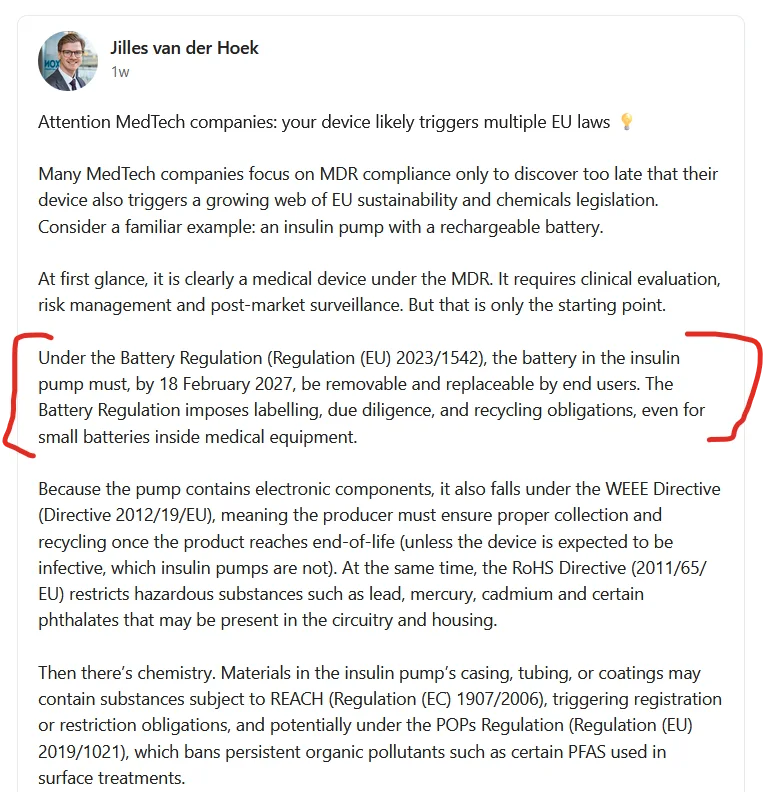
An often made rookie mistake in #medtech: thinking that the #MDR or #IVDR is your only regulatory universe. As my colleague Jilles van der Hoek explains, it clearly is not. Not meeting the requirements under environmental law also taints compliance...
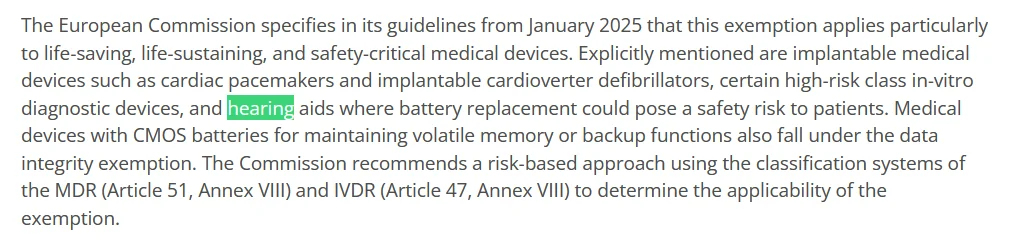
I call “replaceability of battery could pose a safety risk to the patient” BS
have used 13, 312 and 675 batteries for a long time without any problem, but now it is a problem because manufacturer saw a way of milking the caw to indefinite, by imposing rechargeable HA without an easy way to replace the battery.
I think consumer should join and have a class action against those manufacturers.
So it looks like will, in the end, not fall (get a “derogation”) under that new EU law that requires new electronic devices can only be sold with rechargeable, but easily replacable batteries. My guess is that, like for implantable medical devices in other watery places, this is not considered very practical (even if the reason is not clear at all in the text, which babbles about safety).
Be very afraid- this sort of EU law will very much also impact the US, as manufacturers typically market hardware worldwide along the “least common denominator”. For instance, Apple now sells devices with standard USB cables worldwide (thankfully). Output volumes of earbuds have dropped everywhere (by a lot) following EU laws. The EU has also capped the max power of wired vacuum cleaners, and I believe the old power-hungry models are no longer available in the US either. Perhaps Americans should elect a president who more aggressively pursues their country’s interests…
I think the release of the Zeal should have told you everything about which way the wind was blowing.
Oticon would not have released a hermetically sealed aid with a fully encapsulated overmoulded battery, if they knew that they couldn’t sell it next year.
The trouble with disposable battery hearing aids is they don’t seem to have the newest technology in hearing-in-noise or Auracast.
This is a zombie thread that wasn’t updated for months. Life changes, sometimes quickly. The elements that need to be considered in the rechargeable/disposable decision in 2024 are very different in 2026.
*****
The fact that replacement chargers may be available from an auction site cuts a 2 week wait down to a promised 2-4 day or even overnight delivery helps some people, but not all. It does nothing for anyone who is traveling to a different place every day, for example. It does nothing for someone who needs a charger that is not for sale on any known auction site.
As for waiting for relief when can’t be charged, I haven’t been more than an hour from a source for a HA battery in ages. Of course that’s great for anybody except for people who are not that close to a battery source.
In choosing between rechargeables and disposables, one ought to consider many facts, but each of us have to weigh each fact (or not, according to one’s desire) and make a choice.
In 2022, I came down unequivocally on the disposables side. In 2026, with some amazing improvements in speech-in-noise performance available only with some rechargeable products, I think I’ll probably get rechargeable aids ,… and deal with the heavy recharger, the power bank and the statistical probability that yet another couple of devices will fail.
Of course, I’ll keep my Jabras, so if the recharger fails, I‘ll be able to get at least one pair of aids up and running if the new ones fail when I’m close to home….
In any case, I think it’s useful to read why people make one choice or another. At the same time, it’s important to accept that at any point in time some people choose option A, and others choose option B, even though they are dealing with exactly the same facts.
*****
I can see why the European manufacturers might want to comply with EU regulations and sell the EU versions in the US, but I’m sure all of our (US) manufacturers will be happy to produce different versions for both the US and EU markets, maybe with USB-C connections to chargers for the East and West coasts and micro-USB connections for the interior states, and Lightning connectors for Apple users.
I have three pairs of hearing aids and I rotate them when the battery runs out. 2 old Unitron blu and phonak paradise batteries can’t last longer than 13 hours, and the newest phonak audeo sphere which can last a day and a half. I still rotate them because I want them to rest, to dry out because moisture is one of the causes of failure. And of course, I don’t want to sell the old ones because I know I won’t be able to sell them at the desired price, they are more valuable to me. If I work in agriculture at home, I would rather wear the old ones, and I wear the phonak sphere most often when I leave the house, when I drive, go to parties, shopping, etc. I have never been somewhere without electricity for a long time, I see a power bank or charging in the car as a salvation.
Are existing models exempt? Zeal seems like a proof of concept but the parts need to be smaller. There are already comments about how it does not fit some ears well. I’m not sure how that compares to a fully custom like Virto R, where the faceplate size can be an issue.
HA have used 13, 312 and 675 batteries for a long time without any problem, but now it is a problem because manufacturer saw a way of milking the caw to indefinite, by imposing rechargeable HA without an easy way to replace the battery.
If you sent to warranty check near the end of usually 3 year warranty, you probably will get the new battery or even HA. What’s the problem?
Apart from this, I checked for how long will a Sphere charger with a fully charged internal battery last for me. It turned out that it was enough for me for 2 weeks without charging from the power bank.
That’s for ONE Audeo Infinio Sphere 90, so for a pair it would probably be ONE week.
TL;DR:
one Sphere in charger -charger battery lasts 2 weeks
two Spheres in charger - probably one week.
There’s custom 1/2 shell too like the Phonaks, but my point still stands. If the manufacturers were worried about the EU directive, they wouldn’t be punting out rechargeable canal aids. The Zeal definitely wouldn’t be out there as the product premise loses the concept of a replacement battery.
That’s not entirely different than other earbuds tbh.


 Melbourne


 Geneva, Switzerland



 Wales, UK


 Croatia
 Poland