Also, there seems to be something fundamentally wrong with methodology as earbuds style HAs get a major boost, possibly due to occlusion.
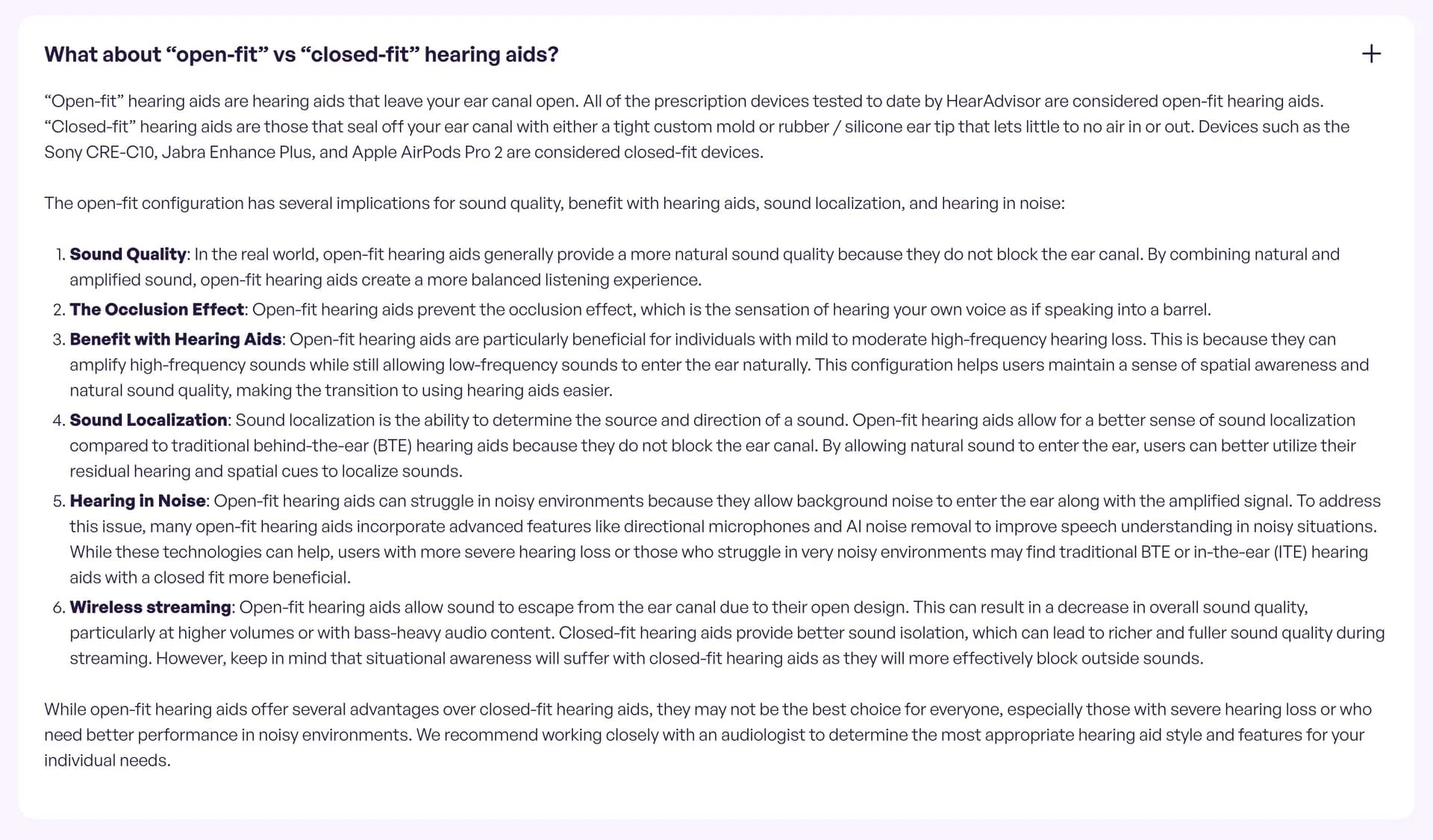
There’s no mistake here. Occlusion helps deliver better audibility and by forcing more sound through the d-mics through the amplified pathway… Our scores are weighted heavily toward audibility and SNR improvement and less weighted toward occlusion (this is the result of a survey we ran showing consumers weight importance for audibility over occlusion related comfort issues) … but we tell people to factor that in when reviewing our metrics:
Last but not least I would like someone to answer me why Signias Active aren’t ranked.
We simply haven’t tested every hearing aid on the market. Signia Active is to me an old irrelevant device, but if Signia launches a new one on IX platform, we’ll definitely test it… The Sony’s are relevant on the market today… that’s why we tested it.
Good point… it really depends on the degree of venting… open vs closed is more of a spectrum. We test REOIG as described in this section (below) from our whitepaper. The degree to which something is open or closed will be related to the amount of acoustic leakage, and this will vary with vent type / size, etc. Having said that, you’re likely more on the closed side of the spectrum with most vented molds.
Another dimension that we considered was own-voice quality. This is a common complaint of hearing aid users (e.g., [16]) and can be attributed to two factors: (1) occlusion which arises from bone-conducted sound becoming trapped in the ear canal and (2) amplification which arises from the receiver-transmitted sound. For these initial metrics, we chose to focus on occlusion which is the larger contributor to user complaints (e.g., [17]). Our goal was to estimate subjective occlusion (a user’s rating of their perceived occlusion from 0-10 - as in [18]) via acoustic measurements. We chose to focus on measurement of Real Ear Occluded Insertion Gain (REOIG – the difference in spectrum between the open ear and the aided ear with the device off [e.g., 18]). We reasoned that acoustic coupling that generates high subjective occlusion usually also generates more negative REOIG (excluding deep-insertion devices). Using the data from [18], we observed that the group average REOIG from 2-4 kHz for instant-fit tips had a strong linear correlation to the group average subjective occlusion (Fig. 6A). We used this relationship to map from REOIG to estimated subjective occlusion. This procedure was used for all devices without active occlusion cancellation (AOC, e.g. [19]), For devices with AOC, the passive REOIG measurement does not capture the influence of cancellation on subjective occlusion. With this in mind, we instead chose to measure objective occlusion on vocalizing humans. Objective occlusion here is the difference in probe mic spectra between the open ear and the aided ear while the participant was vocalizing a sustained /i/ as in [20] (REARVOC - REURVOC). We then wanted to use this objective measurement to estimate subjective occlusion on the same scale as the non-AOC devices. Our approach to this estimation had two steps: (1) map from objective occlusion to a matched REOIG value, and then (2) map from that matched REOIG value to subjective occlusion. For part (1) we replotted data from [19] (their Figs 4 and 7) and observed a strong linear correlation between group average objective occlusion in the 250-500 Hz band and the group average REOIG from 2-4 kHz (Fig. 6B). For part (2) we used the matched REOIG value to estimate subjective occlusion via the same relationship as in the non-AOC devices (Fig. 6A). Finally, we then converted the estimated subjective occlusion value to our own-voice metric by inverting and scaling the estimated subjective occlusion value.
Thank you, Abram. My question remains. How is Phonak runner up? They’re not even in the top 10 on the list you’ve presented. With all of the technology they’ve loaded into the Lumity, I’m sure there’s a case to make, but it can’t be made based on the lab test results. What needs to be explained is why they’re runner up in spite of the lab test results.
They won’t be on the updated page… We had fewer products to choose from before.
EDIT: Actually I probably shouldn’t say that because that’s Steve’s article and he’ll be doing the update, but yeah looking at the data, I’d think he won’t include it unless he plans to do some tests with beamforming manually selected across devices that offer it, or include his tests of Roger, which are compelling.
Asked Andy our main science guy about the beamforming and he says that’s a hard test to do… “Typical way to measure beamformer requires other algos to be off”
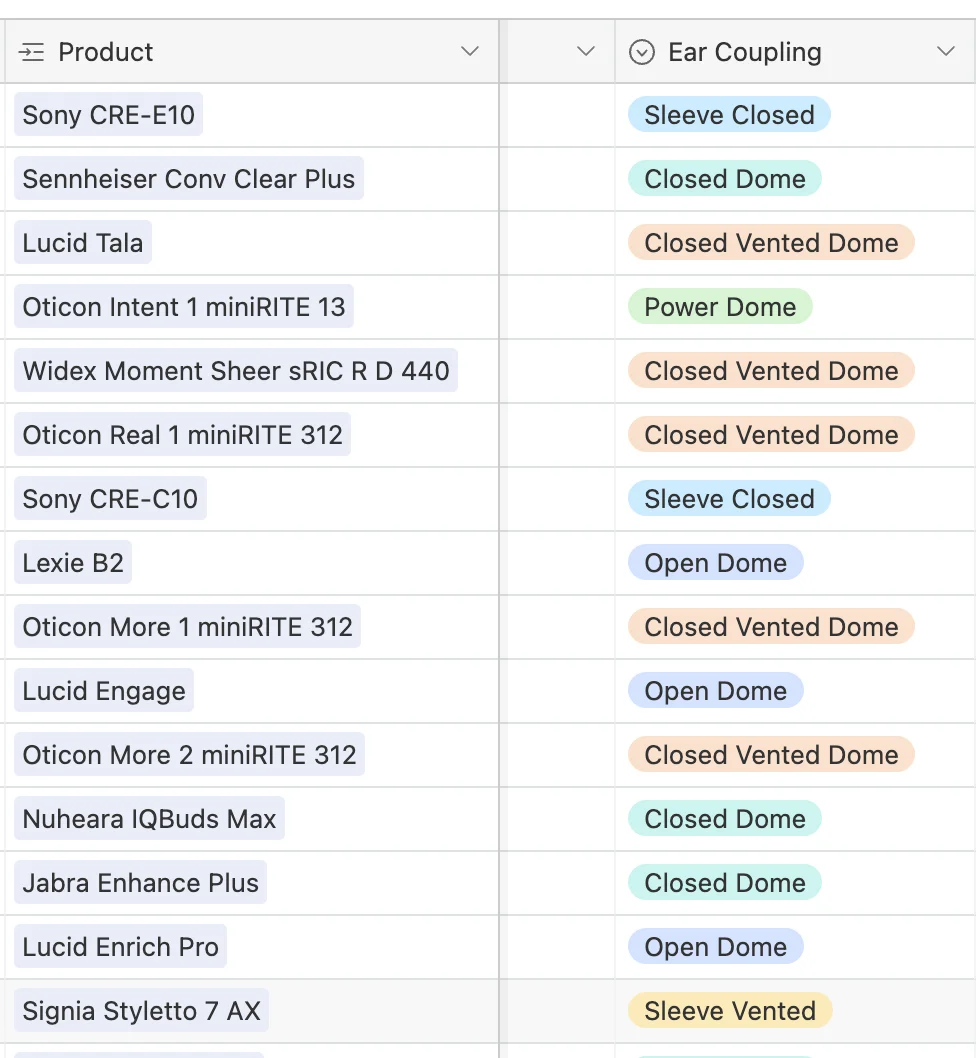
I would think that the issue of occlusion is a tricky one. Any “open” hearing aid can quickly become “closed” by the use of power or other . I myself wear power domes on regular hearing aids. OTOH, the CRE-E10 offers vented sleeves as a standard option, so not necessarily completely closed.
Why not test them all under the same conditions and then let the consumer account for the occlusion factor depending on their individual needs?
Why not test them all under the same conditions and then let the consumer account for the occlusion factor depending on their individual needs?
I’m sure I’ve said this already above, but if not, we’re trying to find the most likely setup that average consumer would use with mild to moderate hearing loss. So in doing this, for prescription devices, we simply use the dome recommended by the manf in the software when running first fit, and then for the Tuned condition, Steve may swap up to a more occluding dome (the minimum occlusion necessary to get to the real ear target without feedback)…
For we go with whatever dome is on the device when it’s unboxed, or whatever dome is recommended by the app if there’s a setup process. There’s a whole workflow here with decision trees in our white paper. I suggest you check it out.
You don’t seem to grasp the problem me and @billgem have.
You’re comparing a pre-assembled product [] with the one which by definition has to be fitted and is extremely flexible, by lowering the flexibility of the former for comparison sake. Ultimately skewing the score heavily in favor of OTC occlusive products.
Where we all know that prescription hearing devices can be as occlusive as we want them to be.
Either put it somewhere in disclaimer in each review or fix your scoring system.
ou’re comparing a pre-assembled product [OTC] with the one which by definition has to be fitted and is extremely flexible, by lowering the flexibility of the former for comparison sake. Ultimately skewing the score heavily in favor of OTC occlusive products.
Where we all know that prescription hearing devices can be as occlusive as we want them to be.
I’m not sure how else to explain this, but we’re looking for the most realistic setup that the average person will use with the device for a mild to moderate loss. The bottom line is that the flexibility one has with a won’t be realistically explored in most scenarios because most people are going to be walking around with their RIC on first-fit settings from the audiologist with the manufacturer recommended dome.
And one more thing… in most cases the manufacturer actually recommends some type of occluding dome, which we went with for our initial fit test setups:
The truth is that the average audiologist / likely wouldn’t even use a more occluding dome on this type of loss, even if the manf recommends it, because fitting professionals often try to leave the ear canal as open as possible whenever possible, even if that means going against the manf recommendations. In other words, we’ve probably given these Rx devices more of an edge than they deserve given the target hearing loss.
I’m not sure how else to explain this, but we’re looking for the most realistic setup that the average person will use with the device for a mild to moderate loss. The bottom line is that the flexibility one has with a RIC won’t be realistically explored in most scenarios because most people are going to be walking around with their RIC on first-fit settings from the audiologist with the manufacturer recommended dome.
You’re basing your methodology on some wild assumptions.
So, according to what you say, your reviews are aimed at “average” folks which are fine with defaults and unaware of options. Am I getting it right?
Yes, that’s correct. You guys aren’t average users. There’s simply no way to show all possible physical acoustic setups for every device tested across all hearing losses. We have to start somewhere. If you don’t agree that this is not better than having nothing, which is what we had before, than I gladly accept your opinion.
But aren’t you seeing the paradox or even hypocrisy in this?
You’re giving consumers scores to help with educated choice while the scores are based on assumptions of them being ignorant?
Yes, we do have to assume that consumers are ignorant… and no, we don’t assume that consumers will use our website to learn from our work… we anticipate that our stamp of approval will be on product boxes in best buy, walmart, and amazon, to help users who need help making the right choice. The primary focus of this endeavor is to sort the good from the bad in the arena and prescription hearing aids are really just there as a baseline. We know they are good already. Where you see a prescription device with a bad score, that is primarily driven by the manufacturer providing overly conservative gain in the “first fit” algorithm, and that is something we feel they should be called out on… if they change their first fit to provide more amplification and benefit to the user, this will change millions of people’s lives.
Yes, we do have to assume that consumers are ignorant
Not what I meant, I know that average consumer is ignorant. What I meant is that your methodology is perpetuating ignorant choices to a degree. And yes I very tentatively agree, that it is better than nothing.
Did you read the press release2? The problem is that there are seriously questionable devices on the market today and consumers are buying them en masse even when there are better devices in the same price category. Consumers need a very simple traffic light system to help them make better choices. Plain and simple.
We have never said our scoring is perfect. We’re very aware that we’ve had to make some decisions to boil this whole thing down to make it feasible timewise AND provide something useful to the most amount of people possible. If you read our FAQs on the leaderboard page and whitepaper, we’re very clear about these decisions and compromises, and urge consumers to consider the impact the target hearing loss we use, the impact of occlusion, and other such things.

 Auckland, New Zealand