
 Kent, England
I have custom molds so not vented (there is a very small pin hole through them) but I think thats more for moisture removal
You’re ignoring this member’s posts.
999 replies59.8k viewsLast reply
I have custom molds so not vented (there is a very small pin hole through them) but I think thats more for moisture removal
You’re ignoring this member’s posts.

I’d be interested to know whether they are cShells or one of Phonak’s other custom molds. I’m getting acrylic cShells but I didn’t know whether they’d be solid enough to get maximum occlusion for noise-reduction purposes. But since Phonak says they’ll provide the best audio by making sure the receiver opening is pointing down the ear canal at the eardrum rather than at a canal wall, I elected to go with them.
Phonak’s first try came with a small vent that my audi described as an “air pressure relief vent.” I had requested a completely occluded mold with no vent, and my audi agreed to send the vented ones back to be remade. Perhaps if the vent really was a required drying hole, as you suggest yours is, Phonak will protest making a no-vent version for me. Did Matthew Alsop say anything about the purpose of your vent hole?
You’re ignoring this member’s posts.

I have custom molds so not vented (there is a very small pin hole through them) but I think thats more for moisture removal
No this is a vent, they don’t come with a drain for moisture, I think .6 is the smallest vent, this is to help stop occlusion.
You’re ignoring this member’s posts.
My varitherm were quite hard, they got softer after they warmed up. I think this is why they are so much easier to put in, yet comfortable while wearing.
My right mold is hardly ever difficult to insert. My left mold is troublesome sometimes, mainly when the ear canal is completely dry. When that happens I lubricate the mold with Oto-Ease and it goes right in. All this was true for me when I was using regular silicone molds also. I’ve never had success with hard acrylic molds; a couple of tries yielded feedback, and I gave up on it and stayed with domes for a while after that.
How does ordering molds from other companies like those work? Who would do the impressions?
An audiologist, in my experience. Microsonic looks like it’s oriented toward working with professionals.
You’re ignoring this member’s posts.
Your clinician can send in that photo and have the silicone slimtips remade to match. You may lose some high frequency gain as you lose some feedback control.
You are probably not a candidate for an active vent–the open position is likely too open for your loss.
A built-in acrylic custom tip (cshell) may or may not be better.
Oticon makes nice custom tips. I’ve asked them if they’ll make custom tips for other manufacture receivers and they’ve said no.
Per someone’s earlier question about expensive phonak battery replacements, phonak does a full repair only, no battery replacements.
You’re ignoring this member’s posts.
Phonak’s first try came with a small vent that my audi described as an “air pressure relief vent.” I had requested a completely occluded mold with no vent, and my audi agreed to send the vented ones back to be remade.
I speculate that the cShell manufacturer thought something like: “He requested no vent with his ? Surely he will demand a remake due to occlusion. Kid, make the smallest hole.” < joke >
I just hesitate considering future earmold:
between “no-vent” or “pressure vent” option
acrylic vs. silicone for better seal
acrylic vs. titanium - titanium enables thinner walls to be made in the earmold, allowing it to be reduced in size and hence inserted deep into the bony part of the ear canal to avoid occlusion
Now I have a 1 mm vent acrylic cShell (made in 2021), which, after increasing amplification in my 1–4 kHz channels in May, is significantly better than the previous 2.5 mm AOV cShell.
You’re ignoring this member’s posts.
they feel massive. They feel more occluded and they stick out of my ear canal more.
I have trialled both Oticon Intent and Phonak Sphere, in both cases with c-shells. The Phonak molds are at least 2ce as big as the Oticon ones, and also stick out of my ears more. My audi sent them back to Phonak along with one of my Oticon molds and asked them to remake them more like the Oticon ones. They replied that they could only reduce them by 2 mm at most. Apparently, their UP receiver is physically much bigger than the Oticon 105 db receiver, and that is what requires the molds to be so big.
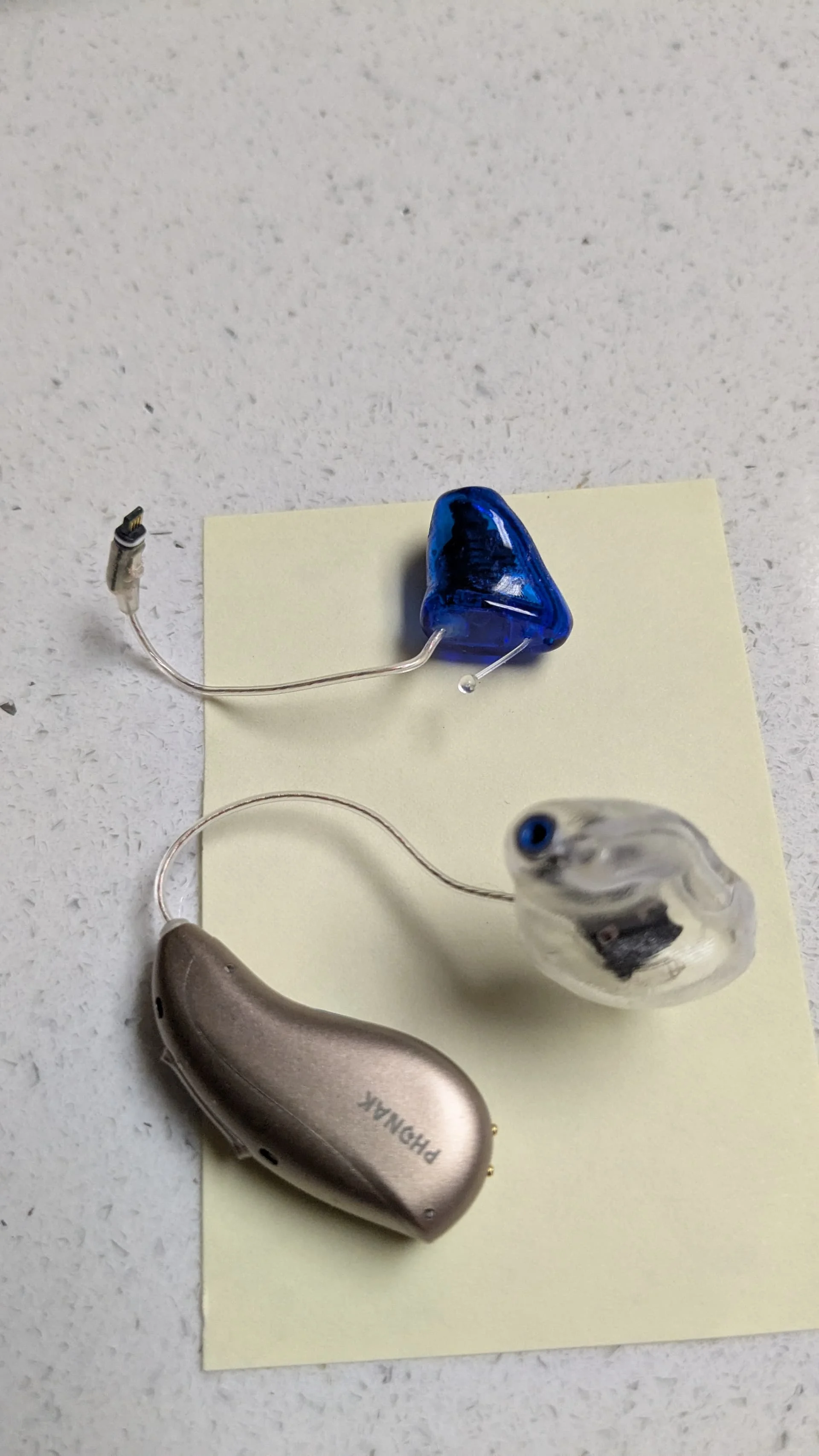
You’re ignoring this member’s posts.
I have trialled both Oticon Intent, in both cases with c-shells. The Phonak molds are at least 2ce as big as the Oticon ones, and also stick out of my ears more. My audi sent them back to Phonak along with one of my Oticon molds and asked them to remake them more like the Oticon ones. They replied that they could only reduce them by 2 mm at most. Apparently, their UP receiver is physically much bigger than the Oticon 105 db receiver, and that is what requires the molds to be so big.
I don’t even have an UP receiver, i have the smaller “M” receiver. So I don’t know why this mold is so large.
You’re ignoring this member’s posts.
You’re ignoring this member’s posts.
It is a vent (Matthew confirmed) and you can’t have complete isolation as your ear drum can’t then vibrate properly. Think about drinking from a coffee cup with a lid. You need a small pin hole at the top to allow air in to displace the air / liquid coming out. Close the system completely and you have no sound waves.
You’re ignoring this member’s posts.
It was an issue I asked myself long time ago, but forgot to raise it on this forum:
“How about eardrum vibration effectivenes when I plug ear completely making ear canal air pressure higher than in the tympanic cavity (middle ear)?”
I wonder does earmold with 0.6mm vent is considered as “closed fitting”?
@jim_lewis perhaps it is interesting for you.
You’re ignoring this member’s posts.
and you can’t have complete isolation as your ear drum can’t then vibrate properly
Actually I think you can, it’s called an occlusive fitting, for profound losses, there’s also the pressure venting as well.
I wonder does earmold with 0.6mm vent is considered as “closed fitting”
Yeah I haven’t heard of this being so, but within the software it doesn’t seem to think it is.
You’re ignoring this member’s posts.
When you are at profound levels things may well be worth enduring as something is better than nothing but sound waves need air to work. It’s why there is no sound in a vacuum but we are talking about technicalities.
You’re ignoring this member’s posts.

I can assure you @threluja, I have worn moulds, without any venting whatsoever for years, I do have a most comfortable set of ’s though, with I believe 0.8mm vents? I always thought these where pressure vents… Cheers Kev 
You’re ignoring this member’s posts.
Pressure vent counts as a closed fit. It impacts low frequencies in a very minor way.
Plugging your ear doesn’t make your outter ear a vacuum. . . I’m confused as to why people think that’s an issue. I had a patient once who was very concerned about sound waves being beamed into his brain, but that’s not really how waves propagate. . .
You’re ignoring this member’s posts.
@jim_lewis perhaps it is interesting for you.
For me, the main problem with a completely closed fit and well-fitting earmolds is in ascending and descending in plane flights - pressure equalization. But I’ve just loosened up my molds a bit then. I hear great, especiallly when streaming, with a completely closed fit. I’ve habituated long ago to the sound of my own voice with an occluded fit. I paid a lot for the Spheres and want to get the maximum noise reduction possible.
You’re ignoring this member’s posts.
I was exaggerating for effect, with the vacuum analogy 
No way would it be airtight anyway. But the point still stands the physics of sound requires the movement of air.
You’re ignoring this member’s posts.
No way would it be airtight anyway. But the point still stands the physics of sound requires the movement of air.
Sound requires not so much the movement of air, but rather its molecules to vibrate and transmit the energy of a sound wave among themselves.
Metals in solid form also conduct sound and even faster than air, but they do not move, only vibrate.
I don’t want to nitpick your words, I guess it was a brachylogy when mentioning about motion.
You’re ignoring this member’s posts.
Ooooo now we are getting into technicalities, although energy created is in the metal and you are correct the reverberation travels through it, sound is the movement of air to your drum not the metal vibrating…
Its the age old conundrum are sound waves a ‘noise’ if they are not received?
We may be drifting off topic a bit here…
You’re ignoring this member’s posts.

Your post really interested me. I read Neville’s response and appreciated it.
I started to respond–didn’t
Way back I wished I had followed the audiologists’ path. It would have been a good career.
Some time ago I was found to have hearing loss when I worked at 3M. They gave me a hearing test; nothing wrong. But the company MD referred me to University of Western Ontario audiologists and they did a lot of testing. Wish I had those tests and results today
You’re ignoring this member’s posts.
Log in to reply to this topic.
Hearing Aids3 replies
Forum Support7 replies
Hearing Aids6 replies
Hearing Aids104 replies
Hearing Aids13 replies

 Poland
 Scottish Highlands