Its not even worth calling out, he just goes on my ignore list now.
ty
PS: better mood now, figured out my networking issue, McAfee software enabled a VPN on me. Made no sense why some websites displayed, others didnt in my VM to install the software in my VM
@Bimodal_user, you might mean the DeepSonic chip. The ERA chip is in both the Sphere Infinio I model line (I90, I70) and the plain Infinio line without the DeepSonic chip, i.e., no Spheric noise reduction.
I listen to the Windows Weekly podcast with hosts Paul Thurrott and Richard Campbell, well-known computer experts. One interesting podcast discussion possibly related to hearing aid models is why there are so many different models of the new Qualcomm Snapdragon X Elite ARM-based computer chip. The two hosts supposed chip BINNING had something to do with it. Modern computer chips have so many small processes that they can’t be produced with 100% perfection. Often many chips are fabricated on a single silicon wafer. Rather than only cut out and save the best-performing chips and throw away all the less-than-perfect copies on a wafer, the less-perfect copies can often be sold as a lower-performing model with fewer features. So, for example, the chip used in the I70 Sphere Infinio might have been produced with some bad circuitry and might not crunch digital sound as efficiently as a Deep Sonic I90 chip. Thus, the I90 chip might be intrinsically more capable with better features and command a higher price. There might be a somewhat deficient chip in I70 that can still do much of the processing but must sell at a lower price. However, it still sells and does not cause a complete loss for that part of the wafer. Those who say, “It’s the same chip in both models, but the OEM deliberately turned off some feature,” would only be half right. If binning is occurring, all the dies on the wafer were intended to be the same premium chip, but some of them, by manufacturing vagaries didn’t make the grade.
This is pure speculation on my part for , but binning is a common practice in the computer industry for other tech components.
Its in autosense, and only if autosense senses the need,
You “can” get get your audiologist to give you a separate Spheric SPeech program you can go to directly.
Make sure he/she also disables the time limit
I would never recommend to disable it! Better make a second program with spherics.
I was a whole day in an amusement park and if there were no limit the Phonak would have ran off after 7h without opportunity to use it.
I was 8h in loud noise, until 3h was used I noticed when the spheric jumped in but it went to spheric mode for nothing as I was standing in a queue and did no conversation.
Thanks to the limit I could also use spherics later on the evening during the lunch.
I myself cannot use spherics, it doesn’t help me much and the normal program is better for me.
Interesting, I havent yet even been able to even get it into Spheric Mode yet other than manually and made little difference. Now that I have Target running, I’ll have to see what my audiologist did. Whether he did that in both, or just the Stand Alone Spheric Program.
I think binning is more of an issue when they’re pushing process sizes to the limits, but I truly don’t know. It would be nice if they would provide at least a little info on the tech that goes into these devices but it seems like all consumer information writing has been handed over to the marketing department.
Binning is actually a common practice across various chip process sizes, not just small ones A1. It’s used in the manufacturing of microprocessors, DRAM chips, and other semiconductor devices to ensure that chips meet specific performance criteria A. This process helps manufacturers maximize yield and improve efficiency by categorizing chips based on factors like speed, power consumption, and operating temperature B.
So, whether it’s a large or small chip process size, binning plays a crucial role in quality control and optimization.
Thanks. Could be. I really don’t trust answers but don’t know enough to evaluate this one. My distrust is born out of seeing answers that I know are BS.
Google Gemini answer to same question. Perhaps a better answer but in general, I’ve found Gemini answers vaguer and less reliable than Copilot, which is based on ChatGPT-4:
Yes, binning is predominantly done at smaller chip process sizes.
Here’s why:
Increased Variation: As chip processes shrink, the manufacturing tolerances become tighter. This means that even small variations in the manufacturing process can lead to significant differences in chip performance.
Higher Value: Smaller process nodes often represent the latest technology, and chips produced with these processes tend to be more valuable. Therefore, it’s more economically viable to bin these chips to maximize their potential revenue.
Complexity: Smaller chips often have more complex designs and architectures, making it more likely that there will be variations in their performance. Binning can help to identify and categorize these variations.
While binning can also be done at larger process sizes, it’s generally less common and less critical due to the lower variability and value of these chips.
Regardless of process size of the Sphere, the DeepSonic chip is a specialty chip produced in limited quantity. Therefore, it’s probably a limited run and much more expensive to produce per chip so that might make binning much more worthwhile on a larger process size chip.
Thanks. Gemini’s answer fits with my “gut,” but I truly have no idea. I think both the ERA and DeepSonic chip are pretty specialized. I’d also love to see some comparison with Starkey’s all in one chip design. Really curious to see how HearingTracker’s testing of the new Starkey turns out.
@Bimodal_user, you might mean the DeepSonic chip. The ERA chip is in both the Sphere Infinio I model line (I90, I70) and the plain Infinio IR line without the DeepSonic chip, i.e., no Spheric noise reduction
Yes, you’re right, the Spheric feature is only from DEEPSONIC chip. Writing “course about ERA chip” I meant title of the webinar, which you recommended.
(coincidentally, the online, not recorde version of course is today).
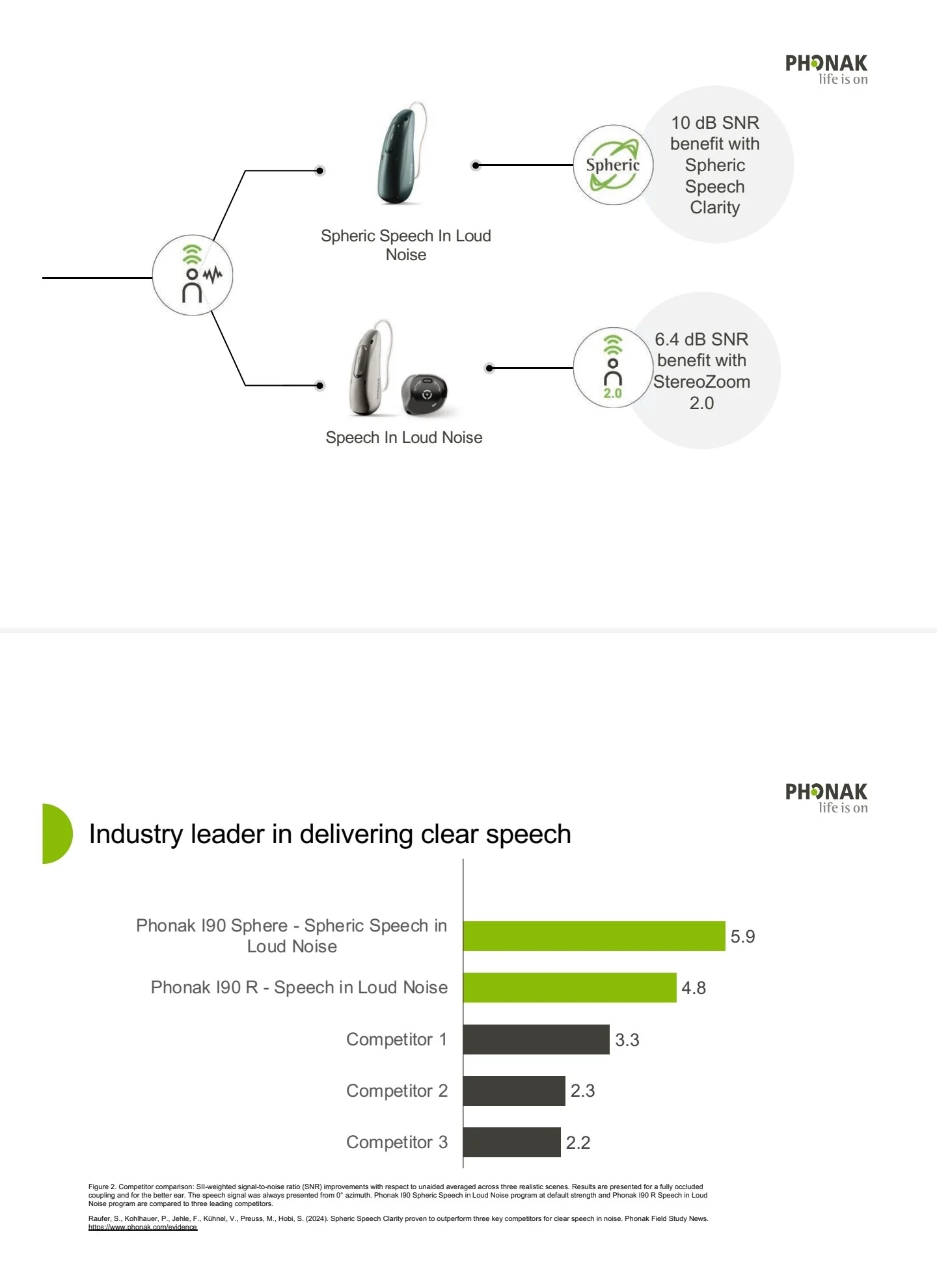
Join us as we introduce the next technological innovation to the world of hearing care by delivering a revolution in hearing aid technology, transcending one of the biggest challenges in hearing care with unprecedented speech from noise separation.
So, for example, the chip used in the I70 Sphere Infinio might have been produced with some bad DNN circuitry and might not crunch digital sound as efficiently as a Deep Sonic I90 chip. Thus, the I90 chip might be intrinsically more capable with better features and command a higher price. There might be a somewhat deficient chip in I70 that can still do much of the processing but must sell at a lower price.
Haha, imagine that I also considered this possibility. That would explain releasing the Infinio 70 Sphere model despite hight probability of higher sales of I90 Sphere model. That also means flashing the I70 is risky because it forces the hearing aid to use defective circuitry/chips.
I remember the ATI Radeon 9800 (weaker) and Radeon 9800 Pro (stronger) graphics cards. A slight modification could upgrade a cheap 9800 to a expensive 9800 Pro if one was lucky enough to get a card with no defects…
I would never recommend to disable it! Better make a second program with spherics.
I was a whole day in an amusement park and if there were no limit the Phonak would have ran off after 7h without opportunity to use it.
@jeffpa, @Misterref78 , IIRC, the 3-hour time limit resets when you put the on the charger for a while. I also wouldn’t disable that function (YMMV).
. It would be nice if they would provide at least a little info on the tech that goes into these devices but it seems like all consumer information writing has been handed over to the marketing department.
Yes, I admit it’s annoying that there is very little technical information for users, despite much of us are even technically trained. For example:
mAh capacity of batteries
nanometer process of chips
maximum current
recently I’ve received new sound processor for my (Nucleus 8) and didn’t know about differences between “Work” and “House” program.
in my sound processor - poor explanation of adaptive directionality (more “for dummies” style instead of professional graph with null places from microphones)
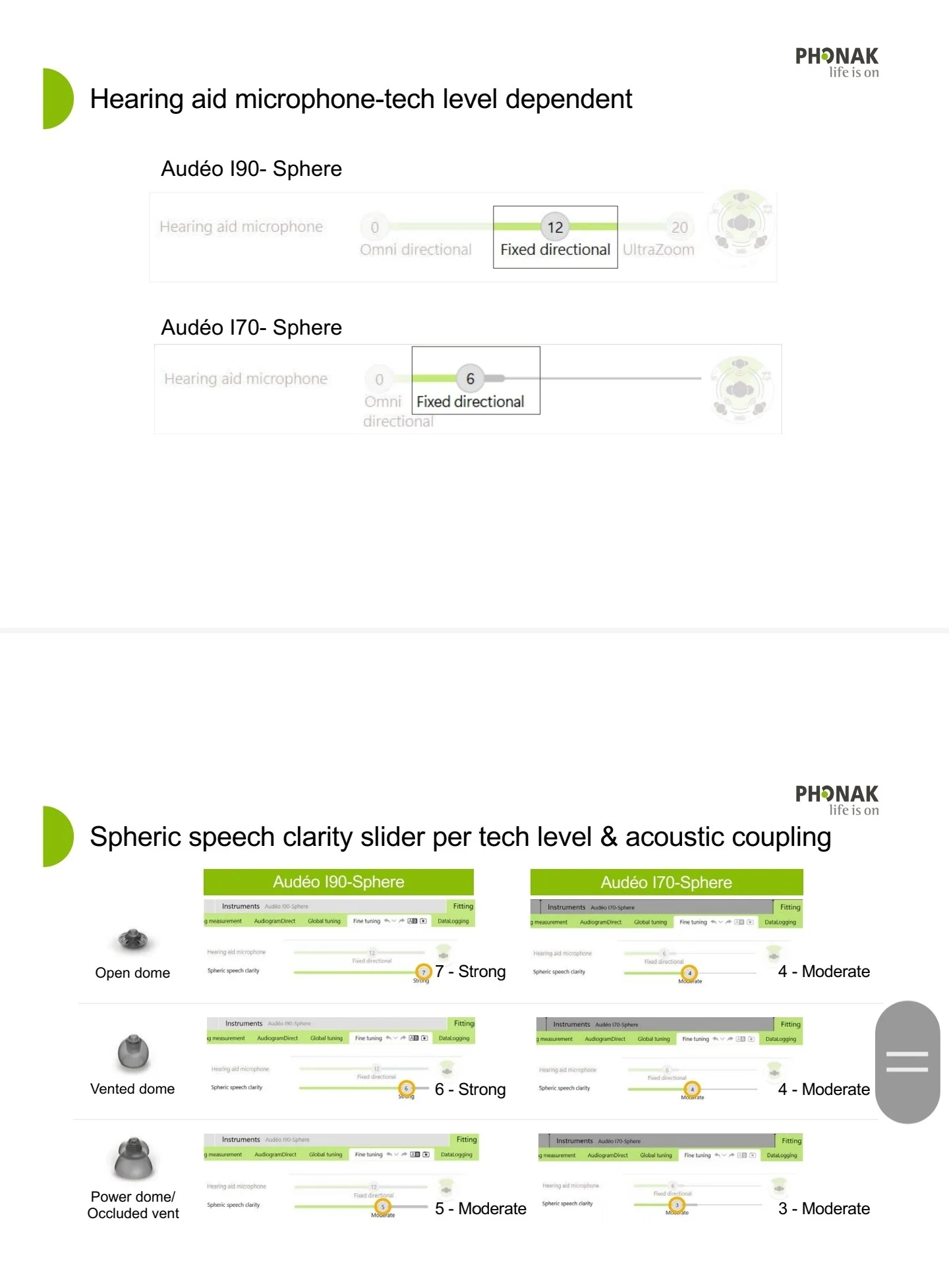
Do you have open domes? It doesn’t work well with them. I’d be shocked if it doesn’t have an impact for you. When people with good hearing use it, it even helps
theres a work and house program? More fun to play with I guess
I was referring to my sound processor, which works with the cochlear implant - it’s different device than . I will edit the post. I received a new one (Nucleus 8) on the 19th, and during the fitting, even my Audi was unaware of the differences.
@jeffpa, IIRC, the more open the fit, the more poorly Spheric noise reduction works because there is much more sound bypassing your hearing aid processing and going directly to your ear drums. Much more important for someone like me with decent low-frequency hearing, so I plan to wear an occlusive fit.
For whatever MS Copilot info is worth, it says the following about the turn-on threshold for Spheric noise reduction: Phonak AutoSense 6.0 is 65 decibels () for a duration of 5 to 10 seconds . Since I have a good decibel meter app for my iPhone, I’ll put it to the test when I get my Spheres.
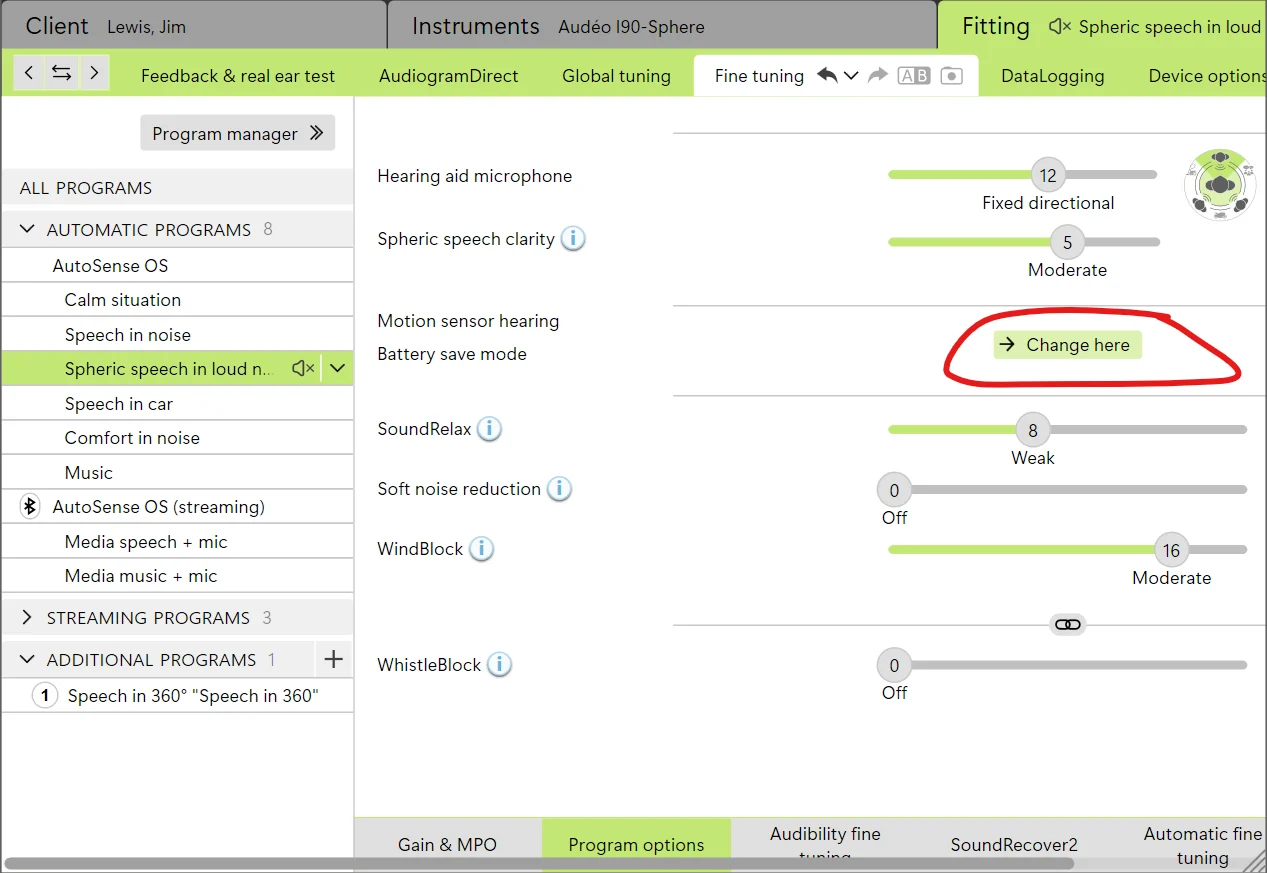
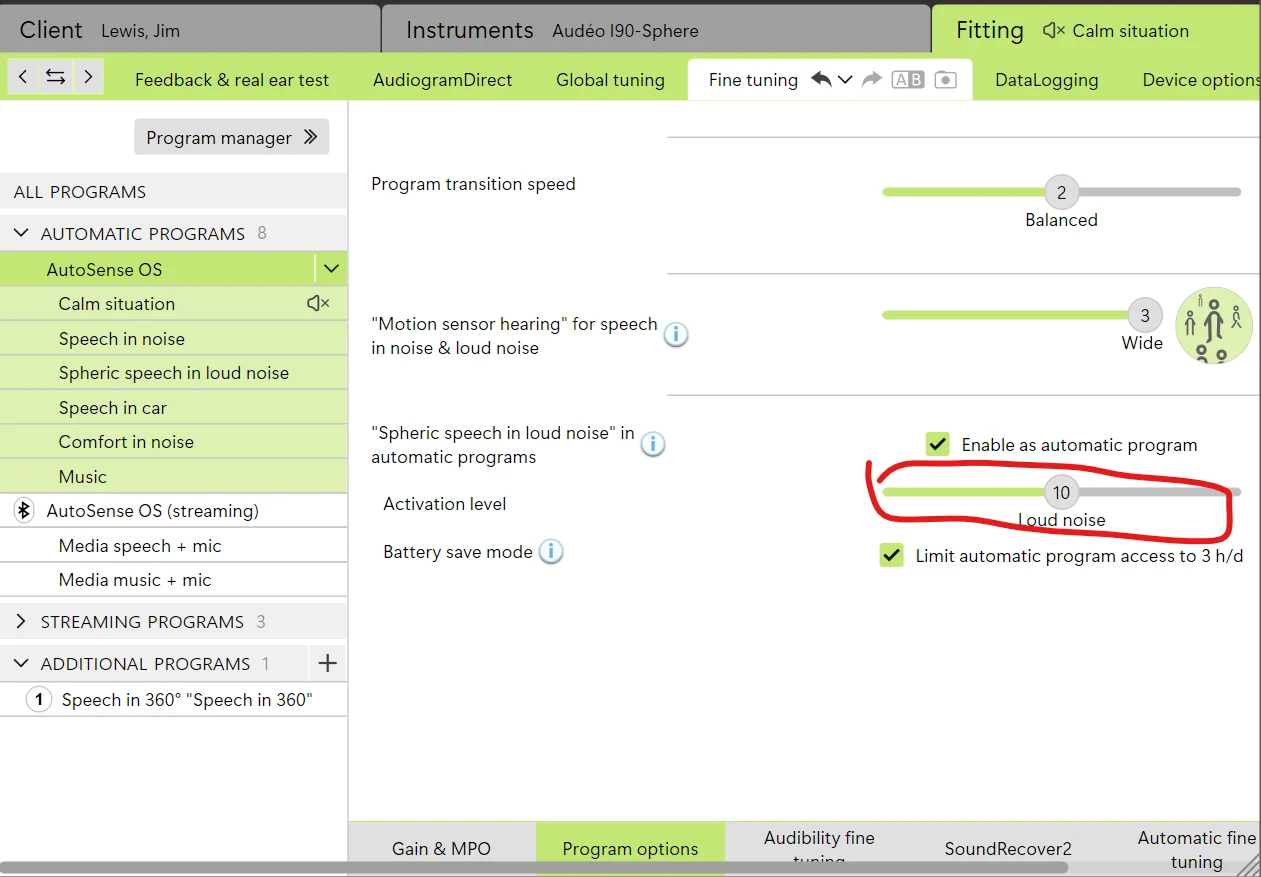
As to adjusting the sensitivity threshold, here are some screen captures from Target. Others may have posted similar already in other threads but here it is again.
so Assume 10 on that slider is around 65db? (or is that seconds at 65db?)
And yea, makes sense with open domes, gonna let noise through. Good old double edged sword/Catch 22 Let more natural sound in, but some of that sound you dont want at certain times
And if I hop on my backhoe, it’ll go into spherical mode?


 Texas Hill Country
 Poland