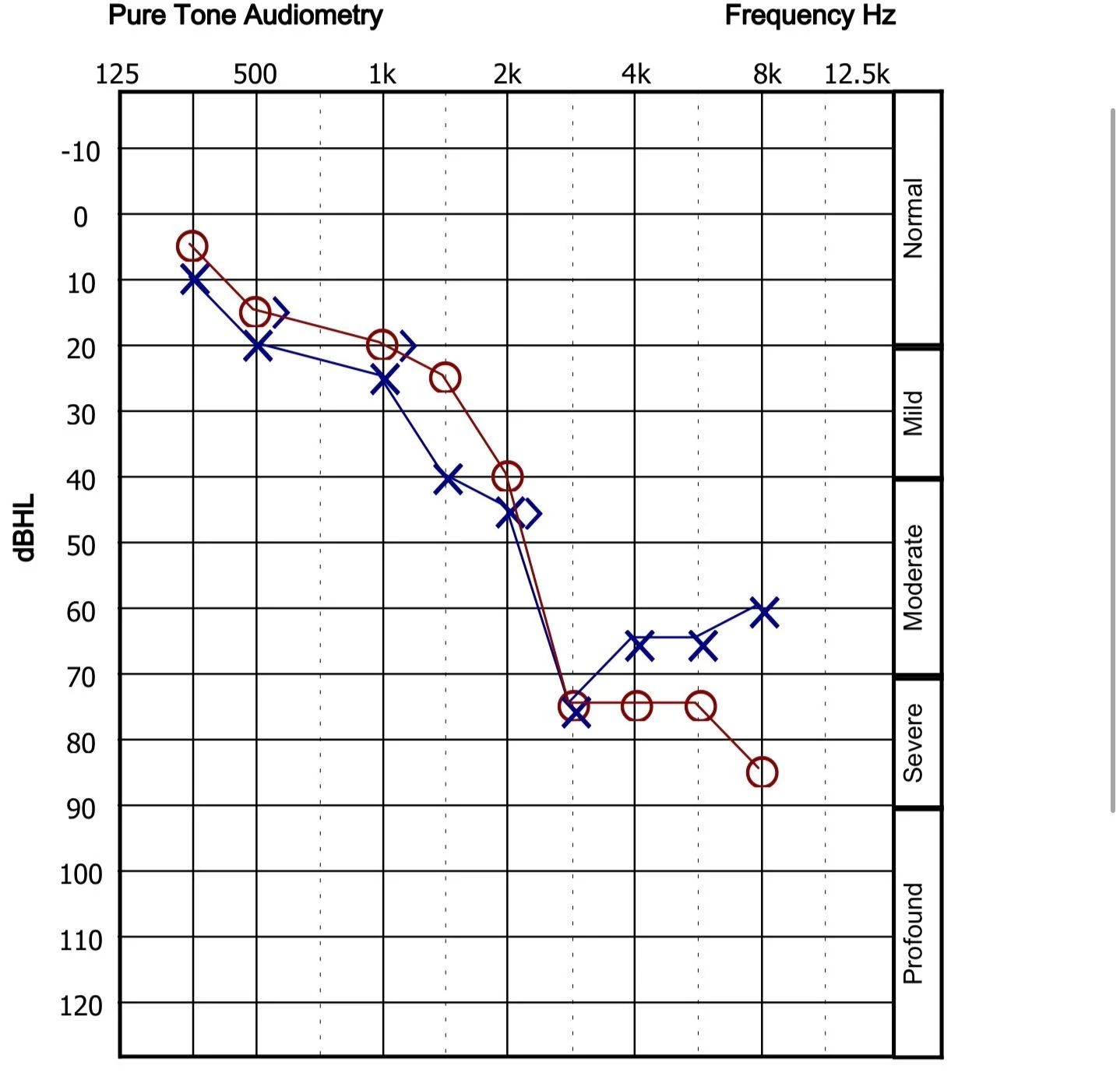
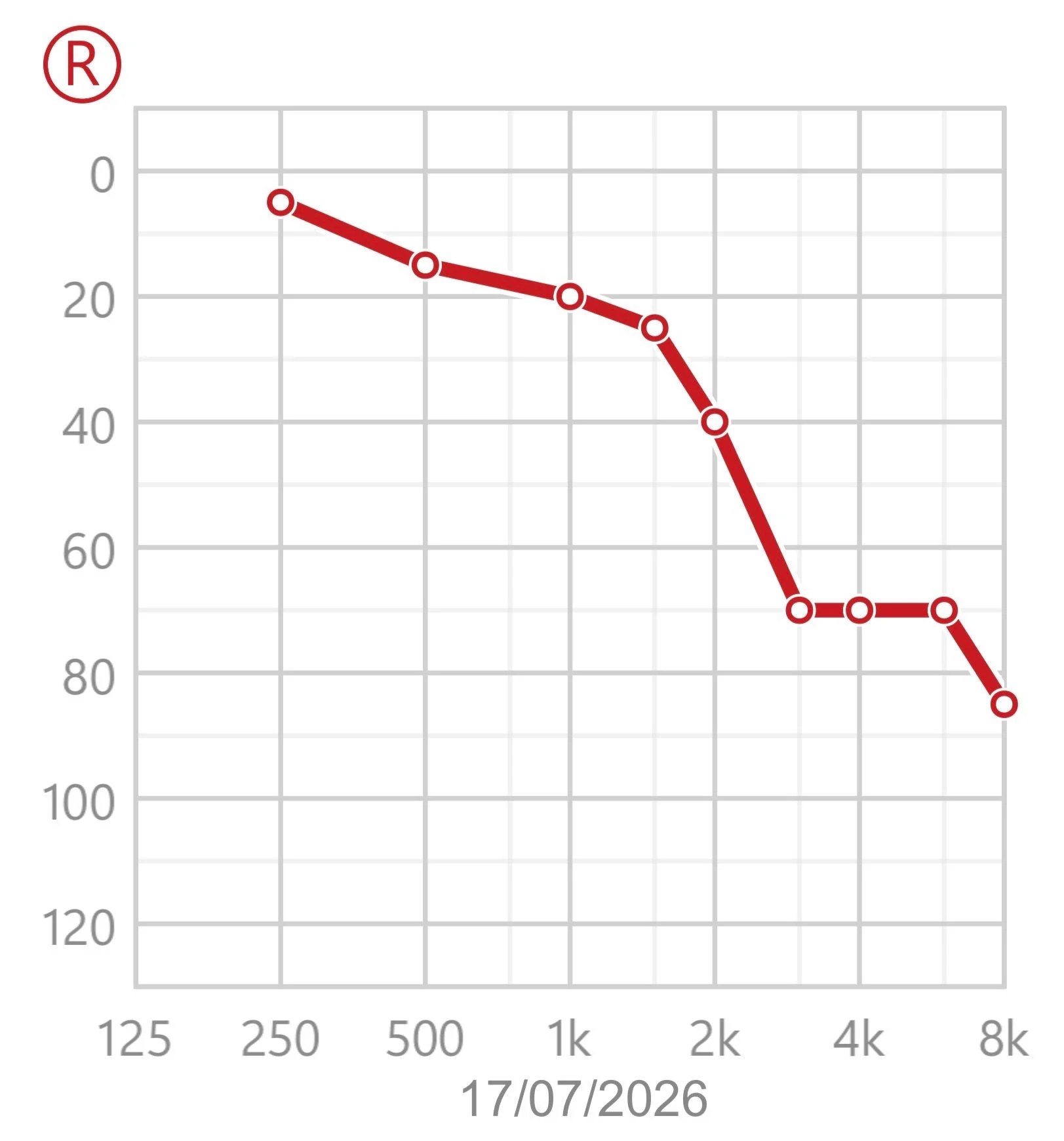
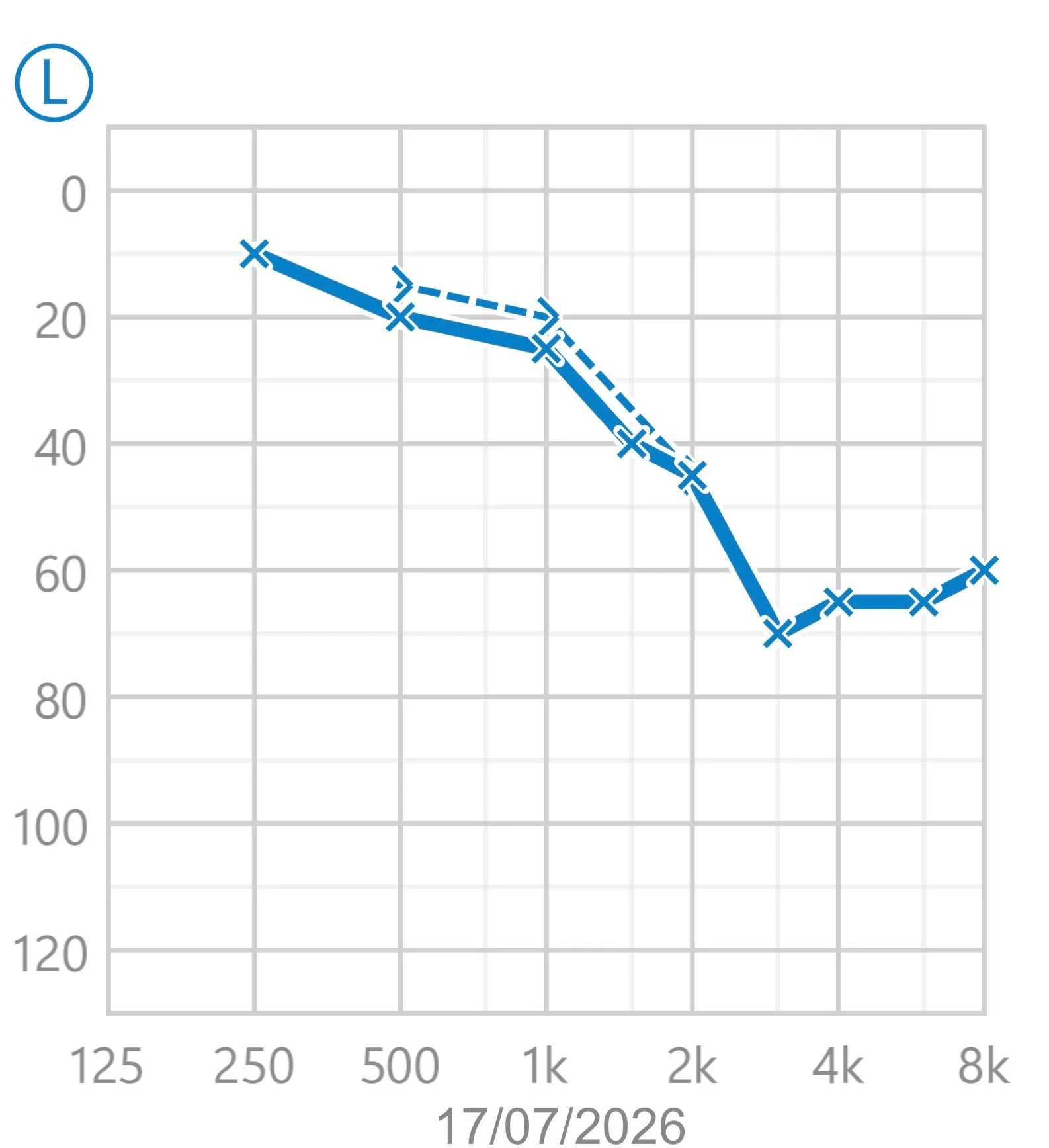
I had an in booth hearing test on the 17/07/2026 & when I got the new Sphere’s on the 11/08/2026 ( now returned ) & waiting for EON E90’s but I had an insitu direct as they wanted to compare before programming, here are pictures for comparison just to show that both can produce identical results .
I really like your hobby. I enjoy stuff like that myself. We have an old German grandfather clock with steel rather than brass inner works from war times. Beautiful old clock that could use your attention.
The right ear (red) is 5, 15, 20, 25,40, 75, 75, 75 85.
The left ear (blue) is 10, 15, 20, 25, 40 75, 65, 65, 60.
In the In Situ
The right ear is 5, 15, 20, 25, 40, 70, 70, 70, 85.
The left ear is 10, 20, 25, 40, 45, 70, 65, 65, 60.
Personally, I am finding In situ to be very good but it may not be for someone else.
What I have found, experienting with it to learn, is how important
it is to be in as quiet a place as possible.
It is VERY important that you use the least detectable sound you can hear, not the sound that is maybe just a bit clearer or very clear to you.
For me, in doing this after I learned these things, I found that my own In Situ and professional audiogams matched perfectly.
What is interesting in your case is that in your right ear you have a 5 decibel better hearing at the 3k, 4K and 6k levels.
Not sure why that would be. Do you have tinnitus? Could you be mistaking tinnitus for a sound?
Your professional audiogram should be accurate.
As Raudrive wisely said, you will have different results in programming because your In situ is different.
The only thing I can suggest is practice, practice and find a silent location. Make sure nothing can cause you to mistake something other than the tone generated by your program.
The insitu was done by the Audiologist not me & yes I do have tinnitus in both ears but is worse in my right ear, also the test was done through my Lumity aids.
I do have target & a Noah wireless because I have been ripped off by 2 Audiologists in the past although not used it for the Lumity’s or sphere’s so I will do a test my self
In-situ may work better because, unlike an , it takes into account the ear architecture, the venting and fit.
Differences of 5dB are considered within the margin of error. Every measurement has a margin of error equal to the tolerance. For instance, a measurement of 60dB at 4Khz is actually 60dB ± 5dB.
It’s not necessary for both tests to be perfectly matched. They’re two different tests conducted using different instruments with distinct objectives. Moreover, if you’re creating your own in-situ diagram, you’re aware of the sound being produced, which can influence the results.
And as one of our pro members said, diy insitu fittings are typically under fit.
In-situ measurements do not do fittings. What you probably heard is that the propietary fitting formulas are typically under fit.
In-situ measurements can consider the type of dome used and the ear architecture, which cannot do. Therefore, in cases where PTA is used without (or a remote fitting) compared to in-situ measurements, the in-situ measurement may yield better results with the fitting formula, depending on how the fitting process utilizes the data.
Also, one of pros here, @Hearing_Potential did say mention that he had seen good results with Widex sensograms. Widex says their can achieve excellent fittings on the first "try" (and my experience confirms this).
This other paper has a different view. It does show that there can be differences but it does explain that the differences are due to venting, the degree of hearing loss and calibration. https://pubmed.ncbi.nlm.nih.gov/25597462/
In the end, what really matters is what happens after the in-situ measurement and what the software does with it (plus of course, the person doing the fitting).
Paragraph one of the introduction of the second paper clearly states:
"With in-situ audiometry, hearing thresholds are measured through the patient's hearing aid....."
So it is not a fit, it is a tool for measuring thresholds just like . I stand by what I said. The data provided by it can be used by the fitting formulas. In fact, with in-situ data, you can use any fitting formula you want (, propietary, , etc). It is data, not a fit.
And the first paper contradicts what you said (see end of abstract)
Quote:
"The results clearly indicated that modern measured in-situ thresholds align (within 5 ) with conventional thresholds measured, indicating the potential of in-situ audiometry for remote hearing care."
In this case, I prefer to consider the professional's publication findings than your opinion. what I said is based on what the publications I shared showed.
I did read your comment again and it did said " in-situ fittings". If you meant to say the DIY fitting overall process with in-situ audiometry then yes, I misunderstood your comment. My post considered the OPs comparing audiometries, not fitting processes. In this case, using vs in-situ for DYI: I have not seen the former providing consistent higher values than the latter. The type of dome used and how the software presents the results can make a difference, in my experience. For instance, I’ve noticed variations in the data displayed between Widex and Phonak.
My comments are respectful and I am allowed to have difference of opinion and, if I missed a part of the comment, I am ackowledging that now.
And, if you have read my others posts, you know I am a very active DYI contributor here.

 Cotswolds UK


 Texas Hill Country


 Auckland, New Zealand