I’m fitted bi-aurally with Starkey Evolv 1600. I noticed a strange phenomenon where my would “resonate” when exposed to musical shakers (baby toys with beans inside), or things that click with higher pitch (think the clicking of spark plugs that light a gas stove). This is even when they are relatively soft. The outputs (both ears) would go very loud and sound broken. A good way to describe the feeling would be as if someone were tapping a stick on the HAs mics.
I my fitting and have tried all ways to isolate the problem, including turning down the maximum output, turning off all features, turning off compression, turning off directionality, or even setting all gain to 0. It appears that the microphones are saturated at a particular frequency.
Ironically, I tried out my Apple iPods Pro with custom transparency mode and they do not exhibit any such phenomena. Much smoother and more natural! I hope Starkey isn’t using sub-standard mics/front-end for such an expensive product!
I wonder if anyone here has experienced the same issue. Or does anyone know if such issue may be brand related.
Agreed that you should get the hearing aids tested. Ideally bring a shaker into your audiologist’s office and demonstrate. If that’s not possible, that’s one of the downsides of .
Thank you for all the advice. Unfortunately my audi isn’t v competent. I don’t see any test box around in his office. He did show me the manufacturer’s test report when I first received the .
I should mention that these HAs are barely one month old, and to have both of them exhibit the same issue seems a bit unusual from a QC standpoint.
@Raudrive The music program has this artifact too. I’ll dig into warbles and see what I can find.
Will update this post as I keep experimenting with possible solutions. Hopefully my experience will be useful for others too!
I have a sensitivity around 8k. Tons of loss at lower frequency, but my hearing is not nearly as bad at 7.5k and up. But, I think I have recruitment as the sounds up there are really annoying. For example, water from the tap hitting the sink takes on a sibilance that grates on my nerves. I will get that band lowered this week hopefully. I’m wearing new Evolv wireless aids.
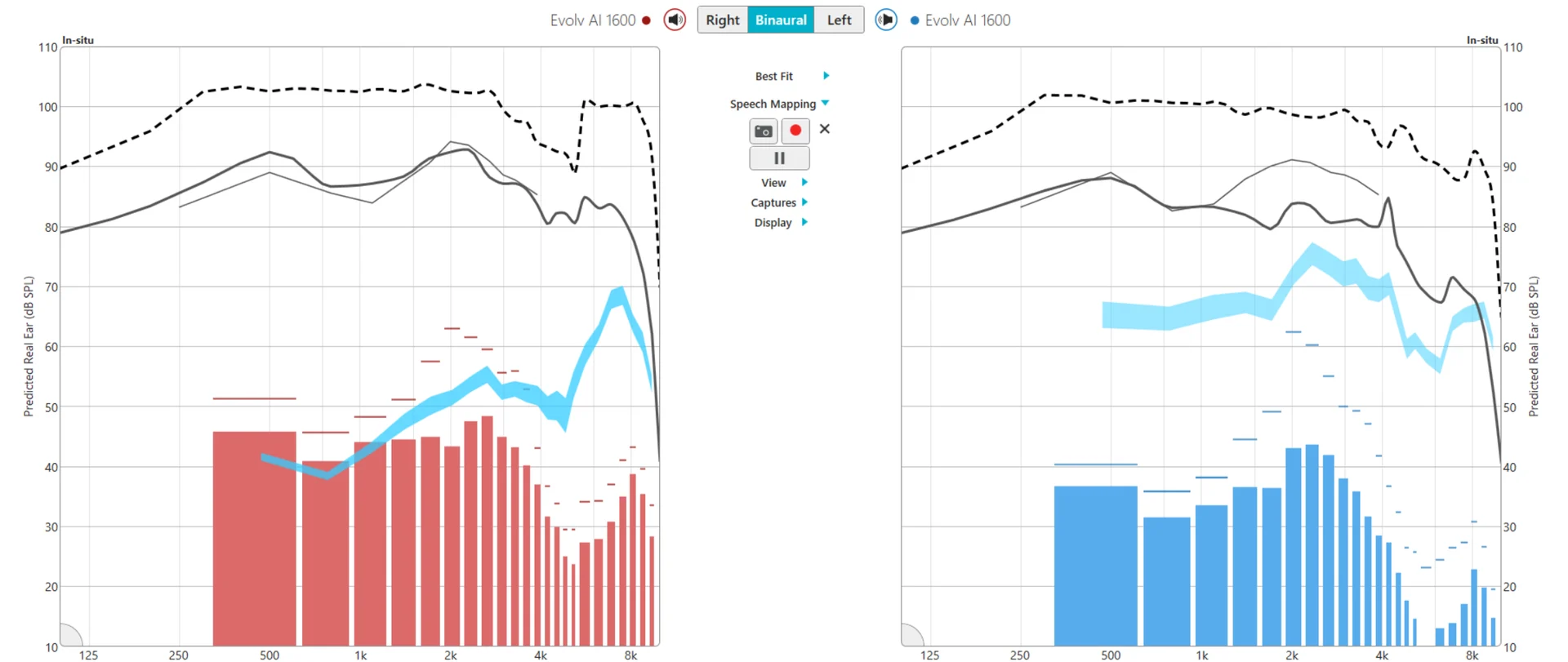
I managed to capture the input spectrum of the shaker using the Inspire X software.
Take note of the blue line, indicating the average output spectrogram. This was captured as I shake the shaker over my left , which produces the crunchy sound. The right HA sounds fine in this case.
Interestingly, it suggests that the spectrum exceeds the 8kHz bandwidth that the HAs can manage. I am hypothesizing that perhaps as the sound gets louder, the high frequency components get increasingly clipped resulting in the unpleasant transition from a gentle rattle to a crude crunching sound. This issue was magnified that due to my reverse slope , I was applying more gain to the lower frequencies than usual.
To investigate, I cut off all amplification to the low frequency bands and true enough, the shaker sounds less “crunchy” now. Now begs the question: when will HAs come with a wider bandwidth, or at least a mode with wide bandwidth if the user needs it (I assume power consumption is the main limiting factor)? I’m sure what I encountered isn’t a corner case as many musical instruments extend beyond 8K.
From your picture, the difference in sound picked up by the microphones of the left and right hearing aids at the same moment is so obvious that the problem may be in the microphones.
The best thing to do is to send the hearing aid to the starkey factory for service.
In addition, you can check the microphone for moisture or dust buildup.
If your hearing aid are or , you can swap the left and right hearing aids and reprogram them to see if the sound will be different.
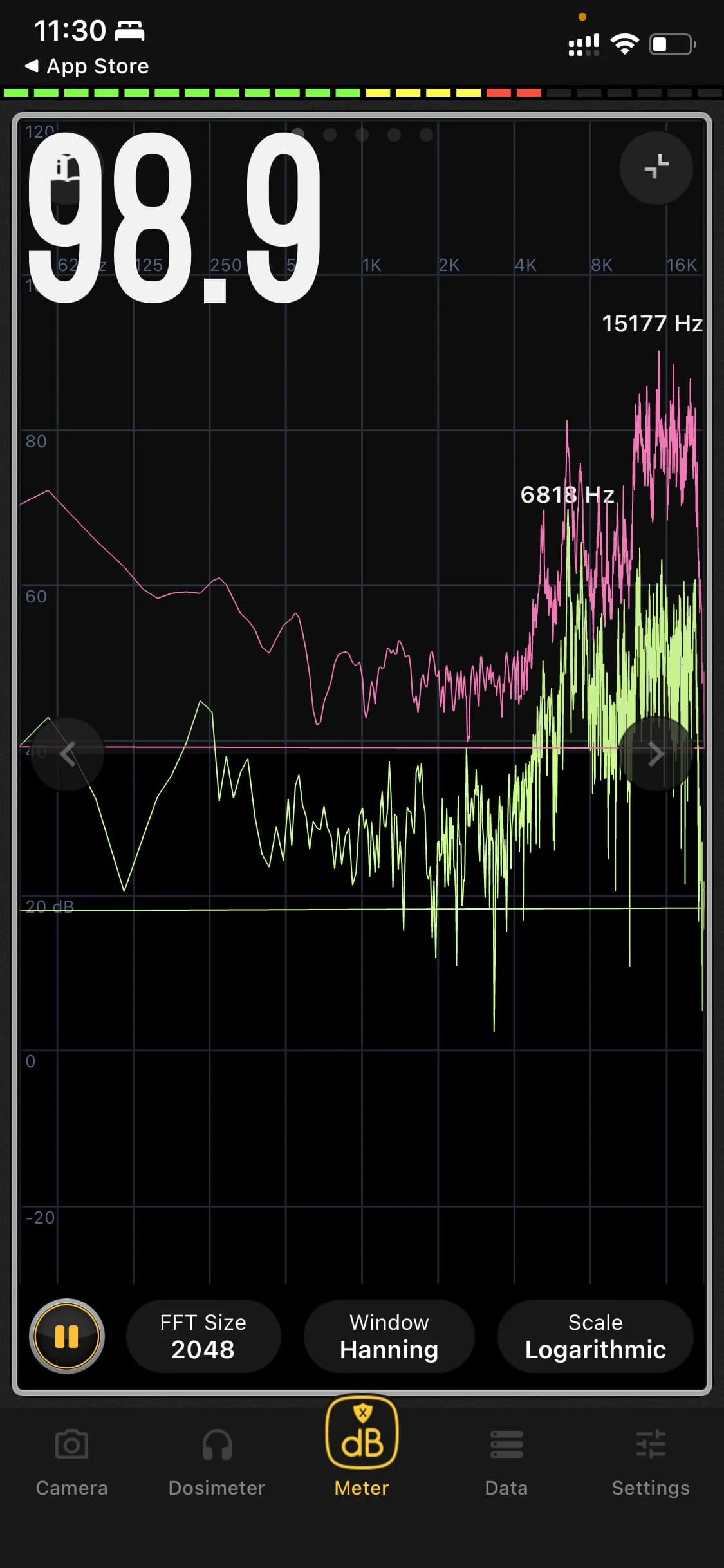
I did some further investigation lately and have zero-ed in on a possible cause. I can now reliably reproduce the distortion by exposing my to high frequency pure tones, typically upwards of 10KHz. I also did a frequency analysis of my shaker, and turns out the peaks are in the very high frequency ranges too:
Right now I’m pretty sure the crunchy sounds are caused by undersampling of the mic, resulting in aliasing of input signals. They should have included a low-pass filter at the inputs. I did a quick verification by covering the mics with a napkin and the artifacts are gone!
I understand that 60118-0 tests the HAs up to 8Khz only, which would not pick up this issue. Will the manufacturers be obliged to fix this design flaw?
Very interesting, but a really tough problem, given the severe space and power limitations in an . In the old days, to process audio up to 8 kHz, an A/D converter might sample at e.g. 20 kHz, preceded by an analog LPF with an accurate passband up to 8 kHz and sufficient attenuation in the 12+ kHz stopband. But that required several op-amps, accurate capacitor values, etc., not practical in an HA. To reduce costs, the modern solution is to sample at e.g. 320 kHz, with a trivial RC filter on the input. The result is then downsampled to 20 kHz with a proper LPF in the digital domain. That may also be currently impractical in an HA, as the computational load may exceed the power budget. I’m not surprised that the manufacturers skimp in this area.
I did a quick verification by covering the mics with a napkin and the artifacts are gone!
Dr. Marshall Chasin, a leading of fitting for musicians strongly suggests using scotch tape over the mics to lower the input headroom.
You can google him, and get some excellent advice on programming HAs for music.
Hello user444. This is a very interesting thread. Spectrograms, too!
Cursed/blessed with hearing developed in a BBC job, and having a love of music, hearing aids for later life high-end droop have introduced new challenges. I have learned that individual audiologists may or may not be music-aware, and I have to say that seems to apply to some manufacturers as well.
First - that shake/rattle phenomenon. For several years, my obsolete Phonak Naidas delivered pretty good speech and ‘live’ music, once all fancy processing had been turned off, apart from high end boost and ‘comfort’ compression.
Then, I was fitted with Signia something-or-others. Dreadful, painful clicks on transient sounds - including elements of speech - simply because the compression was too slow acting. In my day-work I would regard such a thing as mis-design. I improvised a test-rig, and showed the trace of spikes to my audiologist, who to her great credit made contact with the manufacturer.
Now, she’s fitted me with later Phonaks, the M70. She took care, let me try music, extended the lows so I could even hear down to 40Hz, bottom E. Wonderful, but earmoulds had to be replaced - and since then the settings have evidently changed: warble at 2,100 Hz, low-beats if you play that C with an E, ‘clogged’ and phasey orchestral sounds, fade-aways if the music is quiet…
So, yes, fitting is crucial.
As for microphones. It would be surprising if they were culprits. A basic condenser capsule can be bought for £1.50. These will deliver excellent fidelity, and don’t overload until sound level is very high. No doubt hearing aid miniatures do cost more, but surely not worth cheapening?
Most of the cost of an aid is not actually in the box, but in the services and research surrounding it! The very fact that those iPods pro work so well at a fraction of typical costs says a lot.
That’s an ingenious diagnosis, to use a napkin over the mic. Similar here: I have a pad over my hi-fi tweeters so they give out less of what I cannot hear anyway, and put less stress on the hearing aid. Yes, indeed, there should be early-stage filtering. Among the handful of really smart audiology professors, ‘Scotch-tape’ Marshall Chasin has always championed early analogue treatment (for example limiting) ahead of the processing. That’s pretty standard in sound studios.



 Taiwan
 Texas Hill Country

 China

 Crediton town, Devon UK