(N.B. I recently posted the following comment in the midst of another thread, but I’m hoping that it will receive more responses as a separate thread.)
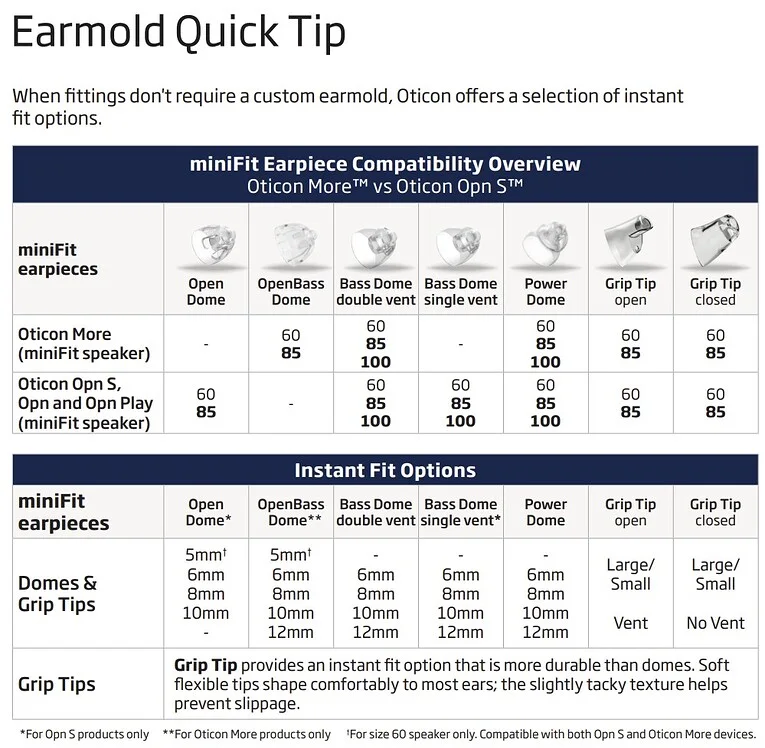
The Philips 9030 and Oticon More can both use an OpenBass dome (although I’m not sure if the domes are interchangeable.)
The “white paper” for the Philips 9030 says this about the OpenBass dome:
The new dome, called the OpenBass dome, replaces the current Open dome… In the legacy Open dome, the acoustical venting is realized by “flat” holes that are perforated on the surface of the silicon dome. In the new OpenBass dome, the acoustical venting is realized by 3D grooves through the silicon dome that are formed by a curved floor, and a ceiling towards the base of the dome. This structure is three dimensional, as opposed to flat holes in the legacy Open dome, and it is referred to as SoundTunnelsTM.
Compared to the legacy Open dome, the benefit of the SoundTunnelsTM is that engineers were able to reduce the acoustical venting area of the OpenBass dome by 70 %, while maintaining the same “openness” perception. The combination of a reduction in venting area and a higher predictability of the effective venting once inserted in individual ear canals has several benefits, including that it creates a better acoustical environment for the feedback canceller, which also facilitates the match of the prescribed gain on expected target gain values.
My question: Does the OpenBass dome create more “insertion loss” than the standard Open dome? The above description is a little confusing. If the acoustical venting area of the OpenBass dome is reduced by 70%, how can the same “openness” perception happen?
Do any Oticon More or Philips 9030 users here have experience with the differences between the two domes?
You’re ignoring this member’s posts.