
tenkanProvider
Well don’t forget you’ll still need to have the correct programming device as well for your projects.
You’re ignoring this member’s posts.
This topic is closed.
64 replies4.6k viewsLast reply
Well don’t forget you’ll still need to have the correct programming device as well for your projects.
You’re ignoring this member’s posts.

Are the overwhelming majority of people fitting and adjusting Oticon hearing aids poorly trained or seriously lacking in knowledge? I have TWO audiologists - one that doesn’t do REM but is happy to go through adjustments and work with me, and one that DOES do REM and believes that’s the solution to most everything.
Or is the problem that I’M not doing a good just of explaining WHAT problems I’m encountering? In which case I need to do a better job.
is not the solution to everything. REM is just a good starting point to start making fine tunings to get to where you’re happy. It doesn’t help that YouTubers like Dr Cliff Olson pounds on relentlessly the value of REM which can give the wrong impression that REM is everything.
If I were given a choice between an who doesn’t do REM but is happy to do as many adjustments for me until I’m satisfied, vs one who does REM but is not happy about making more adjustments after that, I’d choose the earlier one. Of course if I can find an HCP that would do both, I’d pick that one over the above two.
Even if you’re not good at explaining what you want to change, they should be trained and have the experience to interpret what they hear you say correctly into actionable adjustments and acceptable results. So don’t be too quick to blame yourself.
Can the maximum volume of the higher frequencies be reduced significantly so sounds cannot get so loud as to be uncomfortable, while increasing the amplification of soft high frequency sounds to make them more intelligible? And are there frequencies, above and below which, the sound level can be significantly reduced (below 60 or 80Hz and above 1000 or 2000)? And would that significantly reduce the distortion and garbling of higher frequency speech?
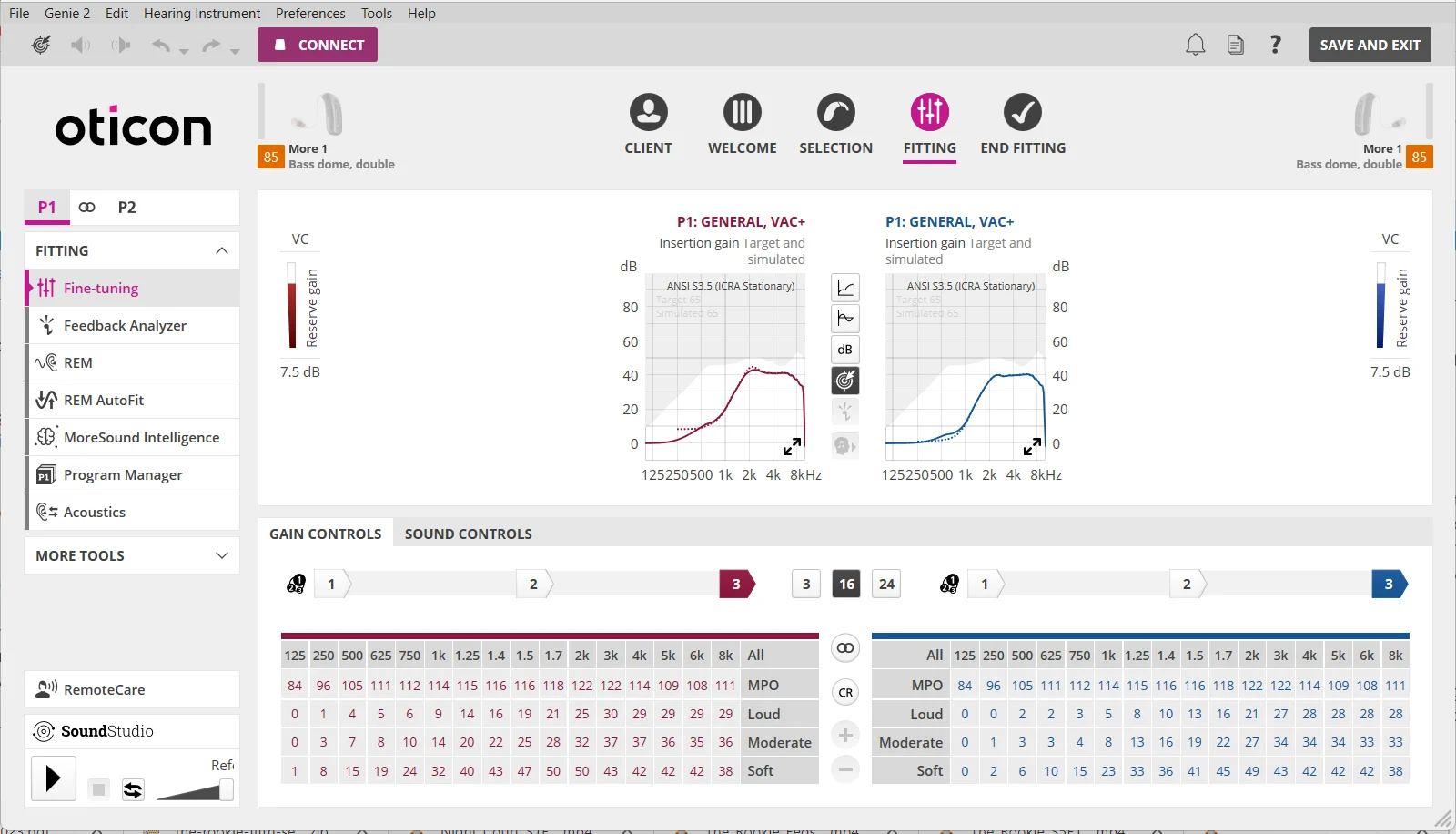
All of the above can be done. With Oticon Genie 2, in the Fine Tuning page, you can adjust the gain for 3 levels of incoming sound: Loud, Moderate, and Soft. And you can set the frequency resolution to as high as 24 different frequency channels. So you should be able to go through it with your audi to adjust the above suggestions to your heart’s content. See the screenshot below to see what I mean. You can also set a (Max Power Output) gain to make sure you don’t hear anything at a sound level too uncomfortable for you.
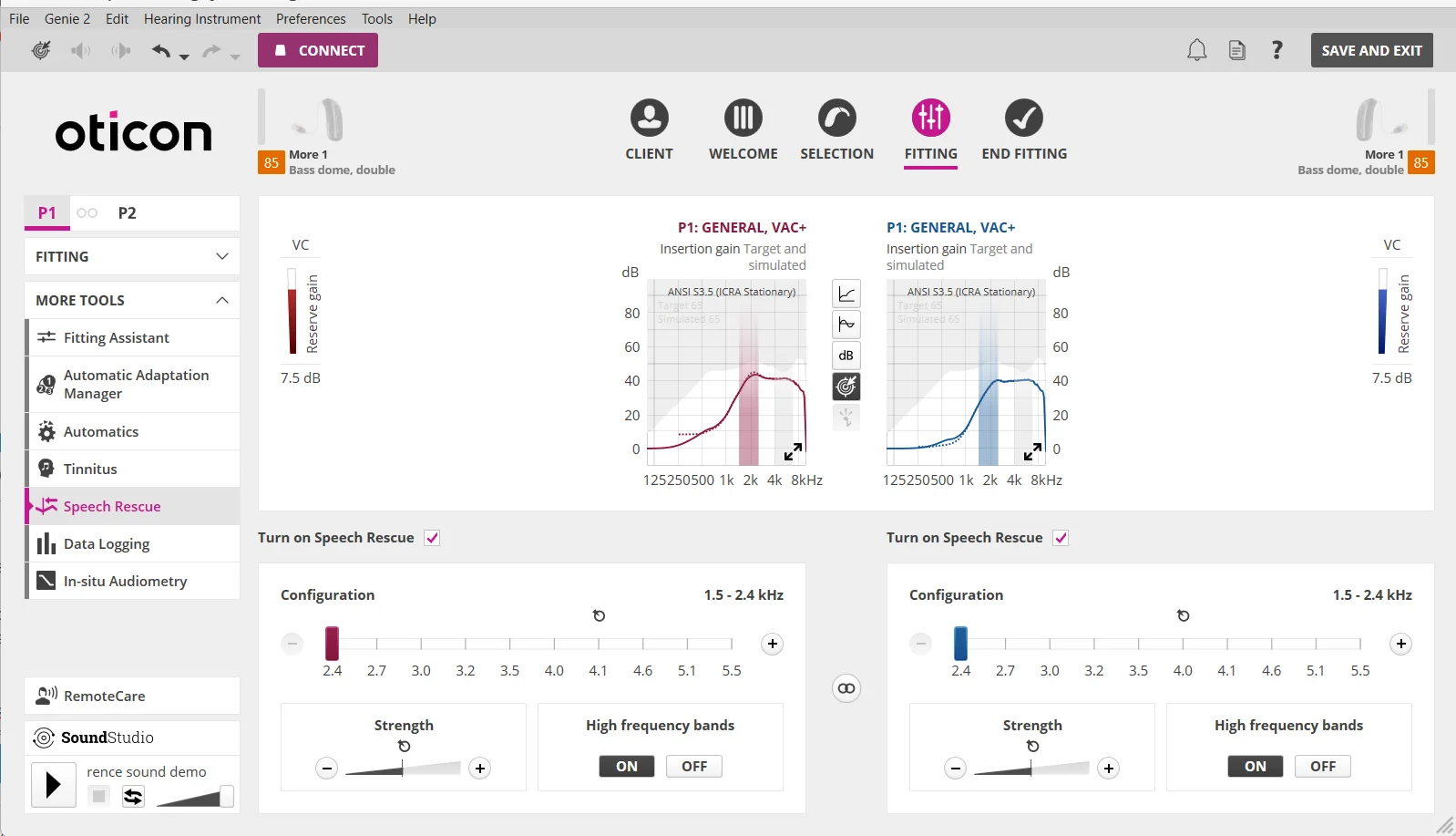
Beside the Fine Tuning adjustments, now that you have posted your , it looks like it’s possible to use the Oticon Speech Rescue option (the technology) to lower some of those very high sounds into the mid range of around 1.7-2.4 KHz where you can still get somewhat moderate audibility. If you haven’t already done so, you may want to explore this option with your HCP. Doing this may help with speech audibility. I get great result with using it myself personally.
Below is a screenshot example of Speech Rescue.
Is there any reason NOT to put a second “speech” program on the hearing aids for experimenting? Keep the “normal” settings as program 1, put a new one on in program 2? That would give me a way to compare what I’m hearing.
You can have up to 4 programs in the More, so there’s no reason not to fill up all 4 with different things so you can compare them. Normally people tend to add a music program, a Speech in Noise program, and maybe a Tcoil/Phone program, or a different (standard) rationale, or another built-in program like Lecture or Comfort, into the fourth program.
Actually, not filling in the remaining 3 programs is kinda wasteful. It’s better to have all 4 programs filled in so that you can access and compare them if/when necessary than to leave 3 programs empty and useless while you’re paying a premium for premium aids that offer 4 programs. I wish I can have 6 to 8 programs even, so that I can be ready for any kind of environments.
You’re ignoring this member’s posts.
Thanks for all the replies. At least in here it seems like people can relate to the frustration of trying to get the clearest communication in a variety of situations!
REM is not the solution to everything. REM is just a good starting point to start making fine tunings to get to where you’re happy. It doesn’t help that YouTubers like Dr Cliff Olson pounds on relentlessly the value of REM which can give the wrong impression that REM is everything.
If I were given a choice between an HCP who doesn’t do REM but is happy to do as many adjustments for me until I’m satisfied, vs one who does REM but is not happy about making more adjustments after that, I’d choose the earlier one. Of course if I can find an HCP that would do both, I’d pick that one over the above two.
Even if you’re not good at explaining what you want to change, they should be trained and have the experience to interpret what they hear you say correctly into actionable adjustments and acceptable results. So don’t be too quick to blame yourself.
I don’t think is the be-all either, but the audiologists I’ve talked to that HAVE one want to use it for most everything, and once they have the readings they’re pretty much (or totally) done. I’ve only USED one audi with one, but I’ve spoken to a couple others who felt that once they set the aids to compensate for the , then run the REM, it’s optimized. Collect $300 and out the door.
My local , from whom I purchased the More 1R aids, is very willing to try things, but I’m not sure he’s easily able to translate my imprecise descriptions into specific adjustments.
I’ve seen the fine-tuning page in Genie 2. We spent quite a while looking at it. Again, the problem is translating my description into specific adjustments. I can tell him “higher and high pitched speech and sound is distorted, sounding like an old AM radio where the tuner is not quite on the station”. Lots of static and hissing sibilants.
Beside the Fine Tuning adjustments, now that you have posted your audiogram, it looks like it’s possible to use the Oticon Speech Rescue option (the frequency lowering technology) to lower some of those very high sounds into the mid range of around 1.7-2.4 KHz where you can still get somewhat moderate audibility. If you haven’t already done so, you may want to explore this option with your HCP. Doing this may help with speech audibility. I get great result with using it myself personally.
I’m not sure what the problem is, but NEITHER of the HCP I’ve worked with want to use Speech Rescue. They usually brush it off when I bring it up. I can certainly push my local HCP (I’ve got another appointment next Tuesday) to try it, and he will, but is there some PROBLEM associated with using it?
I’ve currently got a Music program and a speech in noise program on the hearing aids, but I’ve elected NOT to mess with either until the basic, every day program is working. I figure trying to adjust everything will confuse everybody.
The other thing I’m finding is that it’s better in person. Not good, but better than going through some other medium. Unfortunately, phones, TV, webinars, podcasts, Zoom presentations and all the other things that go through speakers are worse than in-person. It’s somewhat better through the good wireless headset I’ve got (NOT Bluetooth), but the Bluetooth for the phone is bad at the moment. I’ll see Tuesday if we can make that better.
You’re ignoring this member’s posts.
I’m not sure what the problem is, but NEITHER of the HCP I’ve worked with want to use Speech Rescue. They usually brush it off when I bring it up. I can certainly push my local HCP (I’ve got another appointment next Tuesday) to try it, and he will, but is there some PROBLEM associated with using it?
There is NO problem associated with using Speech Rescue at all. Either you like it or you don’t. It’s not going to ruin your hearing, and with your hearing loss profile, I think it can only help and not hurt. If once you try it and you deem it not helpful, simply turn it off.
I think it’s pretty lame that none of your are receptive to trying it out to you. I think they’re just lazy and don’t want to bother. They should know better that you don’t have to turn it on in the main program if the concern is that they don’t want to add “coloration” into the original prescription. They should know better that they can just make a copy of the default P1 program (into P2 for example), then turn on Speech Rescue ONLY for P2 and not P1. Then you can toggle back and forth between P1 (with no SR) and P2 (with SR) to do A/B comparison to see if you like it at all. Turning on SR is never a set-in-stone thing. You can selectively add it only to one program and not the others.
You said you already also have a Music program and a Speech in Noise program that you haven’t tried out much. So there IS an extra unused program you can use for Speech Rescue. Move the Music and the SiN programs to P3 and P4, and copy P1 into P2 and enable SR ONLY in P2. Now you can toggle back and forth between P1 and P2 to see if you might like SR or not. If not, stop using P2 until next time you see your HCP, and have him turn off SR and use P2 for something else. But if you like it enough, then have your HCP enable it in P1 so you’d have it permanently next time you see your HCP.
If a non professional user (like me) on this forum knows how this can easily be done as a “trial” mode without affecting the integrity of the main default P1 program AT ALL (as described above), but 2 or 3 of the professionals serving you are not willing to let their patient try it out and brush it off EVEN WHEN ASKED, especially when there’s an extra program sitting there unused, then there’s something wrong with these professionals.
The only time Speech Rescue is not applicable and not worth trying is when you have a cookie bite hearing loss where your hearing loss is worse in the mid range but you have good or better hearing on the high ends, because there is no point in trying to lower the high frequency sounds into the mid range when you can already hear the highs just fine. But with your hearing loss profile (and that’s why I asked to see your in the first place so I would know), you have severe to profound hearing loss in the high ends, and moderately loss in your mids (the 1-2 KHz) range, so that’s why lowering the high end sounds into the mid range where you can still hear better than at the highs MAY be helpful to you. Your HCPs should know better to let you try SR out when asked than to brush you off.
You’re ignoring this member’s posts.
OK, so there’s no reason not to try it. The mechanics are pretty easy. I’ve already planned to have him move the music program - which SEEMS to work pretty well when I’ve used it, and the speech in noise program - which kind-of works but not very well yet to 3 and 4 and put a “test” program in 2 for trying things.
I don’t think he’ll have a problem trying the speech rescue since he says he rather enjoys the challenge of trying to optimize my hearing… I’ll know more Tuesday.
You’re ignoring this member’s posts.
Hearing Aids2 replies
Hearing Aids2 replies
Hearing Aids2 replies
Fitting Software Requests869 replies
Hearing Aids158 replies