The problem I have with increasing sound too much, apart from the auditory fatigue which I never got used to even when wearing hearing aids like Resound for well over a decade is the fact that I can’t hear speech in noise very well. I used to struggle with noise in speech until Oticon came along. Surely if deprivation was the problem, it would be addressed over a ten year period wearing those Resound hearing aids? But I think you are right. My world is a little quieter than most!
Thank you for insights. You are right I do tend to have a lot more issues with accents like Welsh, Scottish or Irish. I do have moulds just for reference. I am very keen to see this new audio because I think she will be able to help. While I am in agreement that having a massive battery of tests is not indicative of better service, I do think there is value in some of her tests that she offers. Chatgpt has convinced me that the Aided speech testing and ACT in addition to will help identify what my problem is with “soft Speech.” Chatgpt thinks it may be a combination of audibility, frequency specific audibility, reduced speech contrast and listening effort. Which I find credible, because I have never believed that the problem was simply a case of volume too low - just turn up the volume!
I will leave this topic at this point for the moment, until I have seen her, because I appreciate one cannot really diagnose something like this in a forum. This topic was never intended to diagnose the issues, but more provide for the upcoming review of this new audiologist and then it kind of unraveled into various subtopics. I will update once I have seen the audiologist and what she has found.
I asked Chatgpt to explain to me the value of Aided Testing seeing as you don’t see the value in it.
Here is Chagpt’s response based around my hearing loss. I am not one for posting statements from , because I trust humans far more than AI and AI does get a lot wrong. In addition, people can always ask AI themselves. But I thought this particular debate would be of interest to you and worthy of discussion, because clearly Chatgpt sees aided Testing as more than just simply a score card.
Chatgpt View
What aided speech testing is not
It is not:
A fine-tuning tool by itself
A direct instruction like “add 3 at 2 kHz”
A guarantee that speech will improve if the score improves
If an audiologist expects it to tell them what knob to turn, they’ll be disappointed.
That’s probably where the forum audiologist is coming from.
What aided speech testing actually does (and why it matters)
Aided speech testing answers questions that , pure-tone audiometry, and fitting screens cannot.
1. It tells you whether audibility is translating into usable information
REM answers:
“Is sound reaching the eardrum at the prescribed level?”
Aided speech answers:
“Is the brain actually extracting linguistic content from that sound?”
Those are not the same thing — especially at soft and moderate input levels.
If REM looks good but aided speech at 50–55 dB is poor:
The problem is not lack of volume
Boosting indiscriminately will usually fail or backfire
You look instead at contrast, compression, timing, or bandwidth
That distinction alone is clinically powerful.
2. It lets you separate soft-speech limitation from global speech limitation
This is critical for your case.
By testing aided speech at different levels:
Soft conversational
Normal conversational
Elevated conversational
You can see whether:
Performance collapses only at soft inputs
Or improves steadily with level
Or plateaus early despite loudness
Each pattern implies a different mechanism.
Without aided speech testing, all three get lumped into “he struggles with soft speech”.
3. It reveals where benefit saturates
This is the point most audiologists miss.
If aided speech scores:
Improve sharply with amplification up to a point
Then flatten despite increased audibility
That plateau tells you:
Where listening effort or neural limits take over
Where further gain becomes distortion rather than information
This is exactly the situation where patients say:
“Turning it up doesn’t really help — it just gets harsher.”
Aided speech testing shows this objectively.
4. It distinguishes masking from insufficient contrast
Two patients can have the same REM curves and very different aided speech outcomes.
Why?
One has usable contrast
The other hears sound but not structure
Aided speech — especially paired with ACT — helps identify whether:
Speech is being masked internally (cochlear/neural)
Or smeared by processing choices
Or simply not delivered at the right input levels
Again: REM alone can’t tell you this.
5. It gives context to “benefit” — not just a number
The forum audiologist is right about one thing:
Aided speech testing measures benefit.
Where he stops too early is here:
Benefit compared to what, at what level, and where does it stop improving?
Used properly, it answers:
Which listening conditions are already optimised
Which ones are fundamentally limited
Which problems are amplification-solvable vs acceptance-bound
That changes clinical strategy — even if no immediate tweak follows.
Why this matters specifically for you
In your case, aided speech testing is valuable not because it will magically “fix” soft speech, but because it can:
Confirm whether is improving functional access at low levels (not just loudness)
Show whether your soft-speech problem is:
Audibility-limited
Contrast-limited
Effort-limited
Or saturating early despite correct gain
Prevent endless trial-and-error adjustments based on subjective impressions
In other words, it tells the audiologist:
“Is this still an engineering problem — or have we reached a physiological boundary?”
Hope this is of help to audios on the forum. I have no opinion on this, because I am not an audiologist. I am just comforted by the fact that Chatgpt says that my soft speech issues can be diagnosed using ACT and Aided Speech etc.
Let me be clear that I am not trying to attack you or make you feel bad. I’m chatting because I’m interested in the topic. I think you’re asking interesting questions.
But this last summary by ChatGPT is really garbled. I’m going to have to come back to it because I need to leave for my snowy commute in 5 minutes.
But when someone has good clarity at moderate volumes and poor clarity at soft volumes it is generally because their hearing loss is making parts of speech inaudible at soft volumes. It may certainly be the case that they cannot tolerate the gain that would make those soft volumes audible, but there isn’t something special going on in the auditory system that makes soft speech hard relative to moderate speech apart from audibility. Loud speech is a different matter, as there are different cochlear mechanics on the other end.
I can fully believe you. The biggest problem with Chatgpt is it how convincing its arguments are - they sound so convincing so it is really easy to believe, particularly if you don’t know the subject matter. I have seen it myself. Which is why I never make the mistake of thinking Chatgpt knows more than the expert I am talking to, whoever they may be.
My underlying frustration is very simple. Everyone says that speech in noise is really difficult. This is not a problem for me (despite my unusual hearing loss), so I don’t understand why soft speech (which is supposedly relatively easy by comparison to speech in noise) has been so difficult for any audiologist to get right for me. They have never got it right. Anyhow, I think we should all pause for a couple of weeks until I have been to see the audio and see what she has to say. I am seeing her on the 18th Feb. Fingers and toes crossed!
Anyhow, I think we should all pause for a couple of weeks until I have been to see the audio and see what she has to say. I am seeing her on the 18th Feb. Fingers and toes crossed!
You’re getting tired of me . That’s fine. I’m looking forward to how you do with this new clinician. I think it will be better.
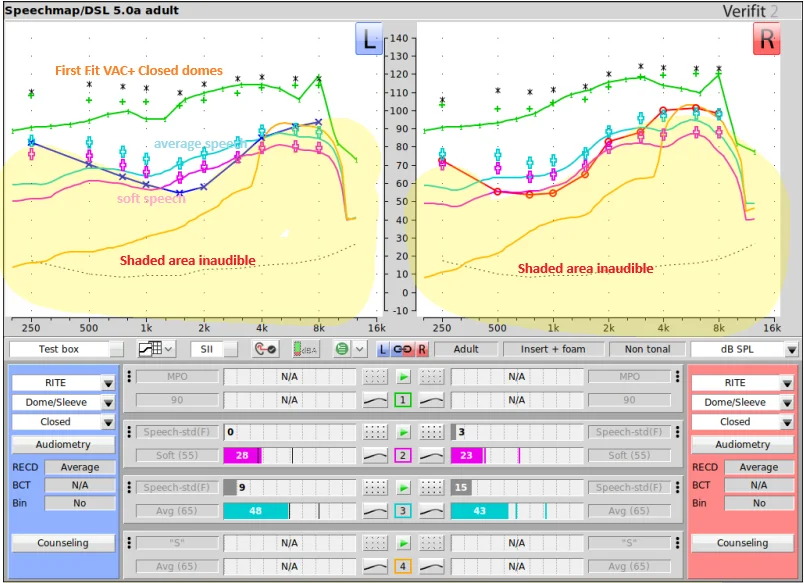
But now I’m at work and I can simulate your loss in testbox with some Oticon . So this is a simulation of a typical sort of first fit with your hearing loss and VAC+. This is what the clinician who doesn’t have but generally is doing everything else well gets.
You can see speech intelligibility for soft speech is about 28%; 72% of speech sounds at that volume are literally inaudible to you. This translates to a predicted for soft speech of 33%.
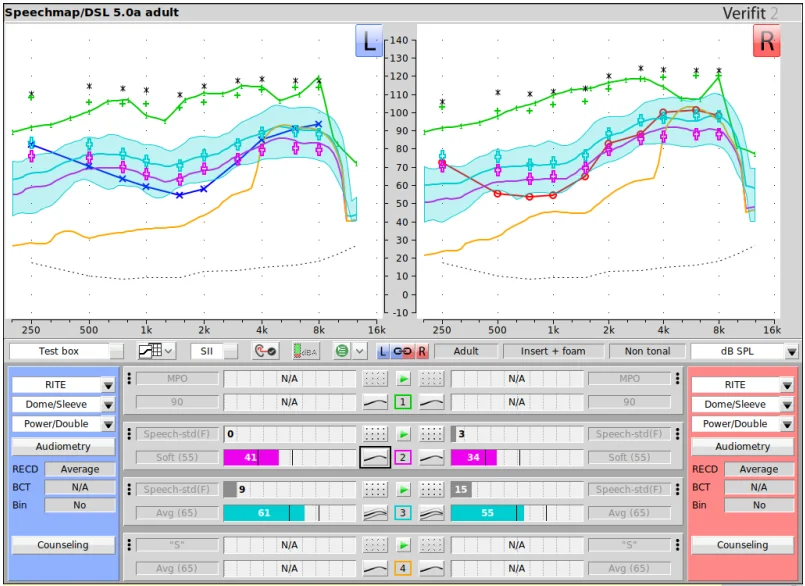
Here I’ve adjusted it to a more robust fit with power domes (custom tips would probably be more appropriate) and that boosts soft speech audibility to 41% which in turn gives a predicted WRS for soft speech of 57%. With a child fit, which I sadly forgot to save, was in the 60s and predicted soft speech WRS goes up to 78% which is very nice. DSL child gain may be intolerably loud for you. The reason I brought it up in the first place is that a lot of children with hearing loss are fit to child targets and then they grow up and go get hearing aids at a new clinic that isn’t familiar with pediatric fittings and they’re fit to adult targets. As a consequence, they lose a lot of audibility and they don’t like it because their brain developed to the louder input in the first place. It doesn’t actually sound like this would apply in your case because when you were a child you were probably fit using the old half gain rule, which would be underfit by today’s standards. But the reason that you feel like soft speech has always been a struggle is most likely because many parts of soft speech have probably been literally inaudible for you.
In regards to whether predicted WRS is useful relative to aided WRS. If you take that first fit you have an SII for moderate level speech of 48% and a predicted aided WRS of 66%. Statistical variability for the WRS is so high in middle scores that if your “true” score is 66%, you could get anywhere from 42% to 80% in the test booth and that would match. I think something to highlight here is that my complaint about aided testing isn’t the idea of it, it’s that our tools are so poor. If a WRS score of 66% and 80% are statistically the same, what use is it? It’s just not a fine enough measure to do anything with other than write it down and say, “yup, that’s how you do”. Clinicians certainly ignore statistics and treat the WRS scores as precise, so they may well say “Your WRS was 75% last time and today it’s 82%, the adjustments that I made are helping!” But with no adjustments at all you could very well be back down to 68% next time just due to test-retest variability. WRS is just not meaningful the way we would really like it to be–we need better tools. However, humans have tremendous skills for perceiving patterns in the world. Your ability to tell your clinician whether an adjustment helped is better than their ability to measure whether it helped at this point, beyond ensuring appropriate audibility.
One thing I would suggest is that if your current settings work very well for you in noise, have the clinician save them in a secondary program. If REM does push you into more audibility it may require some adaptation, and it might make speech in noise worse for a while. In that case, having the option to flip back to your regular program may be valuable.
You’re getting tired of me . That’s fine. I’m looking forward to how you do with this new clinician. I think it will be better.
Quite the contrary. Please do not think that. The honest truth is that I am amazed at how helpful and how much time people have spent discussing my hearing in this post. This topic was intended to be an upcoming review on the new audiologist who I won’t be seeing for another three weeks. It was never intended to be an in-depth discussion on my hearing loss. The topic just kind of ended up getting a life of it’s own. Last but not least, while the discussion is very interesting and offering me a lot of insights into my hearing, the reality is this has been a problem for my entire life. It would be unrealistic to expect to be able to resolve this problem in a forum over the internet without direct access to the patient as it were. The danger also is one ends up going down rabbit holes.
I was just concerned I was taking up a lot of people’s valuable time especially in light of the fact that I am going to be trying a new audio who does and hopefully will be able to use all her tests to help. I also have another source of confidence in her. She used to work in Pretoria in South Africa - I probably went to the same hospital when I was a kid - because I went to Pretoria for an operation once for my ears. Pretoria back in those days had a world class reputation for that. I would really like to give her a proper chance, so I will just say to her these are my problems - can you help and let her expertise do the job. I will however say that we may need to consider Adult instead of .
I had not realised that my hearing was as bad as people say it is from the charts. 72% loss of of soft speech is really bad. I have to say, despite my complaints about hearing aids (which are legitimate obviously) I do actually hear very well when everyone talks at what I call Office speaking volume - people always talk louder at work than they do at home. I am going to ask this new audio to give me a copy of my because the one on this forum is from the NHS and I wonder how accurate it is. I suspect it is probably accurate enough that it doesn’t change the outcome for these discussions as far as what kind of hearing loss I have.
Maybe I might have to make a choice between hearing well in noise versus hearing soft speech properly. The gist of this topic seems to suggest that the reason I hear so well in noise (compared to other hearing aid users) is because I don’t get the full sound experience that others do and if we corrected that, I would end up finding it much harder to hear in noise? I had not realised that. I would unhesitatingly plump for hearing in noisy environments because I experience this every day, whereas soft speech is only very seldom an issue as most people have “loud” voices.
I will certainly update the topic after I have been to see her, because I think it important to review all these tests that she does and see how much difference they make.
Getting ‘a done’ is not that simple. The only NHS Audio near me does not offer this and I am no longer in a financial position to go private. Yes it sucks to be limited by accessibilty offered by the audio and finacialy hampered so that is why I chose the route.
Will I be able to reproduce the results of a really good audio - chances are close to zero without all the stars aligning and the tongue hanging out at exactly the correct angle but I can reasonably hope to get some improvement knowing that I can always reset to the starting position if it goes totally pear shaped.
Do I wish I could go private again - Yes, without a doubt but being on a limited income and having real world issues causing my savings to deplete faster than I would like I cannot justify the cost. My hearing isn’t so bad that I cannot function, I just have to ask people to repeat themselves more often than either party would like.
There are other private hearing clinics close to me should my circumstances change for the better but for now the relatively small amount of money spent on the noahlink wireless 2 is enabling me to experiment with real small improvements being seen.
complain to your GP and tell them to inform the ICB that your local NHS trust doesn’t follow NICE guidelines. i can guarantee you they have the equipment they just probably have lost their best trained staff to the private sector.
The whole system is totally flawed @choccybiccy69 Since I moved, from the Black Isle some 13 years ago, approximately 15 miles as the crow flies, to the Invergordon area, my local doctors surgery went rapidly down hill after they amalgamated 2 surgeries together, which in turn, turned the surgery into a total farce, every doctor was removed by the NHS trust, because they were inundated with complaints, so they were replaced with Locums, I haven’t had my own doctor for around 10 years now!!! The service is abysmal, 2 weeks for an appointment, if you are lucky… My previous doctor on the Black Isle would see me that day, he would come to the house off his own bat, if he heard I was having problems, he was a gem, and so was the other 2 doctors, in that surgery. I was absolutely spoiled rotten… Practically every Audiologist I know jumped ship to the private sector, and I know quite a few! Understaffed, overwhelmed with work, underpaid and totally disillusioned with the service, testing & fitting times were cut to the bone, so they cut their losses, and moved on to a less stressful job… And yes, every NHS Audiology Department will likely have all the equipment, but training and retaining staff, is now probably a major problem? As for me seeing a doctor nowadays, I gave that up, I circumvent this by making an appointment with the “Practitioner Nurse”, usually the following day, probably just as experienced as a doctor, and if she’s not sure, she’ll ask one of the Locums… Cheers Kev
There are many negative views about NHS services reported online. Where does the everyone loves the NHS view come from? Propaganda? That it is viewed as free despite being paid for with taxes? That it is viewed as a safety net Americans do not have? Or is it more that free speech is not the same there? Or maybe it was much better and society has not caught up. It’s hard to tell as an outsider.
Hearing services are pretty marginal to most NHS trusts; if it doesn’t have priority, it doesn’t get much money.
If I had a significant medical condition, the NHS would treat me based on my need at zero cost. One of my friends is on dialysis at the moment. The monthly bundle of drugs and supplies he goes through is worth about £10,000, plus the cost of the staff and his personal dialysis machine.
Nobody gets made medically bankrupt here.
In 2010, people were complaining that their doctor’s appointments were happening too fast. Due to 15 years of deliberate underfunding and mismanagement, the situation has deteriorated and long wait times are now common. Hearing aid services have been partially privatised in some areas, some departments are struggling and have gone back to monaural rationing of aids, can’t afford styles due to receiver replacement costs or have booted rechargeable aids completely.
It’s just about priority: surgeons/consultants have a lot of input in how the money gets spent, hearing aids aren’t ‘sexy’ in terms of treatment methods, but they are a hugely cost effective solution for a significant number of people.
and to add to what @Um_bongo said: the NHS is amazing in certain places and for certain things but quality varies according to location and type of treatment a lot. the negative press internationally about it is largely conservative propaganda aimed at preserving the status quo of private or semi private healthcare in their countries. the negative press in the uk is usually when mistakes happen or when large healthcare inequalities remain unaddressed (usually due to the usual things: class, race and gender discrimination).
last year i had mental health therapy on the nhs which I waited 2 years for but saved my life. the group therapies i had in the meantime also helped. all for free. i’ve had phonak hearing aids for 20 years with , follow ups, repairs, fine tunes, upgraded every 3/4 years (until my recent pair). all for free.
people who lose their hearing suddenly are getting 20k cochlear implants (after waiting perhaps a year for the process) - for free. the nhs can be better but it’s incredible.
The NHS is a wonderful service @user490 in certain departments which are prioritised, as @Um_bongo rightly states… But other departments, leave much to be desired! IMO, many departments were neglected, especially NHS Audiology and indeed NHS Mental Health, when austerity reared its ugly head, they slashed their budgets for the departments whom didn’t have much appeal, and literally no voice, and would not protest at the absence of a reasonable standard of service! In their eyes, if it wasn’t imminently life threatening, their department was slashed, effectively crippling these services due to financial constraints, rural areas like mines were ignored and starved of funding, again they had little or no clout… Unfortunately, a 2 tier system was created, 1 was state of the art like Cancer treatment, the other was a piecemeal service, like Audiology or Mental Health. Now, that is not to say budgets shouldn’t be prioritised, but indiscriminate lack of funding is the main culprit here, and basically the governments of the day had other priorities! I know first hand, how this works or doesn’t, my wife has had Cancer 3 times, Breast Cancer, Bowel Cancer, and now Lung Cancer, the service Elspeth will receive now will be exemplary, the NHS are brilliant, but only if they have funds to back up what they do… Cheers Kev.
To the extent that it’s anything like Canada–our healthcare system is currently in crisis. Money is tight, healthcare providers are burnt out, wait times are high. BUT even with all that the idea of moving to a fully private system like America has is a total nightmare. It feels like we’re grumbling about our house needing some serious repairs, but when we look to the south those guys are living in a tent. Ideologically, we don’t believe that richer people deserve better care. My emergency surgery cost me $45 for the ambulence. Same for my partner. Same for my father and my mother and my sister in law and my best friend (no, she was in England so I’m not sure she even paid for her ambulence). We would all be literally dead without the care we received and the cost to us was next to nothing. Oh, at least four of my relatives have also had cancer treatments for $0, it just goes on and on really. We aren’t trapped into our jobs because our healthcare depends on it. We don’t hesitate to call emergency services when we need them because of the potential cost. Our life-saving procedures don’t bankrupt us. Our taxes are maybe 4-9% higher (depending on which state you’re comparing to) but we don’t have to budget extra money for healthcare. We don’t have predatory third party insurance systems dictating our medical care and handcuffing doctors. Our system absolutely has problems and is constantly a big political issue and people complain all the time, but they are problems relative to how we were doing in the boom years, or problems relative to the ideal situation that we want.
Unlike NHS, however, our hearing aids aren’t covered. I’d love to see publically funded hearing aids, especially for children, but in these recession-y times I don’t expect to see any movement on that. Our surgical hearing aids are covered to start, although there are costs associated with replacement processors.
One can’t compare the best situations in one system to the worst in another. The US system is complex because there is an enormous spectrum of situations. For some the US care is cheaper and more flexible than nationalized systems. There are still risks like it all being job dependant other than those on government programs and a weak safety net if job-based coverage is lost.
Long wait times and lack of choice of provider can leave patients stuck. Private care is costly in nationalized systems but seems to often be something to consider. The US has this too in the form of out of network care which has a varying economic burden. It’s hard to compare lifetime costs and the US has a Medicare tax on all to cover a potion of the population (65+/disabled). The shifting of the population onto Medicare at age 65 (unless still working) combined with the shifting between insurers as people change jobs or companies change plans contributes to the challenges in the US. The US system might work better if there was better accountability but insurers can push the envelope and outlast a patient’s energy.
Cancer care is a well defined area where modern medicine has excelled. It should probably be analyzed separately in any discussion. Cochlear implants is also a well defined area where the main factors seems to be whether one or two are covered. Audiology, mental health, chronic illnesses, community/home/disabled care, access to sophisticated diagnostics, matching specialists to the patient, what is elective, etc. are areas where more differences emerge.
The problems with the NHS are being hijacked by people who have a financial agenda!
Is the NHS perfect? Far from it. Dentistry, Audiology etc have all effectively become defacto privatised because the service in the NHS is so poor in general. Long waiting lists, overly large and poor management, constant interference from the government and let’s not forget the white elephant in the room that the government always chooses to ignore - lack of funding as far too many workers are grossly underpaid.
However, without meaning to disparage Americans, the American health care system is the worst one in the world from what I can see. Very, very expensive and has far lower health outcomes than most of the world. So from a value for money point of view - the US healthcare system is very poor value for money. Not to mention that it means that only the rich can afford good healthcare in America.
Cancer, Dementia and other illnesses like that can affect anyone, no matter what your lifestyle, income etc and can effectively make you bankrupt if you have to pay for it yourself. So no, the American healthcare system is really bad. The reason why so many (particularly right wing) focus on every point of failure in the NHS is not because the NHS is worse than the American system, but because they can make much more money in the American healthcare system than they can in the UK with the NHS. It has always been about money!
The NHS needs massive improvement, no argument from anyone here! But we do not support a privatised healthcare system which will essentially be like the US healthcare system where if you are poor you cannot afford to be ill.
The second elephant in the room is how expensive poverty is! There is a correlation between the high cost of the NHS and poverty as poor elderly people are in worse health than rich elderly people. Poor people frequently live in mould, damp infested homes, do not heat the home enough, do not eat proper food or eat enough because there is no money etc. Not all of the soaring NHS billing is down to poverty obviously, but a surprising percentage of it is!
NB: A good rule of thumb I have found is - those that complain the loudest about the NHS saying it needs reform (read privatisation) - look and see if they are likely to make money out of the privatisation. Very often there is a direct correlation between those calling for reform (privatisation) and those that stand to make money out of it. Always follow the money!
I don’t think it’s fair to be heavily critical of our American cousins healthcare system, it has evolved over many, many decades, and yes it will have lots of flaws, (just like our NHS) a absolute nightmare to reform! In the US when one President attempts to activate affordable healthcare, the next President aggressively dismantles it… It’s a political hot potato, with a 2 tribes political system, the Americans & UK will never resolve this, until they come to terms with that political divide… Both services need funding, here in the UK, we pay for the NHS via “National Insurance Contributions” the more you earn, the more you pay, I think that’s fair! The problem is again political, 1 party starts to reform the NHS whilst in power, gradually increasing their budget, when they get ousted, usually for overspending, the next party slashes the NHS spending, effectively crippling the NHS system, and so it goes on…IMO, both systems, are fundamentally the same, except one syphons off any excess to shareholders, the other syphons off to pay for other (non NHS) governmental expenditure… Basically we pay for a service, that doesn’t meet our needs! Meanwhile as you say, the poor get poorer & sicker, the rich (relatively speaking) get richer & healthier…But, who said life was fair!
 England, UK

 . That’s fine. I’m looking forward to how you do with this new clinician. I think it will be better.
 UK

 Scottish Highlands

 Wales, UK