You’re ignoring this member’s posts.
High Frequency Sound Issues
89 replies3.7k viewsLast reply
 Poland
Perhaps it would be good to proceed with a new (and possibly —uncomfortable levels) to make sure.
Did you try maximizing the high-frequency gain in the equalizer in our app?
Do you have a problem with sibilance in streamed audio, or is the issue only present in real-world situations?
You’re ignoring this member’s posts.
My brain is numb & I’m stunned, at this point. You & I (and my audi, I thought) agreed that 6k & 8k frequencies should be amplified based on my prescription/.
[I’m trying to work through my problem with my audi as I paid a lot of money to my practice for that service & I just don’t have the mental stamina to handle on my own. At other times in my life, I would’ve been a do it yourselfer by now.]
In the last 10 days I’ve dropped off my aids to my audi for adjustments twice, then saw her today. Prior to the 2nd drop-off, I wrote “…I’d like you to program the aids according to the prescription…” She responded, "I can absolutely just start completely from scratch and put you at 100%. and later “They are set exactly to your prescription with no changes made…”
In her office today, she did and the high frequency amplifications (above 4k) were still minimal. I asked her what that was about. She claimed that current technology is limited and significant amplification of the high frequencies can’t be done without resulting in sibilance/poor sound quality. Obviously she now has a credibility problem with me that I’ll be addressing, but have you…or Um_Bongo…or anyone else ever heard of or experienced this alleged limitation in cutting edge technology??? How could many musicians/music fans possibly speak highly of WIDEX Moment 440s, if treble frequencies can’t be amplified much?
Your thoughts?
Brian
You’re ignoring this member’s posts.
She claimed that current technology is limited and significant amplification of the high frequencies can’t be done without resulting in sibilance/poor sound quality.
She probably has in mind a feedback threshold that could be at a level that makes high-frequency amplification much more difficult. It is because of your open acoustic coupling (open domes?). In addition, Widex reportedly doesn’t have good active feedback control.
You can try with more occluding coupling (, power double domes), but I don’t know how bothersome the occlusion effect is for you.
My theory (I may be wrong) is that amplified high frequencies with small gain interact with the same sounds entering the ear canal through openings in open domes, therefore creating comb filter effects. One solution is to occlude the canal more; a second is to give the amplified sound more power compared to the sound entering through the domes..
See that post, especially at the end with picture which I copied here:
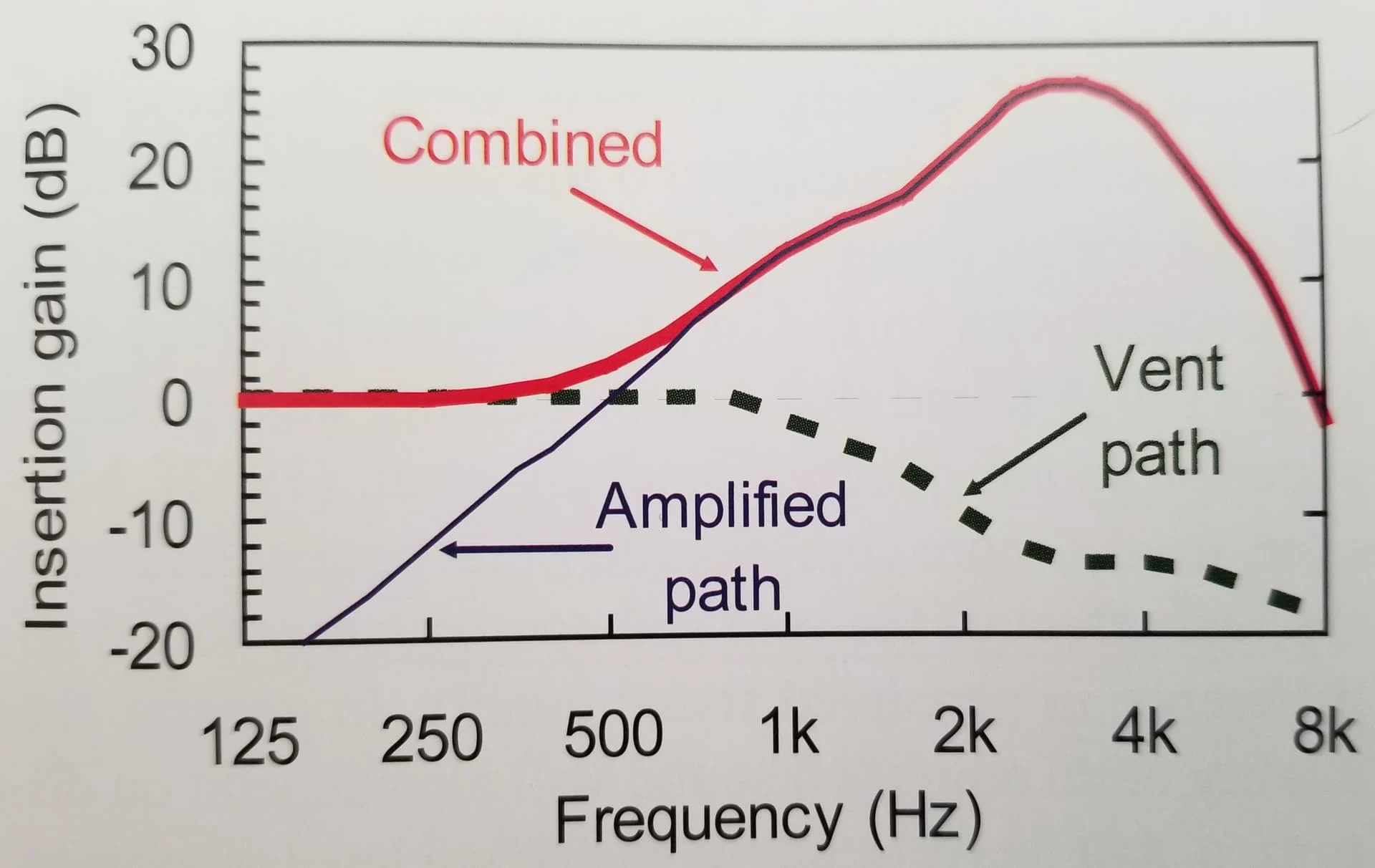
Conclusion from the graph: If amplified sounds are less than 10 louder than sounds entering via the vent, there is a risk of comb filtering. If they are amplified more, the comb effect should not occur, assuming they do not reach the feedback threshold.
Source:
Harvey Dillon’s 2012 book Hearing Aids has a great and comprehensive review of venting (thanks to MDB for the tip that Dillon’s book might be helpful in better understanding HA’s). To tell whether you’re getting any discernible occlusion, he suggests the simple “ah, ee, oo” vowel test. With HA’s out, you can perform the test with and without fingers in your ears and try it with your HA’s on also. If “ee” and “oo” sound louder than “ah,” you’re getting occlusion. I suggest anyone deeply inter…
@Um_bongo also mentioned about occluding canal more.
So you either use an aid with a better canal comparator/damping of the canal signal or you occlude the fitting more. ‘
You’re ignoring this member’s posts.
Thanks for the quick & thorough response. I will try to digest and share select ideas with my audi at some point.
You’re ignoring this member’s posts.

 Wales, UK
My theory (I may be wrong) is that amplified high frequencies with small gain interact with the same sounds entering the ear canal through openings in open domes, therefore creating comb filter effects. One solution is to occlude the canal more; a second is to give the amplified sound more power compared to the sound entering through the domes…
Yes, especially at the crossover between the venting and gain, you can get ‘flutter’. Higher up it tends to be that the dominant aided HF signal will mash out any interference from the other signal, but with musical pure-tones that’s not always the case. As a second peak or harmonics thereof can be out of phase, but still get added to the natural canal response at 2.6KHz creating a competing signal.
Put loosely; if I play you a note in free-field at around 1275Hz, the aid does a bit of peak shifting (Phonak) and introduces a bit of a delay so you hear the primary harmonic (with a bit of smoothing/futzing) at 1300Hz. Not pitch perfect, but fairly acceptable for no feedback. The ‘problem’ is that the secondary harmonic now sits at 2.6 KHz, which is boosted, by both the receiver natural resonance AND the canal natural resonance (which might be offset due to the receiver/dome structure too).
So you’ve potentially got a stronger secondary harmonic than the original signal secondary @2550Hz.
There’s also points to consider either side and other resonances from different bits of the structure, but you get the gist: just because you think you’re squirting signal x down the canal, doesn’t mean that’s what is ‘heard’ at the drum. Hence .
(Oticon used to have a real half harmonic issue with that 1300Hz pitch too, which was unfortunate as it tended to give a real feeling of (Amp-occlusion) with like the Adapto.
You’re ignoring this member’s posts.
Put loosely; if I play you a note in free-field at around 1275Hz, the aid does a bit of peak shifting (Phonak) and introduces a bit of a delay so you hear the primary harmonic (with a bit of smoothing/futzing) at 1300Hz. Not pitch perfect, but fairly acceptable for no feedback.
Oh, this may explain (among others, like bass amplification), why I hear my guitar with better quality with more occluded couplings…! Simply because isn’t forced to make anti-feedback frequency shifting?
You’re ignoring this member’s posts.
Yes, the more occlusion, the less the aid has to do in response to feedback and stray canal resonances through its own ‘comparator’ system.
You’re ignoring this member’s posts.
@Um_bongo, you hit the bullseye, because in recent days while playing guitar I have played guitar harmonics, which should be ~1318.5 Hz (E6, assuming A4 = 440 Hz) and were distorted. It’s played approximately over the half of sound hole in guitar soundbox. I temporarily plugged my 1 mm vent in the cShell with a rolled piece of tissue paper, and it improved. Finally, it sounded like E5, but an octave higher, as it should be.
You’re ignoring this member’s posts.
I spent another hour with my audiologist, yesterday. I wanted to try streaming music directly into my aids (which I had never experienced before). It turned out that there are very few phones that are compatible with that specific Widex functionality. I did try the function using my audi’s phone and was impressed. My music sounded very good in general, and high notes held up rather than going over into sibilance. So I guess I need to get a new phone. Widex also sells a television interface to allow direct streaming. Apparently I’ll be spending more money to get high quality sound for the majority of my listening.
I’m also now using the biggest, that’ll fit in my ears. In fact, in my right ear, it’s too much—I’m experiencing some occlusion (side) effects, in addition to my original complaints. It seems more occluded fittings is not the answer.
I’ll have to review comb filter effect again, to see if that seems to be a factor at this point
We teleconferenced with a Widex audiologist who tweaked a few background program settings. My experience is as bad/worse after the adjustments & with more occluded fittings. Other than the streaming option, we’re still not getting anywhere. As it stands…I’ll still have substandard sound for a significant minority of my listening experience, although direct streaming would seem to be an answer for the worst cases of sibilance, feedback, et al.
You’re ignoring this member’s posts.
I wanted to try streaming music directly into my aids (which I had never experienced before). It turned out that there are very few phones that are compatible with that specific Widex functionality. I did try the function using my audi’s phone and was impressed.
Wait a moment: have you ever tried streaming before, with your phone? If so, was sibilance a problem then? Or was that issue a problem only when listening with hearing aid microphones?
If the latter, the problem is probably mainly with feedback or oscillation, NOT THE PHONE.
Found another useful link, someone on the forum provided it:
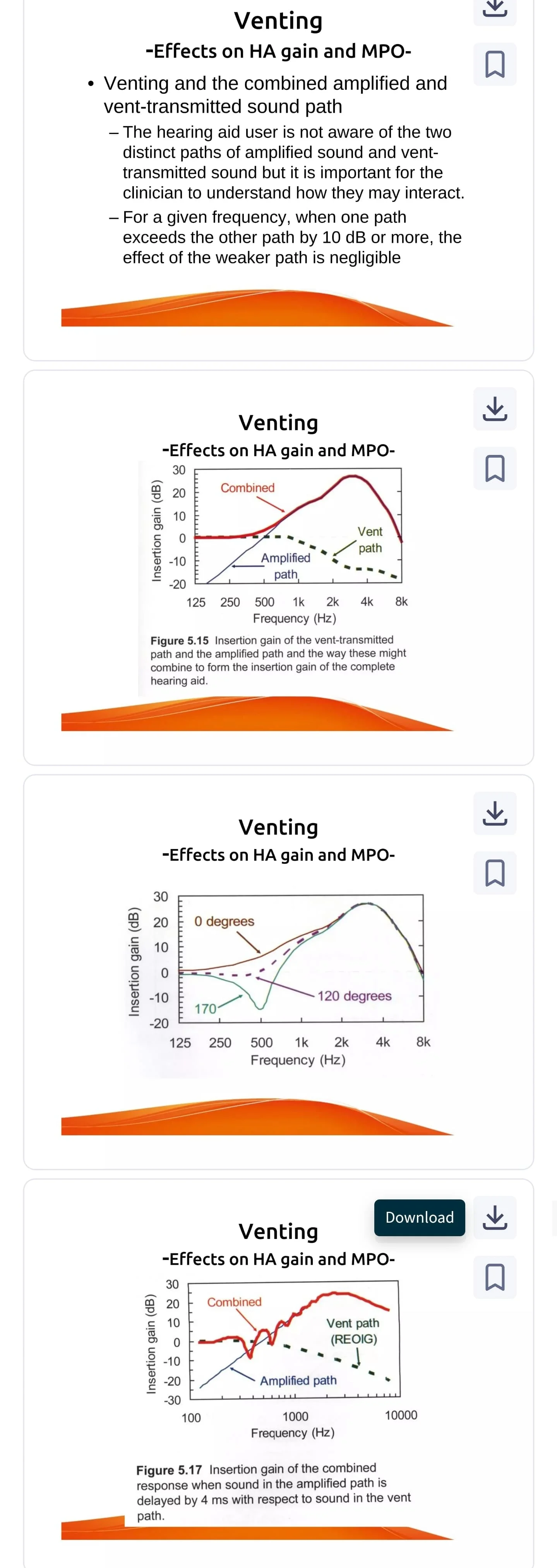
Source:
Earmold acoustics - Download as a PDF or view online for free
So I guess I need to get a new phone.
To be sure, try it on another phone with the same audio samples that previously caused sibilance.
I’m also now using the biggest, closed domes that’ll fit in my ears. In fact, in my right ear, it’s too much—I’m experiencing some occlusion (side) effects, in addition to my original complaints. It seems more occluded fittings is not the answer.
Try to GENTLY push it deeper, toward the bony part of ear canal. It may be uncomfortable at first, but beware: the tip SHOULDN’T touch the eardrum. Make sure you don’t skew the receiver’s position so that its output leads to the ear canal wall.
although direct streaming would seem to be an answer for the worst cases of sibilance, feedback, et al.
If in direct streaming mics are attenuated or even turned off, there is less or no possibility to make acoustic feedback.
You’re ignoring this member’s posts.

 Texas Hill Country
. I wanted to try streaming music directly into my aids (which I had never experienced before). It turned out that there are very few phones that are compatible with that specific Widex functionality
I checked compatibility at the Widex website. That phone is compatible with just about all iPhones and Android 11 and higher phones. Those aids are nice modern aids. Your fitter might be mistaken.
You’re ignoring this member’s posts.
- I had never direct streamed into the . My problem has been with sound coming through the HA microphones, primarily from speakers.
- The only “problem” with my phone, which my HAs are paired with & I operate them from, is that Widex’ streaming function has to be separately paired with your phone. Widex’ list of compatible phones for the streaming function is a short one—Samsung’s models & a couple of other suppliers’.
- I get the large, in my ears snugly. The poor sound quality continues, tho. And if the dome/my right ear canal wall change position…I experience air/sound blockage, periods of a soft hum, incessant feedback with specific facial movements, et al. Maybe one size smaller for the right ear is appropriate?
Thanks again for your support,
Brian
You’re ignoring this member’s posts.
Huh…I am an Android user with version 11.0 on my phone. We tried to pair this specific functionality with the phone and it failed to pair. [Understand that my aids are paired to the phone & I operate the from it.] Apparently this functionality is separate & can only pair with Samsung models & a couple of other suppliers’. I have that list, off the website, in front of me. By all means let me know if you still think we’re missing something and thanks for your input, Brian
You’re ignoring this member’s posts.

You’re ignoring this member’s posts.
You’re ignoring this member’s posts.
And if the dome/my right ear canal wall change position…I experience air/sound blockage, periods of a soft hum, incessant feedback with specific facial movements, et al. Maybe one size smaller for the right ear is appropriate?
I don’t know about smaller domes. Probably not. Ear canal is most mobile often between first and second bend. Try to push further, maybe not straight, perhaps you have to feel o turn/bend of ear canal. If you have problem with repeatable good dome placement, earmold with proper vent is a good option.
Android 11 is from Autumn 2020, quite old… However it doesn’t explain your sibilance problem.
You’re ignoring this member’s posts.
If your phone is listed it should be compatible, as in streaming directly from phone to aids.
Good luck with this
-supported devices:
Hearing aid streaming is possible only on Moment and newer family on selected Android devices with the OS version 11.0 or higher. It is recommended for your device to be on the latest available operating system to get the best possible performance.
Samsung Galaxy Z Flip
Samsung Galaxy Z Fold
Samsung Galaxy A51
Samsung Galaxy A52
Samsung Galaxy A71
Samsung Galaxy A72
Samsung Galaxy S24
Samsung Galaxy S23
Samsung Galaxy S22 5G
Samsung Galaxy S22 Ultra 5G
Samsung Galaxy S22+ 5G
Samsung Galaxy S21
Samsung Galaxy S21 5G
Samsung Galaxy S21+ 5G
Samsung Galaxy S21 Ultra 5G
Samsung Galaxy Note 20 5G
Samsung Galaxy Note 20 Ultra
Samsung Galaxy S20
Samsung Galaxy S20+
Samsung Galaxy S20 5G
Samsung Galaxy S20 Ultra 5G
Samsung Galaxy Note 10+
Samsung Galaxy Note 10
Samsung Galaxy Note 10 Lite
Samsung Galaxy S10 Lite
Samsung Galaxy S10
Samsung Galaxy S10+
Samsung Galaxy S10e
Samsung Galaxy S10 5G
Google Pixel 8
Google Pixel 7
Google Pixel 6
Google Pixel 5
Google Pixel 4a 5G
Google Pixel 4
Google Pixel 4a
Google Pixel 4XL
Google Pixel 3
Google Pixel 3a
Google Pixel 3a XL
OnePlus Nord
OnePlus 8T
OnePlus 8 Pro
OnePlus 7T
OnePlus 7
You’re ignoring this member’s posts.
Yup…that’s the list I’ve got for direct streaming from phone to Moment .
Thanks for your effort to look into it
You’re ignoring this member’s posts.
I asked for my audiologist’s opinion on earmolds with venting. She responded that I’d likely be wasting $250 to experience the occlusion effect, because my hearing is too good in the low frequencies. I know there’s some risk of the occlusion effect. Would properly vented earmolds make that risk minimal? If so, can you make any suggestion as to vent size based just on my & feedback complaint??
Thanks,
Brian
You’re ignoring this member’s posts.
Log in to reply to this topic.
Related discussions
Hearing Aids24 replies
Hearing Aids21 replies
Hearing Aids9 replies
Hearing Aids70 replies
Hearing Aids16 replies