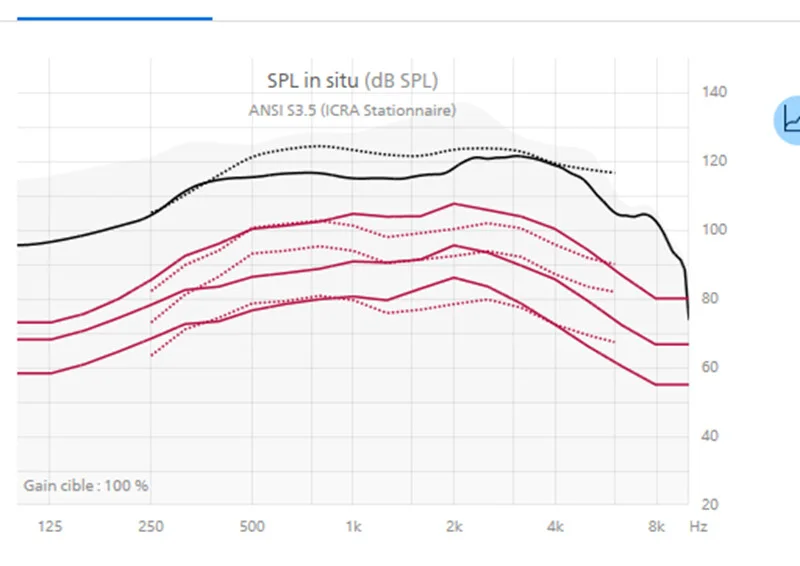
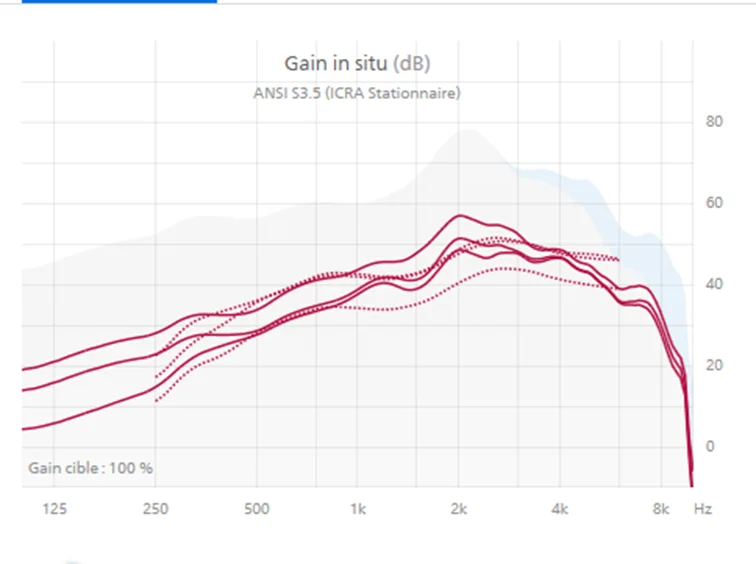
Hello, I am looking for a solution to better hear loud women’s voices (enthusiastic words, laughter). They are too loud in my ears and cause me pain, and are incomprehensible. Do you have any ideas to help me?
You’re ignoring this member’s posts.
10 replies408 viewsLast reply
Hello, I am looking for a solution to better hear loud women’s voices (enthusiastic words, laughter). They are too loud in my ears and cause me pain, and are incomprehensible. Do you have any ideas to help me?
You’re ignoring this member’s posts.

Cookie bite . I sympathize with you. For me it’s both my daughters’ enthusiasm and dismay that are physically hurtful.
I wonder whether girls’ voices aren’t painful to you or whether you aren’t around them often enough to notice?
My approach is to dial down the G85 band (loud sounds) up to a compression ratio of 2.5 to 3 even though it hurts understanding. The Comfort in Noise program is even further failed down. So basically I have a don’t hurt me program that I turn on if my girls get rowdy. Also I max out the sudden sound repression of Oticon.
It’s not a solution, but it’s a start. I would love to find a more specific approach. I tried looking at the sound response and asking my girl to be loud. But somehow it doesn’t reproduce well and I don’t see what frequencies are to blame.
You’re ignoring this member’s posts.
Maybe with a woman speaking loudly?
(I know that may be difficult to access.)
IIRC, @Um_bongo does that often, I’m not sure does standardized ISTS 85dB signal measurement-based fitting may be enough in that case.
You’re ignoring this member’s posts.
Hi,
Same here , with my hearing aid ( ) I feel that my ears are hurting for my daughter’s high pitched voice. I will be with her all day in home and difficult to bare her voice.
What can I ask my Audiologist to reprogram for such hith pitched voices or sharp sounds from objects .
You’re ignoring this member’s posts.
Gain Averaging.
This is where the prescribed gain is calculated as an average of several of the test values, rather than just the individual value at that frequency. In some cases it results in a ‘smoothing’ of the output, which sounds a bit more mellow.
However in the first example above it leads to over prescription around 4KHz. The nominal level of gain for 45dB of loss would be around 15dB (1/3 Gain Rule for Sensorineural Losses). If you look at the claimed gain above, it looks well over double that has been applied. However, this is also unverified, if the canal residual volume is lower than average, the effect on the output might be higher. This can only really be checked by real ear measurement.
You’re ignoring this member’s posts.
You’re ignoring this member’s posts.
Yes, that’s too much output given the loss shown in the original . Like I noted above, for any given audiogram level, divide by 3 and you’ll get a nominal gain figure for a sensoneural loss. Add in the input (50/70/90dB) and that will give you the output.
(I couldn’t re-post that).
Edit: but you need an actual result to prove what’s happening.
You’re ignoring this member’s posts.
I think you’ve saved my ears. Thank you.
Edit : Yesterday, I got that bad sound again. I realized that it was also in the voices, generally male and female, for certain vowels (A, O) It’s loud, and several words are distorted. I’ve tried lowering the , midrange and bass, but an adjustment brings another problem. I wonder if it isn’t the sound of the equipment that isn’t right for my brain. I’ve been wearing hearing aids for 15 years. The ones I have at the moment are the Philips 9050s.
You’re ignoring this member’s posts.
Gain Averaging.
This is where the prescribed gain is calculated as an average of several of the test values, rather than just the individual value at that frequency. In some cases it results in a ‘smoothing’ of the output, which sounds a bit more mellow.
However in the first example above it leads to over prescription around 4KHz.
Looking at the of @Annikgill1234, I understand how gain averaging would lead to over prescription at 4k. However, Mine is nearly flat around 4kHz. Any effect of averaging would rather lead to under prescription, right?
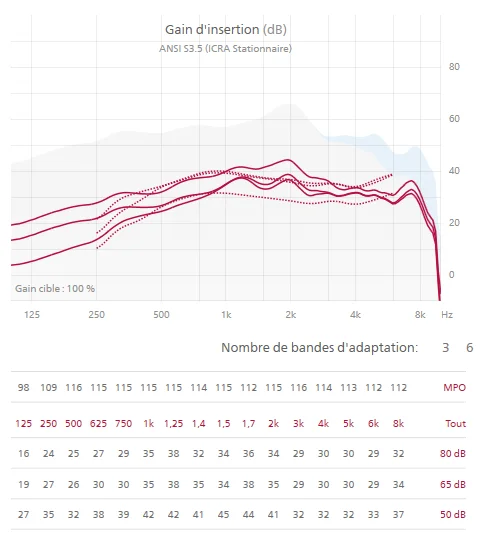
Would you have any other suggestions for dealing with loud female voices? I just decreased the lowest gains in the range 2kHz-4kHz from 37 to 33 and the reduced the mid and loud gains so that C.R. is around 2.5 and it works too, but it still seems like a rather coarse approach, that will lead to less speech understanding.
You’re ignoring this member’s posts.
That still sounds like the aids are a bit over powered given your loss. Unless you have a conductive loss, you should be looking at about 20dB of gain at 4KHz measured by . 37dB Just seems way too much: conversational speech at 65dB with 37dB of gain is over 100dB (near you ). And loud speech/music would likely be excruciating.
You’re ignoring this member’s posts.
Sorry for necroposting..
I got this problem too with my new Oticon Intent 1. At first time, I was wearing it with 85 receivers and , women voices at high volume made a sort of buzzing, with A and E letters. We replace receivers with 100 and Signia power sleeve 3.0 domes, now it’s better but problem still remains. My audiologist made all checks, so she has done her better. After many attempts with Genie 2, for me the best solution is to reduce some frequencies that cause that distortion (in any case the gain for my “hearing” is too high). But it’s not enough, I think that the domes need to be changed again. I got bad experience with custom earmold on my old aids, so I don’t want to put them on the new ones
Here’s the other thread where Tenkan gives me suggestions and with my attempts of diy
Hello, I hope to clear a mysterious distortion occurring on my Oticon Intent 1. Often I get a sort of buzzing listening female voices, in particular with “A” and “E” letters. It happens from the first time that I wear the aids, initially with 85 receiver and closed domes. Now I have 100 receivers and Signia sleeve domes (the left is vented, the right closed). The audiologis makes Rem after replacement of the receivers, made new settings and the distortion decreased, but it reappears when fema…
You’re ignoring this member’s posts.
Log in to reply to this topic.
Hearing Aids6 replies
Fitting Software Requests1.1k replies
Hearing Aid Self-Fitting (DIY)302 replies
Fitting Software Requests513 replies
Fitting Software Requests419 replies
 Rotterdam, Netherlands
 Poland
 Wales, UK