

Is there a general difference between a (receiver in the HA, tube into hearing canal) and (receiver in canal)? Something that could be stated on this general level? Advantages, disadvantages?
You’re ignoring this member’s posts.
This topic is closed.
50 replies2.6k viewsLast reply
Is there a general difference between a (receiver in the HA, tube into hearing canal) and (receiver in canal)? Something that could be stated on this general level? Advantages, disadvantages?
You’re ignoring this member’s posts.
The main differences between and hearing aids are: product design, sound amplification effect, applicable population and maintenance requirements.
BTE hearing aids focus more on high power and durability, and are suitable for people with special physiological conditions or severe hearing loss.
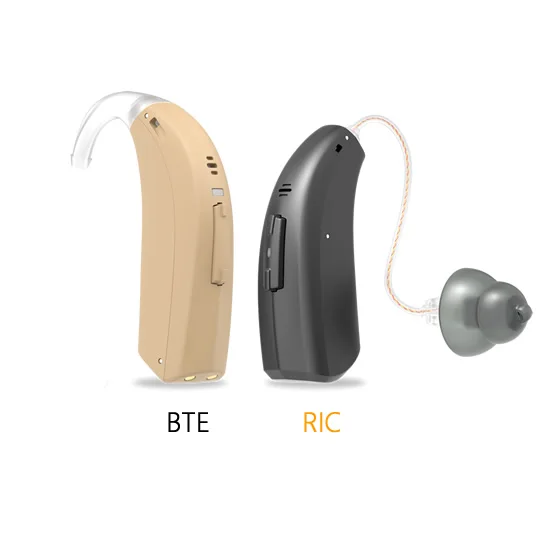
RIC hearing aids are known for their concealment, comfort and advanced technology, and are suitable for the daily needs of most people with mild to severe hearing loss.
When choosing, a comprehensive assessment should be made based on the individual’s hearing loss level, ear canal conditions and living habits.
You’re ignoring this member’s posts.

The hearing aids, have the receiver in the unit behind the ear and the hearing aids, have the receiver in in the ear Canal. The BTE uses a hollow tube to send the sound to your eardrum the RIC has a wire from the unit behind your ear to the receiver that is in the ear. The receiver that go in the ear are smaller and put out less volume and might not make a sound that is as pleasing as the receivers that are bigger more powerful in with the rest of the electronics for the hearing aid…
You’re ignoring this member’s posts.

The receiver that go in the ear are smaller and put out less volume and might not make a sound that is as pleasing as the receivers that are bigger more powerful in with the rest of the electronics for the hearing aid…
In-canal receivers work better acoustically due to closer coupling to the ear drum, less mechanical feedback and no tubing resonance issues.
Lots of users on this forum use aids and find the sound ‘pleasing’……
You’re ignoring this member’s posts.

I read on this forum that aren’t good in high frequencies, in another hand are better in those higher frequencies!
Is this correct?
Thx
You’re ignoring this member’s posts.

One advantage of aids is that some BTE aids are capable of delivering a higher to those with severe or profound hearing loss
You’re ignoring this member’s posts.
We use exclusively for children because they are robust, more secure in the ear, and we can change out the earmold as they grow. Children who grow up with BTEs may stay in them even if a is suitable for their hearing loss because of comfort with the fit. My BTE people like the comfort of the silicone mold, like the ability to change their own tube, and don’t like the floppiness of the RIC wire. For those with more loss, they like the richer low end. BTEs tend to be a bit longer lived.
Adults starting out on hearing aids will choose a BTE if they need a high powered device. They might also choose one if they want something easy to manage (although preferences will vary) or if they have regular drainage that’s hard on a RIC receiver. In some cases a BTE can be easier to manage with vision loss and loss of feeling in your hands.
BTEs are a poor choice for someone looking for an and high frequency gain because the tubing rolls off the highs and it can be hard to get enough boost to compensate, especially with a slim tube. That said, there always that one person. A slim tube can be easier to push into a collapsed canal than a RIC receiver, it can be softer on the top of the ear.
A BTE is usually bulkier behind the ear.
You’re ignoring this member’s posts.
Yes, the output of receivers can get ‘lost’ in certain tubing. However, UP aids are often not designed with broad band responses: simply because it’s more important to get power in the region of the speech banana, than great high fidelity gains around 8KHz.
Also, if your receiver is ‘waggling’ at 8KHz, it’s wasting energy and likely causing feedback over 120dB. However good your physical separation is: some of that signal will get passed back to the mic. So amplifying a bit of the signal you don’t necessarily benefit from, combined with significant downsides mean that you’ll likely pick a receiver that tops out below 6KHz.
You’re ignoring this member’s posts.
You’re ignoring this member’s posts.
I may be crossing my bridges before I come to them as I’m still psyching myself up to get my hearing tested, lol. But this is a very interesting post for me, as I decided long ago that if I ever needed a hearing aid it would not be a type. My mum’s first hearing aids were RIC, but because she has very narrow ear canals they kept working loose, causing feedback whistle, which she couldn’t hear. I have inherited the narrow canals (I have problems even keeping regular earphones in place!) and would be mortified if that happened to me in public. She eventually got with silicone ear moulds. After she passed away I remember feeling the softness and flexibility of the silicone material and deciding that was what I would choose if and when the time came. As I am autistic, textures are ridiculously important, especially in a sensitive place like my ear. The harshness of the acrylic moulds or RIC wire sleeves would totally put me off wearing an aid. If it does come to me needing hearing aid(s), I hope I would be able to have this kind of ear mould, even though my hearing loss (if any) will probably turn out to be relatively mild. For me, keeping my autism happy trumps the perfect audiological solution.
You’re ignoring this member’s posts.
Personally, I would suggest you don’t totally write off the acrylic material for moulds. I found it more comfortable than the silicone material. I think because the silicone is slightly sticky whereas the acrylic material can move and is therefore more comfortable for me.
In your case you will probably be happier starting with the silicone version
You’re ignoring this member’s posts.

I have just been issued with silicon moulds for my NHS aids. Pleasantly surprised how comfortable they are.
You’re ignoring this member’s posts.
You’re ignoring this member’s posts.
Thanks for those helpful insights. It’s great to read the experiences of people who actually use hearing aids, not just professionals who know all the theory.
You’re ignoring this member’s posts.
I may be crossing my bridges before I come to them as I’m still psyching myself up to get my hearing tested, lol.
It’s interesting that people have no issues with having their sight tested to determine if they might need glasses or contacts. when it comes to hearing, however, there’s often a reluctance to take this simple step: test your hearing. I’m a musician and in my community there’s a LOT of unacknowledged stigma about hearing loss. A moment’s reflection will help understand why that is. The notion of hearing loss for a musician–or anyone–is fraught. And so folks would rather not know than take steps to improve their hearing in the areas of their loss. And more, since loss tends to occur over years, most people don’t notice it until it affects hearing the speech of others. Too bad! There’s stigma even today around as compared to wearing glasses, for example. I wear both. I wouldn’t want to live without my glasses in a foggy, blurry world. Same holds true in terms of my hearing.
You’re ignoring this member’s posts.

I hid my sight loss for 4 years while at School many years ago, before finally getting glasses. There was definitely a stigma to that back in the 1960s and 1970s. My hearing loss is through playing guitar, and I finally got hearing aids in 2009. They were beige and analogue. I feel there was a bit of stigma then. But now hearing aids can look hi-tech, along with the youth of today always having something in their ears, I believe the stigma has largely gone.
I much prefer , the thin wires almost make me jave to use both hands, just to change programs.
You’re ignoring this member’s posts.
I much prefer BTE, the thin wires almost make me jave to use both hands, just to change programs.
Perhaps you have too long wire? With my old Paradise and “2” length I had the same problem. With Sphere and “0” lenght - no problem at all, I use rocker swith by one hand.
However, I think than increased width of Sphere housing also play a role. This it why tendency do smallest possible is annoying for me. (I apologize in advance to everyone with smaller earlobes)
You’re ignoring this member’s posts.
Perhaps you have too long wire?
Not at all, it forms perfectly over my ear, and the receiver connection to the slimtip gives no pressure either way. It is virtually invisible to other people, but that isn’t an issue to me. I actually prefer slim tubes over and (with slimtips) they stick out a fair way, but they feel solid, unlike those thin wires.
You’re ignoring this member’s posts.
I actually took the step of booking a NHS hearing test yesterday. Or rather, going on the waiting list … I’m told it’s 17 weeks long!
You’re ignoring this member’s posts.
And if I do need I am definitely not going to try and hide them. I will get the coolest looking that I can and wear as proudly as people with their new glasses. Ironically, I used to wear glasses but switched contacts decades ago, but that was a lifestyle rather than an appearance motivated decision.
You’re ignoring this member’s posts.
Hearing Aids6 replies
Hearing Aids2 replies
Hearing Aids17 replies
Fitting Software Requests510 replies
Hearing Aids164 replies

 Valencia CA
 Wales, UK



 Northern Ireland
 Poland