
I guess this isn’t a quirk very nice…now you can actually access MyPhonak during calls to change the ambient background noise during actual calls!
This is fantastic! I would love to have this feature in my aids!
You’re ignoring this member’s posts.
This topic is closed.
50 replies2.3k viewsLast reply
I guess this isn’t a quirk very nice…now you can actually access MyPhonak during calls to change the ambient background noise during actual calls!
This is fantastic! I would love to have this feature in my aids!
You’re ignoring this member’s posts.
You’re ignoring this member’s posts.
I really appreciate the grace people on this forum give my wild predictive text typos.  Sometimes I’m trying to respond on my mobile during my lunch and it comes out pretty garbled. Glad the gist got through pre-edit.
You’re ignoring this member’s posts.

I would think type of loss and dome/mold could also have a big impact on Sphere’s effectiveness. I would think a relatively flat moderate to moderately severe loss with a pretty closed fitting would be ideal. I would also guess that a loss with good low frequencies and an is going to challenge any technology.
You’re ignoring this member’s posts.

and dome/mold could also have a big impact
Also the material of the mold makes a difference, silicone limits more low frequency that acrylic, also causes more occlusion.
You’re ignoring this member’s posts.
So, does the silicone mold dampen low-frequency sound just as the tubing rolls off high frequencies?
You’re ignoring this member’s posts.
It does not dampen the ’s sound … just sound coming from the environment.
This is just my experience … I have several soft silicone and also several acrylic.
I am a ’er and always do a In-situ when changing coupling. I seem to like the acrylic with just a pressure vent or no vent the best.
I think someone with worse low frequency loss, would do better with silicone in a noise environment.
Just my thoughts … from my limited experience.
You’re ignoring this member’s posts.
I wait for the titanium cShell with a pressure vent for its robustness, but mainly because titanium allows for thinner cShell walls, which allows the P receiver to be placed deeper in the ear canal, thus theoretically giving more ‘free’ gain, clarity, and quality compared to shallower ones.
You’re ignoring this member’s posts.
How close will that put the receiver to your eardrum, will that get it to the 4mm. target ?
I think that is the ideal placement ???
You’re ignoring this member’s posts.
You’re ignoring this member’s posts.
Most receivers sit nowhere near that deep. When you put a tube down the canal that’s about where you want the tip to sit; which is way beyond most moulds.
You’re ignoring this member’s posts.
You’re ignoring this member’s posts.
It’s hard to measure without taking the risk of perforating the eardrum. However, the P receiver is much larger than the M, and with domes, they have limited possibilities to fit their position along the ear canal, especially in the narrower part closer to the eardrum.
See that pic:
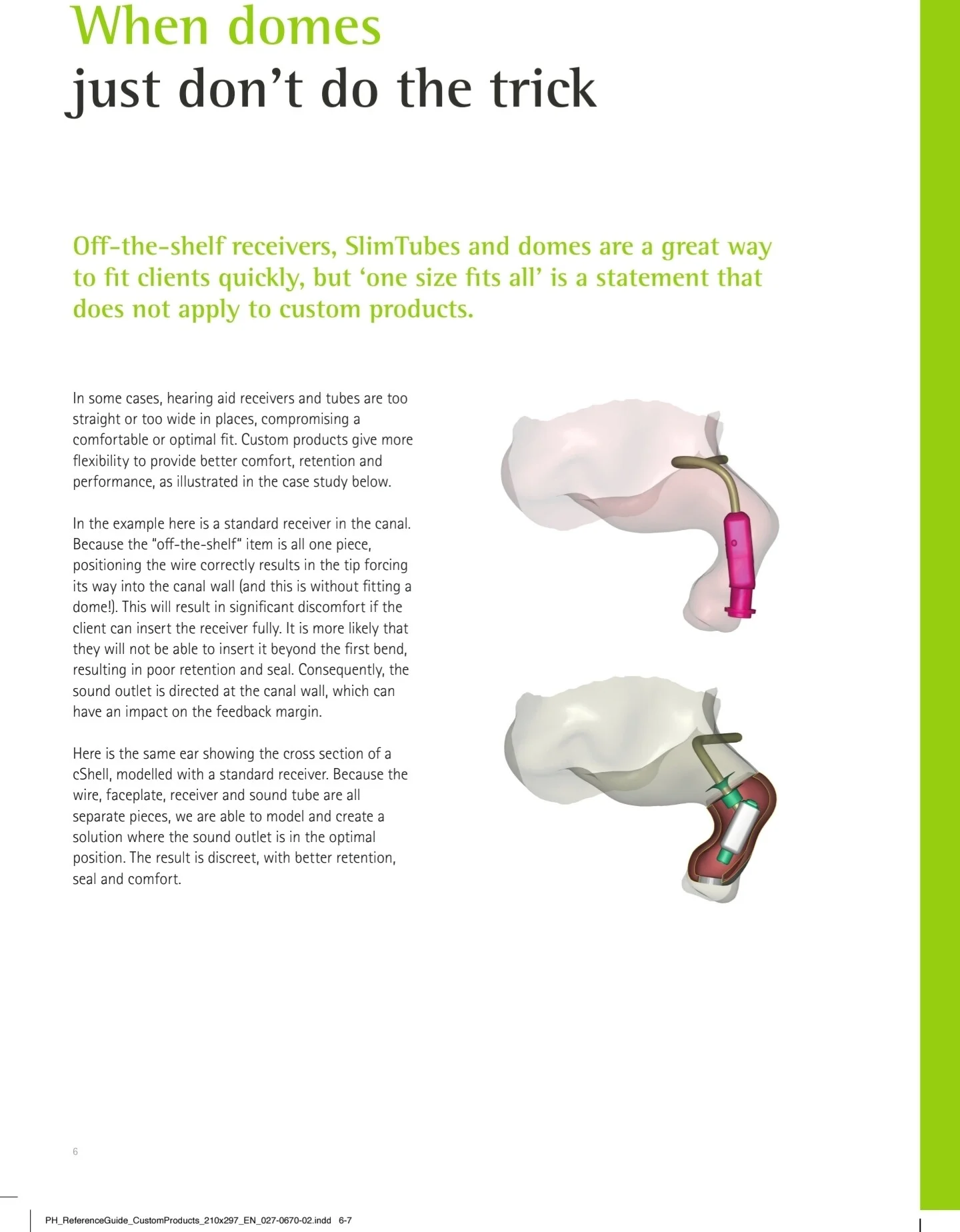
Source:
It’s almost the Phonak encyclopedia about acoustic coupling…
You’re ignoring this member’s posts.
As always, there is rocker switch button, for volume adjustments and program changing.
You can swith easily to manual Spheric program. However, I found that after lowering the threshold of activation, Spheric mode in AutoSense works good.
Thanks for confirming that the switch to spheric mode can be automatic. My audi had forgotten how to do it on Saturday so have written again to ask her to look it up and do it. Presume trial and error as to how much?
You’re ignoring this member’s posts.
Presume trial and error as to how much?
In my case, quite much, but most costly is time spent gaining knowledge and, for example, waiting for many earmolds/cShells to get the perfect one… The latter (probably) will come soon…
(I include also my ‘adventures’ with previous Paradise P90-RT ).
You’re ignoring this member’s posts.
I still have domes. You say you have tried many kinds of molds how on earth does one choose which of the many kinds are best without paying around $150 out of pocket each pair? How do they differ assuming they all are comfortable. I tried one hard plastic pair which had a small vent and I hated the sound of my own voice and the general sound. I know my hearing loss is such that I would do better with molds but since I have been diagnosed with hyperacusis maybe none would be good for me.
You’re ignoring this member’s posts.

Please look at my . Very similar to yours.
I got domes about a month ago.
Mine are Phonak slim tip. It was so easy! They are silicone. I have good waxguards. I’m clumsy. I have trouble changing them
They sound better. They feel so much better. I was stubborn as …. I should have changed long ago.
Dave
You’re ignoring this member’s posts.
You’re ignoring this member’s posts.
Jordan,
Your question raises an interesting point and I’m hoping an audiologist will jump in with a clear explanation. Putting aside the people that should really have molds and don’t get the benefit of the spheres that they should because of that. How does an audiologist make sure that the the Spheric program is working as it should be? I understand that real ear testing will make sure that your aids are delivering sound at your prescriptive level. My question is how do they measure the absence of sound that anyone getting a Sphere is hoping to experience? I recall being wowed by the Spheric mold when I was first fitted in the office. I then have had to deal with some malfunctions. While I’m sure the Spheres are helping me much more than the Marvel’s they replaced I still struggle with wondering how to know when I feel like they are not delivering if it is my own fluctuating hearing or if my aids are not working correctly.
You’re ignoring this member’s posts.
After switching to molds I wished I had them from the start. Aside from the sound improvement I was constantly pushing the domes back in and the aids were much more easily knocked out. I have not had to search for an aid since getting molds. As far as getting the right mold I think that starts with having an experienced audiologist you can trust to help guide you. I know every time I change aids or have a large adjustment it takes me a few weeks to “forget” the sound of my own voice and settle into the new normal. Your hyperacusis may present unique challenges. Good luck!
You’re ignoring this member’s posts.
Hearing Aids12 replies
Hearing Aids43 replies
Hearing Aids34 replies
Fitting Software Requests511 replies
Hearing Aids165 replies

 Marengo Illinois usa
 Poland
 Wales, UK