

It is a playback test at audiology clinic, not a determination, it is very comparable to a noisy restaurant
You’re ignoring this member’s posts.
108 replies4.5k viewsLast reply
It is a playback test at audiology clinic, not a determination, it is very comparable to a noisy restaurant
You’re ignoring this member’s posts.

Would you know if someone’s hearing loss is at the top of my fitting range, would they get longer battery life compared to someone at the bottom of the fitting range?
I’m very interested in this to go with my N8 when I get surgery at the end of the week.
You’re ignoring this member’s posts.

@Zebras Good luck with your surgery and I hope all goes well for you.
Is the surgey at Gloucester Hospital or Cheltenham Hospital?
You’re ignoring this member’s posts.
Thank you @Baltazard
It’s not either of those hospitals, I chose to have it at the same hospital as my friends (twins) as they originally had their first where we live and they had to be re- implanted. 
You’re ignoring this member’s posts.
Cannot wait for xMEMS technology because I need audibility in highest frequencies and there are some evidence that even 8k-20kHz range is useful in speech in noise, so more processing power will be needed.
I’ve been waiting for this technology for a long time, hoping for more power and, above all, a wider frequency range. Does anyone have any news on this?
You’re ignoring this member’s posts.
Would you know if someone’s hearing loss is at the top of my fitting range, would they get longer battery life compared to someone at the bottom of the fitting range?
I am not sure if I understood the quiestion correctly, but theoretically the more amplification is needed, the more power is needed.
I’m very interested in this HA to go with my N8 when I get surgery at the end of the week.
You can, of course, try it; it’s always worth a try. However, I’m afraid that it is too weak for you. Here’s example comparison with Naida Lumity:
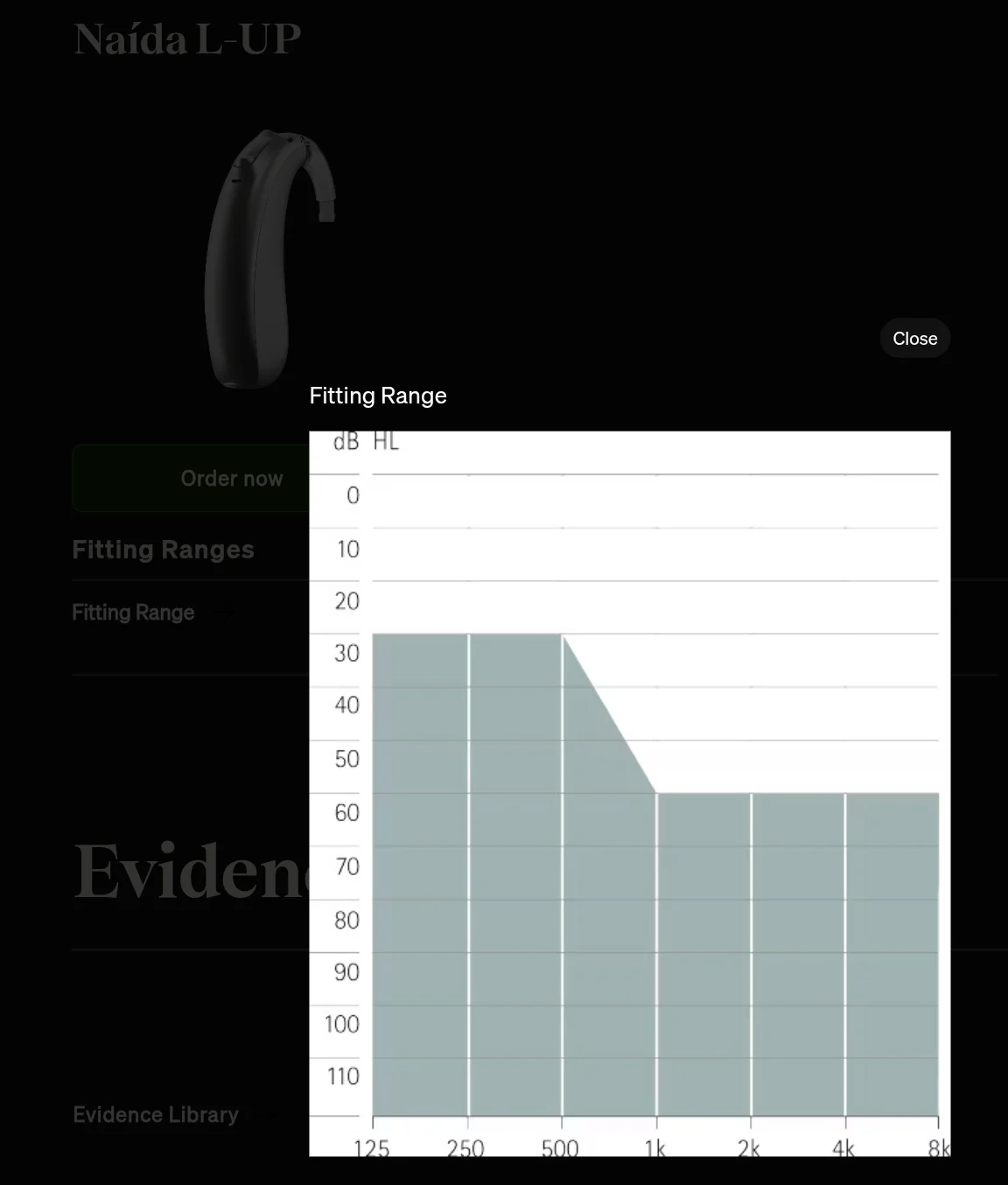
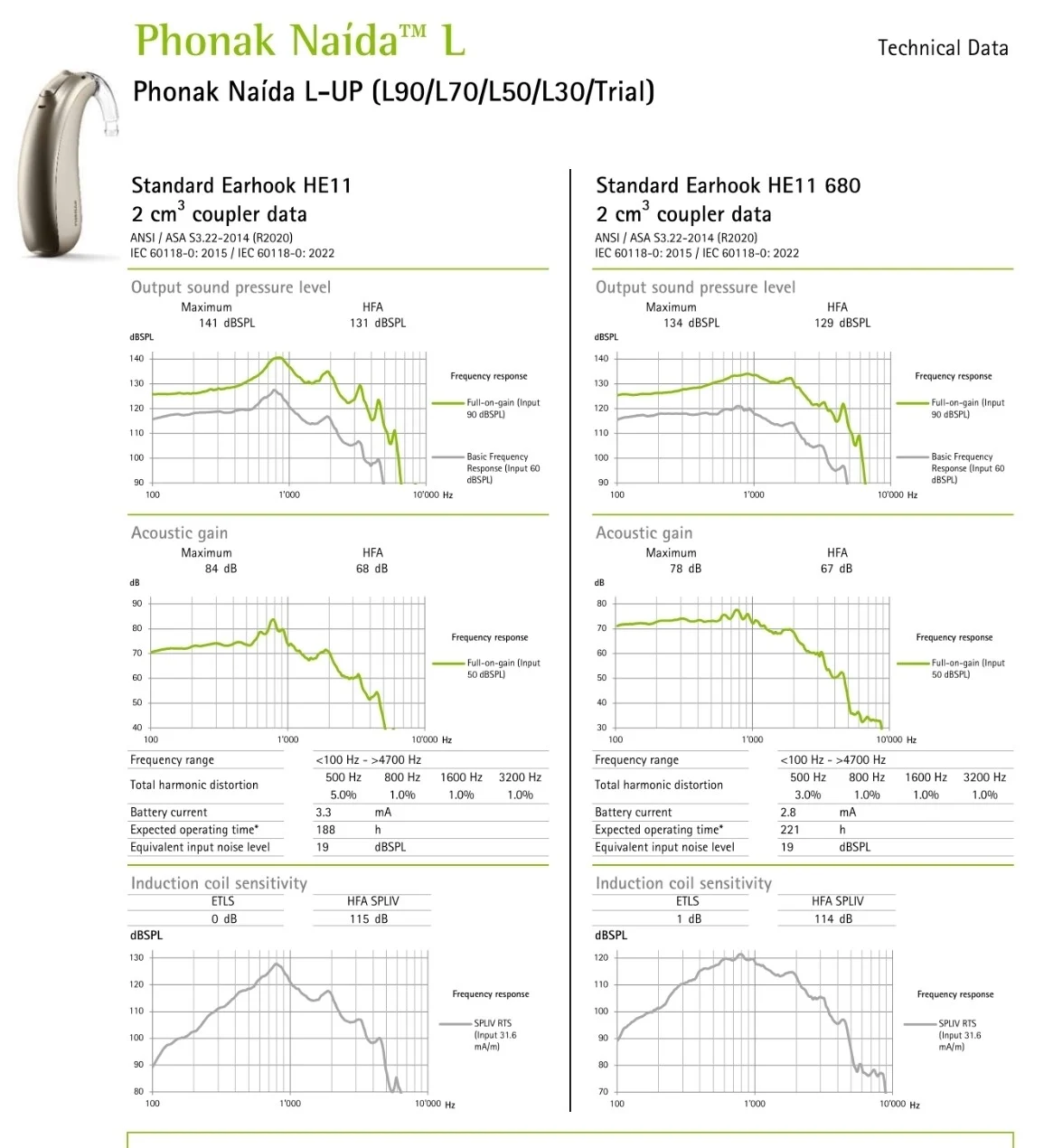
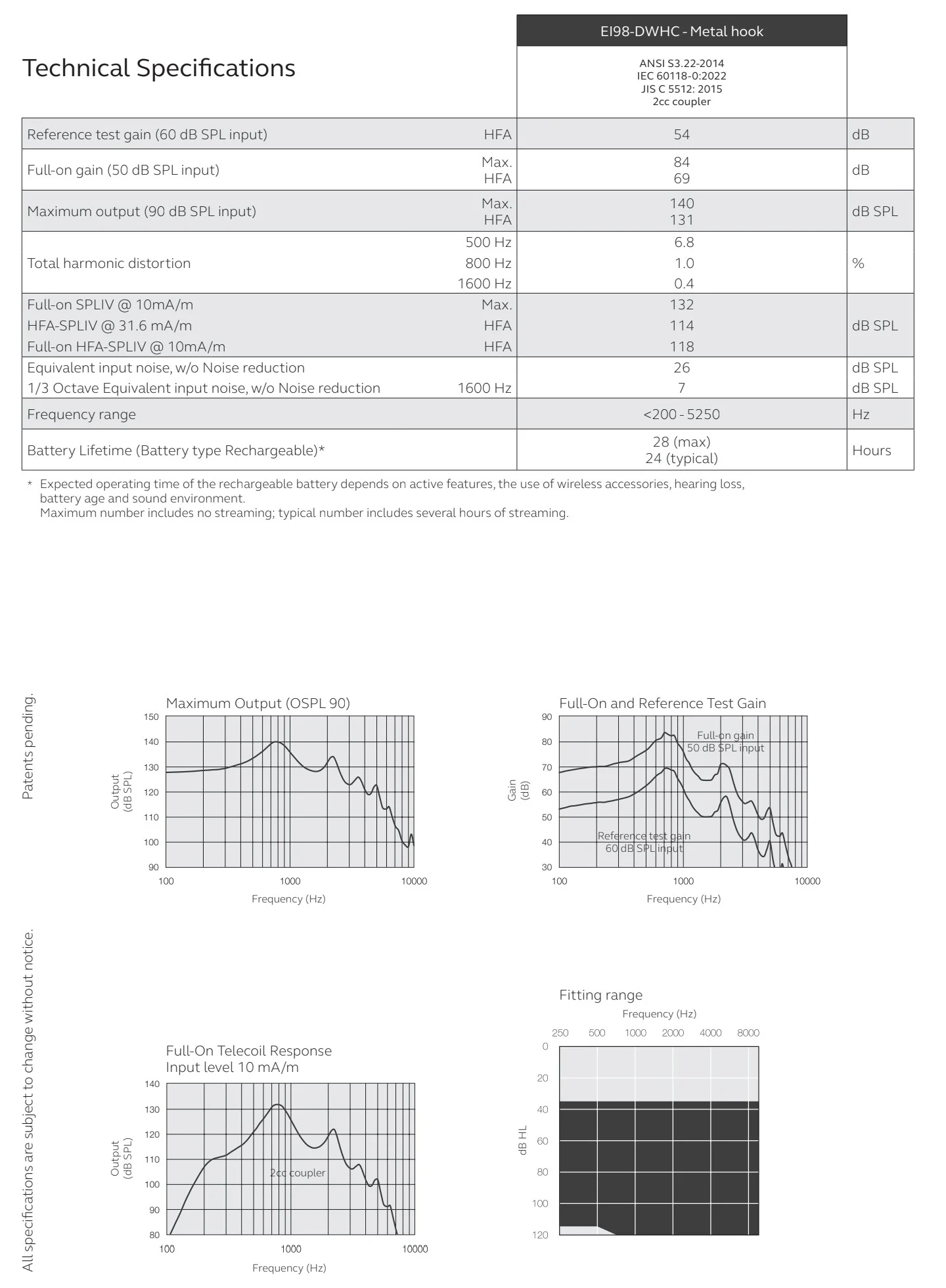
You can also compare it with Oticon xCeed.
HOWEVER, there is a possibility on new Naida Infinio generation. Assuming from better frequency response in Audeo Infinio UP receiver, maybe new Naidas also will have it better.
However, I’m unsure whether the tubes will suppress the highest frequencies anyway.
And I’m not sure does it is worth a try spending so much money if your cochlea is completely dead. Have you already had evaluation, which checked for possible side also?
You’re ignoring this member’s posts.
I have 120 loss but I’m still picking up sound but no speech what so ever.
Should add, I’ve not actually seen my latest , it’s just what I was told
I’m wearing a GN Hearing Aid on my left ready to be linked to my N8.
I tried the Sky L70 UP and couldn’t get much out of it compared to the Xceed.
The GN Hearing Aid is equal to the Xceed I feel.
You’re ignoring this member’s posts.
No that is flat out wrong. anything above 8 khz is not useful in speech. Sure my sound processor can be remapped to 20 khz but what to gain from that.. the older sound processors in the 2000 had a default of 10 khz but they cut it off even lower because there is no clinical benefit for going up to 10khz vs 8khz..
You’re ignoring this member’s posts.
No that is flat out wrong. anything above 8 khz is not useful in speech.
Not really. We can say that frequencies above 10 kHz are less of a priority in understanding speech (especially in silence), but try to say quiet “s” sound in front of app like Spectroid. You will see that a large part between 12 and 16?-20? kHz will be detected.
Devices like Earlens reportedly have better results due to their better frequency response, but now they are old technology, very expensive, and, especially in the first generation with a light beam through the ear canal, not quite reliable.
Sure my sound processor can be remapped to 20 khz but what to gain from that.. the older sound processors in the 2000 had a default of 10 khz but they cut it off even lower
The problem with ale number of channels (22 at best in Cochlear company case) that means 180-8000 Hz must be distributed meaningfully between these 22 channels. It’s like “handles” in software fitting. If CI supported a range of up to 20 kHz, it would mean that a much larger frequency range goes to one channel, resulting in a reduction in the precision of arousing specific frequencies and even a spread of masking effect.
Keep in mind I am speaking about ideal conditions: 22 fully functioning electrodes. In many cases, clinicians are forced to deactivate some electrodes and therefore widen the frequency range per channel.
because there is no clinical benefit for going up to 10khz vs 8khz..
The additional 2 kHz is too small a difference for the general population to perceive any benefits (it would be extremely unprofitable and time-consuming to check this, and there would be no guarantee of improvement). This would be different for individuals. I am not even sure if there was a notch (dip) in the frequency response in the Spectroid app at 8-10 kHz during vocalization of the “s” sound…
You’re ignoring this member’s posts.
Not really. We can say that frequencies above 10 kHz are less of a priority in understanding speech (especially in silence), but try to say quiet “s” sound in front of app like Spectroid. You will see that a large part between 12 and 16?-20? kHz will be detected.
Is there any proof you can hear it in any DB?
You’re ignoring this member’s posts.
Maybe frequencies above 8,000 don’t help, but current UP receivers (essential for a loss like mine) don’t go above about 5,000, so I’m hoping for xmems technology.
You’re ignoring this member’s posts.
Is there any proof you can hear it in any DB?
Yes, I hear it in the only condition (without ) when the gain is appropriate.
EDIT: I came to the conclusion that you asked about frequencies > 10 kHz. My fair response: I don’t know, because I have never extended frequency audiometry. Nevertheless, I still think that importance of the frequencies in 10-20 kHz range are underestimated.
Maybe frequencies above 8,000 don’t help, but current UP receivers (essential for a loss like mine) don’t go above about 5,000, so I’m hoping for xmems technology.
Recent Infinio UP receivers (SDS 6.0) counterintuitively has better frequency range than P, even to ~7,5 kHz.
You’re ignoring this member’s posts.
You’re ignoring this member’s posts.
You’re ignoring this member’s posts.
You’re ignoring this member’s posts.
3 days since Enzo IA fitting to replace a 7 year old Enzo 3D (severe-profound loss on aided ear, profound unaided loss in other ear).
Very much aiming to minimise any change from the Enzo 3D so I won’t make a good reviewer. Only using a single programme - not configured for in noise/music etc. Small difference in sound which I’ve now adapted to albeit a bit louder than I’d like (currently turned volume down to 40 from default 67 on my programme)
Worn 24/7 for almost 72 hours took battery from 100% to 10% so considerably more than the advertised 28 hours (which was a concern going in after decades of getting 7-10 days out of 675 batteries that could be replaced in seonds). Battery level displayed on iPhone appears relatively accurate. Includes about 6-8 hours Mfi streaming but also with the microphone turned down to 0 using iPhone control center. About 4 hours to recharge to 100%, in line with advertised rate. CFF90 desktop charger is smaller than expected although would have still preferred a travel version and 1 charging slot! USB-C powerered so can power off any USB-C supply/power bank etc.
Haven’t tried and tbh don’t really expect to for quite awhile until it becomes more common here. Multi-streaming appears to be Auracast based - not supported by Mfi as iPhone and MacBook connect separately. Haven’t tried two way streaming yet.
A few differences from the Enzo 3D particularly around power on/off. My Enzo 3D was set up to use the battery door for on/off so it was easy to know it was off and also to do a quick power cycle to reset muted microphone (as opposed to do it on the phone). Whereas getting the Enzo IA to shut down is a bit more fiddly and uncertain until removed (when the microphone is muted).
You’re ignoring this member’s posts.
Whereas getting the Enzo IA to shut down is a bit more fiddly and uncertain until removed (when the microphone is muted).
Is there no sound and/or light indication that it is turning off?
What do you have? Could you enter it into your profile settings?
You’re ignoring this member’s posts.
There is a sound and a LED indicator, which is obviously only visible when removed. TBH it was more just a comment on the immediateness and obviousness of a disposable battery door on/off vs the more fiddly approach on modern recharagables.
You’re ignoring this member’s posts.
TBH it was more just a comment on the immediateness and obviousness of a disposable battery door on/off vs the more fiddly approach on modern recharagables.
Yes, I also find it annoying having to press the button for 5 seconds to turn my Sphere off (3 seconds for muting the mics)… However it’s relative minor inconveniece comparing it with possibilities with Sphere program.
You’re ignoring this member’s posts.

I was fitted with a pair of Resound Enzo IA aids on 18 September upgrading from the Resound Enzo 3D which I have had almost eight years.
After almost four weeks use I can report the following: -
Battery Life – typically I wear aids for 16.5 hours a day which includes at least 3 hours streaming (combination of iPhone connecting with MFI and TV, Laptop & tablet connecting with /). I must admit I was nervous about switching to rechargeable aids having been using exclusively disposable battery aids for 50 years. These aids were advertised as having a battery life of 28 hours (20 hours when streaming 50% of the time). In my case I found that these aids would use approximately 20% of the battery power in a day giving me four full days charge before running down to 10% power and the low battery warning sounding every 15 minutes
Hearing Programs – the aids were initial set up with just an All-Around Program and a Program. I subsequently had the Telecoil Program removed and the Hear-in-Noise, Outdoor & Music Programs added.
Initially I found the All-Around program had a sound difference and was notably louder than the previous aids but within a week I had acclimatised to this and it now feels very comfortable and I use this program virtually all of the time.
For Telecoil users I can confirm that the telecoil program works just as well as any other telecoil I have in previous aids. The reason I had this program removed was that I was no longer using it. My only routine use of a telephone was inductive ear hooks to connect to my laptop. I am now using Auracast and Bluetooth LE Audio to do this.
The other three programs I have only had a week and have not used them much but having tried the Hear in Noise Program in a noisy restaurants it does reduce the overall background noise but I found the sound strange and it took away from the ambiance of the venue when switching back the All-Around Program I found that this was fine and I was able to hear my dining companion.
The Outdoor Program have used a couple of times and does seem to help particularly in windy situations an I do find this helpful when cycling. I am not a big music fan and haven’t really used this program but have found that using the All-Around program combined an Auracast TV Streamer or a MFI connection to an iPhone gives clear sound quality for TV and podcasts etc.
Mobile phone – I use an iPhone and like my previous aids these aids connect using which I have found to be very stable and gives clear sound quality.
The main difference with my previous aids is the tap control and ability to use the phone hands free. Under this option my voice is transmitted via the hearing aid microphone rather than the phone microphone. This works fine in quiet and/indoor environment but in outdoor/noisier environments I got complaints from the other caller that they could not hear me. This appears to be an issue with other Resound aids that have this feature, the solution for me was turn the hearing aid mic input on my phone and then the iPhone microphone is used. Since doing this I have no more complaints or problems.
Bluetooth LE Audio/Auracast – whilst there are only a limited number of Auracast Broadcast at public and/or commercial venues at present. There are an increasing number Bluetooth LE Audio/Auracast compatible devices and adapters. I have used these aids successfully with the Avantree Audikast 4HA, the Avantree c82 (Aura) and the FlooGoo FMA120. More details can be seen about these.
All of these devices cost less than £50 each, provide amazing sound quality and are easy to use.
I believe Bluetooth LE Audio/Auracast will be adopted by many public venues quickly as this technology is not just for use by hearing aid wearers but anyone who has Bluetooth LE Audio headphones or earbuds but in the meantime is provides a high quality sound, stable connection, inexpensive means for hearing aid users to connect to personal devices including TVs, Computers, Tablets & phones, for which those of us with severe/profound loss will probably benefit the most from.
I am aware that there are some manufacturers who have devices that are Bluetooth LE Audio/Auracast “ready” but have yet to release the necessary firmware to enable this to be used. Their arguments that Auracast is not ready is disingenuous and perhaps the real reason is that they want to sell more of their own brand expensive TV Streamers and etc.
The only minor criticism I have relates to charging. The charging device itself is compact and easy to use. A full charge takes four hours. However, the aid has a green LED light which flashes whilst charging, which turns to constantly lit once the aid is full charged (but still in the charger). These lights are surprisingly bright the equivalent of a mini lighthouse which I found less than ideal when trying to sleep with charger on my bedside table. Moving the charger to a floor level shelf and putting it behind a pile of books has solved this issue for now. It would be good if the charger was re-designed to incorporate a lid or some other way to shield the LEDS lights.
I found these aids to be very impressive. I would highly recommend that anyone needing a Superpower aid gives these a trial.
You’re ignoring this member’s posts.
Log in to reply to this topic.
Hearing Aids53 replies
Uncategorized12 replies
Press Releases151 replies
Hearing Aids12 replies
Hearing Aids135 replies
 Italy
 Poland
 London