Supposedly the Spheres are LE audio and capable. Other than “impacting peripheral product sales” what difficulties (technical or otherwise) do they have in adding those to their Ultras? Trying to both retain the “pros” of classic Bluetooth as well as adding ?
Other than “impacting peripheral product sales” what difficulties (technical or otherwise) do they have in adding those to their Ultras? Trying to both retain the “pros” of classic Bluetooth as well as adding LE Audio?
Who can tell? Presumably there’s something there that requires some significant software work, but without getting our hands on their source code (fun!) or planting a mole in their organization, it’s pretty much impossible to know what is and isn’t going on. (I’m not very convinced by the “protecting Roger sales” theory, but of course I could be wrong.)
I’m told the Swiss, as a rule, strongly dislike making mistakes in public; to the extent that that’s true, it could encourage some caution in releasing a software update that isn’t yet all that crucial…
It’s not that hard, most of the other manufacturers have already implemented it, maybe the others just have better people who know how to get things done or maybe they just don’t pay their developers enough
It’s conceivable that getting to work smoothly without disrupting the existing Bluetooth Classic capabilities presents a particular problem; if memory serves, the Signia Pure BCT (which supports Bluetooth Classic) will not support LE Audio, which may indicate some level of technical difficulty there (or maybe not - it could also be some kind of arbitrary business decision).
The problem of underpaid software developers is one of the great humanitarian tragedies of our time. I feel my pain.
I just got my Spheres two days ago from the . My trial goes to 5/24/2026 (very, very generous). My thinking is if Phonak does not provide before its end, at least I will switch to a different . ( is desirable but optional to me for now as it will take awhile to be widely adopted. I appreciate they want to preserve their Roger business). I had to go back to the VA today to add a manual Spheric SILN program. The new audiologist said support for classic bluetooth is ending and this may force Phonak’s hand. Please keep us up to date.
FWIW I just got my Spheres yesterday from the VA with custom molds. I asked about the active vent ones as recently for reasons unknown I have been having more the previous wax build up. Anyway he said if I cam Ok with and able to replace the wax traps those are better because if the active vent ones get stopped up it requires a visit to clear them
I didn’t realize that the active vent receivers would require a visit to clear out the wax. Glad I didn’t insist of getting it then! Thanks for sharing this info.
The high latency in Phonak Sphere mode (17ms, as measured by an audio engineer on the forum and also noticeably perceptible to me) combined with abrupt jump among speakers made spatial localisation extremely challenging. (Though the comb filtering effect didn’t significantly affect me, given I use custom ear moulds.). Situation awareness is absolutely crucial for my work.
Intent not only preserves spatial localisation but also appears to retain some acoustic cues, allowing me to intuitively discern the speaker’s orientation: even when they are not directly in front of me, I can still gauge whether they are facing me or seeking my attention through acoustic cues and (partial) dialogue content. Of course, this persumes I can hear the sound.
I can definitely understand your feeling about how Oticon aids is excellent at keeping the spatial awareness and balance compared to the Phonak Spheric SILN mode. You definitely have to give up quite a bit of spatial awareness in this Spheric mode in exchange for better in this mode.
I personally think that the strength of the Spheric mode is not really in its speech clarity, because the voices sound less natural to me, actually. But the strength of the Spheric mode is more in the incredible noise suppression ability, as it basically “recreates” a new sound scene that is more or less devoid of the noise and only lets the “rebuilt” speech(es) coming through. So in the absence of the noise, you can hear the speech better. simply because now that’s almost the only thing you hear. But the speech is not necessarily clearer or more natural.
So if you need the spatial balance and awareness, and if the Oticon aids give you good acoustical cues via the spatial awareness to be able to discern the voices and focus on them better, then I can definitely see how you would prefer that spatially balanced open paradigm over what’s almost like an artificial recreation of a sound scene that’s lopsided to just the speeches only (from the Spheric mode).
@Volusiano Yes. On the other hand ,I am neither satiscfactory with the Oticon on its performance under Noisy environment.
I am not Oticonian nor Phonakian.. Discussion here is just to pinpoint the adv. / dsiadv (IMO) of different hearing aids on the market. Hopefully next generation hearing aids from the two company can meet my expectation: Better performance under noise enviroment for Oticon; Smaller physical size and LE audio, better latency for the Phonak.
Btw, seem not much comment from Starykey Omega users…
The new audiologist said support for classic bluetooth is ending…
Whose “support”? Bluetooth Classic is all over the place, and the vast majority of devices out there (PCs, laptops, speakers and earphones, and even mobile phones) do not yet support . So while competition from other hearing aid manufacturers, plus the gradual spread of , may well push Sonova to get their thumbs out of… wherever they are currently ensconced, I don’t think the obsolescence of Bluetooth Classic is a meaningful threat over the next couple of years.
Thanks Jordan. My hearing loss is still not too bad in the lows so I’m set up with M receivers. I can see how the P receivers would be more suitable for you.
The fitting range of particular receiver aren’t something engraved in stone. It’s more like a tips for starting point.
For example, @SandraN has UP receiver despite her good low frequency hearing and it works perfectly.
For example, from my I am theoretically eligible for the M receiver, but it is too weak, so I bought the P receiver with power domes. Still I have to push it deep into the bony part of the ear canal to get additional “free” gain due to acoustic Boyle’s law.
It’s has still too little gains, especially over 3-4 kHz, so I ordered (and still wait) for the titanium cShell with UP receiver and 0.6mm vent.
In the meantime, a firmware update was unexpectedly released, which actually helped, because I got the option to increase the gain from ~+6 “” in 4000 Hz to even +12 “dB” in 9000-9600 Hz.
UP receiver has even better frequency response than P receiver, so I still wait impatiently.
I was merely passing along what the audi said (and my recent impression is most can and do live in a bubble), but I did do a Perplexity search before I posted. It said the Bluetooth SIG has put classic in maintenance mode FWIW. I agree classic is ubiquitous. My Pixels have both LE audio and classic so it’s not as if manufacturers are going to drop it unless it interferes with a market demand.
I thought I once had a pair of ’s that allowed manual focus to front, rear, left and right. When getting my Sphere’s adjusted yesterday I asked if they had just a feature. It would seem mighty handy. The current MyPhonak option is for wide (360?) or focused (to the front) so you have to keep your head turned to the person you want to hear which is normal but not always doable such as the driver of a car wanting to hear someone in the back seat.
It said the Bluetooth SIG has put classic in maintenance mode FWIW. I agree classic is ubiquitous.
Indeed. From all I’ve read, it does sound like LE is the future - and of course even Phonak knows this. Sadly, though, the future sometimes takes quite a while to fully replace the present - and Phonak knows that as well.
Assuming that the upgrade to support isn’t harder than it sounds like it should be, I would think that Phonak shouldn’t take all that long to get it out the door - more and more will be out there, along with more and more new Samsung and Pixel phones. (I still don’t know if my Poco supports it. Hmph.) At a certain point, not supporting the new protocol will start costing Phonak business, and I have the impression that they’re pretty good about wanting to sell hearing aids.
Not sure which Poco you have, but go to this link and put your model in. Scroll down to bluetooth The F7, for instance has 6 (not just 5.3) and LE (audio): Xiaomi Poco F7 - Full phone specifications3
X7 Pro. GSM Arena doesn’t list among its capabilities, but I have seen it somewhere in the murky depths of my phone’s advanced settings. Unfortunately, I don’t have any LE Audio devices to try to pair it with, so there’s no way for me to tell if it’s an actual capability or just a tease.
When and if we get the Phonak LEA upgrade, I’ll jump into Mad Scientist Mode… To be honest, it’s a pretty short jump for me.
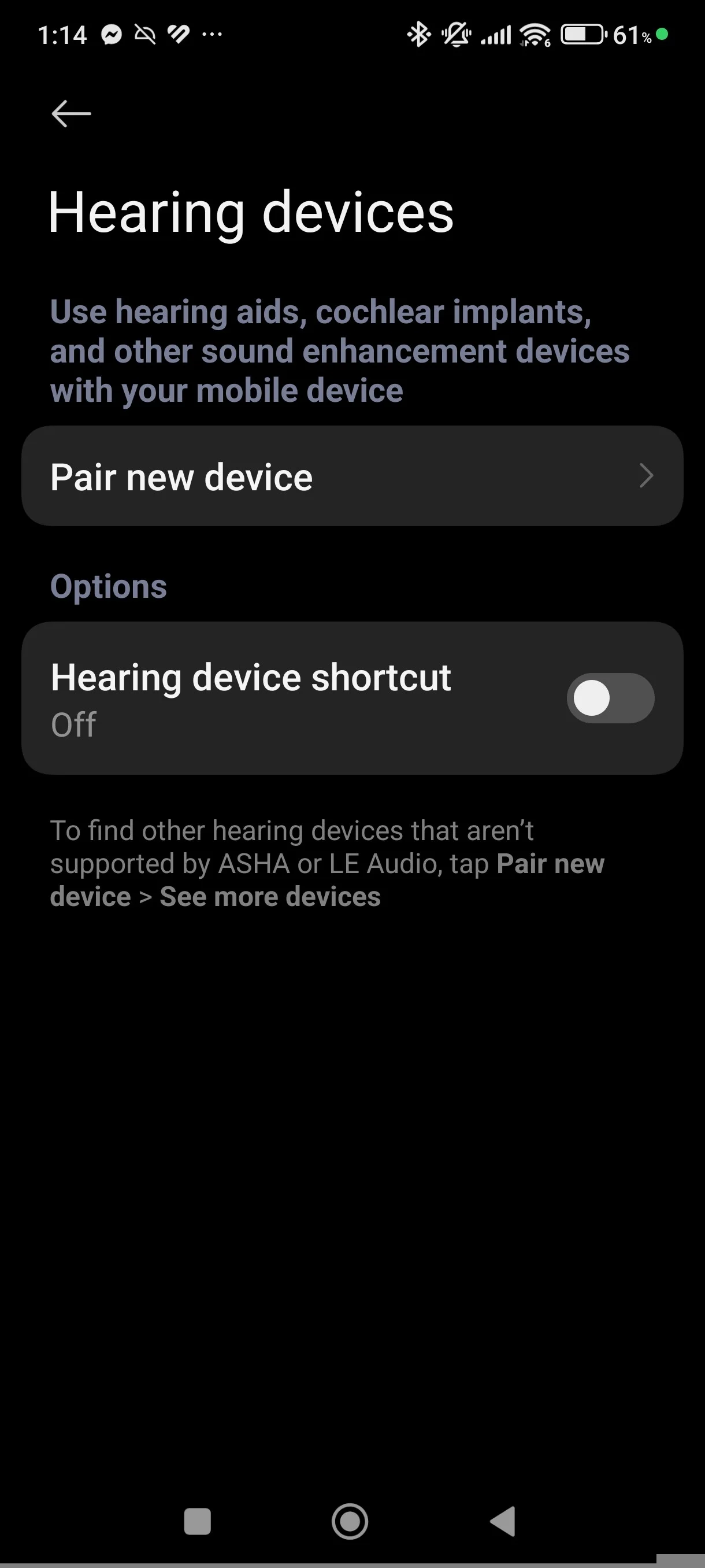
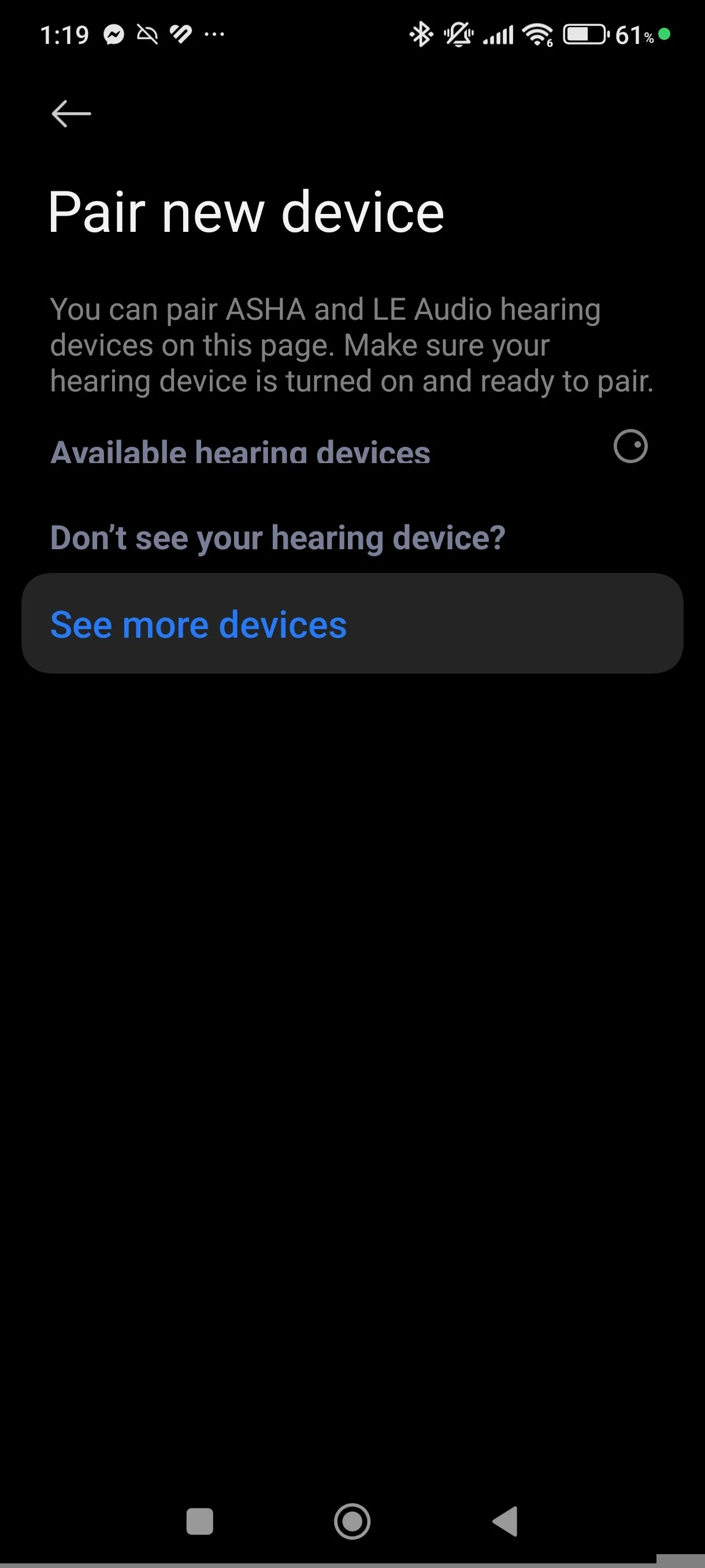
P.S. Here it is - not under Bluetooth, but in Additional Settings / Accessibility / Hearing Devices. The fact that it mentions is suggestive; but until I have something to play with, I have no real idea if it’s a real, usable capability.
I thought I once had a pair of HA’s that allowed manual focus to front, rear, left and right. When getting my Sphere’s adjusted yesterday I asked if they had just a feature. It would seem mighty handy. The current MyPhonak option is for wide (360?) or focused (to the front) so you have to keep your head turned to the person you want to hear which is normal but not always doable such as the driver of a car wanting to hear someone in the back seat.
You shouldn’t feel you have to turn your head in the most conditions. StereoZoom 2.0 helps much with hearing when the speech is from the side or a little bit behind.
X7 Pro. GSM Arena doesn’t list LE Audio among its capabilities, but I have seen it somewhere in the murky depths of my phone’s advanced settings. Unfortunately, I don’t have any LE Audio devices to try to pair it with, so there’s no way for me to tell if it’s an actual capability or just a tease.
The only ones I’ve seen with LEA/ are in this article:
Bluetooth is here. Find out why Bluetooth LE Audio outshines classic Bluetooth and explore its benefits for your Android phones and headphones.
BTW, with LEA Auracast is being used on newer Samsung, and LG TVs, as well as the ability to buy an Avantree or Floogoo USB dongle, and broadcast from your PC/Laptop/Tablet, some media streamers, etc. It’s happening now!!





 Poland

 SoCal