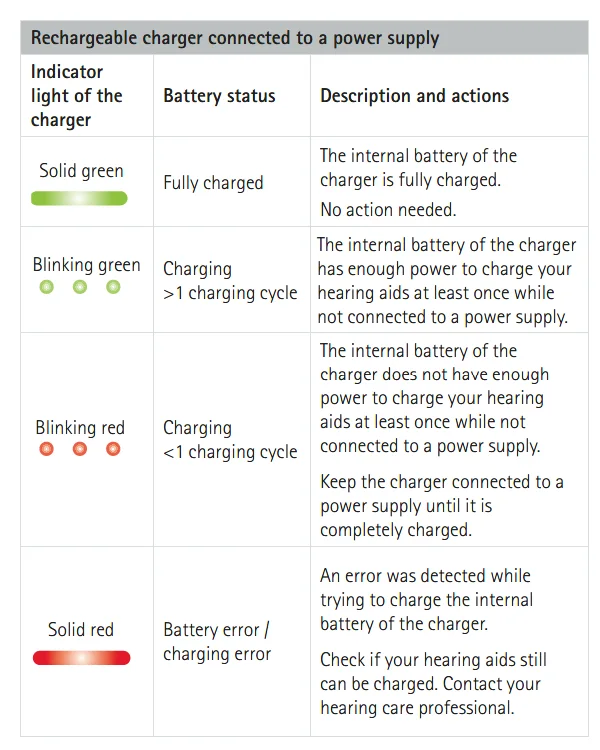
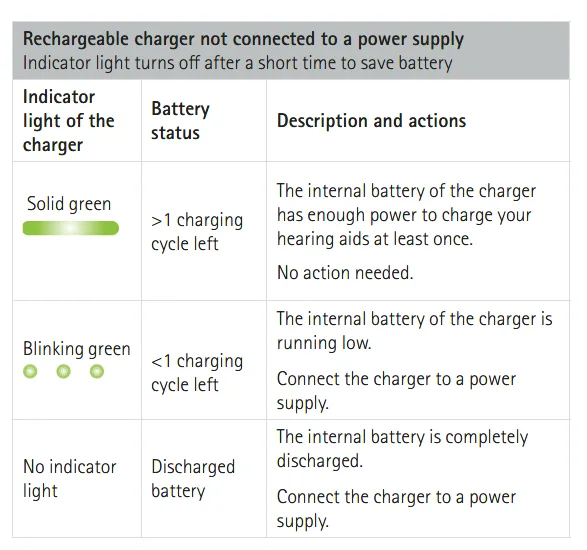
The Phonak website is not that detailed about chargers for the Infinio Spheres or Ultras. Does the charger always have to be plugged into the wall to charge the hearing aids or does it contain a small 3 charge power bank? Can the charger be run by USB, or does it need a 120v wall socket?
It has an usbc input and can use any usbc connection to charge.
My Sphere charging cable is USB-A to USB-C. I plug it into an adapter left over from my Nook reader. The adapter is something like 5V with a max of 0.8 amp output, and, IIRC, the Sphere charging case draws less than 0.2 A when charging at 5V. I usually let it run down to the point where the case indicator shows it has <= 1 charge remaining, then let it charge for 2.5 hours, by which time it should have approximately 2 charges in it. The idea is to prolong its long-term battery lifespan by not charging the case to 100% and leaving it at a full charge. Most AC wall adapters from the past with a USB-A charging port are something like 5V/1A max output, and such an adapter should do fine for charging the Sphere case. It usually takes a magnifying glass and bright reflected lighting to be able to read the specs imprinted somewhere on an AC charging adapter. If you use an inexpensive USB digital multimeter, available from Amazon, you can see the amps, volts, and mAh that you’re inputting to anything you’re charging with a USB cord plugged into an AC adapter, and given the battery capacity of the device and your starting state of charge, you can figure out how many mAh (and how much time) you need to charge to whatever degree you want (my charging setup has Nook adapter→USB DMM→Sphere case; the input male end of the DMM plugs into the female output port of the AC adapter, and the USB-A end of the Sphere case USB cord plugs into the female USB-A output port of the DMM. The DMM displays elapsed charging time, so I can tell just by looking at it how long I’ve been charging, and I also tell Alexa to alert me when the device has charged as many minutes as I want). Just remember, the capacity of Li-ion batteries is evaluating when discharged at ~3.7 volts, but you’re charging at 5 volts. So, whatever mAh you input at 5 V has to be corrected by multiplying by 5/3.7 to allow for the effective mAh hour added being discharged at ~3.7 volts, e.g., 370 mAh input at 5 volts is equivalent to 500 mAh discharged at 3.7 volts. Power = volts x amps or 5 x 370 = 3.7 x 500.
Edit_Update: As a reality check, I had a little discussion with ChatGPT. My explanation above errs on a few finer points. In charging, the actual voltage applied to a Li-ion cell is only about 4.2 V, and my explanation does not account for the fact that charging the battery itself is only approximately 90% to 95% efficient. Most of the fundamental inefficiency in charging a Li-ion battery is in the AC adapter itself, but a USB DMM inserted in the charging path after the adapter only sees the power flowing after that point, but still doesn’t account for the modest amount of power lost in restoring the electrolyte balance of the battery. Explains why when I apply my formula to charge a Ring video camera battery to 63% SOC, I always end up at about 60% SOC! Duh!
Thanks, although this might go under the category of TMI. I do have a concern on what to expect WRT Spheres battery life (if/when I get them) as I regularly use my P90’s close to 16 hours a day. I have read/seen on the internet (FWIW) that they work much better with Spheric Speech in Loud Noise activated which reduces battery life to 7 hours so a mid day mini charge may be needed. So one more thing to carry around or at least have handy. I wish they had put a loop or clip on the charger for easy carrying although I usually wear cargo pants so it’ll fit in my pocket (if I remember it).
I’m finding that I get 4 nightly recharges out of the Spheres’ case/charger. I’ve been figuring that even if Phonak didn’t build in the greatest battery-life-preserving circuitry, this should mean that (A) the charger battery should probably outlast the hearing-aid batteries; and (B) I’ll probably have charged the case at most 450 times before I’m eligible for a new set in 3.5 years.
I do have a concern on what to expect WRT Spheres battery life (if/when I get them) as I regularly use my P90’s close to 16 hours a day. I have read/seen on the internet (FWIW) that they work much better with Spheric Speech in Loud Noise activated which reduces battery life to 7 hours so a mid day mini charge may be needed.
People on the forum have been getting much better battery life than that - including several who have been going somewhat out of their way to be in “Spherical” situations. (@JordanK has written a lot of excellent posts on the subject.)
A couple of relevant facts about Spheric mode and battery life:
It’s not quite accurate to say that the Spheres “work much better with Spheric Speech in Loud Noise activated.” Spheric Speech mode is a powerful tool for specific situations, but it is not “better” except when you are in a crowded, noisy, horrible (OK, that part is just my own opinion) environment. Spheric Speech mode uses heavy processing to extract intelligible speech in challenging situations; and while it’s apparently quite good at what it does (especially with or custom molds), the result is perforce not very “natural” sounding. You want it when you need it, but not when you don’t.
With the new “Ultra” firmware upgrade (which all the cool kids have - you do want to be one of the cool kids, don’t you?), the battery life in Spheric mode has been increased to around 11 hours. Considering that you really don’t want to use Spheric mode except in noisy, difficult (and did I mention horrible?) situations, 11 hours is a lot. Unless you work in a restaurant or someplace similar, it’s doubtful that battery life with the Spheres will be a problem for you.
Have a look at JordanK’s posts, particularly the one describing his experience with Spheres at a wedding. (TLDR version: He gave them a top-up charge beforehand; they worked like a charm; and IIRC he finished the night at 50% charge.)
As @DonRadlauer said, you typically only want to be in the Spheric program when you are in a place with horrible noise. Mostly because of the battery drain but also because speech will be very clear but not necessarily natural sounding.
My typical day has my hearing aids on at 7 am, includes a few hours of streaming and maybe an hour of Sphere use before hitting the sack at 10:30 pm. I rarely end the day without at least 55% left on the Sphere’s batteries. With no Spheric AI use, I end with 60%-65% (with the new Ultra firmware).
Basically, the big battery on the Sphere’s and the Ultra firmware gives you two days of use.
(A) the charger battery should probably outlast the hearing-aid batteries; and (B) I’ll probably have charged the case at most 450 times before I’m eligible for a new set in 3.5 years.
OTH, one can follow a “use a modest depth of discharge and don’t charge above 80% SOC” policy and still have a like-new Li-ion battery after many years, and not have to test warranty service. My iPhone 14 Pro Max and Apple Watch Ultra still have 100% battery capacity after 3 years of use, according to their OSs. I hope to achieve the same for my Spheres and their charging case. You can’t always count on getting the lab-evaluated charging cycles out of a device if you keep it close to 100% charged in a significantly warmer environment than it was test-cycled (usually around 77°F, 25°C). Presumably, Phonak has allowed for folks who leave their case plugged in, charged to 100% all the time. It will be interesting to see how battery-powered charging cases hold up a couple of years down the road.
I did have concern for long term battery health. (I first got concerned for my Pixel phones which I routinely charged all night but then added a cutoff until Google implemented a software feature that stops charging at 80% and also an to learn to aim for that for a usual wake up time.) Anyway I am think if I can determine if the Phoinak charger charges continuously and temps are high I may use the USB charger on a timer set for the approximate length of time needed for a full charge.
I am happy to hear of your good battery life. It is a factor on whether I will give the Oticon Intents a first try (the last time I got aids (5 years ago) they had a great trial policy so I expect I could try those first and then the Shperes and hopefully by then Phonak will make clear its plan for implementing and . I think the Oticons have LE audio and better battery life (as the expense of a lesser capable speech in noise.
I also appreciate the caution on 100% use of speech clarity as I do not yet have a feel for whether this filters out other non-speech sounds that one might want or need to hear.
Since you’re replying to yourself, your query seems to be a rhetorical question to forum members at large. The MyPhonak app gives you the approximate state of charge of your Spheres (it varies a bit depending on how and when you check). The LED flashing pattern on the charging case gives you the approximate state of charge of the charging case. The capacity of the charging case is ~2,000 mAh based on a conversation I had with Phonak technical support: My Phonak Sphere Infinio I90 vs Lumity L90 Shootout - #531 by jim_lewis . So, one could use the approximate state of charge of a discharged case and the math I explained in an earlier post in this thread to charge up the case as much as you want (or don’t fret and just charge the case to 100%): Does Phonak Infinio Spheres Charger come with a power bank; Can USB run it? - #4 by jim_lewis .
jim_lewis - I thought I was replying to you. LOL. I was asking the question because I am planning to recharge them at night while sleeping so I hopefully I won’t be seeing any flashing lights or gauges in apps. LOL
I am planning to recharge them at night while sleeping so I hopefully I won’t be seeing any flashing lights or gauges in apps.
If you don’t watch the flashing LEDs and check the app, how do you know it’s working?
It’s like doing laundry - the only way to know your clothes are getting clean is to watch them go around, and around, and around in the machine… My wife insists that this is not necessary, but she’s a bit weird.
Thankfully we have a top loading washing machine with a solid metal lid so no one can watch even if they wanted to. On the other hand and fortunately our dishwasher is connected to wifi and lets us know when it’s working and when it will be or is done so we know the dishes are clean.



 Hot Springs Village, Arkansas
 The Netherlands


 Toronto, Canada