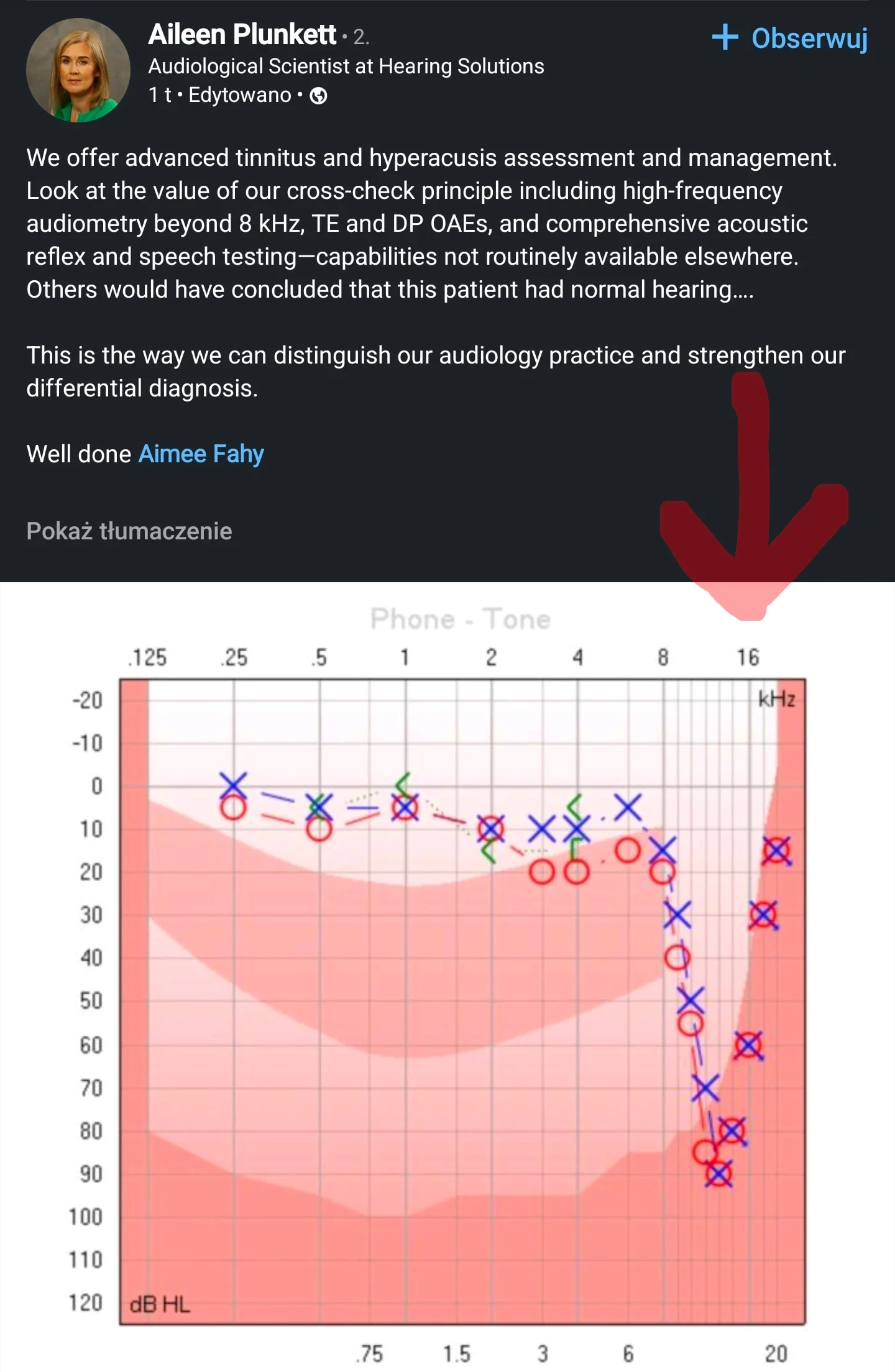
We offer advanced tinnitus and hyperacusis assessment and management. Look at the value of our cross-check principle including high-frequency audiometry beyond 8 kHz, TE and DP , and comprehensive acoustic reflex and speech testing—capabilities...
Yes, absolutely clinicians need to be testing EHF more.
Hearing aids absolutely can’t provide any amplification in those areas so we need to manage it differently. But if people aren’t testing for it then it is just invisible, and if it is invisible then we won’t study its impact and won’t develop supports where needed.
Also, I’ve said this elsewhere, but when I think about EHFs I always think about how humans can hear out to ~20kHz but cats can hear out to ~80kHz. When they look like they are staring at ghosts, they are probably just hearing some interesting things. For example, maybe they are listening to my house plants slowly dying of thirst, which apparently is expressed by the plants in ultra high frequency clicking.
there’s no actual evidence that hearing loss at these frequencies makes any difference to speech discrimination or actually listening skills. several studies have been done to find a link between the hearing loss above 9 kHz and speech discrimination and found no correlation or evidence for “hidden hearing loss”. i think the tests are useful in very specific circumstances but since there is literally nothing that can be done about it apart from surveillance it definitely shouldn’t be done on everyone. i think clinicians who are arguing for it are just trying to make a buck.
EHF hearing supports hearing in complex listening situations, speech in noise. Children with EHF loss develop speech in noise abilites more slowly. Adults with EHF loss need better ratios. EHF hearing supports spatial perception. But yes, research is still weak–we’re not measuring it consistently. You can’t research something that you don’t actually measure.
Also, since we do hearing tests at no charge when I add in EHF testing I am literally doing it for free. I hadn’t personally considered the financial aspect, although certainly others might. It’s also not useful for the majority of people on these boards who already have enough hearing loss that they probably don’t have anything useful up there anyway.
What are some things that can be done to address EHF loss?
You need to just address the functional deficits, which are largely going to be SNR problems and they are probably going to vary across individuals (in the same way, for example, that about 50% of kids with unilateral deafness are able to just compensate while the other 50% struggle). The most evidence-based support for individuals with normal heairng and speech in noise issues are . These are regularly implemented in classrooms to provide good instructor audibility for children. How they may be implemented outside of the classroom is going to be more individual-specific as it relies pretty heavily on an individual’s ability and willingness to effectively USE them. Aside from remote microphone strategies, you’re looking at behavioural strategies. There is some very early evidence suggesting that modern hearing aids can actually provide some support for people with normal hearing in the standard frequency range and there are clinics that are stepping into this, but research-wise we’re talking about maybe four papers with relatively small numbers of participants and if I recall correctly two of the papers use the same dataset. Auditory training is also something that various clinics offer, but while there is actually quite a lot of research on that it is, IMHO, still pretty uniformly disappointing with some exceptions in specific areas for children who are still developiong auditory skills.
Better than normal or those with hearing loss but not EHF loss (does that group exist as some EHF loss happens with age so it would need to be young adults)?
Are there any studies on full spectrum amplification? Focus II might provide that but only in situations where a remote mic can be used and then the remote mic could be spectrum-constrained.
Reduction in hearing due to a dome/mold in the ear might be meaningful in the EHF range, especially because aids are not replacing that.
Better than individuals with normal hearing. Hearing loss group with normal EHF is rare. That group is going to probably be middle-aged and younger with reverse slope or cookie-bite configurations (EHF start to really decline in your 50s). I have a slight low frequency conductive loss but normal EHF out to 20 kHz. Hearing aids (remote mics, really) are useful in distance situations for me but detrimental for general listening because if I close up the ear enough to boost my lows I lose access to the EHFs–exactly as you say. The effect is hard to describe but definitely worse.
Hearing aids largely cannot do amplification much past 8 kHz. The Ear Lens is an expensive niche device that can apparently get to 10 kHz. I really don’t know anything about it practically as I have never met one let alone fit one. So can it ACTUALLY get up to 10 kHz? I don’t know.
data is likely speech-based and there may not be much data on how the EHF of each patient and a group of similar patients alters the SNR needs. Do they use full spectrum speakers and audio tracks and is that reported in studies. As you say they could start by measuring EHF in far more patients.
Yes. Regular hearing loss is also defined versus healthy 20 year olds and varies with age and gender, so . . . would you expect EHF hearing loss not to? Would be nice to see EHF measures in hunter gatherer societies, but I doubt that has been done.
But yes, research on EHF on the whole is very limited still. All audiological research uses careful audio, but I suspect if you dig a bit a lot of the difficulty was actually self report. As in, “Is there a difference in between these people who feel that they struggle in noise versus these people who feel that they do not struggle in noise”.
It pulls out noise exposure from age related loss. We live in a noisy world. Depending on the population it also pulls out smoking and shitty diet and sedentary lifestyle. In the typical frequencies, there’s less “age related" loss in those groups suggesting it’s maybe not just "normal aging”. Although there’s certainly a genetic component too for how susceptible you are to noise damage (and smoking compounds noise damage significantly).
Pure tone results are independent of language yes. Interesting question because my first instinct was “of course" but my second was “well wait a minute, let’s think about this". I can’t really think of why they wouldn’t be so long as the task is communicated correctly. The ear is the same. Researchers certainly treat it like it should be the same, but honestly I’d need to dig back into the historical literature to see just what was between the very first definition of “normal hearing" which was almost certainly defined initially in a bunch of wealthy white undergraduate university boys, as so much research was back in the day, and now. I occasionally test individuals who are non-verbal with an unclear amount of receptive language and depending on the level of disability we can do behavioral pure tone testing with pediatric methods and get thresholds in the normal range but we often don’t chase " true” thresholds in that case because of other more global cognitive concerns.
What are some things that can be done to address EHF loss?
It will be probably useful when xMEMS will be available for hearing aids. There is also EarLens 2.0, but apart from making ideal amplification with no risk of feedback it has obsolete another technologies, like connectivity, etc.
It would be very useful for the lower frequencies, they’re hard to adjust. However, it’s probably physics, it’s harder to adjust membrane when it generates low frequency sound.
Have there been any dual speaker receivers? Now that the parts can be made very small, possibly there could be a benefit to having two different speakers and using one, the other, or both or doing so with a or a hybrid BTE/. There seems a lot of focus on the aid processing and perhaps not enough on the sound delivery.
 Poland




 London

 San Francisco