An elderly relative of mine has been using for a long time Unitron Moxi Blu B9-R (equivalent to Phonak Audeo Lumity L90-R) with max-power receivers embedded in custom earmolds, covering up to 105 . Since last summer, despite her audiologist increasing the R receiver gain to the maximum, it’s now insufficient. On the L side the situation with these HAs is better, although she still misses some words.
A few days ago she underwent new , speech audiometry, and immittance testing, performed by an audiologist at a public hospital (not her usual one). I’m posting the graphs below.
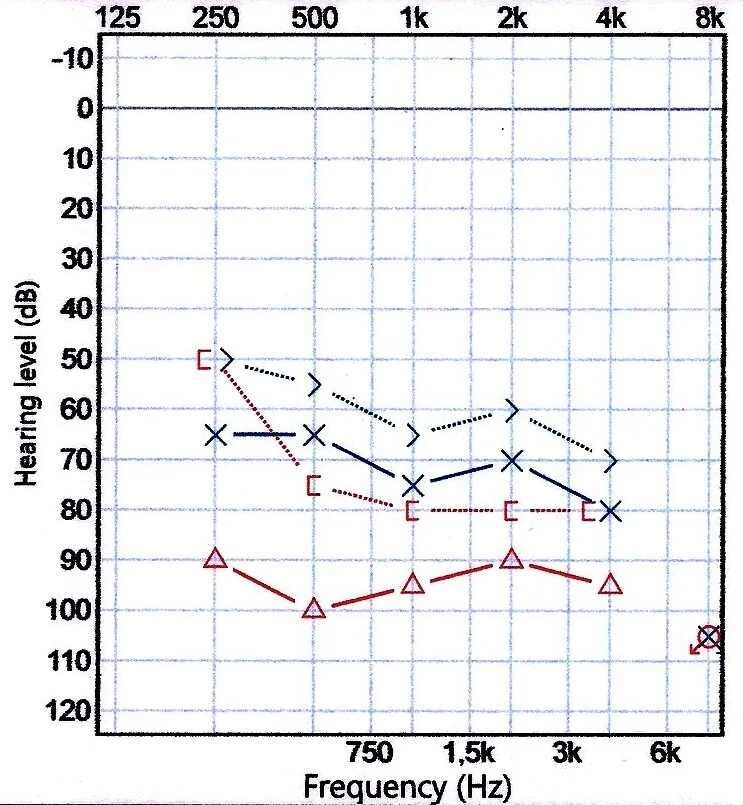
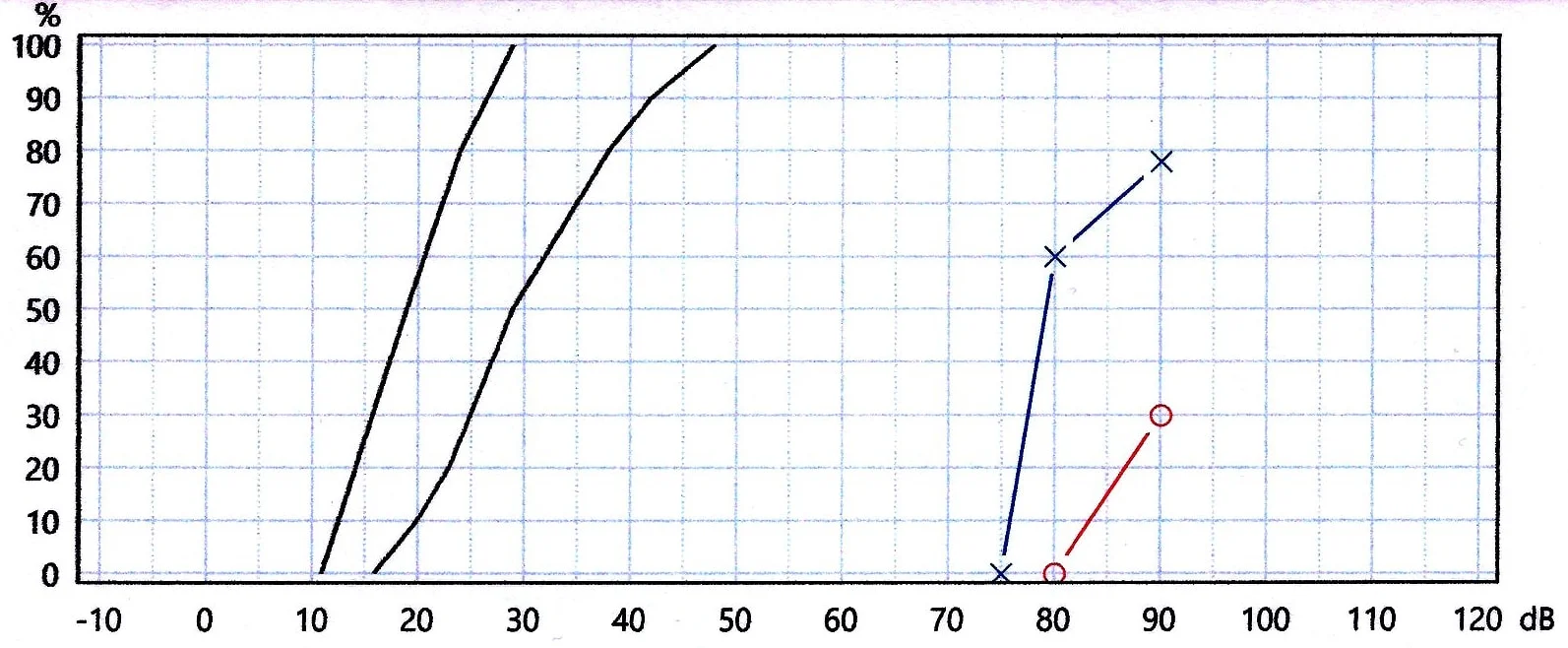
Below is the English translation of what the audiologist wrote in the report:
Suffering from: Bilateral sensorineural hearing loss
After evaluation, the average Hearing Loss is determined:
in the Right Ear: 95
in the Left Ear: 73 dB
Notes: Profound sensorineural hearing loss in the Right Ear, severe in the Left Ear bilaterally with a dip on high frequencies.Pure tone audiometry examination: Profound sensorineural hearing loss in the Right Ear, severe in the Left Ear bilaterally with a dip on high frequencies.
Speech audiometry examination in booth: Word recognition is very poor in the Right Ear, reduced in the Left Ear bilaterally starting from 90 dB.
Perception threshold: 90 dB in the Right Ear and 80 dB in the Left Ear.
Examination performed in a sound-treated boothTympanogram: Bilaterally of type “As” (A-shallow).
Acoustic reflexes: In the Right Ear, Ipsilateral (Same-ear) and Contralateral (Opposite-ear) are absent on all frequencies. In the Left Ear, Ipsilateral and Contralateral are present only at 0.5K (500 Hz).
Let me know if you also need the immittance data.
The hospital audiologist was rather discouraging: he said that even if my relative tried a max-power HAs (covering up to 120 dB), the expected improvement in speech discrim would only be about 10-15% vs the current RIC HAs!
Nevertheless, I’d still like to try maximum-power BTE HAs with custom earmolds. After that, I’d bring my relative back to this audiologist to perform two speech tests: one with the RIC HAs and the other with the BTE HAs under trial, in order to objectively determine the improvement.
I’d like to ask if my idea of performing two speech tests with the two different types of HAs is the best way to obtain an objective measurement of the difference in speech discrimination between the two solutions. More generally, I’d like to ask what you’d do in my situation to try to improve a scenario like this, eg. I’d like to know if anyone has ever tried wearing a RIC in one ear and a BTE in the other, with the goal of optimizing word understanding.
Finally, I’d like to ask if, in a case like this, it’s realistic to try anything else or if we simply have to accept the situation. It’s certainly unrealistic to consider cochlear implant surgery for someone over 90 years old  .
You’re ignoring this member’s posts.


 Texas Hill Country

 Melbourne