Hi, first time poster here! I have read a few posts on here relating to hearing aids for musicians, and I empathise with the frustration a lot are expressing. Is it simply the case that dedicated musicians’ hearing aids are not available (yet)? I play piano and sing as a solo performer - sometimes in quiet places, sometimes in places with loads of background noise. I have tried using custom IEMs (In Ear Monitors), which are appropriate for some gigs such as large festival stages. However, most of my gigs are intimate piano bars, which require me to have an ear on the crowd and be able to interact with them constantly. In other words, I need (some) of the ambient noise, but also need to hear myself clearly with all the frequency boosts this requires. My hearing loss is moderate up to 4kHz, severe from 4kHz to 6kHz, and profound above that. I have found audiologists to be no help as they seem more concerned with upselling/pushing whatever the latest gimmick product is on me (for an inflated price too). Maybe this is just too niche and I’m wishing on a solution that doesn’t exist? Thanks for any pointers!
Hi, I am a performing and recording musician. I use Sennheiser Rise right now, having been wearing them for the past two weeks. These are the evolution of the Costco KS-9s that I’d been wearing since 2019. And both are based on Phonak aids - the KS-9s were basically the Phonak Marvel M-90s. The Sennheisers are basically the Phonak Audeo Infinios and are the evolution of the Marvels. I wear large-size open domes as I cannot get used to having the domes that block outside sound - and my low end is fine without amplification.
In both cases, I had to program my own MUSIC setting, and to do that, I needed to get ahold of a copy of Phonak Target software (now up to 11.2.2) and a NoahLink Wireless unit (proprietary Bluetooth interface for the aids - bought for $175 on EBay back in 2019).
The reason is that the best sound for music involves shutting off several of the features and adjusting the volumes accordingly. NOTE: The Target software is available only to fitters and audiologists, so to find it, you need to get creative. There’s a section here on this site that can help with that (as can I, if you can’t find someone), though no longer have the original installer for the app. Also, this is a PC-Only app, and doesn’t work at all on a Mac, and is spotty with using BootCamp or other PC emulators. So, being a Mac person, I had to buy a small PC just to work with this setup - which I did for around $200 on Amazon.
To set up for a music setting…
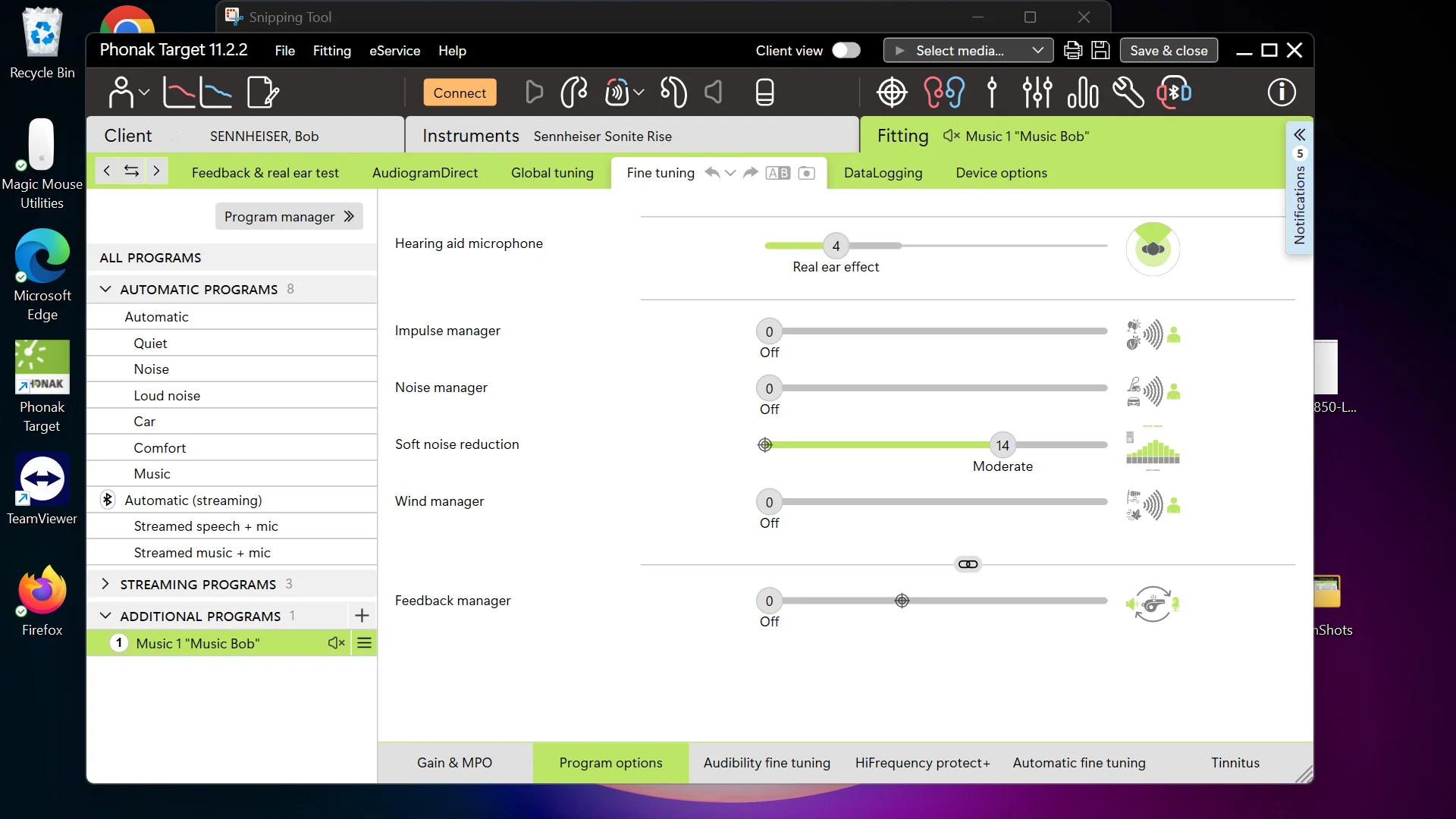
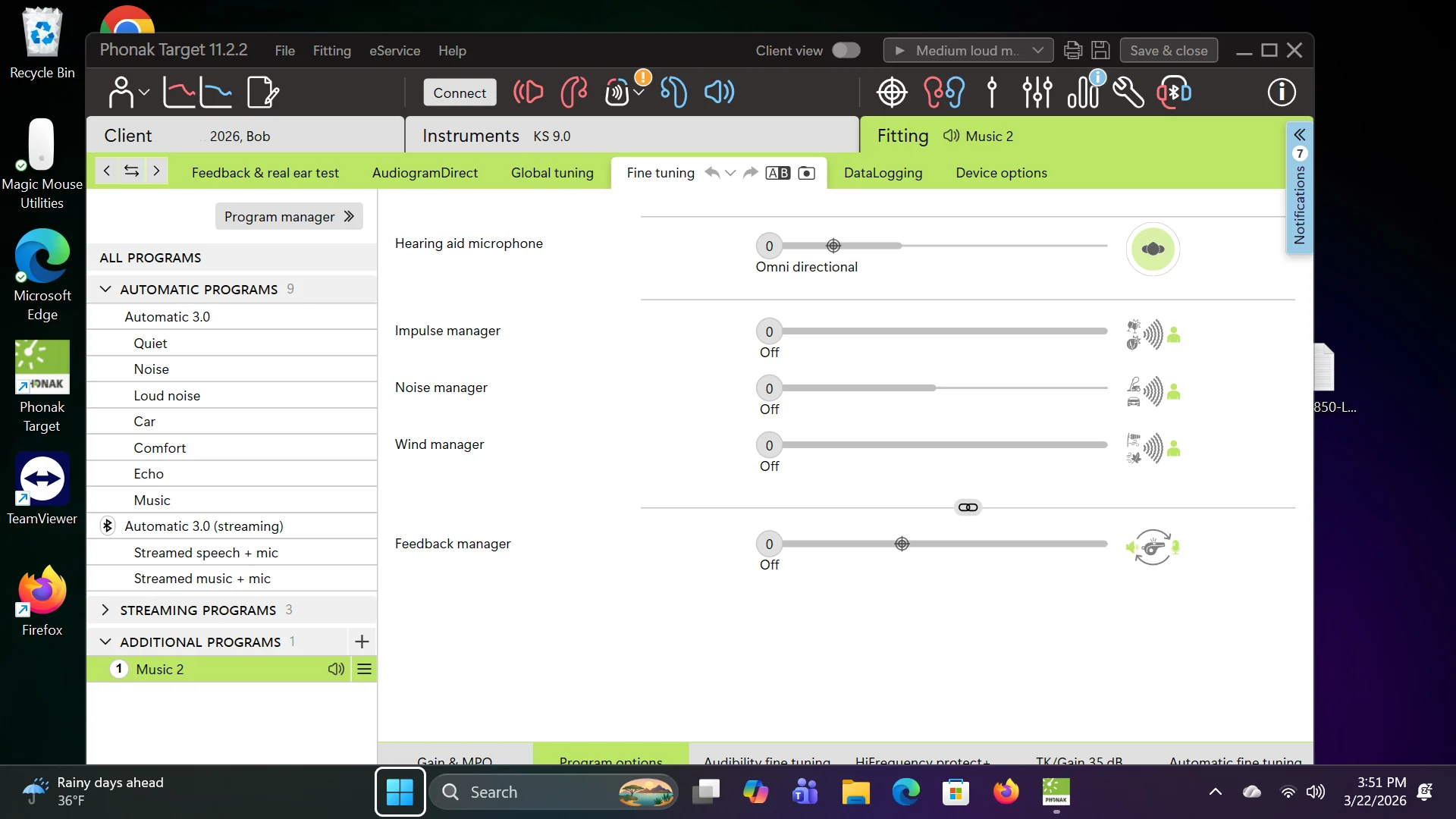
There’s a Feedback Rejection setting that needs to be shut off entirely. This is because when it hears tones it interprets as feedback, it oscillates the sound which presents as a ‘trilling’ of the audio. And that is completely unsuitable for making music.
And I prefer the Omni-Directional mic, which creates issues with possible feedback, so careful tweaking is required. THOUGH, the Real Ear Effect mic setting is MUCH better for music with the Sennheiser Rise than it was with the KS9s. The type of mic you choose is only changeable with the Target software.
Additionally, you need to adjust the Low Noise Suppression and the Impulse Suppression to suit your environment. There are settings in the Target software to do this and for me, shutting both of these off works best - with a caveat. There are also settings in the EasyLine Remote App software (Costco-branded version of the Phonak software) that allow you, as a consumer, to bring them up to suit your environment. Once done, you can save the instances in the App for future reference…though I find the app sometimes seems to forget your custom settings.
Anyway, I highly recommend Costco for both the money and accuracy of fitting. They do a full workup - air conduction, bone conduction, word recognition, tone recognition, and when fitting, they do a complete Real Ear Measurement to customize it to your physiology. And I highly recommend the Phonak/Sennheiser Rise aids that they just released - they are wonderful…a large leap forward from the Phonak Marvels/Costco KS9s that were also great at the time. At the time of fitting, you should request that they work with you to enable you to have a setting without any Feedback rejection, and tweak to get minimal feedback. Then, if you are happy and not a Do-It-Yourselfer, you should be able to customize the audio using the consumer-friendly EasyLine Remote app.
Feel free to ask any questions. Hopefully I am not too convoluted or rambling in explaining my experience.
I am attaching screen shots of the setup pages from Target that I use for the Sennheiser Rise and that I used with my older KS9s. After playing around with the Sennheiser Rise settings, I found the Soft Noise Rejection was good at a “14” setting, and I have two music settings - one for Omni Directional, and one for Real Ear Effect mics. Still determining which works best.
Great tips from Bob. Lots of variables and constant tweeking involved. This is what brought me here some years ago. The main thing I have learned here is that musicians with aids must . It is not that hard and informed musicians have a head start.
I’m also a musician (I play acoustic guitar and I sing in a polyphonic choir).
I started to enjoy again both these hobbies after switching to with my Phonak Audeo . I discovered the music program, included it in the button sequence and I took my time testing all the possible features being offered by my HAs for this specific usage. No more unwanted tremolo on guitar’s 2nd string, no more voice isolation in the bass section of the choir, etc.
It takes some time and patience, but it’s great to enjoy your own music again!
Also having some basic audio knowledge helped a lot (I’m engineer in electronics), but you can find a lot of great advices in the Bob’s post here above!
Reading your post two famous people Paul Simon and Marla Martin (name? deaf actress) come to mind. Paul Simon speaks and writes about his deep grief as a musician losing ability to hear as well as before and how it has affected his performances and creative work. When I read some of his comments in writing and in interviews my first thought was he has access to the best doctors and aids available. I wondered who are his providers? And, what technology does he use. Maybe a visit to his web site would reveal more especially how he is adapting. Do you think the work of a musician performing in noisy environments has impacted your hearing? I never attended concerts other than one or two back in the day; but the world is a noisy place and the only thing that comes to mind is as an adult I vacuumed a lot. Maybe not really but my ex-spouse always commented on the fact I vacuumed a lot. In any case today with hearing aids and moderate to severe loss even my job is affected working in an office at the front desk at a large Boston hospital. No matter the laws there is no accommodation. No place to position my microphone which can stream to my aids given it is pediatrics and everything is within some little darling’s reach. Headphones help quite a bit but the sound is not streaming to my aids. It is lonely too because the disability is not understood and I find for the most part revealing it to co-workers is not well received – you can sense it. And if you ask someone to reapeat what they said it is annoying to others especially younger co-workers under age 35/40. I find in that demographic they truly fear the aging process and speak out loud amongst themselves about life events such as “I’m getting close to 30” as if they are on a timeline toward death and there is ageism which is spoken out loud. I do not look my age which has always been my secret sauce keeping and landing employment. Has anyone else had a similar experience in the workforce? I can relate to your experience the need to hear the audience as well as your instrument. It seems to me there should be more of a focus on musicians when it comes to product development. Again, I wonder what Paul Simon has taken advantage ofwhen it comes to technology. Anyone know?
I just took a look for what Paul Simon is doing. His is a very different situation, having gotten sudden hearing loss of 94% of his hearing in his left ear. Right now they are still working on things that will help him. For more typical incidental or genetic hearing loss, the solutions that are out there are the best they’ve ever been (see my report above on my experience). I’ve actually been wearing aids since 2008, having gotten them from America Hears just before I flew to London to record at Abbey Road. Being able to HEAR at Abbey Road was wonderful. And the nice part about America Hears is that they were the first to offer remote software that their technicians could work via the Internet, or you could tweak yourself. Being a musician and sound engineer was very helpful in learning the way it’s approached from an audiology point of view.
As far as Marlee Martin, she, I believe, has been deaf since she was 18 months old. She reads lips and, through cochlear implants, can feel/hear vibrations.
Here’s a video where Paul Simon explains his hearing loss:
That is an interesting share by Paul Simon and generous too. I was so sad to learn he lost hearing. To me it was like hearing a dancer lost a leg. I was heartbroken for him. This interview shows the journey he has been on and how he has worked hard to do as much as possible despite hearing issue. We should support him by purchasing his work in my view. As he said there is evidence an artist reaches a peak in creativity when struck with a disability and he can testify the hearing loss has not silenced his creativity. That is inspiring and it is true we are built to survive which is tested throughout life and come out stronger and more empathetic. I had no idea what hearing loss was like and thought hearing aids restores hearing, but people resist because they identify this loss with aging. Now I understand the reason it is considered a disability and an invisible one at that. I remember the first-year with aids in a new high-pressure job adjusting to the loudness of a new fitting and so nervous but adjusting and managing but also feeling hurt deeply when people displayed no understanding. Like a doctor who came up behind me and when I noticed I admitted sorry I did not hear you – and revealed I have trouble with hearing to which he said curtly and not kindly, “Yes. You do.” I wanted to die inside I cratered. Or a co-worker in another more recent job who was a bully in any case but would say things like “Didn’t you hear him?” She was referring to a provider who rushed into the front desk area and went directly to her, and he was known for his mumbling in any case, but I was also focused on writing an email and paid the exchange no mind since she was handling it. But when freed up so I could be in the loop about whatever patient he spoke to her about I asked “What did David need for us to know?” And she said, “Didn’t you hear him?” She did a lot of cruel things when it came to my hearing. But I rose above it and handled her bullying on many levels then left with notice on good terms because it was not sustainable. I did report it early on and got validation and support from our manager who revealed she had a history and tried to manage the situation, but a bully cannot be managed, in my view they should be fired. She had a history of it. But that feeling of heart break for me is when not a unintentional incident occurs but the actions of the cruel where I experienced their ignorance reminding me in an unkind way that there is something about me for which I have no control over that is being judged by the cruel person as if I could change it. Believe me I can handle myself but I’m just relating the entire experience of being diagnosed and fitted with aids (RESOUND) opened my eyes and informed my innate compassion about the invisibility of hearing loss and equipped me with the insight of knowing how it feels which extends to my having compassion for all differences, which I did before but even more so now. Equality is key and or diversity is our strength. I am waiting for the majority of us to come around to this truth.
I feel that even speech is harder to comprehend with all the feedback suppression tremolo going on. It’s therefore not just a music thing.
I’ve been using devices for more than 25 years and don’t see myself going back unless I can’t get a tremolo free signal. This really bothers me, as it also distorts bird song.
I use Phonak hearing aids, and use them as a monitor for the PA, which all our instruments go through (I play sax, flute, wind synthesizer, guitar, bass, drums, keyboard synthesizer and vocals),
I use the TV Connector on the headphone jack of my PA Mixer. The phonak app on my android phone lets me set the mix between ambient sound.
The app has a slider control. All the way to the right is mostly monitor, all the way to the left is mostly ambient sound. With the right mix, I can hear the people talking to me.
I also keep the phone on stage and powered, and set it do it doesn’t go to sleep when powered. If someone comes to the stage to say something, I can slide that sider all the way left, and it’s like I’m just using hearing aids.
I don’t know if this will help you. I play in a duo, and everything is electrified. We do dinner sets, use a meter during the sound test, and can play as low as 60dba. Also, we never play louder than 85dba, unless the person who hired us wants it louder. We see no reason to damage the ears of our audience.
With the Phonak TV Connector, there is no noticeable latency. If there is, it’s not enough for me to notice, since I have ambient sound and monitor, I hear both. But I slide the slider mostly to the TV Connector (monitor) side.
I have custom ear molds, I don’t think it would work as well without them. So by hearing mostly monitor in the mix, I can turn down the volume so I’m sure I’m not damaging what’s left of my hearing with volume.
I’m in a duo, and my partner does the sound test. Unless the people say “crank it up”, we keep the volume lower than 85dba on a sound pressure level meter. I would guess, the equivalent in my monitor is down about 70, but that’s just a guess.
I like the quiet monitoring so much, I don’t want to gig without them anymore. The earmolds cancel out the crowd noise, so I don’t need it higher to hear it.
BTW, I’ve always used musician’s ear plugs, but a misdiagnosed allergy cut off the circulation to my inner ears. Then, COVID got another one and made it even worse.
I’m using the last year’s Phonk model, Lumity. I bought 2 TV Connectors, because I believe in redundancy. I bought a used, reconditioned one on eBay, to try it out, and when I found it worked, I bought a new one at a hearing aid store. I bring them both, in case of a failure.
I don’t think the model matters. I had to send mine in for service, and it worked with the loaner demo model the audio supplied. But I think you do need the app on your phone.
I run a mini phone plug from the TV Connector to the monitor out of my mixer. And I run a USB to the computer, for power only. I suppose I could use a USB power supply, but I have a computer on stage anyway.
First time I pressed the button on the TV Connector to pair it with my hearing aids. Now it just connects automatically.
I feel that even speech is harder to comprehend with all the feedback suppression tremolo going on. It’s therefore not just a music thing.
The main cause of tremelo or TTTF is feedback management issues, either caused by acoustics, ie: your domes/molds not fit properly, or the feedback management programming on your aids.
I endured that issues with Phonak marvels, and finally switched to Oticon Mores, and now the Oticon Intent. There is a Feedback Manager setting which allows turning off the feature which totally alleviates the issue.
Idk if your have a similar feature, but that’s the one that does it. When a pure tone is presented, the FB mgr interprets it as distortion, and attempts to cancel it out by generating a 5hz signal, which is the fluttering effect you hear.
Hi all, Bob’s information was great if you can get the Target Software. I got a great Audiologist who understands my needs! I am an old Audio guy who used to have “Golden Ears “. I have used Phonak Marvels then Paradise then Luminity and finally Infinio’s. It seems the newer technology in the Infinio’s Chip doesn’t work for me. It’s too bright no matter how adjusted. I ended up going back to my Paradise’s and bought a used backup pair. They use a different Chip and it is Smoother than the Infinio’s by far. With lot’s of tweaking by my great Audiologist, I now have a backup pair of Paradise’s that sound great! It took awhile to make them this way but now even in Automatic mode they sound great. I kept telling my Audiologist to turn down Midrange Frequencies and boost High frequencies. Finally in Music Programs Custom made I can hear the Music the way I want. After my Audiologist made the Custom Programs I go to the App for ultimate Adjustments in the little Equalizer mode. That works for me. Good Blessings to you in your attempt to get your sound the way you want it! Larry
Finally in Music Programs Custom made I can hear the Music the way I want. After my Audiologist made the Custom Programs I go to the App for ultimate Adjustments in the little Equalizer mode.
Yep. If you can find a tech/audi who knows about (or is willing to learn) musician settings, you can have a dedicated musician program set up. All the regular features can remain on on the other programs. Somewhere on this forum there’s a very good set of instructions for how to set up a musician program.It’s made for audiologists/techs. You can bring this in with you to your provider. It’s put out by highly credible people.
Not a musician but I also recently bought the Sonnheiser R from Costco and really liked the Costco experience. I have worn hearing aids over 25 years and it was my first experience with Costco. My previous hearing aids were also the Marvels. I do like the natural sound with the Sonnheiser and they are good for listening to music with my TV connetor and CD player.
I do similarly via Target, but do checks by holding my phone directly in front of my eyes whilst playing a Hz generator app, to determine all levels above say 500Hz (as the phone speaker is useless below 500Hz). My grand piano sounds fantastic.
is the only way to approach perfection, as audiologists can never hear what we hear.
How did you deal with the latency when performing live?
AFAIK, the Widex has the lowest latency. As I recall, less the 1 ms (millisecond). The Widex Allure and other Widex models are often preferred by musicians and pro-sound techs (me). The iPhone app has a lot of user adjustments, but some parameters need to be set by the provider.
My tech essentially set up my Signia 7 musician program like a Widex musician program. I’m not sure about latency, however. My point is, a tech can set up a music program easily in his or her own office. No need to , although many DIYers will disagree. Some people like to fiddle with computers. Any provider will have all of the necessary software and real time info available, and can make adjustments in real time with the click of a mouse. I play classical guitar and recorder. My musician program is different than my music program, because I’m playing my instruments close to my ears, more, close to the input microphones. Whereas at a concert I’m seated well back from the musicians and the responsiveness of the mics is different. That’s my guess anyway.
Phonak, in Target, allows you to shut off feedback rejection, eliminating the trill. A Phonak fitter can handle that. Or, you can ‘find’ the Target software (PC only) and get a NoahLink Wireless to handle it yourself. Been doing that with my KS9/Marvel, and now with my Sonite Rise/Infinio.


 La Grange Highlands, IL
 Milan area, Italy