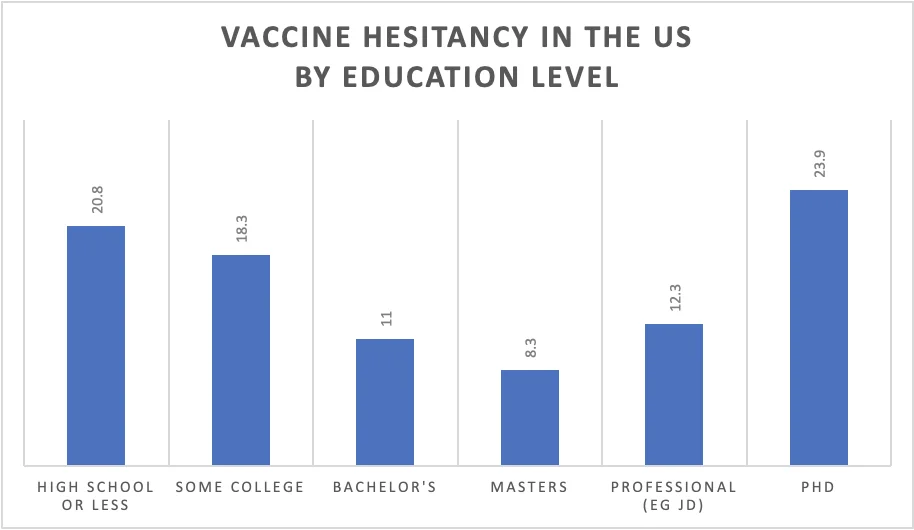
A survey of 5 million people by researchers from Carnegie Mellon & Pittsburg universities found the least vaccine hesitant group to be those with Master’s degrees, but the most hesitant group were those with PhDs!
I’m going to assume that you made an honest error linking the original un-corrected pre-print rather than the corrected and finally published paper, and aren’t aware that the authors themselves disagree with that particular interpretation of their results and issued media statements clarifying that, given that their open facebook survey results didn’t actually match demographic data, survey takers were not answering that question in good faith.
Speaking of replicability, let’s remember, too, that there is a lot of evidence that vaccine uptake is associated quite clearly with educational levels. Just off a quick search:
Social determinants of health and vaccine uptake during the first wave of the...1
Significant differences in SARS-CoV-2 vaccine uptake during the first wave related to age, socioeconomic status, ethnicity. Age was a significant determinant of vaccine uptake, with coverage increasing with age. Higher education levels were ...
COVID-19 vaccine perceptions and uptake in a national prospective cohort of...
In a multi-center prospective cohort of essential workers, we assessed knowledge, attitudes, and practices (KAP) by vaccine intention, prior SARS-CoV-2 positivity, and occupation, and their impact on vaccine uptake over time. Initiated in July 2020,...
Predictors of vaccine uptake during a pandemic: The interplay of lifetime...1
The experience of discrimination can have significant health implications, especially during a global pandemic. This study examines how lifetime discrimination, educational attainment (measured in years of education), and family support individually...
Reconsidering inequalities in COVID-19 vaccine uptake in Germany: a...
Combining the frameworks of fundamental causes theory and diffusion of innovation, scholars had anticipated a delayed COVID-19 vaccination uptake for people in lower socioeconomic position depending on the socioeconomic context. We qualify these...
Factors and reasons associated with low COVID-19 vaccine uptake among highly...2
COVID-19 vaccine hesitancy is a public health threat. Our findings suggest that low education levels are a major contributor to vaccine hesitancy and ultimately vaccination levels. Since education levels are not easily modifiable, our results suggest...
The original study you cite did not find an educational difference between their specific subset of ‘pro- or antivaxxers who actively discuss vaccines on social media’. I did enjoy this bit in the conclusion, which is in line with what I’ve experienced: “A very important result is that while positive attitudes toward science were most strongly associated with [the pro-vaccine] group’s Importance, the anti-vaccine group exhibited the strongest association between pro-science and Superiority. This may indicate that pro-vaccine individuals are pro-scientific because they feel that their pro-scientific group is important to them, or they feel that being pro-vaccine is important because it fits their pro-scientific attitudes. In case of the anti-vaccine group, it seems that they exhibit pro-scientific attitudes because they believe that being anti-vaccine is actually scientifically correct—the anti-vaccine group is, in their eyes, superior in understanding science.”
Science is absolutely experiencing a replicability crisis, particularly in fields like psychology but yes in biology too. Not so much in human clinical trials though, which have their own specific set of safeguards.
Let’s also not pretend that an audiology degree confers the skills required to assess the vaccine literature.
That all said, at no point did I indicate that antivaxxers were unintelligent nor did I particularly say that they were uneducated. It turns out that research seems to show that they do tend to be less educated–but this is group data. Although, that does give an ironic twist to the bit I quoted from the identities paper.


 Texas Hill Country


 Poland

 Wales, UK

 Topanga, CA