
You’re ignoring this member’s posts.
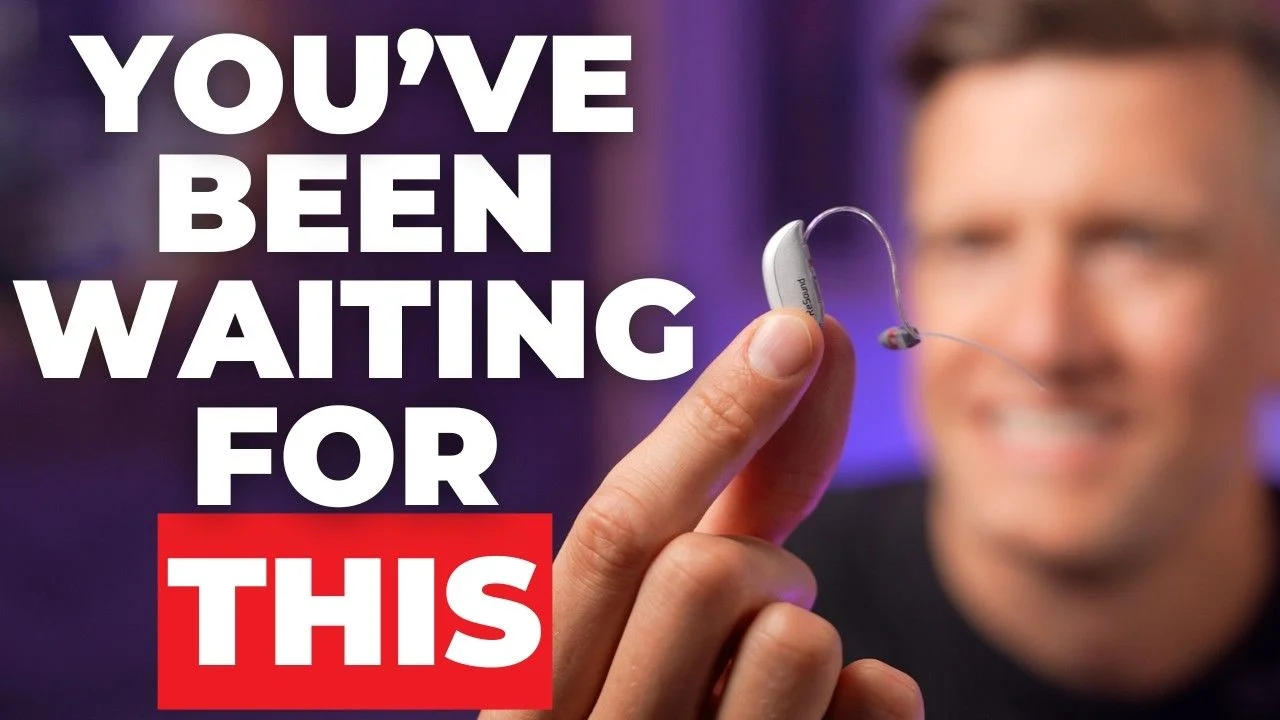
Resound Launches Sensia- The Hearing Aid that Knows Who You Want to Hear
21 replies1.4k viewsLast reply
 Auckland, New Zealand
You’re ignoring this member’s posts.
 Poland
Still requires fitting to get the most of their new features, which is based mostly on their 2+2 mics binaural beamforming…
So, Resound still isn’t good option for me, when I have Cochlear sound processor on another side.
It’s a bit shame that they can’t make a binaural beamforming with Cochlear sound processors despite their brand cooperation.
You’re ignoring this member’s posts.
Vivia is being replaced? How long until there’s a Costco version? If Costco can get most of the competition to Sphere then Sphere is more likely to end up at Costco.
This approach may still focus on the wrong sound. It seems that Resound does not have a Sphere competitor and needed something to fall less behind. More details and real world feedback will let us know.
Does Fortell’s approach use any similar processing?
You’re ignoring this member’s posts.
At least 2 months after official launch, same chip set but new software. It seems a bit shady that Viva can’t be upgraded like Sphere.
“Why not update Vivia by firmware?
Because Sensia builds on the same chipset as Vivia, including the same , an obvious question is whether it could have been made available to existing Vivia users through a firmware update similar to how Phonak recently allowed previous Infinio users to update to Infinio Ultra.
GN executives say the difference is less about a new DNN than a substantial reworking of how the hearing aids decide when and how to use their available processing. Christensen said Sensia incorporates new steering throughout its automatic program, including lower activation thresholds that bring Better Ear and Speech Intelligibility modes into use more often, as well as revised coordination of the beamformer, DNN denoising, and ReSound’s established noise-reduction system.
“It’s all new steering. It’s not the same steering that Vivia has,” Christensen said. GN also used real-world usage data from Vivia wearers to help determine where those activation thresholds should be set.”
ReSound Sensia Launch: AI That Follows the Voice You Want to Hear9
You’re ignoring this member’s posts.
I don’t like the Hear in Noise program on my ReSound Vivia. It feels like it quiets everyone down and picks out voices in a TV streamer way, almost like an system. I use All-Around program 100% of the time. (The only times I use other programs is if I accidentally switch to them.  )
ReSound Vivia in All-Around is the clearest and crispest sound for me among the hearing aids I’ve tried which include Oticon, Phonak and Signia. Can ReSound Sensia use the old non- All-Around program? Or is it gone 
You’re ignoring this member’s posts.

Here’s the comparison:
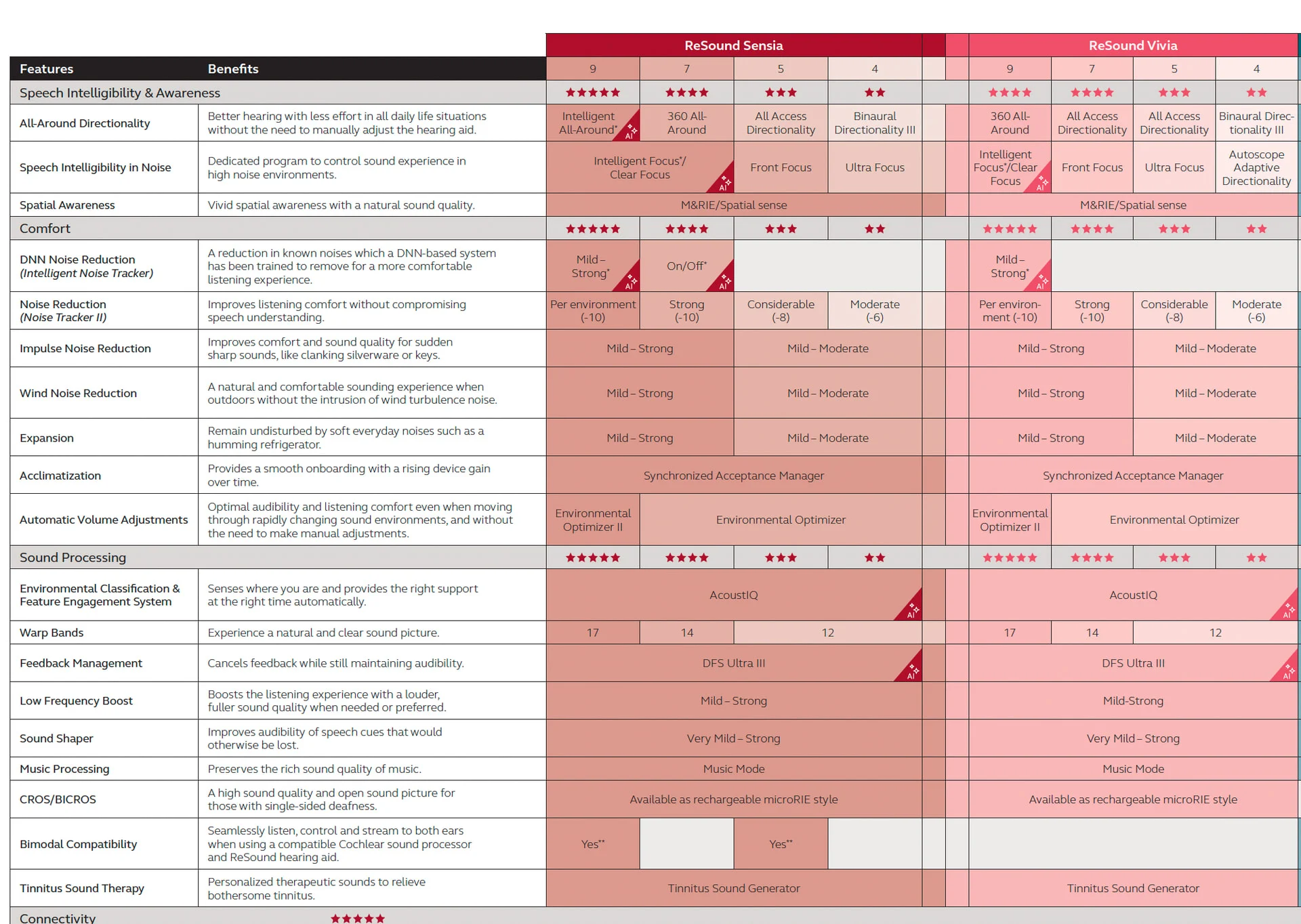
* The DNN noise reduction technology used in the Intelligent
All-Around and Intelligent Focus are only available on the
ReSound Sensia microRIE and ReSound Vivia microRIE.
** Only available for microRIE style.
*** Hands-free calls are compatible with iPhone 11 or later,
iPad Pro 12.9-inch (5th generation), iPad Pro 11-inch (3rd generation),
iPad Air (4th generation), iPad mini (6th generation),
iPad (10th generation)or later, with software updates iOS 15.3
and iPadOS 15.3 or later.
**** Not available for ReSound Enzo Core.
***** All-day battery on one charge is based on an average
use time of 20 hours, streaming 50% of the time.
You’re ignoring this member’s posts.
You’re ignoring this member’s posts.
Sensia 9 has Intelligent All-Around with no way to use the old 360 All-Around, other than downgrading to Sensia 7? The Intelligent All-Around better be perfect.
You’re ignoring this member’s posts.
I called my audi here in Fla. and he was told no demo’s for Sensia for about 90 days?? He also said they were available but only to purchase with no trial time.. who would ever purchase ‘s without trying them out first??
You’re ignoring this member’s posts.
You’re ignoring this member’s posts.
You’re ignoring this member’s posts.
 Chicago
Hey and any other Cochlear Nucleus users,
Am I reading this wrong, as I believe that you have a Sphere on one ear and a Nucleus on another ,that this new Sensia will NOT work the same as the Advanced Bionics and the Phonak Link?
Cochlear implant and professional fitting software updates
GN is also introducing ReSound Sensia Bimodal and ReSound Enzo IA Bimodal, designed to work with Cochlear Nucleus sound processors through the companies’ Smart Hearing Alliance.
I am having difficulty sifting through all of the hoopla, but it seems to read that it WAS the answer also haveing Aurcast, bluetooth etc that I was waiting for….that worked like the /Phonak system. Your prior post says not so. Please chime in as you have loads more understanding than me. Appreciate it.
You’re ignoring this member’s posts.
Thanks for the info. However, I don’t see any concrete points from Resound and Cochlear yet, only marketing statements.
I don’t know if this will like in the past - just streaming - and that’s all. It doesn’t make any impression on me.
To get true benefits, there should be introduced REAL 4 (2+2) microphone beamforming and scene classifier.
Even if it does, Resound has rather poor denoising compared to Infinio Sphere . Even Hear Advisor assessed that in case of Resound Vivia.
And yet a new generation of Phonak hearing aids is just around the corner.
You’re ignoring this member’s posts.
When will they make a firmware update available for the Vivia that gives you the Sensia feature in the form of a new selectable program? (since the hardware is supposedly the same…)
You’re ignoring this member’s posts.

Hearing_PotentialProvider
No, they’re treating it as a brand new product as the operating system is supposedly completely different to Vivia in every way.
You’re ignoring this member’s posts.
Hearing_PotentialProvider
You are correct. Phonak and devices work together to enable advanced signal processing features like beamforming microphones. While Cochlear Ltd uses Resound’s wireless technology, this doesn’t enable binaural beamforming with the Sensia and Nucleus Speech Processor microphones. There will be automatic synchronisation of environment detection with Sensia products, as well as synchronised program and volume changes.
You’re ignoring this member’s posts.


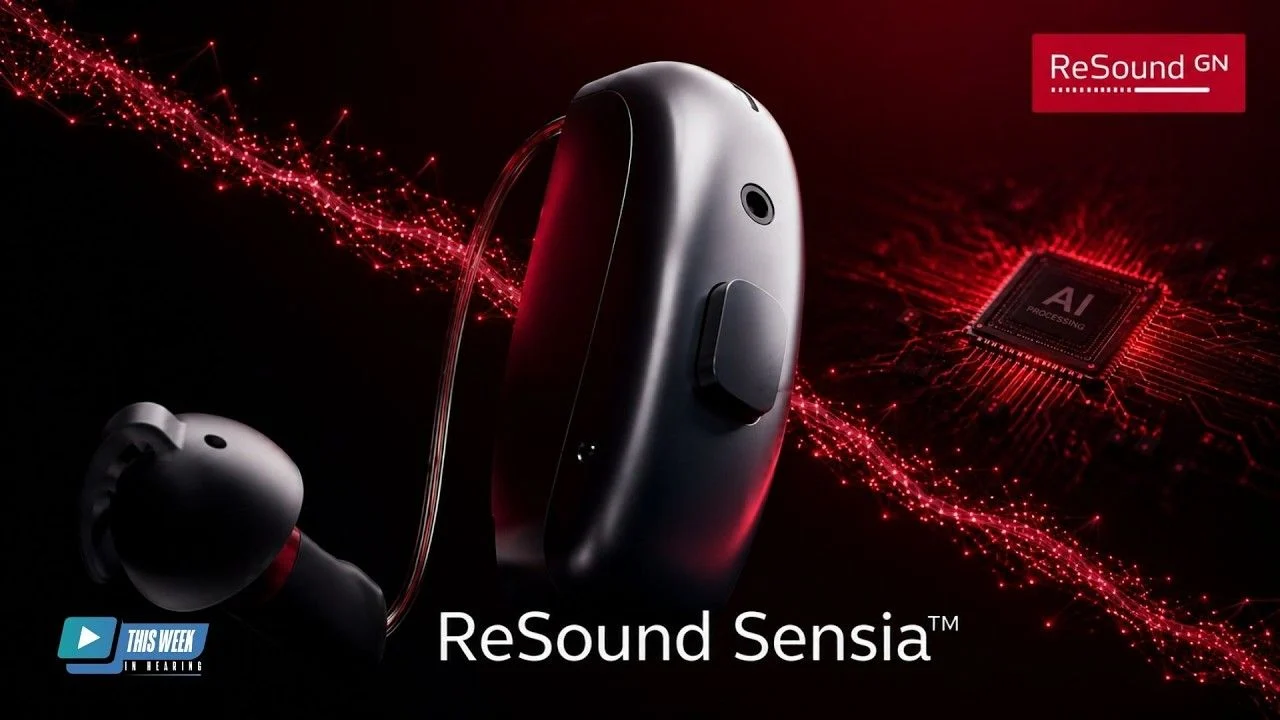
In this YouTube video Andrew Bellavia visits GN headquarters in Denmark to speak with Laurel Christensen, Chief Audiology Officer, and Brian Dam Pedersen, Chief Technology Officer, about the technology behind Sensia and how GN is combining traditional signal processing with newer approaches
You’re ignoring this member’s posts.
I see that Cochlear’s own website targeting the Smart Hearing Alliance mentions the latest lineup of solutions (so only referring to the Sensia Bimodal and Enzo IA Bimodal) are future-ready for , as part of the Smart Hearing Alliance branding (https://www.cochlear.com/us/en/professionals/products-and-candidacy/nucleus/smart-bimodal-solutions).
This makes sense as the next step for Resound and Cochlear. I had a meeting with the bimodal team and explained that ear-to-ear communication as well as Auracast were necessary. They were aware that a fully bimodal hearing aid was what we all want. They did mention Auracast as a main goal. In a prior meeting with the Bimodal team, it had been mentioned that Bimodal compatibility was limited by the chipsets and their differences - in Resound and Cochlear devices. So, it would take time to get there. In 2025, Cochlear and Resound expanded their Smart Hearing Alliance to share proprietary information beyond streaming, which finally made way for a full bimodal experience eventually. And bilateral Cochlear users’ processors don’t “talk” to each other yet (aside from streaming), so this could allow Cochlear access to Resound’s technology that allows for this.
I believe that while it’s 99% the case that Auracast will be bimodal with the Sensia Bimodal (be sure to purchase the Bimodal-specific model), that we may not see ear-to-ear communication work until perhaps the next generation of bimodal hearing aids and also Cochlear processors: so, presumably the N9. The product development for a new processor starts when the new processor is released, and likely before that point. But it takes a lot of time and strategy.
The reason I believe that Auracast is the only likely advancement for the Sensia is because it took so long for the two companies to agree to share proprietary information beyond streaming, and that means the N8 may not be able to take advantage of ear-to-ear streaming for bimodal use since hardware would need to be compatible. In addition, there are no specific studies like there are for Phonak and Advanced Bionics, on ear-to-ear compatibility. I did see a study trying out hearing aid functionality with the Cochlear N8. The U8 was allegedly the hearing aid. Here’s the study: https://ctv.veeva.com/study/a-study-evaluating-the-application-of-hearing-aid-technologies-to-signal-processing-for-adult-cochle
That’s potentially a first step to bringing some form of digital processing compatible with not only bimodal users but also bilateral: as beyond streaming, Cochlear devices do not have ear-to-ear communication - one processor does not detect noise and inform the other processor, etc.
Phonak and Advanced Bionics have been truly bimodal for longer and so there are studies for some of their technology using ear-to-ear communication between Phonak and Advanced Bionics instruments.
There have to be studies for every new feature, whether bilateral or bimodal since Cochlear processors are Durable Medical Equipment, and this is why open-label FDA studies are conducted prior to the release of new sound processing methods (eg. Cochlear SCAN, SCAN2) and processors comparing one to a newer one in a small group of people.
—
I’d hope the Resound Sensia Bimodal would have more functionality beyond just adding Auracast. But I doubt it given the foundation is still being laid out for ear-to-ear communication and no specific studies have taken place yet.
You’re ignoring this member’s posts.
You’re ignoring this member’s posts.
Log in to reply to this topic.
Related discussions
Hearing Aids1 reply
Hearing Aids0 replies
Press Releases63 replies
Cochlear Implants30 replies
Hearing Aids5 replies