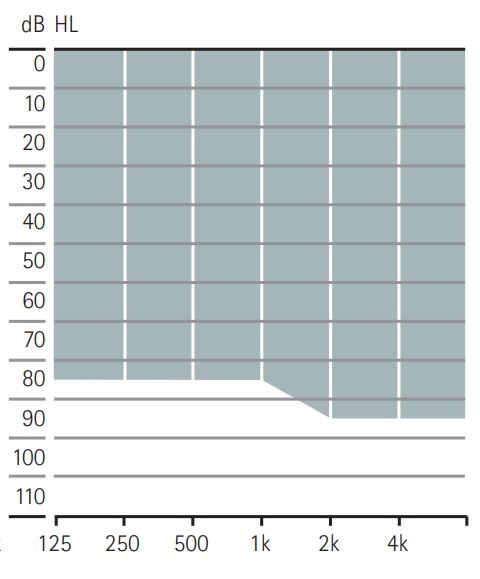
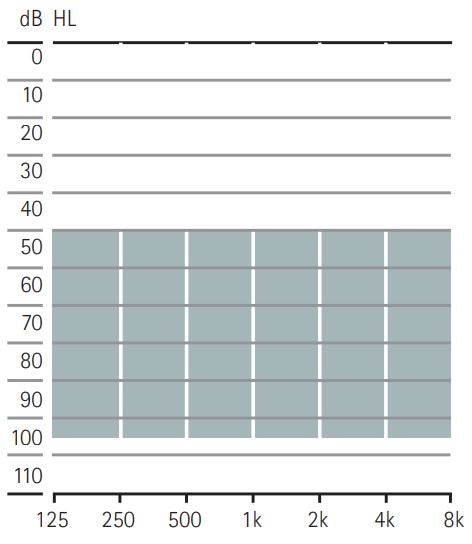
You're within the fitting range for the M receiver according to Starkey's fitting ranges. Talk to your hearing care professional about the distortion. There are programming errors that they can make that result in distortion. There is also the possibility of device faults.
By the way, I'm taking advantage of this topic to submit a question about myself: according to the ADP paradigm, my is in the fitting range of Medium receivers for my Phonak Lumity, which is surprising because I thought that my profound loss would require stronger receivers. And, in fact, if I switch to the paradigm, it suggests to use Power receivers.
However, even when I fit my with the DSL paradigm, I find M receivers to be better for me: with P receivers low frequencies get automatically boosted to the extent that they end up masking the medium and the high ones...
How come that Medium receivers (and a fitting below my targets) works better for me considering that some people here have even suggested I should use UP receivers?
The question is: Are they better for your speech understanding or are you more comfortable (sounds better) with it (M receiver)? Target with may recommend M because most likely it combines it with very aggressive frequency shifting (SoundRecover2).
A switch from M to P is not going to change anything: A change of programming that uses the additional power of the P (or UP) is what can create a difference.
The M receiver simply cannot provide enough gains to match your targets: It cannot provide the necessary gains >= 750Hz. You can verify this by comparing the fitting range of the M receiver (below) to your . M receivers are not for profound loss.
low frequencies get automatically boosted to the extent that they end up masking the medium and the high ones...
This doesn’t make sense to me because your audiogram shows you have almost no recoverable hearing above 1.5 kHz so your comment may refer to all the sounds that are being compressed to <1.5 Khz (or <750Hz for the M receiver). I have no idea what the optimal way would be to program these aids in such a limited low frequency range so that you can understand speech.
What you said makes perfect sense on paper but then more gain to me doesn't necessary translate into better speech understanding. And that's where a fitting below my gain targets, less aggressive than what I would need, proves better. 🤷🏻
And yes, by the way, I use quite a lot of sound recover...
With all frequency sounds put in the <750Hz range (M), I have no clue how the gains have to be balanced in that range. Hopefully, one of the experts here can explain it, I would love to learn more about this.
The upper portion of your gets abandoned: the amount of gain needed to amplify the lower portion fits the mid powered receiver; with less distortion. Like you say: the Frequency Compression is doing some heavy lifting.

 TN


 Wales, UK